
Review · CRUISES & BOAT TOURS
Berlin East Side Tour 2.5 hour cruise with commentary
Berlin is easiest to understand from the water, where old churches, Cold War relics, modern government buildings, and riverside oddities line up in one long view. This 2.5-hour Spree cruise takes you well beyond the usual short city loop, including the East Side Gallery and the Mühlendammschleuse.
I like the slow, picture-friendly pace, and I like the chance to see Berlin’s government quarter and East Side sights without changing trains or walking long distances. The main catch is the length: the final part can feel slow, especially for young children or anyone hoping for a history-heavy tour rather than architectural commentary.
In This Review
- Key things to know before boarding
- Why the Spree is a smart way to see Berlin
- Alte Börse to Museum Island
- The Mühlendammschleuse and Berlin’s starting point
- East Side Gallery from the Spree
- Molecule Man and the newer east bank
- Nikolaiviertel and the central skyline
- From Schiffbauerdamm to the Reichstag
- House of World Cultures and the final river views
- Commentary, seating, and weather
- Who should book this Berlin river cruise?
- Should you book the 2.5-hour East Side Tour?
- FAQ
- How long is the Berlin East Side Tour?
- Where does the cruise begin?
- What time does the cruise depart?
- Where does the cruise end?
- Is commentary provided in English?
- Is food included in the ticket?
- Is there a toilet on the boat?
- Does the cruise pass the East Side Gallery?
- How many people can join the cruise?
- Can I cancel for a full refund?
Key things to know before boarding
- The route reaches the East Side Gallery: You see the surviving Berlin Wall section from the river, along with the Oberbaum Bridge and Molecule Man.
- The Mühlendammschleuse adds real interest: The boat spends about 20 minutes at the historic lock, close to the place where Berlin and Cölln grew into one city.
- Commentary is live in German and English: It covers a large number of buildings and sights, though English listeners may find the German-first format harder to follow at times.
- The upper deck has the best views: You get clearer photos and a better sense of the river, but sound can be harder to catch in the open air.
- Reserved seating matters: Tables and chairs on the upper deck may be reserved, so check at the dock if you want a forward-facing place.
- You return to where you began: The boat leaves from Alte Börse on Burgstraße and ends at the same meeting point.
Why the Spree is a smart way to see Berlin
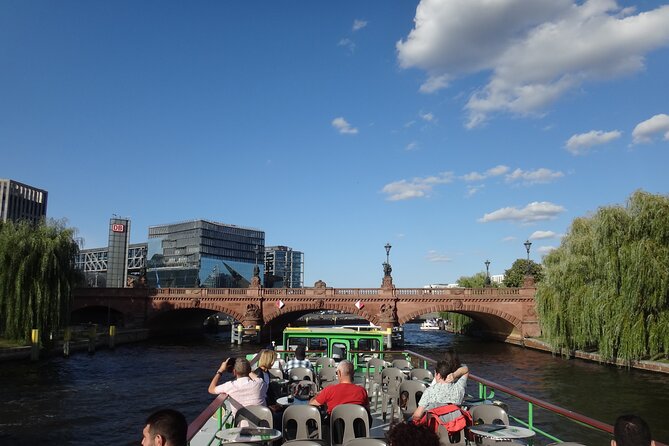
Berlin is spread out, and its sights do not always connect neatly on foot. A cruise gives you a sitting-down tour of several districts while the city moves past at water level. You are not simply ticking off famous buildings. You are watching Berlin shift from royal center to Cold War border zone, then to a modern capital.
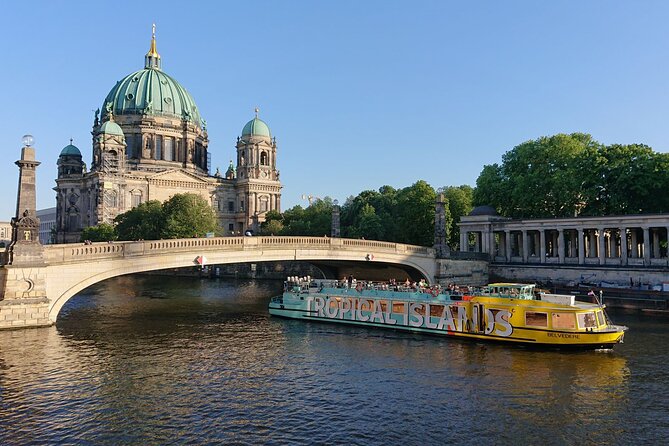
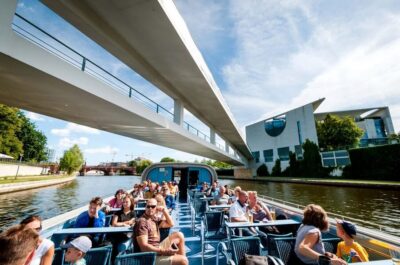
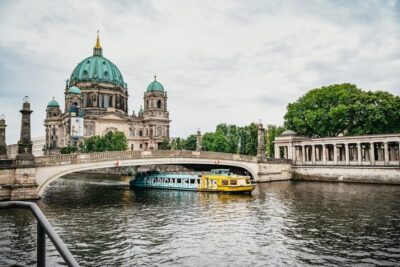
The river also changes how familiar sights look. The Berlin Cathedral is especially striking from the Spree, while the government buildings feel less imposing from the open water. Bridges become part of the story, not just things you cross on a bus.
The boat used by Reederei BWSG is functional rather than luxurious. It has an upper deck, an indoor salon, toilets, and a bar selling food and drinks at your own cost. Seating is arranged in connected rows or tables, which keeps passages clear but can feel tight if you prefer personal space.
At about $36.04 per person, this costs more than a basic one-hour cruise. The value depends on what you want. If you only need a quick look at central Berlin, the shorter option may be enough. If you want the East Side Gallery, the southeast riverfront, a lock passage, and the government quarter in one outing, the extra time has a clear purpose.
More boat trips in Berlin:
- Berlin: 1-Hour City Tour by Boat with Guaranteed Seating
★ 4.3 · 16,993 reviews - Berlin: Boat Tour Along the River Spree
★ 4.4 · 11,252 reviews - Berlin: 3.25-Hour Spree & Landwehrkanal Boat Tour
★ 4.6 · 4,311 reviews
Alte Börse to Museum Island
The meeting point is the BWSG landing at Alte Börse, Burgstraße 27, near Museum Island. The listed departure is 2:45 pm, and the activity returns to this same dock after roughly 150 minutes.
The early part of the route gives you Berlin’s historic center from the Spree. Museum Island is the heart of that view. The island holds the Old Museum, New Museum, Old National Gallery, Bode Museum, and Pergamon Museum, forming one of Europe’s major museum districts. The complex is a UNESCO World Heritage site.
The Bode Museum closes the island at its northern end with a grand neo-baroque profile and a rounded riverfront. Inside are sculpture, Byzantine art, and a coin collection, but from the boat you are mainly seeing the building and its setting.
The Berlin Cathedral dominates the Lustgarten. Built between 1894 and 1905 in neo-Renaissance and neo-Baroque styles, it is Germany’s largest Protestant church by floor area and an important Hohenzollern burial place. The river gives you a useful sense of its scale, though the cruise is not a substitute for going inside.
Across the water, the Humboldt Forum occupies a modern reconstruction of the former Berlin Palace. It houses the Ethnological Museum, the Museum of Asian Art, Berlin city displays, and Humboldt University’s Humboldt Laboratory. This is one of the places where the commentary may focus more on architecture and institutions than on dramatic historical events.
That balance is worth knowing in advance. You will hear plenty about buildings, bridges, and city development. If your main goal is a detailed account of Berlin’s wars, division, and reunification, you may want to pair the cruise with a dedicated history museum or walking tour.
The Mühlendammschleuse and Berlin’s starting point
The Mühlendammschleuse is one of the most useful parts of the trip. It lies in the Spree near Fischerinsel, east of Mühlendamm, and the lock handles a drop of about 1.51 meters. The current lock opened in 1942.
The wait can take around 20 minutes. That may sound like lost sightseeing time, but it is a welcome change of pace. You watch the water level adjust while the boat sits inside the chamber, and the delay gives you time to take photos, order a drink, or simply watch Berlin pass at a slower rhythm.
The location also carries unusual historical weight. A water crossing between Berlin and Cölln once occupied this area, and the two settlements later grew into the city of Berlin. The cruise turns a piece of river engineering into a short lesson about the city’s beginnings.
The boat passes through the lock as part of the longer route, with the operator describing two lock passages on this East Side itinerary. Exact timing can vary, so treat the lock as part of the experience rather than a precisely timed show.
East Side Gallery from the Spree
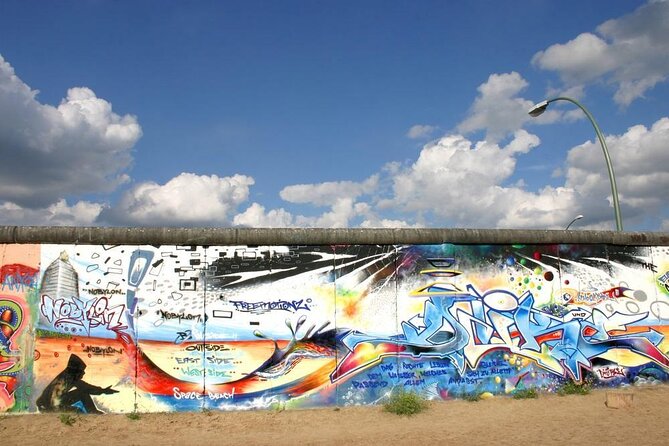
The southeastern section is where this cruise earns its name. The East Side Gallery occupies a 1,316-meter stretch of Berlin Wall along Mühlenstraße between Ostbahnhof and the Oberbaum Bridge.
After the Wall opened, 118 artists from 21 countries painted more than 100 works on the former East Berlin-facing side. The paintings respond to the political changes of 1989 and 1990, making the gallery both public art and a record of reunification.
From the boat, you see the wall from a different angle than you would on the pavement. The riverbank opposite was the actual border, while the painted wall was the Hinterland Wall, the barrier that sealed off East Berlin’s border area. That distinction is important, and good commentary helps explain why the famous artwork is not exactly the main border barrier.
Do not expect to get off here. The cruise stays on the water, so you cannot stop for close-up photographs or walk along the full gallery. The original paintings have also been replaced by replicas made in 2009 after damage and urban changes. Still, the river view makes the wall’s position in the city easier to grasp.
The Oberbaum Bridge is another highlight. Its red brick towers and arches connect Friedrichshain and Kreuzberg and are among Berlin’s most recognizable bridge views. The boat’s route lets you see its full span from below, and the slow speed is useful for photography.
A different side of Berlin on the same trip:
- Berlin: Reichstag, Dome and Government District Guided Tour
★ 4.7 · 18,288 reviews - Discover Berlin Half-Day Walking Tour
★ 5.0 · 9,624 reviews - Berlin: Hop-on Hop-off Bus Tour with Live Commentary
★ 4.3 · 8,579 reviews - Berlin: Government District around the Reichstag Guided Tour
★ 4.7 · 8,447 reviews
Molecule Man and the newer east bank
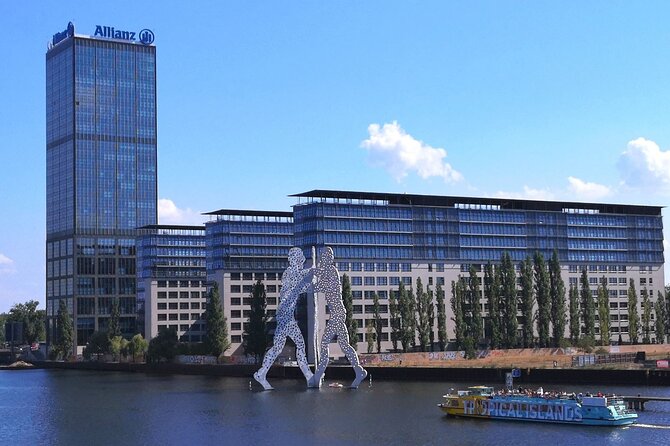
Near the meeting point of Kreuzberg, Alt-Treptow, and Friedrichshain, three large human figures rise from the Spree. This is Molecule Man, created by American sculptor Jonathan Borofsky and installed in 1999.
The sculpture is made of three perforated figures leaning toward one another. From the boat, it reads as a bold river marker, and the water gives you the best overall view. It is one of those sights that can be hard to appreciate from a road vehicle because its placement in the river is the whole point.
The route also reaches newer parts of the eastern riverfront, including the Osthafen area, the district around Uber Arena, the Badeschiff, and the alternative cultural center Holzmarkt 25. These places help show how former industrial and marginal river edges have changed.
This is also where the cruise can feel less focused. Not every building along the bank is a major sight, and the commentary may spend time on everyday structures, former industrial sites, and newer developments. I find that useful if you want a wider picture of Berlin, but it may feel ordinary if you only want headline attractions.
Nikolaiviertel and the central skyline
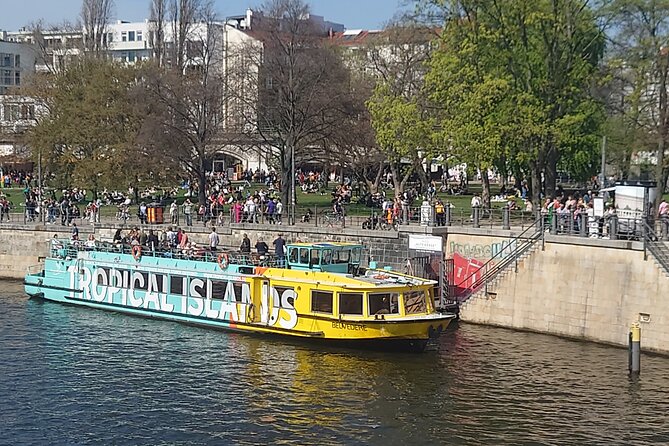
As the boat returns toward the center, the Nikolaiviertel brings you back to Berlin’s oldest settlement area. World War II destroyed most of it, and East Berlin rebuilt the quarter between 1980 and 1987 for the city’s 750th anniversary.
The result is a reconstructed medieval-style district around Nikolaikirche. It is not an untouched old town, but it gives the central city a more intimate scale than the grand boulevards nearby. From the river, you can see how the quarter fits against the Spree and the larger Mitte skyline.
The television tower then provides a useful point of orientation. At 368 meters, it is Germany’s tallest building and one of Berlin’s most familiar markers. Completed in 1969, it was a major symbol of East German modernity and remains visible from much of the city.
The cruise does not take you up the tower. Instead, it lets you watch the sphere and antenna rise above the historic center. That may sound simple, but the river view helps you place Museum Island, the old city, and the former East Berlin in relation to one another.
From Schiffbauerdamm to the Reichstag
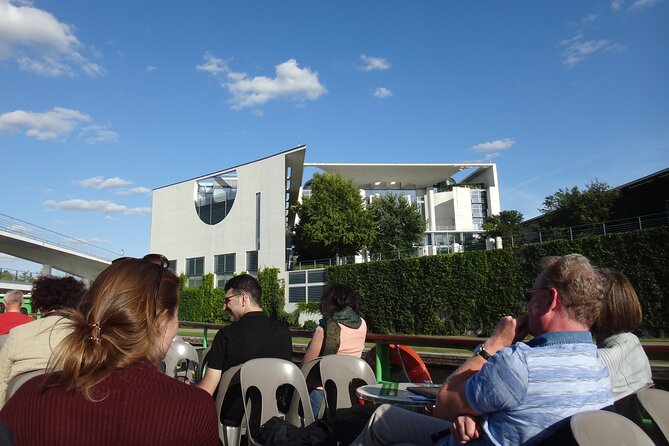
The central return section follows important government and cultural sights. Schiffbauerdamm runs along the right bank of the Spree in Mitte, a name recalling the shipbuilding companies once located there.
The Palace of Tears, at Friedrichstrasse station, is one of the most meaningful stops to understand from the river. It was the former departure hall for the border crossing, where East Germans said goodbye to western visitors who were usually free to travel in ways they were not. The building held the control counters staffed by East German security personnel.
You may also pass the Weidendammer Bridge, a listed bridge carrying Friedrichstrasse over the Spree. A bridge has occupied this location since the 17th century, and the present structure has links to Berlin’s literary life as well as its transport network.
The Reichstag is the visual star of this section. Built between 1884 and 1894 for the German Empire, it was badly damaged by the 1933 fire and World War II. Norman Foster’s late-20th-century renovation gave it the glass dome now associated with the German Bundestag.
From the river, you see the building’s formal front and its place in the government district. Nearby are the Kronprinzenbrücke, Humboldthafen, and the Federal Chancellery. Humboldthafen is a listed dock with a water surface of about 33,500 square meters, while the Chancellery is part of the federal government complex in the Spreebogen.
These sights are a strong reason to choose the longer cruise. They are spread across the city and can be awkward to combine efficiently on foot. You get a clear architectural survey while remaining seated, though the experience is less personal than walking among the buildings.
House of World Cultures and the final river views
The House of World Cultures occupies the former Congress Hall beside the Spree in the Tiergarten and government district. Its curved roof earned it the Berlin nickname Pregnant Oyster, and it now presents international contemporary art with a focus on non-European cultures and societies.
It is a good final example of the city’s mixture of history and modern use. A building tied to the German-American alliance now serves as a forum for international art and public discussion.
The last stretch can test your patience. The total ride is 2.5 hours, and some of the final sights may feel less exciting after the East Side Gallery, Oberbaum Bridge, and Molecule Man. I would not choose this version for very young children unless they are comfortable sitting for a long time.
On the other hand, a clear afternoon can make the ending pleasant. The boat moves slowly enough for photographs, and the onboard bar gives you the option of a coffee, beer, or snack. Food and drinks are not included, and supplies may not always be available, so do not rely on the bar as a full meal stop.
Commentary, seating, and weather
The live commentary is in German and English. It covers the sights as they appear, with an emphasis on architecture, civic buildings, bridges, and the city’s development.
English delivery can be clear and informative, but the bilingual format has a practical weakness. German is presented first, so you may reach a building before the English explanation begins. On the upper deck, wind and river noise can also make the words harder to hear. Sit near the speaker if you can, and move indoors if the weather or sound becomes difficult.
The upper deck is the place to sit for photographs and open views. It can become hot in strong sun, while the lower salon may feel stuffy if ventilation or air conditioning is not working properly. Connected seats can feel narrow, and some tables may be reserved. Ask at the dock about reserved upper-deck seating before boarding if facing forward is important to you.
The boat holds a maximum of 55 people. That is a manageable group size, but it does not guarantee a quiet ride. A noisy group can change the mood, especially when you are trying to hear the commentary.
Who should book this Berlin river cruise?
I would choose this tour for a first or second day in Berlin if you want a broad visual introduction without a long walking route. It is also a good fit for anyone who likes architecture, city planning, bridges, modern sculpture, and seeing famous sights from an unusual angle.
It suits adults and older children who can handle 150 minutes on a boat. The slower pace works well for a relaxed afternoon, and the lock passage adds something you do not get on every city cruise.
I would be more cautious if you want a tightly edited history tour, dislike bilingual narration, need guaranteed comfortable seating, or have young children who tire quickly. The shorter cruise may suit you better if you only want the central sights.
The activity is offered with a mobile ticket, is near public transportation, allows service animals, and has an onboard toilet. Most people can take part, though the boat may not be practical for a wheelchair user based on the access concerns reported for this setup. Free cancellation is available until 24 hours before departure, but changes or cancellations inside that window are not refunded.
Should you book the 2.5-hour East Side Tour?
Book it if the East Side Gallery, Mühlendammschleuse, Molecule Man, and the government district are all on your list. For about $36.04, you get a long, varied river route that reaches more of Berlin than a one-hour loop and gives you time to relax between major sightseeing stops.
Skip it if you want nonstop landmarks or a short introduction. The boat is not the newest, the seats may feel close, and the commentary sometimes favors buildings over political history. For the right audience, though, this is a useful way to connect Berlin’s divided past, royal center, modern parliament, and changing east bank in one afternoon.
FAQ
How long is the Berlin East Side Tour?
The cruise lasts approximately 2 hours and 30 minutes, or 150 minutes.
Where does the cruise begin?
It begins at the BWSG landing at Alte Börse, Burgstraße 27, 10178 Berlin, Germany.
What time does the cruise depart?
The listed start time is 2:45 pm.
Where does the cruise end?
The boat returns to the starting point at Alte Börse.
Is commentary provided in English?
Yes. Live commentary is provided in English and German.
Is food included in the ticket?
No. Food and drinks are not included, but an onboard bar sells food and drinks at your own expense.
Is there a toilet on the boat?
Yes. The boat has a toilet onboard.
Does the cruise pass the East Side Gallery?
Yes. The route follows the Spree beside the East Side Gallery, the long open-air gallery on a surviving section of the Berlin Wall.
How many people can join the cruise?
The activity has a maximum capacity of 55 travelers.
Can I cancel for a full refund?
Yes, if you cancel at least 24 hours before the experience start time. Cancellations made less than 24 hours before departure are not refunded.
Just added around Berlin
- Berlin Highlights in One Day★ 5.0 · 3 reviews
- Private Berlin One Day Tour with a Local: See the City Unscripted★ 3.5 · 3 reviews
- Individual city tour Berlin for max. 8 persons★ 5.0 · 3 reviews
- Transfer from Berlin Schönefeld Airport (SXF) to Berlin city Hotels – ROUND TRIP★ 4.0 · 3 reviews
- Private Analogue Photography Experience in Berlin★ 5.0 · 3 reviews
- Berlin: Museum Island Tour★ 5.0 · 3 reviews
- Berlin: Local Food Tour in Secrets Hidden Gems★ 4.0 · 3 reviews
- Berlin & The Third Reich Private Guided Tour★ 5.0 · 3 reviews
Cruises & Boat Tours, compared.
1-Hour City Tour by Boat with Guaranteed Seating
Read our review →
Hop-On Hop-Off Sightseeing Bus with Boat Options
Read our review →
2.5-Hour East Side Boat Cruise with Commentary
Read our review →Browse the lists this tour appears in