
Review · THIRD REICH & WWII SITES
Berlin & The Third Reich Private Guided Tour
Berlin’s darkest chapters are not tucked away in a single museum. They are spread across ordinary streets, grand squares, rebuilt plazas, and even a parking lot. This private tour connects those pieces, from the Nazi rise to power and the Second World War to the Cold War that followed.
I like the private format, which gives your group a guide rather than a fixed script for a large crowd. I also like the route’s range: the Führerbunker site and Holocaust Memorial carry a heavy emotional weight, while Potsdamer Platz and Checkpoint Charlie show how Berlin rebuilt and divided itself. The main consideration is that this is a walking-focused history tour, and the non-refundable booking policy leaves little room for a last-minute change.
- Hitler’s final headquarters is now an unremarkable parking area, a sharp reminder of how Berlin deals with difficult places.
- The route links Nazi, wartime, and Cold War history instead of treating them as separate subjects.
- A private group of up to 15 lets you ask questions and keep the pace suited to your party.
- Guides including Walid, Campbell, and Gregor have led the experience, with the guide assigned to your booking.
- All listed stops are free to enter, so your payment mainly covers the guide’s time and interpretation.
- The four-hour length gives you a broad overview, but most stops are brief rather than museum visits.
In This Review
- Berlin’s difficult story, told street by street
- Pariser Platz and the first steps toward power
- Reichstag: parliament, fire, and battle
- The Brandenburg Gate, from royal entrance to national symbol
- The Holocaust Memorial and the weight of absence
- The Führerbunker site and Berlin’s unmarked wound
- Potsdamer Platz and the city erased by war
- Checkpoint Charlie and the Cold War after 1945
- Why a private four-hour tour can be good value
- What the guides add to the route
- Who should book this Berlin history walk?
- Practical details before you reserve
- Should you book the Berlin and Third Reich tour?
- FAQ
- Where does the tour begin?
- Where does the tour end?
- How long does the tour last?
- What is the price?
- Is this a private tour?
- Does the tour offer pickup?
- Are the sites included in the admission price?
- Can I cancel or change the booking?
Berlin’s difficult story, told street by street
This tour works because Berlin itself is the main exhibit. You are not simply looking at memorials and famous buildings. You are being shown how one place changed from imperial capital to Nazi headquarters, wartime ruin, divided city, and reunified capital.
That sequence matters. The Brandenburg Gate means one thing when you first see it on Pariser Platz, another when you hear about Nazi propaganda and the war, and something else again when you learn that it sat beside the Berlin Wall for almost three decades. A good guide helps you connect those layers rather than treating each stop as an isolated photo opportunity.
The experience is led by Private Tours Berlin, with guides such as Walid, Campbell, and Gregor. The guide matters a great deal here. The buildings often do not explain themselves, and the former Führerbunker has almost no physical remains to inspect. Your understanding depends on clear storytelling and a willingness to answer questions.
The route begins at the Brandenburg Gate and returns there after about four hours. Pickup is offered, though the stated meeting point is Pariser Platz at the Brandenburg Gate. Confirm the exact arrangement when booking, especially if pickup is important to you.
Pariser Platz and the first steps toward power
Pariser Platz is Berlin’s most prestigious square, sitting at the western end of Unter den Linden. It is also a useful opening scene because the Brandenburg Gate dominates the space, while the Reichstag is nearby.
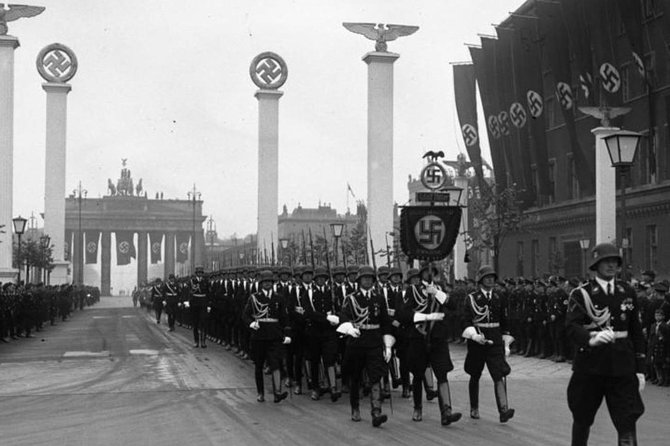
Your guide uses this area to explain how Hitler and the Brownshirts fought their way into political power. That framing gives the tour a necessary foundation. The Nazi period did not begin with war in 1939. It grew through political pressure, public spectacle, intimidation, and the capture of state institutions.
You have about 15 minutes here. That is enough for an introduction and orientation, though not enough for a full architectural study of the square. If you want polished photographs of the gate, arrive with time before the start. The tour is about historical meaning more than lingering for pictures.
More Third Reich sites in Berlin:
- Berlin: Third Reich and Cold War 2 Hour Walking Tour
★ 4.9 · 6,830 reviews - Berlin: Berlin Story Bunker Entry Ticket
★ 4.6 · 6,759 reviews - Berlin’s Best: 2 Hour Walking Tour Third Reich and the Cold War
★ 5.0 · 5,486 reviews
Reichstag: parliament, fire, and battle
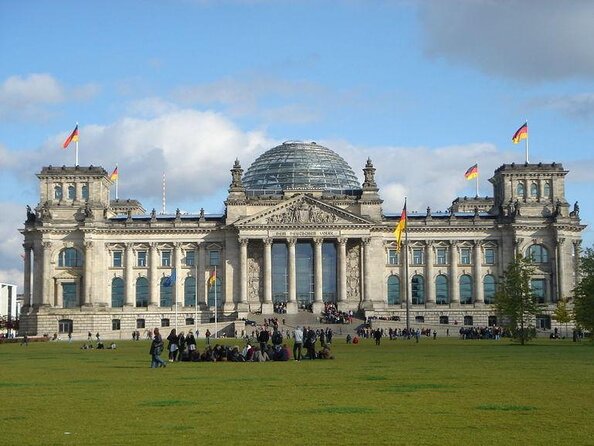
The Reichstag Building is only a short stop, listed at about 10 minutes, but it carries several major stories. It is Germany’s parliament, and its association with the Reichstag Fire gives your guide a way to explain how Hitler used crisis to gain sweeping control.
The building also became a battlefield during the final struggle for Berlin. German and Soviet forces fought over it in 1945, leaving the Reichstag tied to both the Nazi dictatorship and the destruction of the city.
Today, the building is topped by a glass cupola designed by British architect Sir Norman Foster. That modern addition creates a striking contrast with the building’s earlier history. The tour does not include an interior visit or a cupola admission, so you should not expect to go inside. You will get context from outside, then continue on foot.
The Brandenburg Gate, from royal entrance to national symbol
The Brandenburg Gate is the route’s most famous landmark and receives another 15-minute stop. Originally one of 18 city gates, it served as the royal entrance for the Hohenzollern family.
Its later history is far less ceremonial. The gate survived Napoleon and the Second World War, then ended up in the restricted zone beside the Berlin Wall. For almost 30 years, it represented a divided city rather than an open gateway.
That change in meaning is one of the tour’s strongest themes. Today, the gate is linked with German reunification. Your guide can help you read the monument as a political symbol, not just a grand neoclassical backdrop.
The stop is short, and the area can feel crowded with sightseeing groups. A private guide cannot remove the crowds, but your small party can usually gather close enough to hear without the awkwardness of a large tour formation.
The Holocaust Memorial and the weight of absence
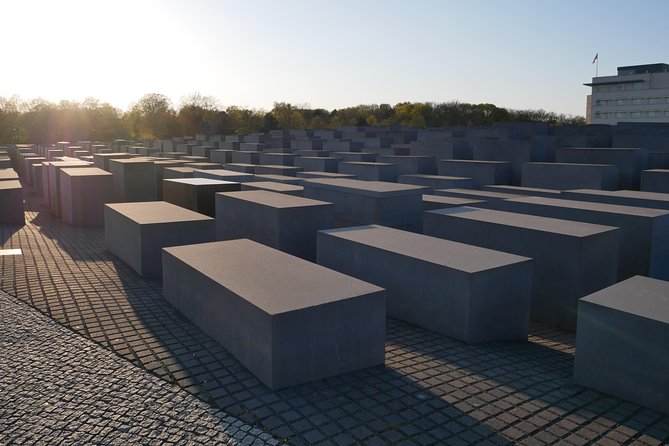
The Memorial to the Murdered Jews of Europe is one of the most serious stops. Its field of concrete stelae covers a large open site near the Brandenburg Gate. You have about 20 minutes here, the longest pause on the route.
The memorial is dedicated to the Jewish victims of the Holocaust. Its design offers no simple statue or single scene to photograph. Walking among the blocks changes your sense of scale and direction, which gives the guide room to discuss the Nazi persecution and the millions of lives destroyed.
This is a place where respectful behavior matters. The memorial can attract casual photo-taking, but the subject is not casual. Stay close to your group, listen carefully, and allow the site to set the tone.
The short visit is enough to introduce the memorial and its purpose, but it is not a substitute for a museum visit or a longer study of the Holocaust. If that subject is central to your Berlin plans, treat this stop as one part of a larger visit.
A few more Berlin tours worth weighing up
- Berlin: Private Reichstag and Glass Dome Tour
★ 4.8 · 2,226 reviews - Berlin Private Complete History All Day Walking Tour
★ 5.0 · 474 reviews - Private Walking Tour Berlin Third Reich Hitler and World War II
★ 5.0 · 360 reviews - Private Berlin: Iconic Sights and Hidden Gems Walking Tour
★ 5.0 · 292 reviews
The Führerbunker site and Berlin’s unmarked wound
The former Führerbunker is perhaps the most surprising stop. Hitler spent his final days there, married Eva Braun, and died by suicide during the final days of the war in Europe.
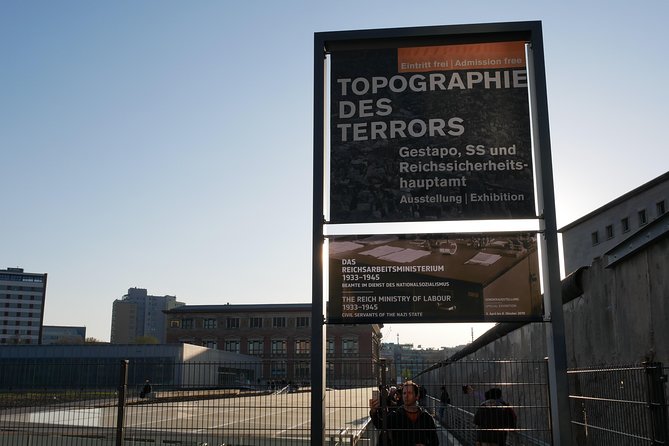
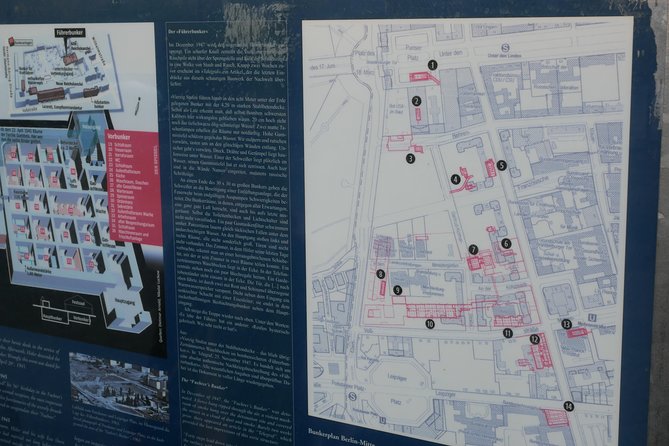
You will not see a preserved bunker interior. The location is now a parking lot with a simple sign. That plain setting can feel almost anticlimactic, but it is exactly what makes the stop memorable. A site associated with the center of Nazi power has been reduced to an ordinary piece of the city, with only a modest marker explaining what was once below ground.
Your guide’s explanation is essential here. Without it, you could walk past without noticing anything. The stop lasts about 15 minutes, giving you time to understand the location and the events of 1945 without turning it into a shrine.
This is also where the tour’s tone is strongest. The guide is not offering spectacle. The point is to explain how the regime ended and how Berlin chose to mark the place afterward.
Potsdamer Platz and the city erased by war
Potsdamer Platz gives the tour a useful change of pace. Before the war, it was one of Europe’s busiest traffic intersections. During the Second World War, it was almost completely destroyed.
The area was later rebuilt as one of Berlin’s most modern districts during the 1990s and early 2000s. You have about 10 minutes here, enough to connect the prewar city, wartime destruction, the divided border zone, and post-reunification construction.
The modern buildings can seem unrelated to the Nazi story at first. That contrast is the point. Berlin did not restore every damaged street to its former appearance. In places such as Potsdamer Platz, the city created something new over the ruins and empty spaces left by war and division.
Do not expect a preserved old quarter here. Expect an urban comparison: what a major Berlin crossroads was, what war did to it, and how reunified Germany reshaped the area.
Checkpoint Charlie and the Cold War after 1945
Checkpoint Charlie shifts the focus from Nazi Germany to the decades that followed the war. The site was a frontline crossing staffed by American and Soviet forces during the Cold War.
The stop lasts about 10 minutes. That is brief, but it places the Second World War in a wider political story. Germany’s defeat did not bring an uncomplicated peace. Berlin became a divided city, and Checkpoint Charlie became one of the best-known symbols of tension between the Western Allies and the Soviet Union.
The checkpoint is also one of the city’s more commercialized historic locations. Your guide helps separate the real Cold War importance from the souvenir shops and staged photo opportunities nearby. If you want a detailed account of the Berlin Wall, border escapes, or daily life in divided Berlin, you will need more time elsewhere. On this tour, Checkpoint Charlie works as the final chapter in a broad four-hour narrative.
Why a private four-hour tour can be good value
The price is $329.92 per group of up to 15 people. That sounds high if you are traveling alone or as a couple, but the calculation changes with a larger party. At the full capacity, it works out to roughly $22 per person. For two people, the per-person cost is much higher, so the value depends on how much you want personal attention and historical explanation.
All the listed sites have free admission. You are paying mainly for the guide, the route, and the connections between places. That is important because several stops, especially the Führerbunker site, offer little to see without interpretation.
A private booking also gives you room to ask about subjects that interest your group. You can spend more time on the Nazi rise to power, the Holocaust Memorial, or the final battle for Berlin if those topics matter most to you. The tradeoff is that the tour does not include entry to museums or the Reichstag cupola.
The four-hour length is well suited to a first serious look at Berlin’s 20th-century history. The scheduled stops add up to about 95 minutes, leaving the rest of the time for walking, transitions, and explanations. Wear comfortable shoes and expect to remain on foot for much of the experience.
What the guides add to the route
The guide is the difference between a list of landmarks and a coherent tour. Walid has led a four-hour walk that moves through Berlin’s key historical locations with breaks at important sites for discussion. Campbell has also guided the tour, including a private booking in early June, and Gregor has been praised for his clear grasp of Berlin’s modern history.
Those names give you a sense of the human side of the experience, but the exact guide is not guaranteed unless confirmed at booking. I would ask which guide is assigned if that matters to you, and I would share any particular interests before the tour begins.
The best use of a private guide is to ask direct questions. Why was the Führerbunker left unmarked apart from a simple sign? How did the Reichstag become useful to Hitler’s political campaign? What changed at the Brandenburg Gate after reunification? The route gives you plenty of openings for that kind of conversation.
Who should book this Berlin history walk?
I would recommend it most strongly to first-time visitors who want a clear overview of Berlin’s Nazi and Cold War past in one morning or afternoon. It also suits families or friend groups who prefer a private guide to a large scheduled party.
It is a good choice if you have already seen the main landmarks but feel you missed their meaning. Several sites on this route are easy to walk past without context. The tour gives them a place in one connected story.
You may want something else if you prefer long museum visits, interior access, or a slower architectural tour. The Reichstag visit is exterior only, the Holocaust Memorial stop is relatively short, and the Führerbunker site is primarily an explanation rather than a physical attraction.
The subject matter is also serious. This is not a light sightseeing walk with occasional historical trivia. The route deals with dictatorship, mass murder, war, suicide, and political division. That is precisely its value, but you should plan your day with some emotional space afterward.
Practical details before you reserve
The experience lasts about four hours and begins at the Brandenburg Gate on Pariser Platz, 10117 Berlin. It returns to the same meeting point at the end. Pickup is offered, but confirm the details because the published start and end point is the gate.
A mobile ticket is provided, confirmation arrives at booking, and service animals are allowed. The tour is near public transportation, and most people can participate. Since this is a private activity, only your group joins the guide, with a maximum group size of 15.
The cancellation rule is strict. The booking is non-refundable and cannot be changed for any reason. I would reserve only after checking your date, meeting point, and group size carefully.
Should you book the Berlin and Third Reich tour?
Book it if you want Berlin’s major Nazi, wartime, and Cold War sites explained as one story rather than visited as disconnected stops. The private setup is especially sensible for a family or group of friends, where the total price can be shared.
I would be more cautious if you are a couple watching every euro or if you want substantial time inside museums. For a first visit, though, the route covers an impressive amount in four hours. The most useful detail may be the simplest one: at the Führerbunker, there is almost nothing to see. You need a guide to understand why that ordinary parking lot matters, and this tour is built to provide exactly that context.
FAQ
Where does the tour begin?
The tour begins at Brandenburg Gate on Pariser Platz, 10117 Berlin, Germany.
Where does the tour end?
The activity ends back at the meeting point at Brandenburg Gate.
How long does the tour last?
The tour lasts approximately four hours.
What is the price?
The price is $329.92 per group, with up to 15 people included.
Is this a private tour?
Yes. Only your group participates, and the maximum group size is 15 people.
Does the tour offer pickup?
Pickup is offered. The stated meeting point is Brandenburg Gate, so confirm the pickup arrangement when booking.
Are the sites included in the admission price?
The listed stops have free admission. The tour does not state that interior admission to the Reichstag cupola or other museums is included.
Can I cancel or change the booking?
No. The experience is non-refundable and cannot be changed for any reason.
Just added around Berlin
- Berlin Highlights in One Day★ 5.0 · 3 reviews
- Private Berlin One Day Tour with a Local: See the City Unscripted★ 3.5 · 3 reviews
- Individual city tour Berlin for max. 8 persons★ 5.0 · 3 reviews
- Transfer from Berlin Schönefeld Airport (SXF) to Berlin city Hotels – ROUND TRIP★ 4.0 · 3 reviews
- Berlin: Museum Island Tour★ 5.0 · 3 reviews
- Private Analogue Photography Experience in Berlin★ 5.0 · 3 reviews
- Berlin: Local Food Tour in Secrets Hidden Gems★ 4.0 · 3 reviews
- Potsdam Highlights – Private sightseeing tour by minibus★ 5.0 · 3 reviews
Third Reich & WWII Sites, compared.



Berlin’s Best: 2 Hour Walking Tour Third Reich and the Cold War
Read our review →
Third Reich Berlin: Hitler and WWII Walking Tour
Read our review →

Berlin Third Reich Sites: Half-Day Walking Tour
Read our review →
Guided Bike Tour of the Berlin Wall and Third Reich
Read our review →
Hitler’s Germany: Berlin During the Third Reich & WWII
Read our review →Browse the lists this tour appears in