
Review · THIRD REICH & WWII SITES
Private Walking Tour Berlin Third Reich Hitler and World War II
Berlin’s Nazi past is not tucked away in one museum. It is spread across ordinary streets, government buildings, memorials, and empty spaces. This private walking tour connects those places into one sober, readable story, from the Soviet assault on Berlin to the Holocaust and the collapse of Hitler’s regime.
I like the private format, which lets your guide adjust the pace and focus. I also like the hotel pickup and drop-off, a real help when you are facing four hours of serious history and a fair amount of walking. Guides such as Daniel, Jimmy, Emma, Jasper, and Simon have been praised for clear explanations, good stories, and personal attention.
The main drawback is the price: $192.97 per person is a large outlay for a walking tour. Several stops last only 10 to 20 minutes, and the Reichstag visit does not include admission, so you are paying mainly for the guide’s time, planning, and private access to the conversation rather than for tickets.
In This Review
- Key points to know before booking
- Why this private Berlin history tour works
- Soviet Memorial Tiergarten begins with the Battle of Berlin
- Detlev-Rohwedder-Haus and Wilhelmstraße reveal Nazi power at work
- Topography of Terror puts repression into human terms
- Bendlerblock honors German resistance
- Bebelplatz shows how repression can begin with books
- Reichstag connects Nazi crisis to modern democracy
- The Holocaust Memorial requires silence and time
- The Führerbunker site avoids false drama
- Anhalter Bahnhof tells the story of deportation
- The T4 memorial confronts Nazi euthanasia
- Moltkebrücke and the final Soviet assault
- How the 3 to 4 hours feel in practice
- Is $192.97 per person good value?
- Who should book this tour?
- FAQ
- How long does the private Berlin Third Reich and WWII tour last?
- Is hotel pickup included?
- Is the tour conducted in English?
- Is this a private tour?
- Are admission tickets included?
- Does the tour operate in bad weather?
- What is the cancellation policy?
- Should you book it?
Key points to know before booking
- The Führerbunker site is only a surface visit: You stand above the former bunker location, since the original underground complex is largely gone and not open as a visitor attraction.
- The Topography of Terror and Holocaust Memorial deserve extra time: The tour introduces both sites, but 20 and 15 minutes are brief for their exhibitions and memorial spaces.
- Hotel pickup and drop-off simplify a spread-out route: You begin and end at your hotel, with the guide shaping the day around your starting point.
- The private group setting encourages questions: Guides can tailor the route to your interests, skip places you already know, and adjust the pace.
- The tour covers more than Hitler’s headquarters: You also encounter resistance, book burning, Nazi euthanasia, deportation, Soviet victory, and the postwar meaning of democracy.
- Come ready to walk outside in any weather: The tour operates in rain and cold, and there is no food or drink included.
Why this private Berlin history tour works
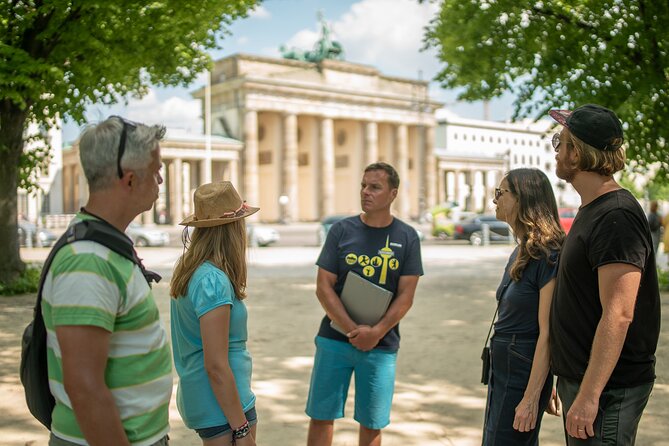
The strength of this experience is its connected story. You are not simply ticking off famous places. You move between sites tied to Nazi government, military defeat, organized murder, opposition, and remembrance.
A private guide can explain the links as you go. At Wilhelmstraße, you see where Nazi ministries worked. At Bebelplatz, you consider how censorship began in public. At the German Resistance Memorial Center, you meet people who chose to oppose the regime. Later, the T4 memorial shows how state murder first targeted disabled people and those with mental illnesses.
That range matters. A tour focused only on Hitler can turn history into a story about one dictator. This route gives you a wider picture of institutions, choices, victims, resistance, and the aftermath.
The guides are the heart of the day. Daniel has been especially praised for meeting groups at their hotel, asking what they wanted to see, and shaping a plan quickly. Jimmy is described as engaging with strong stories and a relaxed manner. Emma has adjusted both content and pace to suit a group. Jasper, Simon, Callum, Oren, Tobi, Martin, Artie, Xavier, and others have also been singled out for clear explanations and an ability to answer questions.
Guide assignments can change, so you should not book on the assumption that one particular person will lead your tour. Still, the pattern is clear: the best part of this experience is the live conversation. You can ask about family history, the Holocaust, the Cold War, architecture, or the choices made by ordinary Germans, then follow that thread instead of waiting for a standard script.
More Third Reich sites in Berlin:
- Berlin: Third Reich and Cold War 2 Hour Walking Tour
★ 4.9 · 6,830 reviews - Berlin: Berlin Story Bunker Entry Ticket
★ 4.6 · 6,759 reviews - Berlin’s Best: 2 Hour Walking Tour Third Reich and the Cold War
★ 5.0 · 5,486 reviews
Soviet Memorial Tiergarten begins with the Battle of Berlin
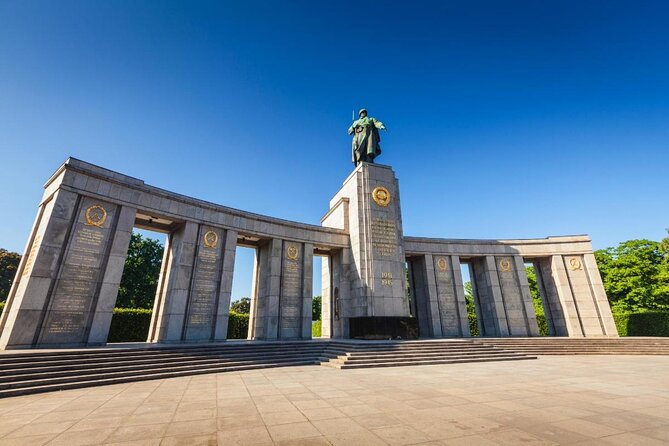
The Soviet Memorial in Tiergarten gives the tour a strong opening. Built in 1949, it commemorates Soviet soldiers killed in the Battle of Berlin in 1945, the final major fight that brought Nazi Germany to defeat.
The memorial’s central figure is a large Soviet soldier holding a sword and shield. Your guide explains the symbolism of victory and sacrifice, along with the role of the Soviet Army in the fall of Berlin.
This is a short stop, listed at about 10 minutes, so expect an outdoor explanation rather than a full study of the site. Its value comes from setting the military context before you move into the machinery of Nazi government and persecution.
Detlev-Rohwedder-Haus and Wilhelmstraße reveal Nazi power at work
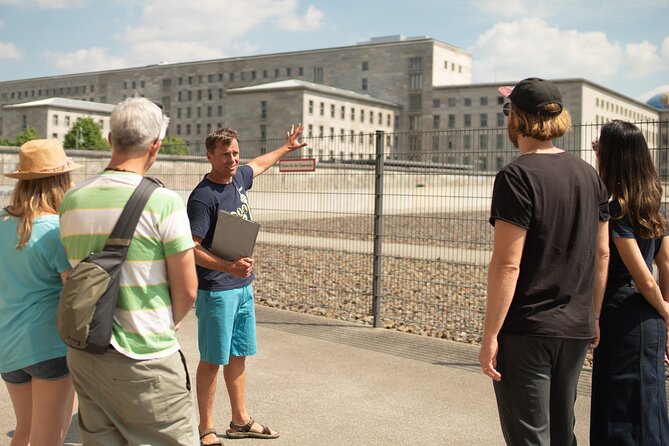
On Wilhelmstraße, the Detlev-Rohwedder-Haus helps you picture how the regime operated. The building was constructed in the 1930s as the Reichsbank headquarters and later housed the Ministry of Aviation under Hermann Göring.
Your guide discusses the building’s role in the economic and political work of the Third Reich. The focus is useful because dictatorship depends on offices, budgets, ministries, and paperwork, not only speeches and uniforms.
After World War II, the building became the German Federal Treasury. That later use adds another layer to the story: Berlin’s government district did not vanish after 1945. It was reused, renamed, and given new meaning.
The visit lasts roughly 10 minutes, followed by about 20 minutes along Wilhelmstraße. You will hear about ministries, military parades, propaganda events, and decisions made along this avenue. I find this one of the better places to understand Nazi rule as a system rather than a single personality.
Topography of Terror puts repression into human terms
The Topography of Terror occupies the former site of the SS and Gestapo headquarters. Its indoor and outdoor exhibitions use photographs, documents, and personal accounts to explain political repression and state violence.
Your guide introduces the rise of the Nazi regime, the persecution of opponents, and the methods used to control society. The setting is powerful because the place itself was once part of the machinery being explained.
The scheduled visit is about 20 minutes. That is enough for an orientation and a few key points, but not enough to read the full exhibition at a relaxed pace. I would treat the tour stop as a guide-led introduction, then return later if you want to study the material in detail.
This is also where a private tour earns its keep. You can ask your guide to clarify terms, people, or events that might otherwise blur together. The subject is grim, but a good explanation helps you understand it without turning the visit into a parade of atrocities.
More walking tours in Berlin:
- Discover Berlin Half-Day Walking Tour
★ 5.0 · 9,624 reviews - Berlin: Discover Berlin Walking Tour
★ 4.9 · 5,998 reviews - Berlin: Hidden Backyards Guided Walking Tour
★ 4.8 · 5,360 reviews - Third Reich Berlin: Hitler and WWII Walking Tour
★ 5.0 · 3,301 reviews
Bendlerblock honors German resistance
At the German Resistance Memorial Center in the Bendlerblock, the focus shifts from Nazi authority to opposition. The exhibits cover different resistance movements, with special attention to Claus von Stauffenberg and the July 20, 1944 attempt to kill Hitler.
Your guide explains why people resisted, what they hoped to change, and what happened after the plot failed. The memorial area invites a quieter kind of attention. It asks you to consider moral courage under a dictatorship, including the risks faced by people who acted when success was unlikely.
The stop lasts about 20 minutes. As with the Topography of Terror, that is a useful introduction but a short museum visit. If resistance history matters to you, ask your guide how to return for a longer look.
Bebelplatz shows how repression can begin with books
Bebelplatz is one of Berlin’s most memorable public squares because of what happened there on May 10, 1933. Thousands of books labeled un-German were burned as the Nazi regime attacked free thought and expression.
The square is surrounded by major buildings, including the State Opera House and Humboldt University. Beneath the paving is a memorial of empty bookshelves. You may not see the installation clearly from every angle, but its idea is direct: the missing books represent a culture stripped of its voices.
This 10-minute stop is brief, yet it adds an important theme to the tour. Mass violence did not begin with deportation trains and killing centers. Censorship, public intimidation, and the removal of ideas helped prepare the ground.
Reichstag connects Nazi crisis to modern democracy
The Reichstag is one of Berlin’s best-known political buildings. Completed in 1894, it became central to the Nazi seizure of power after the Reichstag Fire in 1933.
Your guide explains how the Nazis used the fire to suppress political opposition and tighten their control. You also hear how the building was damaged during the war and later restored as a symbol of democratic government.
The outside discussion lasts about 15 minutes, and admission is not included. This is important: the tour covers the Reichstag’s Nazi-era meaning, but it is not a ticketed dome visit. If you want to enter the building separately, plan that on your own.
The stop works best when your guide explains the contrast between the building’s past and its role in present-day Germany. It is a reminder that historic places can be given a new civic purpose.
The Holocaust Memorial requires silence and time
The Memorial to the Murdered Jews of Europe consists of 2,711 concrete slabs arranged in a grid. The blocks vary in height, creating paths that feel increasingly enclosed and disorienting as you walk among them.
Your guide explains the design and places it within the history of the Holocaust, including Nazi persecution and the destruction of European Jewish communities. The memorial is deliberately open to interpretation, so do not expect a single tidy message.
The scheduled time is about 15 minutes. That is enough to walk through part of the field and hear the basic context, but you should not rush. If the space affects you, slow down. You can also return later to spend more time at the underground information center, though its inclusion or admission details are not specified here.
This stop needs respectful behavior. It is not a photo backdrop or a place for loud conversation. The guide can supply historical facts, but the memorial also asks you to pause and think.
The Führerbunker site avoids false drama
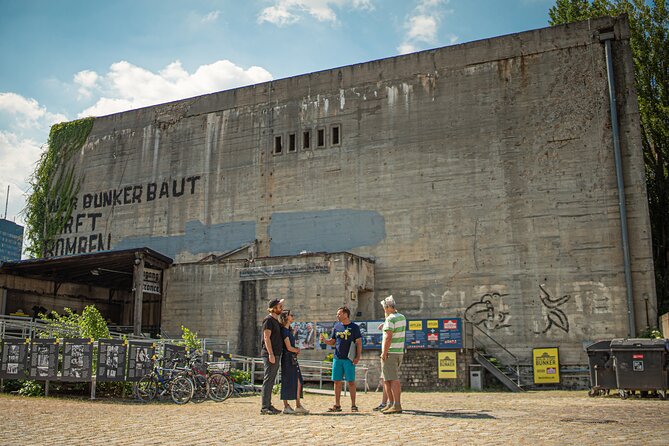
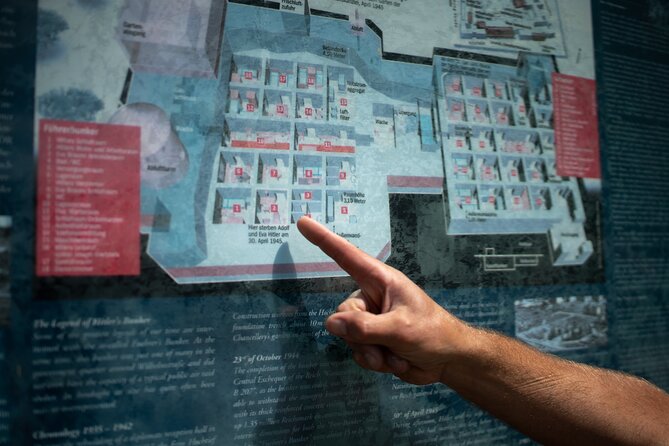
At the Führerbunker, you stand above the location of Hitler’s final refuge. The underground complex was beneath the Reich Chancellery and served as the Nazi leadership’s last headquarters during the final months of the war.
Your guide recounts the bunker’s layout, the collapse of the regime, and the decisions made as Allied forces closed in on Berlin. Much of the original structure was destroyed after the war, so there is no grand underground attraction waiting below the street.
That absence is part of the point. The site is deliberately ordinary now. You receive a sober explanation rather than a theatrical ruin, which helps keep attention on the consequences of totalitarian power instead of on Hitler as a figure of fascination.
The stop lasts around 10 minutes. If you want photographs, expect an unremarkable surface location rather than a preserved bunker interior.
Anhalter Bahnhof tells the story of deportation
Anhalter Bahnhof was once one of Berlin’s major railway terminals. Its damaged façade and remaining structures offer a visual reminder of a station that once carried ordinary passengers, then became connected to the deportation of Jewish families during the Holocaust.
Your guide explains how the station fit into the wider system of Nazi persecution and shares the human cost of those departures. The point is not simply that trains left Berlin. Families were torn apart, and the railway helped make mass deportation possible.
This is another 10-minute stop, so the value depends on your guide’s ability to connect the architecture with individual lives. The partial remains can be easier to understand after the explanation than before it.
The T4 memorial confronts Nazi euthanasia
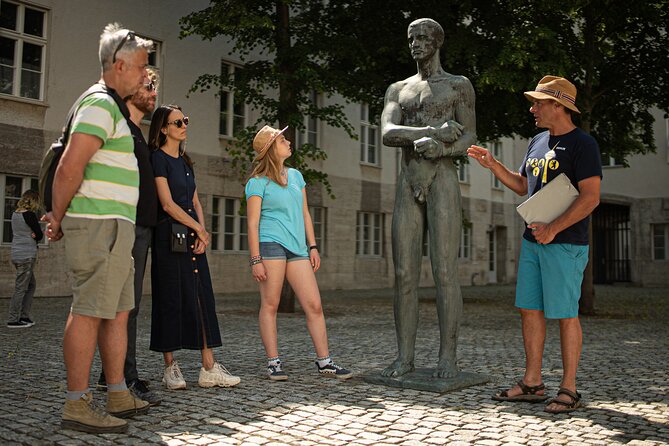
At Tiergartenstraße 4, the T4 memorial recalls the Nazi euthanasia program. The campaign targeted disabled people and those with mental illnesses, labeling them unworthy of life and killing them through a planned state program.
Your guide explains the history, the victims, and the ethical questions raised by this crime. The memorial also shows why Nazi persecution must be understood beyond the Holocaust alone. Bureaucratic language, medical authority, and social prejudice were used to justify murder.
The visit lasts about 10 minutes. It is short, but the subject is essential. Ask questions if you need the chronology clarified, especially if this is your first introduction to the T4 program.
Moltkebrücke and the final Soviet assault
The Moltkebrücke gives you a place to picture the final battle for Berlin. Soviet forces crossed the bridge in 1945 during their assault on the city, using it as a route into the government district.
Your guide describes the fighting around the bridge and the meaning of the Soviet advance for Berlin’s future. The bridge is both an architectural feature and a practical battlefield location, which makes the story easier to place on a map.
The stop takes about 10 minutes. It works as a closing military chapter after the earlier discussion of the Soviet Memorial, showing how the campaign moved from sacrifice and advance to the capture of central Berlin.
How the 3 to 4 hours feel in practice
The listed stops add up to about 160 minutes. The remaining time is used for walking, movement between districts, questions, and hotel transfers. That makes the advertised 3 to 4 hours reasonable, but the day will not feel like three or four uninterrupted hours of formal commentary.
You should expect a steady outdoor pace. One guide-led experience covered about 10,000 steps, so comfortable shoes matter. The route operates in all weather, and a cold or rainy day can change your enjoyment quickly. Bring weatherproof clothing, since hotel pickup does not turn this into an indoor tour.
A private group is a major practical advantage. You can ask for more time at one location, move faster past a place you already know, or add related subjects such as the Cold War when time allows. One guide also began at Museum Island and ended at the Berlin Wall for a group, showing how the route can be adjusted, though exact changes depend on your guide and schedule.
Food and drinks are not included. Plan to eat before or after, since the tour is built around moving between historical sites rather than stopping for a meal.
Is $192.97 per person good value?
At $192.97 per person, this is not the cheapest way to see Nazi Berlin. You pay a premium for a private guide, hotel pickup and drop-off, flexible pacing, and the chance to ask as many questions as your group likes.
The value improves with a larger private party because the guide’s time is shared among more people. It also makes more sense if your group has mixed ages or different levels of background knowledge. A guide can explain the basics to one person while giving a more detailed answer to another.
The price is harder to justify if you mainly want to enter museums or spend long periods reading exhibitions. Several stops are short, and the Reichstag admission is extra. You might prefer a lower-cost group tour plus separate museum visits if you enjoy exploring at your own speed.
Who should book this tour?
I would choose this for families, first-time visitors to Berlin, history-focused couples, and anyone who wants the city’s Nazi-era sites placed into one clear timeline. It is also a strong choice if you have only one full day for this subject.
Families can benefit from the private format. One guide successfully engaged quiet children, and another tour was described as especially meaningful for a family with kids. Still, the material is difficult. Parents should decide in advance how much detail is suitable.
You do not need a strong background in German history. The tour can begin with basic context and build from there. If you already know the subject well, the private format lets you push into questions about policy, resistance, memory, or the transition to the Cold War.
The tour is less suited to anyone who dislikes walking, outdoor weather, or emotionally heavy subjects. It is also not ideal if your main goal is a long museum visit.
FAQ
How long does the private Berlin Third Reich and WWII tour last?
The tour lasts approximately 3 to 4 hours.
Is hotel pickup included?
Yes. Hotel pickup and hotel drop-off are included.
Is the tour conducted in English?
Yes. The tour is offered in English.
Is this a private tour?
Yes. Only your group participates.
Are admission tickets included?
Most listed stops have no admission charge. Admission to the Reichstag Building is not included.
Does the tour operate in bad weather?
Yes. It operates in all weather conditions, so dress appropriately.
What is the cancellation policy?
You can cancel up to 24 hours before the start time for a full refund. Cancellations or changes made less than 24 hours in advance are not accepted for a refund.
Should you book it?
Book this tour if you want a guide to connect Berlin’s Nazi government, persecution, resistance, defeat, and remembrance in one private outing. The hotel service, flexible route, and strong guide focus make it especially useful for families and first-time visitors.
Skip it if $192.97 feels high for a walking tour, or if you want hours inside museums. For the right group, though, the private conversation is the point. Berlin’s memorials and empty sites can be hard to read on your own. A good guide gives them shape, context, and the space to ask better questions.
Just added around Berlin
- Berlin Highlights in One Day★ 5.0 · 3 reviews
- Individual city tour Berlin for max. 8 persons★ 5.0 · 3 reviews
- Transfer from Berlin Schönefeld Airport (SXF) to Berlin city Hotels – ROUND TRIP★ 4.0 · 3 reviews
- Private Berlin One Day Tour with a Local: See the City Unscripted★ 3.5 · 3 reviews
- Berlin: Museum Island Tour★ 5.0 · 3 reviews
- Private Analogue Photography Experience in Berlin★ 5.0 · 3 reviews
- Berlin: Local Food Tour in Secrets Hidden Gems★ 4.0 · 3 reviews
- Berlin & The Third Reich Private Guided Tour★ 5.0 · 3 reviews
Third Reich & WWII Sites, compared.



Berlin’s Best: 2 Hour Walking Tour Third Reich and the Cold War
Read our review →
Third Reich Berlin: Hitler and WWII Walking Tour
Read our review →

Berlin Third Reich Sites: Half-Day Walking Tour
Read our review →
Guided Bike Tour of the Berlin Wall and Third Reich
Read our review →
Hitler’s Germany: Berlin During the Third Reich & WWII
Read our review →Browse the lists this tour appears in