
Review · THIRD REICH & WWII SITES
Berlin’s Best: 2 Hour Walking Tour Third Reich and the Cold War
Berlin’s hardest history is often found in ordinary streets. In two hours, this walking tour links the Brandenburg Gate, the Reichstag, Hitler’s bunker site, the Berlin Wall, and Checkpoint Charlie into one sharp lesson about how Berlin became the city you see today. You walk where buses cannot, with the past close under your feet.
I like the tight route and the way it connects Nazi rule to the Cold War instead of treating them as separate chapters. I also like the guides’ use of old photographs and direct answers to questions. The main drawback is simple: two hours is enough for a strong overview, not a slow visit to every museum, and winter weather can make the open-air stops hard work.
In This Review
- Key points to know before you book
- Why this two-hour Berlin walk works
- Brandenburg Gate and the Reichstag: a powerful opening
- Tiergarten and the Soviet memorial
- The Holocaust Memorial and the bunker site
- The Aviation Ministry and the Topography of Terror
- The Berlin Wall on Niederkirchnerstraße
- Checkpoint Charlie and the end of the divided city
- Guide style: clear stories, old photographs, and room for questions
- Price, pace, and practical trade-offs
- Who should book this Berlin history tour?
- Should you book it?
- FAQ
- How long is the Berlin Third Reich and Cold War walking tour?
- Where does the tour start?
- Where does the tour end?
- How early should I arrive?
- Is the tour offered in English?
- Are admission tickets included?
- Can I cancel for a full refund?
Key points to know before you book
- Brandenburg Gate to Checkpoint Charlie: The route runs between two of Berlin’s best-known landmarks and covers major Nazi and Cold War sites along the way.
- A serious history lesson in two hours: Expect clear context on the Reichstag fire, Hitler’s final days, the Holocaust, East Germany, the Berlin Wall, and reunification.
- English-speaking guides with different strengths: Past guides include Glen, Maggie, Mikey, Tom, James, Georgia, Peter F., and Mikhail. The exact guide depends on the day.
- Historic photos add useful context: Guides may show images of places as they looked during the Nazi period or the divided-city years.
- Free sights, paid expertise: Admission to the listed stops is free, so the $24.07 price mainly pays for the guide and the structure of the walk.
- Dress for Berlin weather: Wear sensible shoes, bring gloves in winter, and use the restroom before meeting the group.
Why this two-hour Berlin walk works
This is a good first look at Berlin because the route has a clear story. You begin at the Brandenburg Gate, a symbol of a divided city that now represents reunified Germany. You finish at Checkpoint Charlie, where the Cold War became a daily fact of life and where the Berlin Wall’s fall helped reshape Europe.
Between those points, the walk moves through the machinery of Nazi power, the wreckage of war, and the political split that followed. That order matters. Berlin’s history can feel like a pile of monuments unless someone explains how one event led to another. A strong guide turns the city itself into a timeline.
The tour is offered in English and has a maximum of 30 people. That is large enough to create energy but still manageable on city streets. You should not expect a private walk or long one-to-one conversations at every stop, but the guides are prepared to take questions. Several, including Ben, Maggie, Joachim, and Mikhail, are praised for explaining difficult subjects clearly and responding well to questions.
The meeting point is in front of the Tourist Information office at the Brandenburg Gate on the Pariser Platz side. Arrive 15 minutes early and look for the guide with the pink umbrella. That bright marker is more useful than it sounds in a busy square.
More Cold War Berlin:
- Berlin: Third Reich and Cold War 2 Hour Walking Tour
★ 4.9 · 6,830 reviews - Cold War, Berlin Wall, Spies and the East Side Gallery
★ 5.0 · 1,024 reviews - Berlin: Cold War Walking Tour on Berlin Wall Route
★ 4.8 · 437 reviews
Brandenburg Gate and the Reichstag: a powerful opening
The Brandenburg Gate is a strong place to begin. You get the famous view, but the useful part is the explanation of why this neoclassical monument became a symbol of German division and reunification. It is not just a photogenic arch. Its meaning changed with the country around it.
The stop lasts about 15 minutes, and admission is free. You remain outside, listening to the guide set up the political story that follows. If you have only seen the gate in photographs, this opening gives it much more weight.
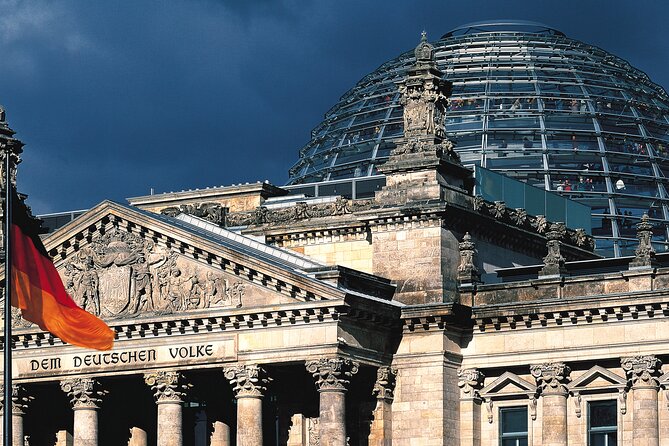
The nearby Reichstag Building adds another layer. The guide explains why this parliament building reflects so much of Germany’s past century, including the 1933 Reichstag fire and the way Hitler used the event to help destroy democratic government. You do not go inside, so this is a brief exterior stop of about 10 minutes, but the subject is crucial.
I like this early pairing because it shows both the ideal of parliamentary government and the speed with which it can be weakened. The guide’s job here is not to recite dates. It is to show you how a building can become part of a national crisis.
Tiergarten and the Soviet memorial
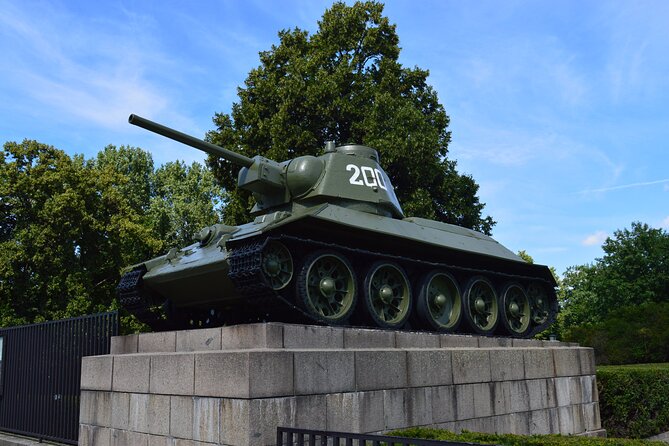
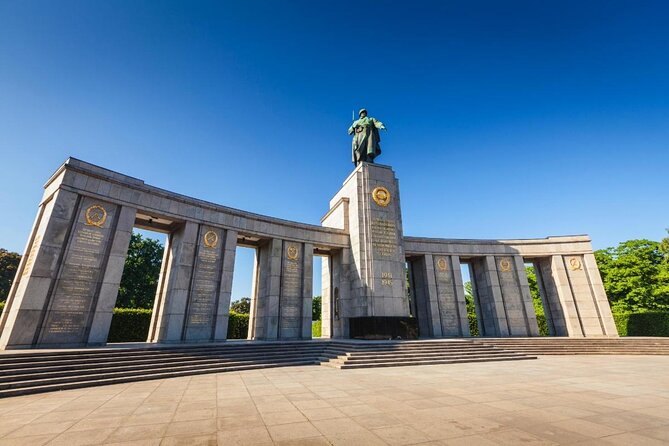
The Soviet Memorial in the Tiergarten gives the walk a physical reminder of the Second World War’s final phase. You see Soviet T-34/76 tanks and field artillery displayed at the site. The stop is short, about seven minutes, but the hardware makes the scale and force of the fighting easier to grasp.
The memorial also helps explain Berlin’s postwar political setting. The city was occupied and divided among the victorious powers, and Soviet military memory remained visible in the center of the former capital.
The itinerary also includes the Victory Column and its connection to Albert Speer. You hear why Speer moved the column from its original location and learn about his plans for Germania, the proposed Nazi redesign of Berlin as a world capital. This is a useful warning against viewing grand architecture as harmless decoration. In this case, urban planning was tied to dictatorship, propaganda, and a fantasy of Nazi victory.
The exact time listed for the Victory Column stop is not specified, so the guide will need to keep the whole route moving. That is part of the bargain with a two-hour tour: you get the story and the location, but not an extended look at every monument.
The Holocaust Memorial and the bunker site
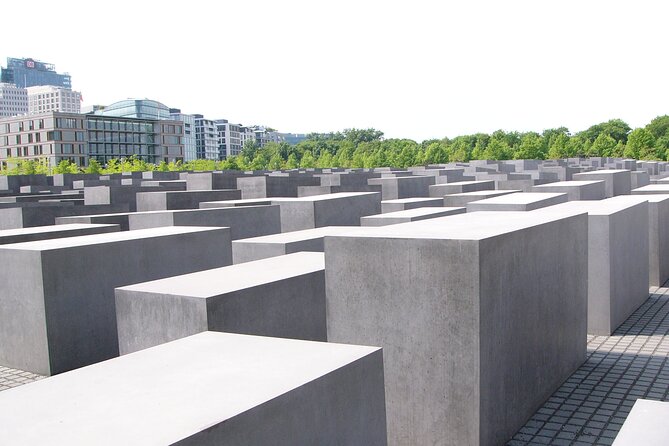
The Memorial to the Murdered Jews of Europe is one of the tour’s most important stops. You walk through the large field of concrete slabs, a space designed to make you feel unsettled rather than comfortable. The guide discusses the memorial and the murder of Europe’s Jews during the Nazi period.
You have about 10 minutes here. That is enough to walk among the slabs and hear the basic context, but it is not enough for a full museum visit or a long personal reflection. If this memorial matters deeply to you, plan to return later with more time.
The next stop is the former Führerbunker site. Nothing dramatic marks the exact location today, and that absence is part of the point. You stand above the bunker and hear about Hitler’s final days, his suicide on April 30, 1945, and the way Berlin and Germany have dealt with this destructive past.
This can be an emotionally strange moment. The place is historically famous, yet there is no grand monument inviting admiration. A thoughtful guide keeps the focus on the consequences of dictatorship rather than on Hitler as a personality. Guides such as Mikey and James have been praised for handling grim subjects with respect while using carefully judged humor when appropriate.
That balance matters. Berlin’s past is too serious for a parade of sensational stories, but a guide who speaks in a flat, lifeless way can lose the group. The strongest approach makes the facts understandable without making the crimes feel like entertainment.
More Third Reich sites in Berlin:
- Berlin: Berlin Story Bunker Entry Ticket
★ 4.6 · 6,759 reviews - Third Reich Berlin: Hitler and WWII Walking Tour
★ 5.0 · 3,301 reviews - Berlin: Third Reich, Hitler, and WWII Walking Tour
★ 4.9 · 1,133 reviews - Berlin Third Reich Sites: Half-Day Walking Tour
★ 5.0 · 835 reviews
The Aviation Ministry and the Topography of Terror
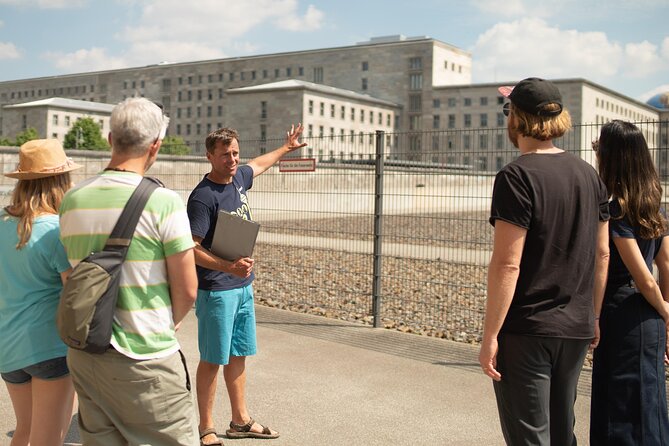
The walk continues to the former Aviation Ministry, a long building associated with Hermann Göring and the Luftwaffe. You walk along its length and learn that the building was also the site where East Germany, or the GDR, was proclaimed in 1949.
This is a good example of how the tour layers time onto the same street. Nazi institutions did not vanish from Berlin’s physical fabric when the war ended. Buildings survived, changed hands, and became part of the next political order.
The Topography of Terror follows. This site once held the headquarters of the SS, Gestapo, and SD, three central institutions of Nazi repression. Today, the exhibition documents their crimes.
The stop lasts about 15 minutes and takes place near one of the most useful historical exhibitions in the city. You see where the institutions operated and hear what happened there. You do not get a full museum visit during the walk, so I would treat this as an introduction and return later if you want documents, photographs, and more detail.
Historic photographs can make this section especially effective. Guides Glen and Mikhail, for example, have used old images to show how the setting looked in earlier decades. Seeing the past superimposed on the present helps you understand that these crimes happened in real offices and streets, not in some distant, abstract world.
The Berlin Wall on Niederkirchnerstraße
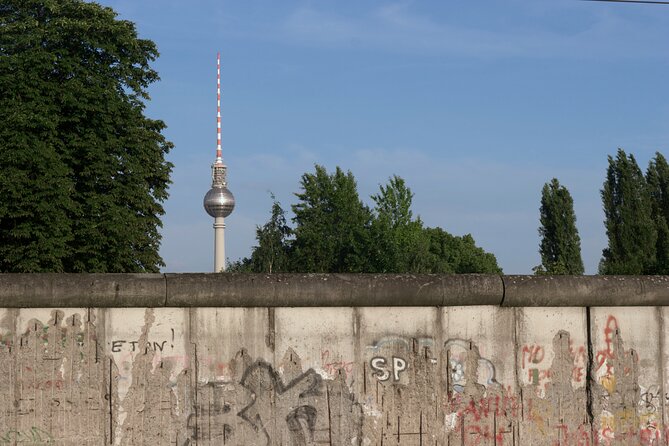
At Niederkirchnerstraße, you see a large surviving section of the Berlin Wall. This is one of the places where the Cold War becomes more than a political idea. Concrete, guard systems, escape attempts, and divided neighborhoods all become part of the discussion.
The guide tells stories of people who tried to escape and explains what happened to those who failed. You also hear about daily life on both sides of the Wall, in East Berlin and West Berlin.
The stop lasts around seven minutes. That is short, but the remaining wall section gives the guide something solid to point to. The experience is strongest when the explanation stays focused on people, not only on dates and leaders.
You should also note the contrast between the Wall’s modern setting and its former purpose. Berlin has changed greatly, and much of the border is no longer obvious. That makes the surviving piece valuable. It gives you a fixed point from which to imagine the barriers, controls, and fear that once shaped movement through the city.
Checkpoint Charlie and the end of the divided city
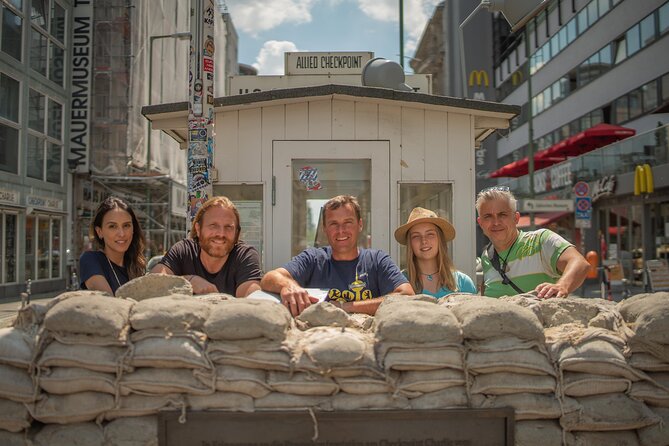
The tour ends at Checkpoint Charlie on Friedrichstraße, one of the most famous former crossing points through the Berlin Wall. The guide explains the 1961 confrontation between Soviet and American tanks and the events of November 9, 1989, when the Wall came down.
The final discussion turns to reunification and how successful it has been over more than 30 years. That keeps the tour from ending as a museum lesson about the past. Berlin’s division still influences its buildings, politics, neighborhoods, and public memory.
Checkpoint Charlie itself can feel theatrical today. It is a heavily visited city landmark, and the modern setting does not always convey the tension of the Cold War. The guide’s historical explanation is therefore essential. Without it, you see a famous name and a busy street. With it, you understand why this crossing became a global symbol.
The ending also makes practical sense. You are left in a central area with public transport nearby, and you can continue to the surrounding museums and historic sites. The tour does not include admission to museums, so you can decide for yourself if you want a longer visit after the walk.
Guide style: clear stories, old photographs, and room for questions
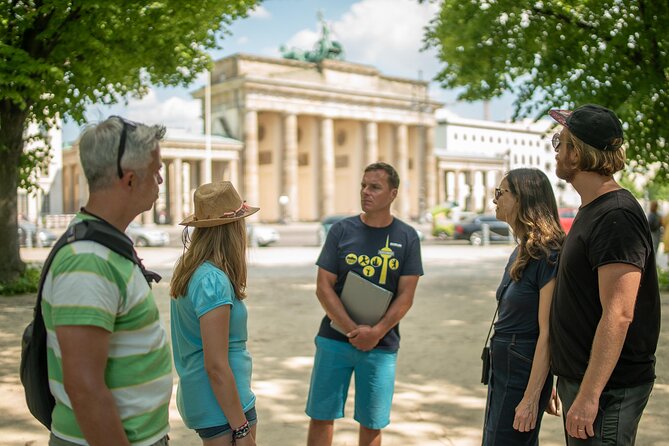
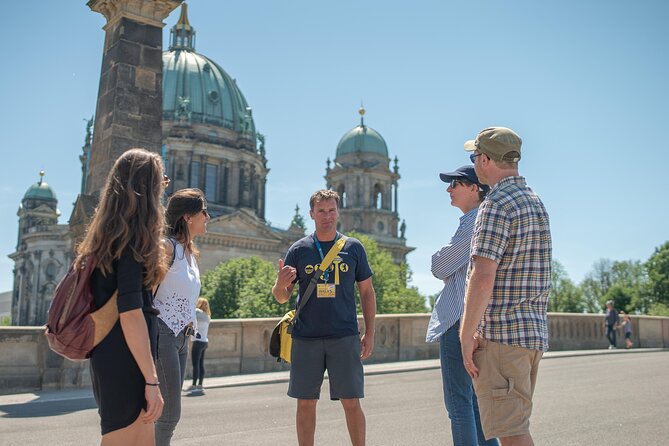
The guide makes or breaks a history walk, and this experience depends heavily on who leads your group. Names praised for strong work include Glen, Ben, Maggie, Joachim, Peter F., Simon, Paul, Mikey, Georgia, Jamie S., Mikhail, and Tom.
The recurring strength is not just subject knowledge. It is the ability to explain the past in plain language, answer questions, and keep a respectful tone. Maggie is noted for offering fresh perspectives in an accessible way. Mikey is described as friendly and engaging with both adults and younger visitors. Peter F. is known for clear stories and useful recommendations after the tour.
Families should find the format workable. An 11-year-old and a 16-year-old were able to ask questions and stay interested with an engaging guide. That does not mean every child will enjoy two hours of Nazi and Cold War history, but the route gives younger people real places and strong stories to connect with.
You may also see historic images at selected stops. These are especially useful at the Reichstag, bunker site, Wall, and other places where the present-day view does not reveal much.
Price, pace, and practical trade-offs
At $24.07 per person, this is a good-value introduction if you want a guide to connect the sights. Every listed stop has free admission, so you are paying for explanation, route planning, and the ability to ask questions rather than for entry tickets.
Two hours is the right length for a first orientation. You can cover many central landmarks without giving up most of a day. The trade-off is pace. Each stop is brief, and you will spend much of the experience standing outside. This is not the tour for lingering in the Holocaust Memorial, reading a full museum exhibition, or examining every architectural detail.
Wear comfortable shoes. In winter, add a warm coat, gloves, and sensible footwear. The route continues in cold weather, and a restroom break may not be easy to arrange at once, so use one before meeting the guide.
Most people can take part, and service animals are allowed. The meeting area is near public transportation, but the tour itself is on foot. It is offered in English only, and the maximum group size is 30.
Free cancellation is available up to 24 hours before the start time for a full refund. Cancellations or changes made within 24 hours are not refunded or accepted.
Who should book this Berlin history tour?
I would choose this walk early in a Berlin visit, especially if you want a quick framework for the city. It suits first-time visitors, history-minded families, and anyone who wants to see major landmarks while learning what happened around them.
It is also useful if you have only a short stay. The two-hour schedule lets you cover the Brandenburg Gate, Reichstag, Soviet Memorial, Holocaust Memorial, bunker site, former Aviation Ministry, Topography of Terror, Berlin Wall, and Checkpoint Charlie without booking a full-day activity.
I would not choose it as your only Berlin history experience if you want long museum visits or detailed military analysis. You should also think twice if walking and standing outside in cold or wet weather will make the day unpleasant.
Should you book it?
Yes, if you want a well-planned historical overview at a modest price. The route covers the subjects most people hope to understand in Berlin, and the strongest guides make complex events clear without treating painful history lightly.
Book it near the start of your stay, then return on your own to the Holocaust Memorial, Topography of Terror, or another museum that catches your interest. That combination gives you both the citywide story and time for closer study. For two hours, $24.07 is a sensible way to get your bearings and see Berlin’s twentieth century through the places where it happened.
FAQ
How long is the Berlin Third Reich and Cold War walking tour?
The tour lasts approximately two hours.
Where does the tour start?
It starts in front of the Tourist Information office at the Brandenburg Gate, on the Pariser Platz side, in Berlin.
Where does the tour end?
The tour ends at Checkpoint Charlie, at Friedrichstraße 43 to 45 in Berlin.
How early should I arrive?
Arrive 15 minutes before the scheduled start time. Look for the guide carrying a pink umbrella.
Is the tour offered in English?
Yes. The tour is offered in English only and includes an English-speaking local guide.
Are admission tickets included?
The listed stops have free admission. The experience includes the guided walking tour, not paid entry to museums or exhibitions.
Can I cancel for a full refund?
Yes. You can cancel at least 24 hours before the start time for a full refund. Cancellations within 24 hours are not refunded.
More 2-Hour Experiences in Berlin
- Berlin: 2-Hour Lake Oberhavel Cruise from Tegel
★ 4.4 · 577 reviews - Berlin 2-Hour Segway Tour
★ 4.6 · 238 reviews - East Berlin and the Berlin Wall 2-Hour Walking Tour
★ 5.0 · 228 reviews - Berlin: Backyards of Berlin 2-Hour Tour
★ 4.7 · 163 reviews
More Walking Tours in Berlin
- Discover Berlin Half-Day Walking Tour
★ 5.0 · 9,624 reviews - Berlin: Discover Berlin Walking Tour
★ 4.9 · 5,998 reviews - Berlin: Hidden Backyards Guided Walking Tour
★ 4.8 · 5,360 reviews - Berlin: Alternative Berlin Walking Tour
★ 4.6 · 1,204 reviews
Just added around Berlin
- Berlin Highlights in One Day★ 5.0 · 3 reviews
- Private Berlin One Day Tour with a Local: See the City Unscripted★ 3.5 · 3 reviews
- Individual city tour Berlin for max. 8 persons★ 5.0 · 3 reviews
- Transfer from Berlin Schönefeld Airport (SXF) to Berlin city Hotels – ROUND TRIP★ 4.0 · 3 reviews
- Berlin: Museum Island Tour★ 5.0 · 3 reviews
- Private Analogue Photography Experience in Berlin★ 5.0 · 3 reviews
- Berlin: Local Food Tour in Secrets Hidden Gems★ 4.0 · 3 reviews
- Berlin & The Third Reich Private Guided Tour★ 5.0 · 3 reviews
Third Reich & WWII Sites, compared.



Third Reich Berlin: Hitler and WWII Walking Tour
Read our review →

Berlin Third Reich Sites: Half-Day Walking Tour
Read our review →
Guided Bike Tour of the Berlin Wall and Third Reich
Read our review →
Hitler’s Germany: Berlin During the Third Reich & WWII
Read our review →
Private Walking Tour Berlin Third Reich Hitler and World War II
Read our review →Browse the lists this tour appears in