
Review · THIRD REICH & WWII SITES
Berlin Third Reich Sites: Half-Day Walking Tour
Berlin’s Nazi past is not tucked away in one museum. It is spread across streets, empty lots, railway ruins, government buildings, memorials, and the very heart of modern Germany. This four-hour walk links those places into one clear story, from Hitler’s rise to power in 1933 through the collapse of the regime in 1945.
I like the efficient route, which lets you cover far more ground than you would on your own. I also like the chance to ask questions as the story unfolds, especially at sites that can seem ordinary without a guide’s explanation. The drawback is simple: you walk for about four hours, often outdoors, and the subject is grim. Good shoes, weatherproof clothing, and a little emotional stamina matter.
In This Review
- Key points at a glance
- Why this walk works better than a map
- Starting near Hackescher Markt
- Otto Weidt and the Neue Synagogue
- Anhalter Bahnhof and the reality of deportation
- The Topography of Terror and Nazi power
- The former Aviation Ministry
- Johann Georg Elser and the question of resistance
- The Holocaust Memorial and other forms of remembrance
- The Soviet Memorial in Tiergarten
- Finishing at the Reichstag
- The walking pace, group size, and practical details
- Is $21.77 good value?
- Who should book it?
- Final call
- FAQ
- Where does the Berlin Third Reich Sites walking tour begin?
- What time does the tour start?
- Where does the tour end?
- How long does the experience last?
- Is the tour offered in English?
- Is public transportation included?
- How large can the group be?
- What happens if it rains?
Key points at a glance
- A 4-hour route from Hackescher Markt to the Reichstag: You finish in central Berlin with the rest of your day free.
- Ten significant stops: The route includes Jewish sites, Nazi offices, memorials to persecuted groups, a resistance sculpture, and a Soviet war memorial.
- Strong historical framing: Your English-speaking guide explains how Hitler and the Nazi Party gained power, then connects that political story to persecution and war.
- A small enough group to ask questions: The tour allows up to 25 people, and several guides are praised for answering questions clearly and keeping the group involved.
- A serious tour with wide coverage: Jewish, Sinti and Roma, LGBT, political, military, and civilian experiences all appear in the walk.
- Good value at $21.77: The guide, route, and four hours of instruction cost less than many museum admissions, though your AB Zone transit ticket costs about €3.80 extra.
Why this walk works better than a map
You can find most of these locations on a phone map. The hard part is understanding how they connect. A railway station ruin, a former air ministry, and a modern memorial can look like unrelated stops until someone explains the system of power, deportation, resistance, and war that joins them.
That is where this tour earns its modest price. Guides such as Peter, Hannah, Tom, Gregor, James, Jonathan N, and Giles are praised for making difficult material clear without treating it lightly. The strongest guides use old photographs, pointed questions, and personal stories to help you picture what changed at each location.
The route also gives you a useful timeline. You begin with the Nazi rise to power and finish at the Reichstag, where the final fighting in Berlin took place. In between, you see the machinery of persecution, the places connected with deportation, attempts to resist Hitler, and memorials created by the Germany of today.
This is not a casual sightseeing stroll. The guide discusses murder, dictatorship, deportation, war, and the persecution of Jewish people, Sinti and Roma, and homosexual people. Some guides add carefully timed humor to help the group keep moving through four heavy hours, but the subject remains central.
More Third Reich sites in Berlin:
- Berlin: Third Reich and Cold War 2 Hour Walking Tour
★ 4.9 · 6,830 reviews - Berlin: Berlin Story Bunker Entry Ticket
★ 4.6 · 6,759 reviews - Berlin’s Best: 2 Hour Walking Tour Third Reich and the Cold War
★ 5.0 · 5,486 reviews
Starting near Hackescher Markt
The meeting point is at Neue Promenade 3, beside Hackescher Markt S-Bahn station, with a 10:00 a.m. start. The station makes the beginning practical, but remember that an AB Zone transport ticket is not included. You can buy one at the station for about €3.80 per person.
The opening section introduces Adolf Hitler, the Nazi Party, and the dictatorship that ruled Germany from 1933 to 1945. This matters because the tour does not begin with a list of buildings. It first gives you the political setting needed to understand why those buildings were used and how ordinary institutions became tools of a criminal state.
The route then moves through central Berlin toward the former Jewish quarter and government district. You are not simply checking off monuments. You are watching the city change from an area of Jewish life and civic institutions into a capital shaped by Nazi control, deportation, destruction, and later remembrance.
Otto Weidt and the Neue Synagogue
The first stop is the Museum Blindenwerkstatt Otto Weidt, where the guide explains the site’s history. The stop is brief, listed at about five minutes, and admission is free.
Its place at the start of the walk is useful. It introduces the human scale of persecution before the route turns to the larger machinery of state power. Instead of discussing only leaders and military events, the guide can bring attention to the ways individuals and communities experienced the period.
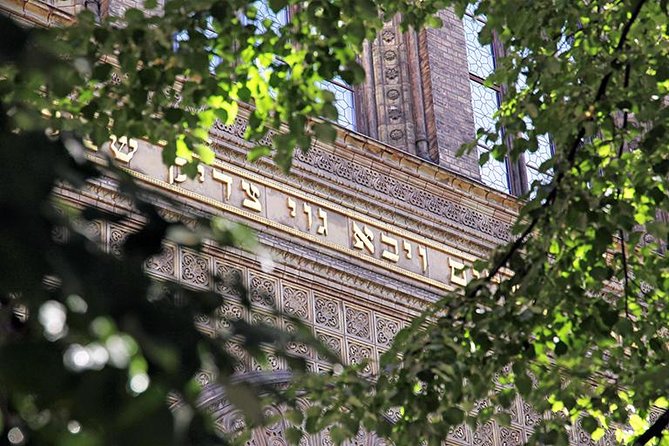
You then pause at the Stiftung Neue Synagoge Berlin, also called the Centrum Judaicum. Again, the guide explains the site rather than taking the group inside, and the listed stop lasts about five minutes.
The combination of these two locations gives the early part of the tour a needed focus on Jewish life in Berlin. The tour then carries that story forward to what happened when Nazi policy moved from discrimination to organized deportation and murder.
Do not expect long indoor visits here. These are short outdoor explanations, so you should treat them as orientation points rather than museum stops. If you want extended time at either site, plan to return independently after the walk.
Anhalter Bahnhof and the reality of deportation
The ruins of Anhalter Bahnhof are one of the tour’s most affecting locations. The station once served as a major Berlin transport hub. During the Nazi period, many Jewish residents were deported from Berlin to concentration camps through railway operations such as this.
The remains make the subject stark. You are looking at a fragment of a once-important station, not a polished exhibition built to explain the past. Your guide supplies the missing context, explaining how a familiar public place became part of the deportation process.
The stop is listed at about five minutes, but its importance is greater than its length suggests. A short explanation here can alter the way you see railway stations across Europe. They were not only places of travel. Under Nazi rule, they could become links in a system of forced removal.
This is also a good point to ask questions. Guides are expected to speak clear English, and the strongest ones make room for questions instead of rushing through prepared facts. Keep in mind that the tour’s schedule is fairly full, so longer discussions may not always be possible.
More walking tours in Berlin:
- Discover Berlin Half-Day Walking Tour
★ 5.0 · 9,624 reviews - Berlin: Discover Berlin Walking Tour
★ 4.9 · 5,998 reviews - Berlin: Hidden Backyards Guided Walking Tour
★ 4.8 · 5,360 reviews - Third Reich Berlin: Hitler and WWII Walking Tour
★ 5.0 · 3,301 reviews
The Topography of Terror and Nazi power
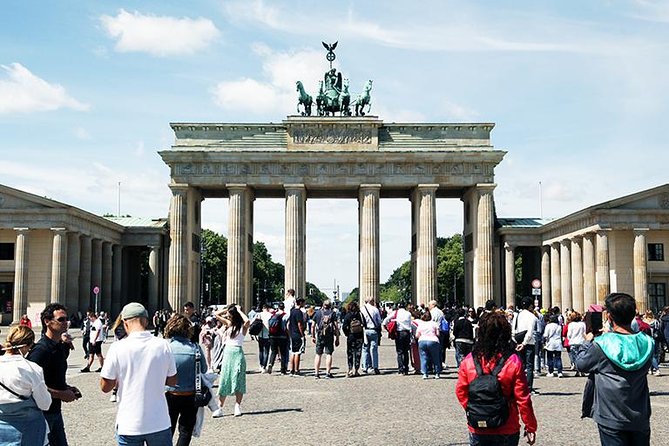
At the Topography of Terror, the group reaches the former SS and Gestapo headquarters on what was once Prinz-Albrecht-Strasse. The buildings themselves were largely destroyed, but the site now holds an important museum and outdoor documentation area.
The guide explains how the SS and Gestapo operated and how these institutions helped enforce Nazi rule. This is one of the most useful stops because it shifts the story from ideology to administration. Terror required offices, police structures, files, orders, interrogations, and people willing to carry out those orders.
The listed stop lasts about 15 minutes, longer than most of the outdoor explanations. Admission is free, but this tour does not present itself as a full museum visit. You should expect a guided look at the site and its meaning, not enough time to read every panel or see every display in detail.
If you want to study the Topography of Terror properly, return later with more time. The walking tour gives you a strong introduction and places the museum in the larger route. That is a practical advantage, since you will already understand why the location matters.
The former Aviation Ministry
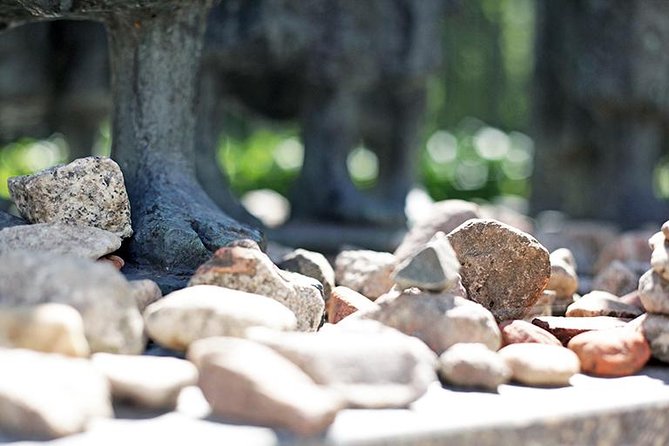
The next major stop is the former Ministry of Aviation, described during the walk as the headquarters connected with the German Luftwaffe, or air force. Your guide discusses Nazi rule and its consequences for Jewish people and for Sinti and Roma communities.
The building is a reminder that dictatorship was not limited to party offices or police headquarters. Government ministries, military bodies, and civil institutions all formed part of the state that pursued war and persecution. The location lets your guide explain how policy moved from political language into government action.
The stop is scheduled for about ten minutes. This is enough time for a clear explanation, but not a full architectural or museum visit. The attraction here is the connection between the surviving building and the wider story, not an elaborate interior experience.
The route also helps you understand Berlin’s layered appearance. A building may survive while its original political purpose has changed completely. A good guide makes that contrast visible without turning the walk into a lecture on architecture.
Johann Georg Elser and the question of resistance
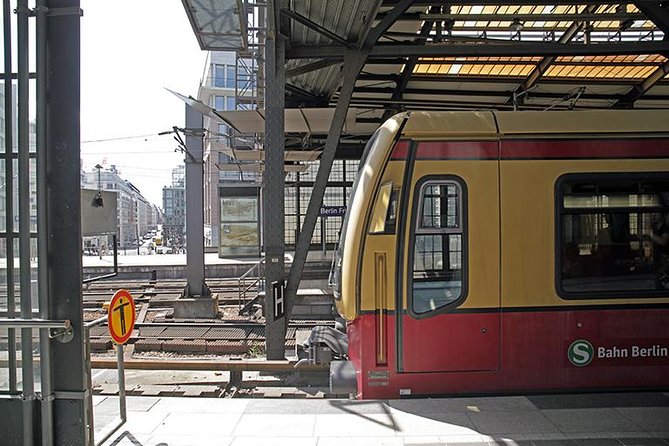
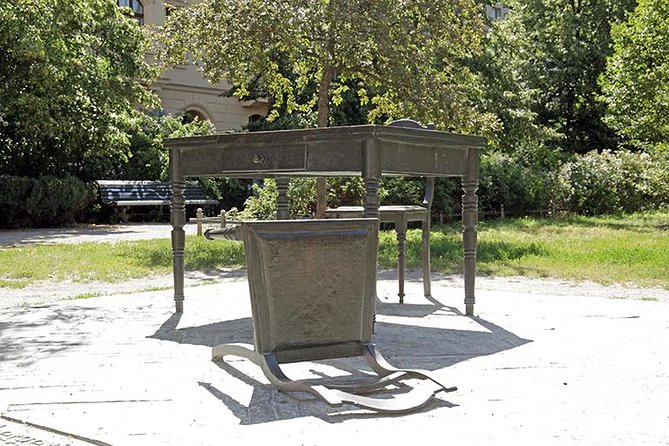
At the Johann Georg Elser Sculpture, the guide explains an attempt on Hitler’s life. Elser planned and carried out a 1939 bomb plot at the Bürgerbräukeller in Munich, and the memorial gives the walk a chance to discuss resistance to Hitler.
This is an important correction to the lazy idea that nobody opposed the Nazi regime. Resistance took different forms, carried different risks, and did not always succeed. The stop is brief, about five minutes, but it adds a personal face to the question of courage under dictatorship.
The sculpture also breaks the tour’s rhythm in a useful way. Much of the route deals with institutions and mass persecution. Here, the focus turns to one person making a decision to act. You may find this one of the most memorable stops because it raises difficult questions about timing, fear, responsibility, and the limits of individual action.
The Holocaust Memorial and other forms of remembrance
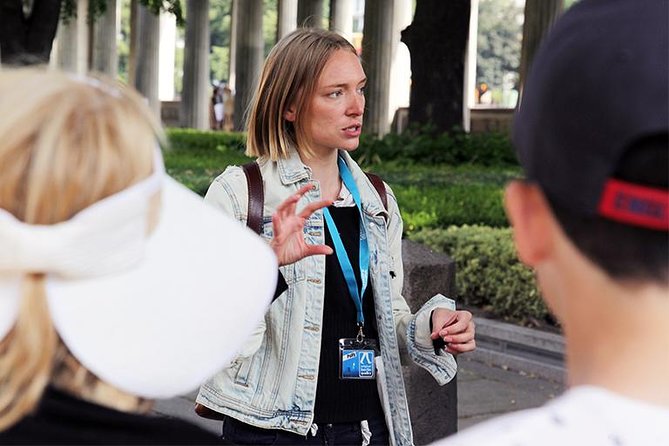
The Memorial to the Murdered Jews of Europe is one of Berlin’s best-known sites, but a guide can help you approach it with more care than a quick photo stop. The guide explains its purpose and history, then gives the group time to take in the arrangement of concrete blocks and the changing sense of space within it.
The tour also visits the Monument to Homosexuals Persecuted Under National Socialist Regime. This stop widens the story beyond the persecution of Jewish people. It shows that Nazi violence also targeted homosexual people and that remembrance in Berlin addresses several groups harmed by the regime.
The route’s attention to Jewish, Sinti and Roma, and LGBT history is one of its strongest features. You are not given a single, simplified account of suffering. Instead, the guide points to different policies, communities, and memorial practices.
These memorial stops can feel rushed if you want time for quiet reflection. The Holocaust Memorial is listed at about ten minutes, as is the monument to homosexuals persecuted under National Socialism. I would treat the tour as an introduction, then return on your own if you want to walk through the memorials without a group around you.
The Soviet Memorial in Tiergarten
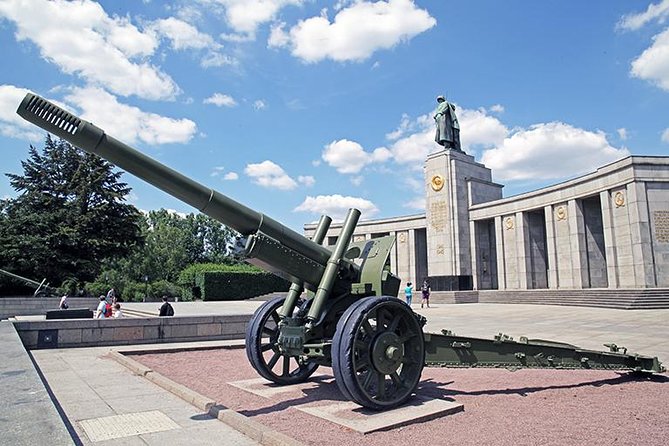
At the Soviet Memorial Tiergarten, the guide explains the history of the site. The memorial commemorates Soviet forces and connects the end of the war in Berlin with the military defeat of Nazi Germany.
This stop is valuable because it brings the route toward 1945. Until this point, much of the walk has focused on the construction and operation of Nazi power. The Soviet Memorial helps you consider the final military phase and the forces that reached Berlin.
It also adds another layer to the city’s memory. Berlin does not commemorate the war from only one national or political viewpoint. You see how the end of Nazism, the Soviet role in defeating Germany, and the city’s later history remain part of the public space.
The stop lasts about ten minutes. As with the other outdoor sites, your guide provides the essential context, but you should not expect a long formal ceremony or an extended museum visit.
Finishing at the Reichstag
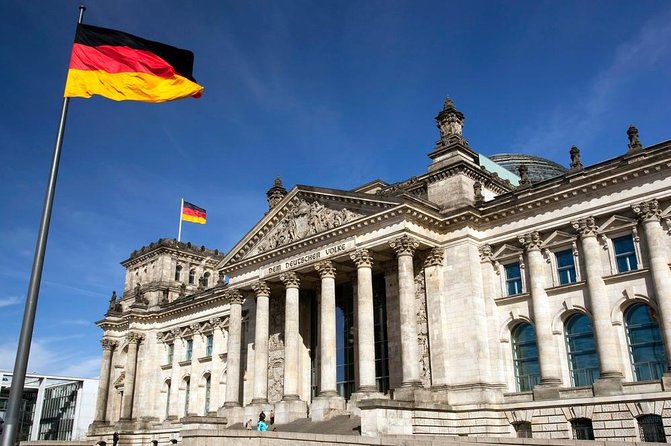
The tour ends outside the Reichstag Building at Platz der Republik, near the German parliament. This is a fitting finish. The Nazis came to power in 1933, and the final days of the war in Berlin unfolded around this area in 1945.
The Reichstag stop ties the whole route together. You begin by discussing the Nazi rise to power and finish at a building linked both to that political transformation and to the regime’s defeat. The contrast between dictatorship and present-day parliamentary Germany gives the final explanation real weight.
The tour ends outside the building, so do not assume that entry to the Reichstag is included. It is not listed as part of the experience. From here, you can continue exploring Berlin’s central sights, visit another museum, or pause for lunch without needing to cross the city.
The walking pace, group size, and practical details
This is a four-hour walking tour with a maximum group size of 25. That is not a private tour, but it is small enough for a guide to hear questions and keep the group together. Several guides are praised for clear voices, easy-to-follow explanations, and an ability to keep teenagers and adults interested at the same time.
Wear comfortable shoes. The route covers a lot of ground, and the repeated advice about footwear is worth taking seriously. The tour operates in all weather, so bring clothing suited to rain, cold, heat, or wind. There is no promise of shelter during every explanation.
Most people can participate, and service animals are allowed. The tour is near public transportation at the start, with the Reichstag area as the finish. Because the walk crosses several parts of central Berlin, the point is not merely to move between attractions. The distance helps you see how widely the Nazi capital was organized.
The tour is offered in English, and the guide is described as professional and fluent. Guide quality can vary by departure, but the named guides praised for this route include Peter, Glen, Rohan, Tom, Giles, Jimmy, Gregor, Paul, Eran, Scott, Anja, Hannah, Benjamin, Rebecca, James, Johnathan N, and Jonny. The repeated strengths are clear speaking, strong command of the subject, sensitivity, and a willingness to answer questions.
Is $21.77 good value?
At $21.77 per person, this is an inexpensive way to organize half a day around Berlin’s Nazi-era sites. You are paying mainly for the route and the guide’s interpretation, not for paid admissions. Every listed stop is free, and the AB Zone transport ticket, about €3.80, costs extra.
The value is strongest if you are new to Berlin or want a firm framework before visiting museums alone. A guide can help you avoid wasting time trying to piece together locations from scattered plaques and online maps. The four-hour length also leaves the afternoon open.
The value is weaker if you prefer to read every museum panel at your own pace or spend long periods in quiet reflection. This walk introduces many sites, but it cannot give each one a full hour. Think of it as a guided foundation, not a complete study of Nazi Berlin.
Who should book it?
I would choose this tour if you want a clear overview of Berlin between 1933 and 1945, especially if you have limited time. It suits first-time visitors, families with older teenagers, students, and anyone who wants to ask questions rather than listen to an audio guide.
It also suits people who want a broader account of persecution. The inclusion of Jewish, Sinti and Roma, and LGBT memorials makes the route more useful than a narrow military tour. The Johann Georg Elser stop adds resistance, while the Soviet Memorial and Reichstag bring the story to its end.
I would hesitate if four hours on foot sounds tiring or if you are looking for a light introduction to Berlin. The subject is painful, and the weather can affect the experience. You should also plan separate time for the Topography of Terror and any memorial you want to explore closely.
Final call
Book this walk if you want Berlin’s Third Reich sites explained as one connected story rather than as isolated addresses. Its strongest points are the well-planned route, the range of memorials, and guides who explain difficult material in clear, human terms.
Choose it early in your Berlin stay if possible. Then use the rest of your visit to return to the places that speak to you most. At this price, with a four-hour route and free cancellation up to 24 hours before the start, it is a sensible first step into one of the city’s most important subjects.
FAQ
Where does the Berlin Third Reich Sites walking tour begin?
The tour begins at Neue Promenade 3, 10178 Berlin, near Hackescher Markt S-Bahn station.
What time does the tour start?
The scheduled start time is 10:00 a.m.
Where does the tour end?
The walk ends outside the Reichstag Building at Platz der Republik 1, 11011 Berlin.
How long does the experience last?
The walking tour lasts approximately four hours.
Is the tour offered in English?
Yes. The tour is offered in English and includes a professional English-speaking guide.
Is public transportation included?
No. An AB Zone transport ticket is not included. You can buy one at the station near the meeting point for approximately €3.80 per person.
How large can the group be?
The tour can have a maximum of 25 travelers.
What happens if it rains?
The tour operates in all weather conditions, so you should dress appropriately for the forecast.
More Half-Day in Berlin
- Potsdam Half-Day Walking Tour from Berlin
★ 4.5 · 398 reviews - Berlin Private Half-Day Walking Tour: Discover the German Capital’s History
★ 5.0 · 244 reviews - From Berlin: Potsdam Half-Day Guided Tour
★ 4.6 · 167 reviews - From Berlin: Potsdam Half-Day Tour in Spanish
★ 4.6 · 135 reviews
Just added around Berlin
- Berlin Highlights in One Day★ 5.0 · 3 reviews
- Private Berlin One Day Tour with a Local: See the City Unscripted★ 3.5 · 3 reviews
- Individual city tour Berlin for max. 8 persons★ 5.0 · 3 reviews
- Transfer from Berlin Schönefeld Airport (SXF) to Berlin city Hotels – ROUND TRIP★ 4.0 · 3 reviews
- Berlin: Museum Island Tour★ 5.0 · 3 reviews
- Private Analogue Photography Experience in Berlin★ 5.0 · 3 reviews
- Berlin: Local Food Tour in Secrets Hidden Gems★ 4.0 · 3 reviews
- Berlin & The Third Reich Private Guided Tour★ 5.0 · 3 reviews
Third Reich & WWII Sites, compared.



Berlin’s Best: 2 Hour Walking Tour Third Reich and the Cold War
Read our review →
Third Reich Berlin: Hitler and WWII Walking Tour
Read our review →

Guided Bike Tour of the Berlin Wall and Third Reich
Read our review →
Hitler’s Germany: Berlin During the Third Reich & WWII
Read our review →
Private Walking Tour Berlin Third Reich Hitler and World War II
Read our review →Browse the lists this tour appears in