
Review · HISTORICAL TOURS
Berlin Private Complete History All Day Walking Tour
Berlin’s history is not tucked away in one museum. It is written across streets, empty lots, memorials, grand squares, and buildings that survived war and dictatorship. This private walking tour follows that story from Brandenburg Gate to Alexanderplatz, linking Prussian Berlin, Nazi rule, the Cold War, and reunification in one long day.
I like the private format, which gives you one guide’s full attention and lets you ask questions without waiting for a group to catch up. I also like the route’s range: you see famous sights such as Checkpoint Charlie and Museum Island, but also pause at quieter, more difficult places such as the Führerbunker site and the Johann Georg Elser sculpture.
The main drawback is simple: six hours on foot is a serious outing. One account put the distance at about 5.5 miles, and although the pace can be adjusted, this tour will suit you best if you are comfortable walking for most of a day.
In This Review
- Key points to know before booking
- Why this Berlin walk works as a first-day orientation
- Brandenburg Gate and the Reichstag: symbols of a changing capital
- Tiergarten, the Soviet Memorial, and the Victory Column
- The Holocaust Memorial and the Führerbunker site
- Resistance, Nazi administration, and the Topography of Terror
- The Berlin Wall and Checkpoint Charlie
- Friedrichstrasse, Gendarmenmarkt, and Bebelplatz
- Unter den Linden and Museum Island
- Humboldt Forum, St. Mary’s Church, and Alexanderplatz
- What the private price gets you
- Pace, comfort, and the best type of participant
- Should you book this Berlin history tour?
- FAQ
- How long is the Berlin Private Complete History All Day Walking Tour?
- Is this a private tour?
- Where does the tour start and finish?
- Is transportation included?
- What language is the tour offered in?
- What is included in the price?
Key points to know before booking
- A full six-hour route: You cover 22 stops, moving from the government quarter through Nazi and Cold War Berlin to Alexanderplatz.
- Private attention: Only your group takes part, so the guide can answer questions and adjust the pace.
- Strong World War II focus: The Reichstag, Führerbunker site, Topography of Terror, Holocaust Memorial, and Bebelplatz receive careful attention.
- No sightseeing vehicle: Pickup is on foot, and private transportation is not included.
- English-speaking guides: Guides named in guest feedback include Ciaran, Rhys, Paul, Beth, Darren, Eugen, Ken, Francisco, and Julian.
- Good first-day choice: The route helps you decide which museums and memorials deserve more of your time later.
Why this Berlin walk works as a first-day orientation
The tour begins at Ebertstraße, near the Brandenburg Gate, and finishes at Alexanderplatz. That eastward route makes practical sense. Instead of spending your first day zigzagging around central Berlin, you cross a large portion of Mitte in a logical line.
You will see the city as a series of political layers. Prussian royal power appears in the grand buildings along Unter den Linden. Nazi history comes into view through sites of government, terror, resistance, and destruction. Later, the Wall and Alexanderplatz show how East Germany reshaped the capital after the war.
The private setup matters here. Berlin’s history is full of dates, names, changing borders, and competing interpretations. A good guide can pause when you want more detail, move along when your attention fades, or adjust the conversation for a mixed-age group. Paul, Rhys, Ciaran, and Beth are specifically praised in the supplied feedback for clear explanations, flexibility, and an ability to tailor the day.
You should not expect a museum-style visit at every stop. Much of the tour takes place outdoors, and several locations are viewed from the street or from a nearby public space. The value comes from having someone explain what you are seeing and how each place fits into Berlin’s story.
More walking tours in Berlin:
- Discover Berlin Half-Day Walking Tour
★ 5.0 · 9,624 reviews - Berlin: Third Reich and Cold War 2 Hour Walking Tour
★ 4.9 · 6,830 reviews - Berlin: Discover Berlin Walking Tour
★ 4.9 · 5,998 reviews
Brandenburg Gate and the Reichstag: symbols of a changing capital
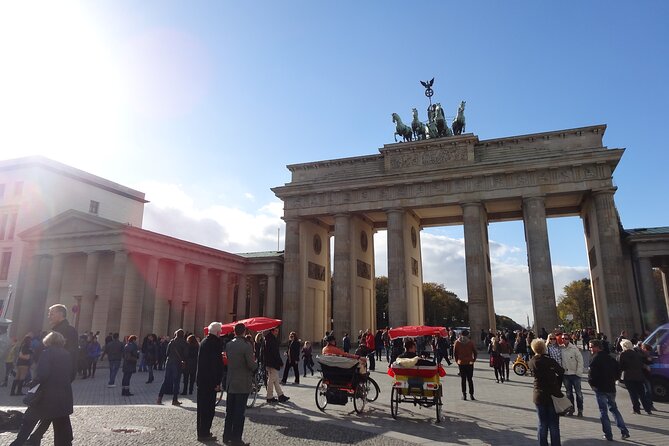
At Brandenburg Gate, your guide explains why the gate was built and how its meaning changed as Germany changed around it. It began as a royal entrance, later became a symbol of Nazi ceremony, and then represented divided Berlin during the Cold War before taking on a new role in reunited Germany.
Allow time for photographs here. The gate is one of those places that can feel familiar from pictures, yet its location becomes more striking when you understand the political lines that once ran through this part of the city.
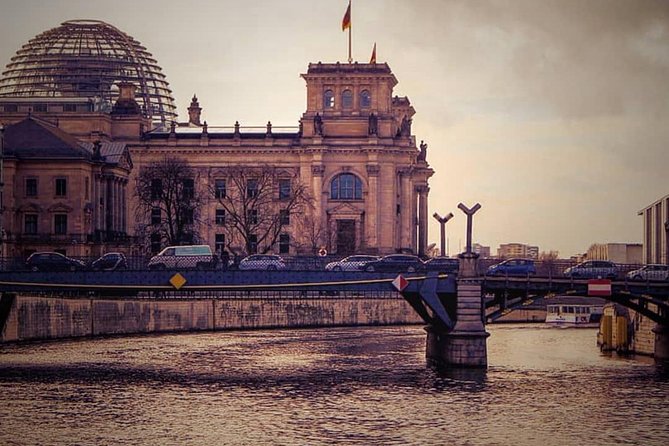
A short walk brings you to the Reichstag Building. You will hear about the Hohenzollern era, the building’s role in the early Nazi dictatorship, the fierce fighting during the Soviet capture of Berlin, and its later place in reunified Germany.
The stop is brief, so this is an introduction rather than an interior visit. If you want to enter the Reichstag or see its glass dome, ask about that separately when planning your Berlin days. The tour’s strength here is context, not admission access.
Tiergarten, the Soviet Memorial, and the Victory Column
The route then passes through part of Tiergarten, Berlin’s large central park. Your guide connects the park’s development from medieval hunting ground to public green space with the city’s later upheavals.
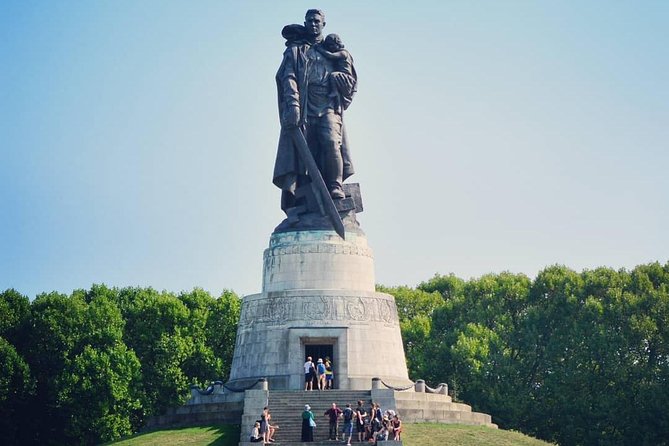
The Soviet Memorial Tiergarten is especially unusual. It was built in West Berlin after the war, making it a reminder that Soviet military memory existed even on the western side of the divided city. The discussion includes the surprising source of its building materials, along with the memorial’s symbols and controversies.
You view the Victory Column from a distance rather than climbing it. That keeps the stop short, but your guide explains why it was built and where it originally stood. The column’s relocation is a useful reminder that Berlin’s monuments have often been moved, repurposed, or given new meanings by later governments.
These early stops are a good warm-up for the day. You get open space, major landmarks, and a little room to absorb information before the route turns toward the most painful chapters of Berlin’s past.
The Holocaust Memorial and the Führerbunker site
The Memorial to the Murdered Jews of Europe is one of Berlin’s most important places for quiet reflection. The field of concrete slabs changes as you walk through it, and the experience is intentionally open to personal response.
Your guide can provide the historical setting, but this is a stop where you should allow yourself some silence. It is not a place for a rushed lecture or casual sightseeing. The memorial is free to enter, though the main outdoor field is the focus of this walk.
Nearby, the former Führerbunker site is marked by something far less dramatic: an ordinary parking area. There is no grand ruin to inspect. That plainness is part of the point, since the site is not presented as a shrine.
The guide explains where Hitler spent his final days and what happened during the collapse of Nazi Germany. This can be an emotionally heavy part of the walk, but it helps correct the false idea that Nazi history exists only in monumental buildings. Some of the most important locations are now ordinary spaces with only modest signs.
More history walks in Berlin:
- Berlin: Natural History Museum Entrance Ticket
★ 4.6 · 3,382 reviews - Berlin: World Heritage Cruise to Potsdam
★ 4.5 · 1,435 reviews - Berlin Historical Highlights Walking Tour
★ 4.9 · 657 reviews - Berlin: Historic Boat Sightseeing City Center Tour
★ 4.5 · 415 reviews
Resistance, Nazi administration, and the Topography of Terror
The Johann Georg Elser sculpture introduces one of the lesser-known stories on the route. Elser attempted to kill Hitler and came painfully close to changing the course of European history. His story gives the tour a human focus beyond military leaders and heads of state.
You then see the former Aviation Ministry, a large building that has remained in continuous use since 1936. Its survival allows the guide to explain how a structure from the Nazi period continued into later chapters of German government.
The Topography of Terror is one of the most substantial stops. The site once held the headquarters of the SS, Gestapo, and SD. Here you examine how the Nazi state organized persecution and terror, then consider what happened to the location after the war.
The center is an important place to revisit on your own if you have time. On the walking tour, you enter the site and receive an explanation, but the six-hour route cannot replace a careful museum visit. If modern European history is your main reason for coming to Berlin, plan a separate visit so you can read the displays at your own pace.
The Berlin Wall and Checkpoint Charlie
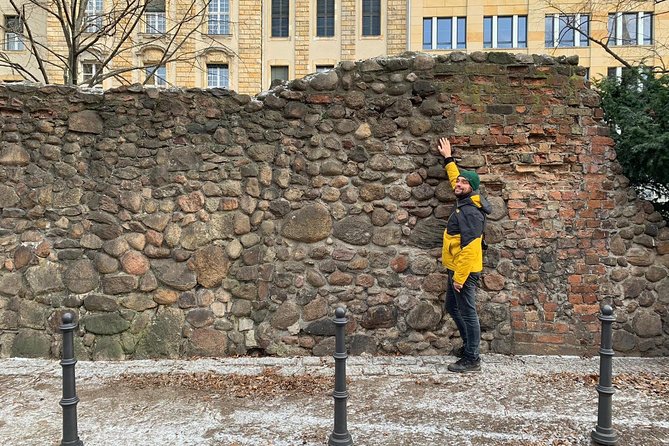
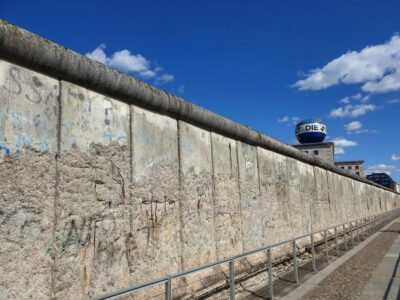
The route next shifts from Nazi dictatorship to the Cold War. At a remaining section of the Berlin Wall, your guide explains why it was built, when it went up, and how it divided families, neighborhoods, and daily life.
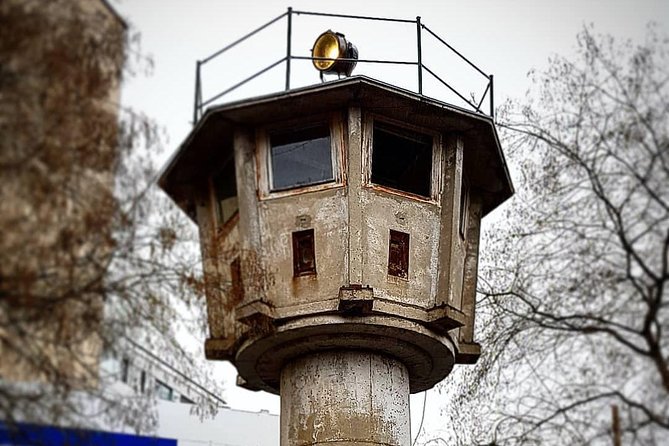
Stories of escape attempts and deaths make this stop more than a quick photograph. The Wall was not just a concrete barrier. It was a system of fences, watch points, patrols, and restricted zones, and the human cost is easier to grasp when you hear individual stories.
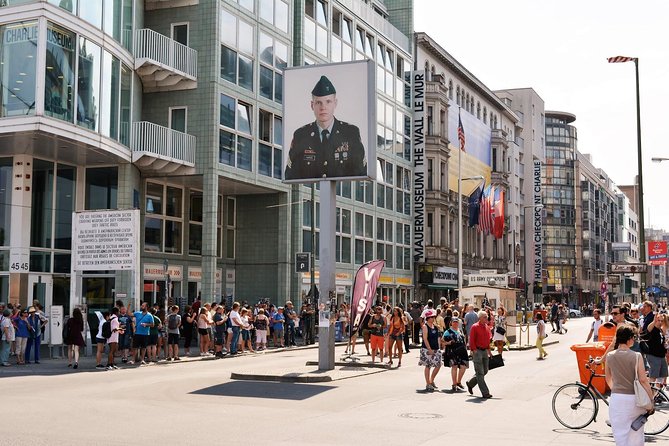
Checkpoint Charlie is the famous name, but it is also one of the most commercialized places on the route. You will see the iconic checkpoint location and hear why it mattered during the Cold War. Expect crowds, photo stops, and modern businesses nearby.
That contrast is useful. Berlin does not preserve every historic site in a quiet or polished setting. Some places are surrounded by tourism, advertising, and traffic. A guide helps separate the real Cold War importance from the postcard image.
Friedrichstrasse, Gendarmenmarkt, and Bebelplatz
A stroll down Friedrichstrasse brings another change of mood. Once known as Berlin’s Cabaret Mile, the street reflects the city’s long connection with entertainment, commerce, and urban life. It also gives your feet a brief change from memorials and political history.
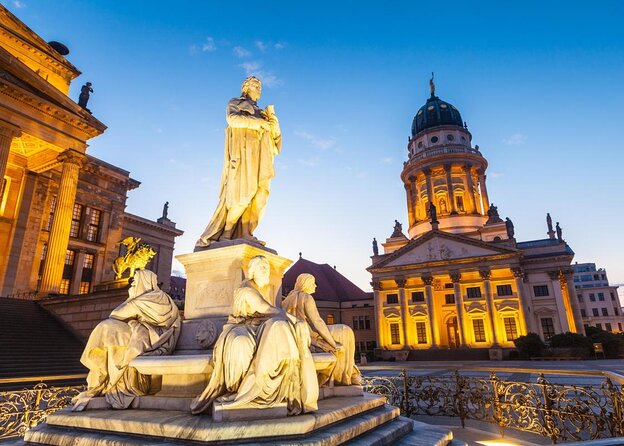
Gendarmenmarkt is one of central Berlin’s most handsome squares. Your guide explains how it began and how its churches, concert hall, and surrounding buildings developed into a unified architectural setting.
At Bebelplatz, the architecture is beautiful, but the history is grim. The square is surrounded by St. Hedwig’s Cathedral, Humboldt University’s law faculty, and the State Opera House. It was also the site of a major Nazi book burning.
The memorial beneath the square is easy to miss if you do not know where to look. Your guide points it out and explains its meaning, giving the place a useful lesson in how Berlin remembers wrongdoing without turning every memorial into a giant monument.
Unter den Linden and Museum Island
Humboldt University adds a different thread to the route. You hear about the university, its building, and the Humboldt family. The stop helps explain why Berlin became an important center of learning as well as government and military power.
At Neue Wache, you enter one of the most moving buildings on Unter den Linden. Its meaning has changed with each political era, making it a kind of memorial record of Germany’s shifting ideas about war, sacrifice, and mourning.
The Deutsches Historisches Museum is discussed from outside. Its building is the oldest surviving structure on Unter den Linden, and the stop gives you a reason to return if you want a larger chronological view of German history.
Museum Island is a UNESCO World Heritage site, and the guide explains how the island developed, which museums occupy it, and how the cathedral and other major buildings were designed. You see the museums from the outside rather than taking a full collection visit.
That is both an advantage and a limitation. You cover more ground, but you cannot study the Pergamon Museum, Bode Museum, or other collections in detail during this walk. Use the tour to choose where to spend a later half-day.
Humboldt Forum, St. Mary’s Church, and Alexanderplatz
The Humboldt Forum brings the route into present-day Berlin. Its story is complicated and surprisingly recent, so your guide can explain how the building fits into the city’s efforts to address monarchy, war, reconstruction, and cultural collections.
St. Mary’s Church is another welcome change of scale. It is described as Berlin’s oldest church still in continuous use and a fortunate survivor of the city’s destruction. If possible, you go inside, though access can depend on conditions at the time.
The walk finishes at Alexanderplatz, rebuilt after the war as a major center of the German Democratic Republic. The square looks very different from the royal and imperial spaces earlier in the day. That contrast makes it a fitting endpoint: Berlin’s story does not stop with the Wall, but the Cold War left a strong mark on the city’s appearance.
Because Alexanderplatz is well connected by public transportation, it is a practical place to finish. You can continue sightseeing, find food, or return to your accommodation without arranging a private transfer.
What the private price gets you
The listed cost is $253.95 per person, with group discounts available. That is not a low-cost walking tour, but the comparison should be with a private guide, not with a large group outing.
You are paying for about six hours of one guide’s time, a route covering 22 locations, and the ability to shape the conversation around your group. If you are traveling with several people, a group discount can improve the per-person value. For a couple, the price is harder to justify unless Berlin’s political history is a major priority.
The tour includes an expert guide and visits to the historical sites. Food and drinks are not included, and no vehicle is used. Build in a meal or coffee break yourself. One account describes a lunch break, but treat that as something to discuss with your guide rather than a guaranteed inclusion.
The route is offered in English. Pickup means meeting your guide on foot, not being collected in a car or minibus. Confirmation arrives when you book, and free cancellation is available until 24 hours before the start time. Changes or cancellations inside that window are not refunded.
Pace, comfort, and the best type of participant
This is a private activity, so only your group takes part. The guide can walk at the group’s pace, and several accounts describe the experience as flexible and unhurried.
Still, do not mistake flexible pacing for an easy stroll. Twenty-two stops spread across central Berlin require stamina. Wear comfortable shoes, take water, and think carefully about the weather. The tour permits service animals and pets, and most people can participate, but the long distance remains the key practical issue.
I would recommend it most strongly to:
- First-time visitors who want a clear map of central Berlin
- Couples, families, and small groups who prefer conversation over a scripted group tour
- People with a strong interest in World War II and Cold War history
- Visitors who have only one full day to see the major central sights
- Groups with mixed ages, since the guide can adjust detail and pace
The tour is less suitable if you want long indoor museum visits, a short easy walk, or a tour focused mainly on art and food. It is also not the best choice if you prefer to explore each memorial silently and independently.
Should you book this Berlin history tour?
Book it if you want Berlin’s major sights explained as one connected story. The strongest part of the experience is not simply reaching Brandenburg Gate, Checkpoint Charlie, or Museum Island. It is understanding how those places relate to the city’s political changes.
The consistently high rating, 99 percent recommendation figure, and 5 out of 5 score from 474 ratings support the tour’s appeal, especially for guide quality and historical depth. Names such as Ciaran, Rhys, Paul, Beth, and Darren appear in particularly strong feedback, with praise for clear explanations, humor, patience, and the ability to answer difficult questions.
My practical advice is to book this near the start of your Berlin visit, when its broad route can help you choose later museum visits. Bring good shoes, keep lunch flexible, and tell the guide what interests you before setting off.
If you can comfortably walk about 5.5 miles and want serious historical context, this private day is a strong use of your time. If you mainly want a quick introduction or low-cost transportation between sights, choose a shorter group tour instead.
FAQ
How long is the Berlin Private Complete History All Day Walking Tour?
The tour lasts approximately six hours.
Is this a private tour?
Yes. Only your group participates, and the guide can adjust the pace and discussion to your interests.
Where does the tour start and finish?
The listed starting point is Ebertstraße 24, 10117 Berlin, near Brandenburg Gate. The tour ends at Alexanderplatz, 10178 Berlin.
Is transportation included?
No. This is a walking tour, and private transportation is not included. Pickup takes place on foot with the guide.
What language is the tour offered in?
The tour is offered in English.
What is included in the price?
The price includes the expert tour guide and visits to the listed historical sites. Food and drinks are not included.
More Full-Day in Berlin
- Private Full-Day Tour to Meissen and Dresden from Berlin
★ 5.0 · 5 reviews
Just added around Berlin
- Berlin Highlights in One Day★ 5.0 · 3 reviews
- Private Berlin One Day Tour with a Local: See the City Unscripted★ 3.5 · 3 reviews
- Individual city tour Berlin for max. 8 persons★ 5.0 · 3 reviews
- Transfer from Berlin Schönefeld Airport (SXF) to Berlin city Hotels – ROUND TRIP★ 4.0 · 3 reviews
- Berlin: Museum Island Tour★ 5.0 · 3 reviews
- Private Analogue Photography Experience in Berlin★ 5.0 · 3 reviews
- Berlin: Local Food Tour in Secrets Hidden Gems★ 4.0 · 3 reviews
- Berlin & The Third Reich Private Guided Tour★ 5.0 · 3 reviews
Historical Tours, compared.



Small group Potsdam: A Journey Through History and Palaces
Read our review →
Berlin Private Half-Day Walking Tour: Discover the German Capital’s History
Read our review →Browse the lists this tour appears in