
Review · TOURS
Dark Berlin Criminal Tour
Berlin’s grand boulevards and royal buildings tell only half the story. This two-hour walk follows the city’s rougher trail, from a 1931 double shooting near the Volksbühne to gang crime, prostitution, stolen goods, police work, and Berlin’s first banking scandal.
I like the tour’s original locations and its mix of grim and absurd stories. I also like that it goes beyond famous monuments, showing how everyday streets around Alexanderplatz and the Scheunenviertel became tied to crime, politics, law, and scandal. The main drawback is that the tour is non-refundable, and it can be canceled if the weather is poor or too few people book.
In This Review
- Key points before you book
- Why Berlin’s criminal past makes a good walking tour
- Start at Rosa-Luxemburg-Platz and the Volksbühne
- Walk into the Scheunenviertel’s rougher past
- Alexanderplatz and the gang that frightened Berlin
- Alexa and a vanished building with a famous past
- Littenstraße, the courts, and a famous defense attorney
- Finish at Rotes Rathaus and Berlin’s first banking scandal
- What the $18.52 price really gives you
- Timing, tickets, and weather concerns
- Who will enjoy this walk most
- Should you book Dark Berlin Criminal Tour?
- FAQ
- Where does the Dark Berlin Criminal Tour start?
- Where does the tour end?
- What time does the tour begin?
- How long does the tour last?
- How many people can join the tour?
- Can I cancel or change my booking?
Key points before you book
- A two-hour walk through old Berlin: The route covers six stops between Rosa-Luxemburg-Platz and Rotes Rathaus.
- Crime tied to real places: You visit locations connected with police killings, gangs, legal battles, and a major banking scandal.
- A certified guide leads the walk: Expect historical explanation, strange details, comedy, and darker stories rather than a simple list of crimes.
- Small enough to stay manageable: The group limit is 25 people, useful on narrow city streets and during spoken storytelling.
- Good value at $18.52: The price is modest for a guided look at several central Berlin districts and their past.
- Plan for the conditions: The tour starts at 2 pm, uses a mobile ticket, and requires good weather.
Why Berlin’s criminal past makes a good walking tour
The best city walks connect the past to places you can still see. This tour does that by using streets and squares in central Berlin rather than keeping the stories inside a museum. You are not only hearing that crime existed in Berlin. You are learning how it took root in working-class districts, public squares, courtrooms, shopping areas, and government centers.
The time span runs from the late 19th century to the present day, with much of the route focused on the early 20th century and the years between the wars. That period gives the walk plenty to work with. Berlin was growing fast, social conditions were hard, police methods were changing, and organized crime made money through protection rackets, prostitution, and stolen goods.
I like this broad approach because it keeps the tour from becoming a parade of sensational crimes. A good guide can show how crime connects to city life. You hear about victims and suspects, but also about police work, lawyers, politicians, business, and the people who simply lived nearby.
The tone is not relentlessly grim. The route includes violence, death, betrayal, greed, and passion, but it also includes bizarre details and comic moments. That balance matters. Two hours of murder and corruption would grow heavy. The lighter stories give you room to breathe.
The tour has a 4.2 rating from five published ratings, with three five-star comments praising the unusual city stories, the link between each tale and its location, and the guide’s friendly manner. One particularly useful point is that the walk can still offer something new to people familiar with Berlin. You do not need to be a first-time visitor to get value from it.
Other Berlin tours people book alongside this one:
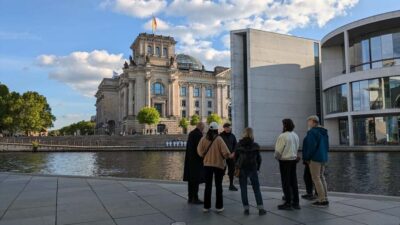
- Berlin: Reichstag, Dome and Government District Guided Tour
★ 4.7 · 18,288 reviews - Berlin: 1-Hour City Tour by Boat with Guaranteed Seating
★ 4.3 · 16,993 reviews - Berlin: Boat Tour Along the River Spree
★ 4.4 · 11,252 reviews
Start at Rosa-Luxemburg-Platz and the Volksbühne
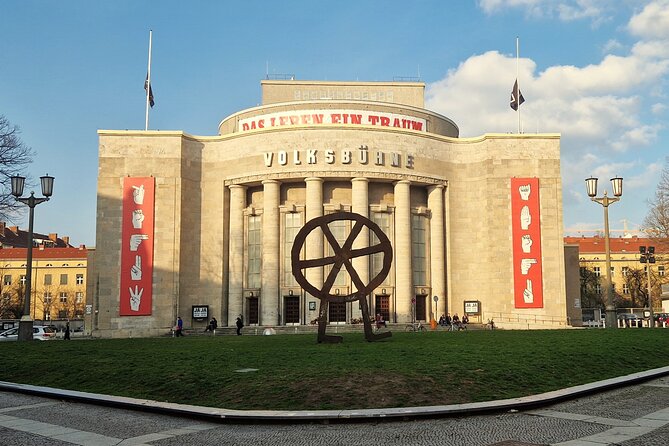
The walk begins at Rosa-Luxemburg-Platz 1/U at 2 pm. The first stop is the Volksbühne Berlin, where a gruesome crime took place on August 9, 1931.
Two police officers were shot here by two men, one of whom later became the Minister for State Security of the German Democratic Republic. The tour uses the crime to explain the background and events that led to the shooting. That political connection makes the story more than a police case. It points toward the unstable and violent political climate of Berlin in the early 1930s.
The stop itself lasts about five minutes, with free admission. Do not expect to enter a paid attraction. The value comes from standing at the place and hearing why it mattered.
The Volksbühne also gives the tour a useful opening setting. It is a well-known cultural building, yet the story attached to it is anything but polished theater history. That contrast is typical of this walk. A familiar public place becomes the scene of a crime that is easy to miss if you are only looking at architecture.
Walk into the Scheunenviertel’s rougher past
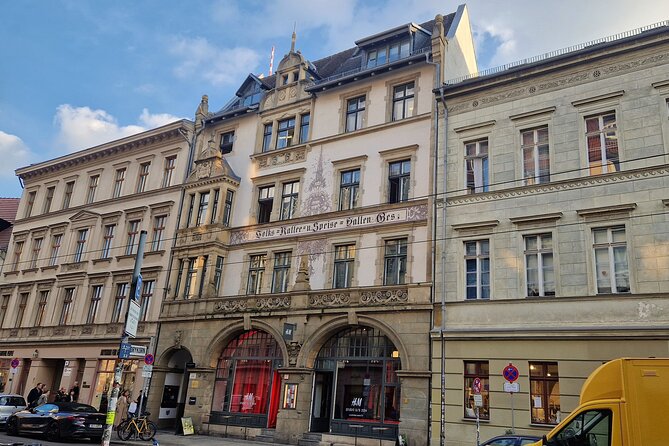
The next stop is the Scheunenviertel, with about ten minutes devoted to the area. In the 1920s, this part of Berlin was associated with factory workers, office employees, prostitutes, pimps, and criminals.
The description of the district is deliberately crowded with different types of people. Workers came home tired from their shifts. Office managers wore worn clothes. People stopped for a beer. Prostitutes worked the streets, while crooks and pimps looked for opportunities.
That mix helps you picture the area as a lived-in neighborhood rather than a crime set. Poverty and ordinary work sat beside nightlife and illegal trade. The tour’s focus on protection money, prostitution, and receiving stolen goods fits naturally here.
This may be the most atmospheric section of the walk, though atmosphere depends on your guide and your own imagination. Modern Berlin has changed greatly, so you will not see the district exactly as it appeared in the 1920s. Instead, you use the present street plan as a frame for stories about people who once worked, drank, schemed, and struggled here.
I would listen closely during this section. The facts about organized crime matter, but the small social details may stay with you longer: clothing, work hours, neighborhood habits, and the uneasy closeness of respectable and criminal life.
Alexanderplatz and the gang that frightened Berlin
Alexanderplatz is the next major stop. Berliners call it Alex, and the tour explains how the square got its name before turning to a more threatening chapter.
You hear about a gang of young people that terrorized the city during the war years. The story shifts the focus from professional criminal networks to youth crime and public fear. That change keeps the route varied.
Alexanderplatz is also a useful place to discuss how a public square can collect many different roles. It may serve as a transport hub, meeting place, shopping area, and stage for political or criminal activity. The tour does not treat Alex as just a famous Berlin landmark. It asks what kind of people used the square and what dangers could follow them home.
The stop lasts about five minutes. That is enough for a sharp story, but not enough for a long lecture on every era of Alexanderplatz. If you enjoy social history, this part should appeal to you. If you want extensive architectural detail, this is not that kind of tour.
A different side of Berlin on the same trip:
- Discover Berlin Half-Day Walking Tour
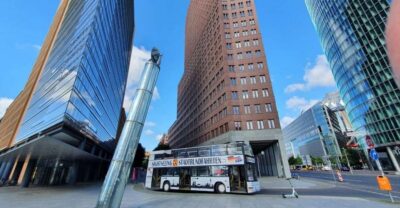
★ 5.0 · 9,624 reviews - Berlin: Hop-on Hop-off Bus Tour with Live Commentary
★ 4.3 · 8,579 reviews - Berlin: Government District around the Reichstag Guided Tour
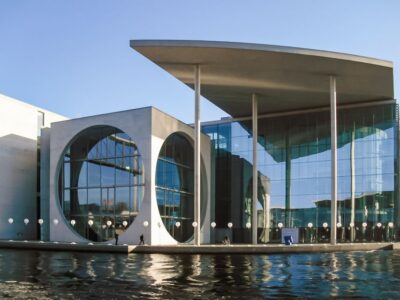
★ 4.7 · 8,447 reviews - Berlin: Reichstag, Plenary Chamber, Cupola & Government Tour
★ 4.6 · 8,422 reviews
Alexa and a vanished building with a famous past
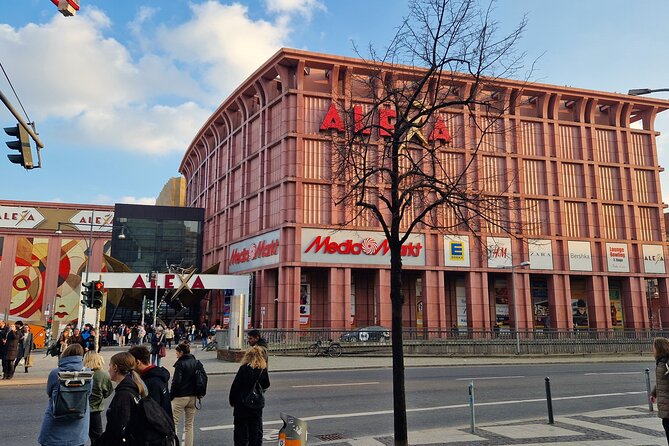
The walk continues to Alexa, now a shopping center where people shop and spend time. The interesting question here is what stood on the site before the war and why that earlier building earned world fame and high regard.
This is one of the route’s more surprising transitions. A modern retail center does not immediately suggest police history or criminal intrigue. That is precisely why the stop works. It shows how quickly Berlin’s physical appearance can change and how easily important older stories disappear beneath new construction.
The supplied details do not identify the earlier building, so you should not book this stop expecting a specific museum visit or an interior tour. The point is the guide’s explanation at the site. You get a short piece of urban memory, linked to a place many people now know only as a shopping center.
At roughly five minutes, Alexa is another compact stop. The walk keeps moving instead of asking you to spend a long time at each location. That pace suits people who prefer a flowing city walk to a series of formal talks.
Littenstraße, the courts, and a famous defense attorney

Littenstraße brings the tour to the Berlin Mitte district court. The legal angle gives the route a needed counterweight to stories about criminals and victims.
Here you learn about one of Berlin’s best-known defense attorneys of the 1920s. The story also includes Lola, whose connection is presented as part of the lawyer’s personal or professional world. The wording of the tour leaves some of that detail for the guide to reveal, which adds a little suspense but makes it hard to know in advance exactly how much legal history you will receive.
This stop should interest you if you want to see how Berlin’s justice system handled the city’s criminal underworld. A crime story is never only about what happened on the street. It also involves courtroom strategy, public reputation, legal rights, and the people willing to defend unpopular clients.
The district court remains an active civic setting, so treat this as an exterior storytelling stop rather than a courthouse tour. It lasts about five minutes and has no admission charge.
I like the placement of this section late in the route. After hearing about street crime and gang fear, you get a look at the formal system built to respond. It also helps explain how Berlin’s criminal police gained international fame, a major theme of the wider walk.
Finish at Rotes Rathaus and Berlin’s first banking scandal
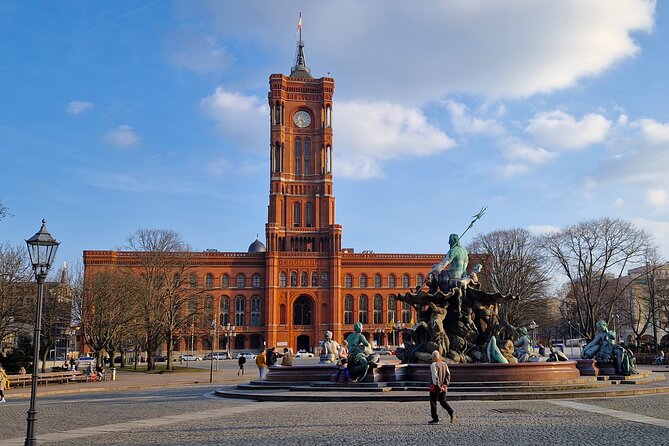
The tour ends at Rotes Rathaus, Berlin’s Red City Hall. The meeting point is at the entrance with direct underground access, making the finish practical for continuing your afternoon.
The final story concerns Berlin’s first banking scandal in the 1920s. The mayor was involved, and the guide explains the background. After shootings, prostitution, gangs, and stolen goods, the walk closes with financial crime and political responsibility.
That ending broadens the meaning of criminal history. Crime is not limited to alleys or street gangs. It can also involve institutions, money, influence, and people in public office. The setting outside city hall makes the point neatly.
The final stop lasts about five minutes, but it may be one of the most memorable because of the contrast between the respectable civic building and the scandal attached to it. Once the tour ends, you can use the nearby underground or continue exploring central Berlin on foot.
The listed stop times add up to about 35 minutes, so the rest of the two-hour experience is spent walking between locations and hearing the connecting stories. Wear comfortable shoes and expect a steady urban walk rather than long periods standing in one place.
What the $18.52 price really gives you
At $18.52 per person, this is a low-cost guided activity for central Berlin. You are paying mainly for the guide’s storytelling and the route design, not for museum admission. Every listed stop has free admission, and the tour uses public streets and squares.
That makes the experience a good value if you enjoy history told on location. You get six stops, a certified guide, about two hours of context, and a route that links several central neighborhoods. The cost is also modest enough to fit alongside paid museums and major attractions.
The value depends on how much you enjoy spoken history. If you want grand interiors, exhibits, or dramatic objects from Berlin’s criminal past, this walk may feel light. If you like learning why an ordinary-looking place matters, the price is easier to justify.
The group limit is 25 people. That is not a private tour, but it is more manageable than a huge city group. You should still position yourself where you can hear the guide, especially at busy public squares.
Timing, tickets, and weather concerns
The start time is 2 pm, which works well if you want a slower morning or an earlier museum visit. It also places the tour in the middle of your sightseeing day, so check your plans before booking.
A mobile ticket is provided, and confirmation arrives when you book. The route is near public transportation at both ends, with the start at Rosa-Luxemburg-Platz and the finish at Rotes Rathaus.
Most people can participate, but the tour is an outdoor walk. The experience requires good weather. If poor weather forces cancellation, you are offered another date or a full refund.
The stricter point is the cancellation policy. Your booking is non-refundable and cannot be changed for any reason. If you have uncertain plans, this is not a flexible activity to reserve casually. Book it when you are confident you can attend, and check the forecast as the date approaches.
The tour also requires a minimum number of participants. If that minimum is not met, you receive an alternative date or experience, or a full refund.
Who will enjoy this walk most
I would recommend Dark Berlin Criminal Tour to you if you like city history with a human edge. It suits visitors who want to understand how neighborhoods worked, how organized crime made money, and how police and courts responded.
It is also a good choice for repeat visitors. The route moves away from Berlin’s most polished sights and uses familiar places in a different way. Even if you already know Alexanderplatz, you may not know the criminal stories attached to it.
The tour can work for people who prefer a mix of dark and funny material. It is not presented as nonstop horror. Expect violence and death, but also strange details and moments of amusement.
You may want to skip it if you dislike outdoor walking, need a flexible cancellation option, or prefer detailed museum displays to oral storytelling. The stop times are short, so the tour favors a brisk sequence of stories over lengthy discussion at one location.
The small published review sample gives useful clues about the experience’s strongest points. The comments repeatedly praise the interesting facts, the clear connection between stories and places, and a friendly, capable guide. One German comment says the tour added something even for real Berliners, while another notes that the two hours passed quickly. Those are exactly the qualities I would look for in a city walk: strong pacing, a pleasant guide, and information that changes how you see the street.
Should you book Dark Berlin Criminal Tour?
Book it if you want an inexpensive, location-based history walk that shows Berlin away from its grandest image. The route has enough variety to keep two hours moving, from a police shooting and working-class Scheunenviertel to Alexanderplatz gangs, a famous attorney, and a mayor-linked banking scandal.
The tour is not a substitute for a museum about Berlin crime, and the short stops mean you will not study each site in depth. Still, at $18.52, it offers a practical way to add unusual context to central Berlin.
I would book this for an afternoon when the weather looks sound, your plans are firm, and you are curious about the city’s rougher underside. Bring comfortable shoes, keep your mobile ticket ready, and stay near the guide at the public squares. If that sounds like your kind of sightseeing, this walk earns its place in a Berlin itinerary.
FAQ
Where does the Dark Berlin Criminal Tour start?
The tour starts at Rosa-Luxemburg-Platz 1/U in Berlin, Germany.
Where does the tour end?
It ends at Rotes Rathaus, at the entrance with direct access to the underground.
What time does the tour begin?
The scheduled start time is 2 pm.
How long does the tour last?
The walking tour lasts approximately two hours.
How many people can join the tour?
The maximum group size is 25 travelers.
Can I cancel or change my booking?
No. The experience is non-refundable and cannot be changed for any reason. If poor weather or an insufficient minimum number of participants causes the provider to cancel, you are offered another date or experience, or a full refund.
Just added around Berlin
- Berlin Highlights in One Day★ 5.0 · 3 reviews
- Private Berlin One Day Tour with a Local: See the City Unscripted★ 3.5 · 3 reviews
- Individual city tour Berlin for max. 8 persons★ 5.0 · 3 reviews
- Transfer from Berlin Schönefeld Airport (SXF) to Berlin city Hotels – ROUND TRIP★ 4.0 · 3 reviews
- Berlin: Museum Island Tour★ 5.0 · 3 reviews
- Private Analogue Photography Experience in Berlin★ 5.0 · 3 reviews
- Berlin: Local Food Tour in Secrets Hidden Gems★ 4.0 · 3 reviews
- Potsdam Highlights – Private sightseeing tour by minibus★ 5.0 · 3 reviews
Tours, compared.
Reichstag, Dome and Government District Guided Tour
Read our review →
1-Hour City Tour by Boat with Guaranteed Seating
Read our review →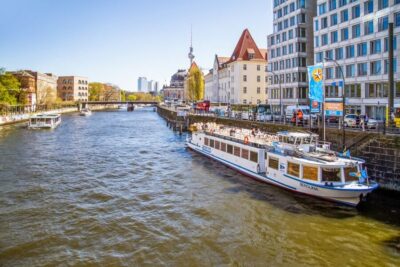

Reichstag, Plenary Chamber, Cupola & Government Tour
Read our review →