
Review · BERLIN
Explore Berlin: See All The Iconic Sights & Some Hidden Gems
Berlin’s story comes into sharp focus on this walk. In a few hours, you move from the Palace of Tears and Museum Island to Checkpoint Charlie, Hitler’s former bunker site, the Holocaust Memorial, and Brandenburg Gate. The route links beautiful buildings with places tied to war, dictatorship, division, and reunification.
I like two things right away. First, the tour puts Nazi and Cold War history in the same physical space, so you can see how one period shaped the next. Second, guides such as Joseph, Klaus, Tina, Hannah, Jimmy, Paul, and Rohan are praised for clear explanations, humor, personal insight, and a willingness to answer questions. The main drawback is pace: three hours, about three miles, and more than 20 stops leave little time for photographs or extended visits.
In This Review
- Key points to know before booking
- Why this route works for a first look at Berlin
- Starting at Friedrichstrasse and the Palace of Tears
- From memorials to Museum Island
- Bebelplatz and the memory of Nazi book burning
- Gendarmenmarkt and the road to Checkpoint Charlie
- The Berlin Wall at the Topography of Terror
- Hitler’s bunker and the Holocaust Memorial
- Brandenburg Gate and the Reichstag quarter
- The guides make or break the experience
- Three hours, $24.07, and the real value
- Who should book this Berlin walk
- Should you book it?
- FAQ
- How long is the Berlin walking tour?
- What is the price?
- What language is the tour offered in?
- Where does the tour begin?
- Where does the tour end?
- Is entry to the museums included?
- Does the tour enter the Reichstag?
- How large can the group be?
- Can I cancel for a full refund?
Key points to know before booking
- The route covers Berlin’s major central sights: Brandenburg Gate, the Reichstag area, Checkpoint Charlie, Bebelplatz, Gendarmenmarkt, Museum Island, and the Holocaust Memorial.
- The focus is historical rather than interior sightseeing: museum and church visits are viewed from outside, and admission is not included.
- Expect a brisk walk: one review describes roughly three miles, with short stops at many locations.
- The strongest material concerns the Third Reich and Cold War: you hear about Hitler’s bunker, Nazi book burning, the Berlin Wall, and the division of Germany.
- Guide quality matters: Joseph, Klaus, Tina, Hannah, Jimmy, Paul, Rohan, Jef, Giles, Ru, and others are praised for clarity and engaging storytelling.
- The group can contain up to 25 people: arrive 15 minutes early and confirm the exact meeting point before setting out.
Why this route works for a first look at Berlin
Berlin can be hard to read. Important sites are spread across a large central area, and many of the most meaningful places are not grand buildings. A parking lot can mark a bunker. A line in the pavement can show where the Wall once ran. A quiet square can recall a public crime.
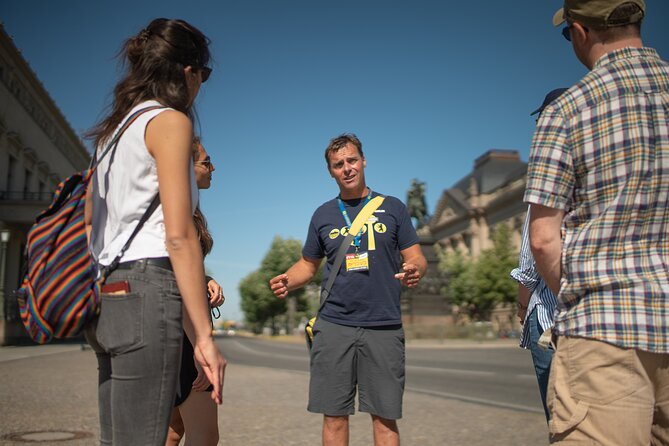
This walk helps you connect those fragments. You get architecture, political history, and personal stories in one moving lesson. The guide explains not just what a building is, but how it was used and why it matters.
The tour is also useful at the start of a Berlin stay. You will pass places you may want to revisit later, including the Holocaust Memorial, the Topography of Terror, Brandenburg Gate, and the museums of Museum Island. One practical advantage is that you can use the walk to decide which sites deserve more of your time.
Do not expect a museum tour. The listed stops are short, often five or ten minutes, and the main experience is listening outdoors while moving between locations. That format works well for orientation, but it is not ideal if you want long photo stops or detailed architectural study.
Other Berlin tours people book alongside this one:
- Berlin: Reichstag, Dome and Government District Guided Tour
★ 4.7 · 18,288 reviews - Berlin: 1-Hour City Tour by Boat with Guaranteed Seating
★ 4.3 · 16,993 reviews - Berlin: Boat Tour Along the River Spree
★ 4.4 · 11,252 reviews
Starting at Friedrichstrasse and the Palace of Tears
The published meeting information refers to the Friedrichstrasse station area and gives Reichstagufer 17 as the start address. Because both details appear in the booking information, I would check the map pin and meeting instructions carefully before the day of the tour. Arrive 15 minutes early, especially if you are unfamiliar with Berlin’s central train stations.
The first stop is the Palace of Tears, or Tränenpalast. This former border checkpoint handled departures between East and West Berlin. Its nickname came from the tearful goodbyes that took place there when people crossed the border.
The stop is brief, but it sets the tone. Berlin’s division was not just a matter of maps and military barriers. It affected families, visitors, commuters, and anyone trying to leave one side for the other.
From memorials to Museum Island
The walk continues to Neue Wache, a national memorial focused on war and tyranny. Its simple, solemn design gives the guide a natural place to explain how Germany remembers military violence and state crimes.
Nearby, Humboldt University adds another layer. Marx, Engels, and Einstein studied or taught here, making the site a useful reminder that Berlin’s intellectual life reaches far beyond its 20th-century disasters.
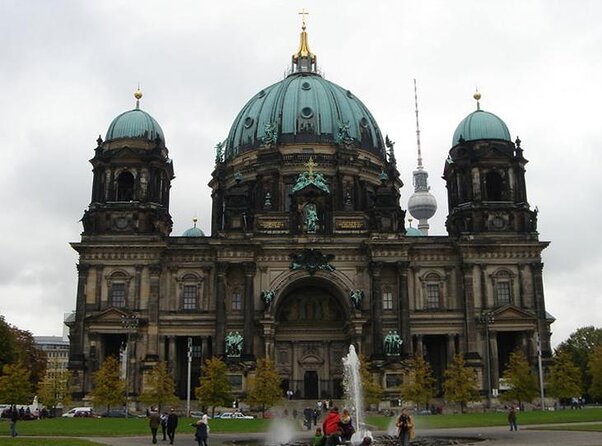
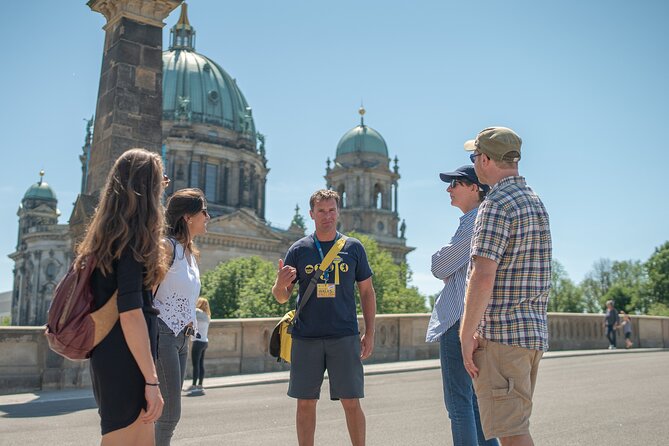
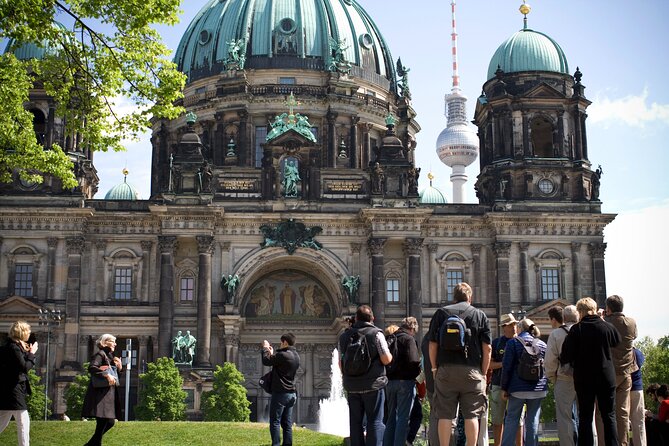
Then the route reaches Museum Island and the area around Berliner Dom, Lustgarten, the former City Palace, and the Humboldt Forum. Berliner Dom is Berlin’s largest church, while the reconstructed palace frontage and newer cultural buildings show the city’s ongoing argument with its own past.
You will also see the exteriors of the Pergamonmuseum, Neues Museum, and Altes Museum. The guide points out the major collections and buildings, including Islamic art, the Ishtar Gate, the Market Gate of Miletus, ancient Egyptian objects, and the work of architect Karl Schinkel.
This portion is especially useful if you have never visited Berlin. You get a quick map of the Museum Island complex and can return later with a ticket. Admission is not included, and the museums are not toured inside, so do not book this walk expecting access to their galleries.
The Humboldt Forum, housed in the reconstructed Hohenzollern palace, provides another talking point. You see how Berlin has rebuilt a lost royal building while trying to explain the complicated history connected with it. The contrast between old forms and new uses is one of the more interesting features of central Berlin.
Bebelplatz and the memory of Nazi book burning
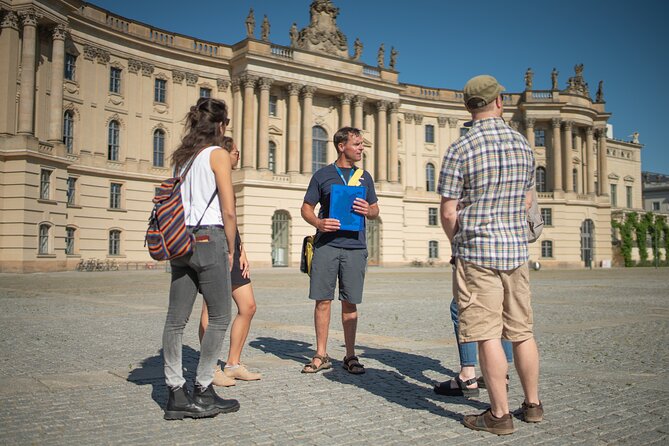
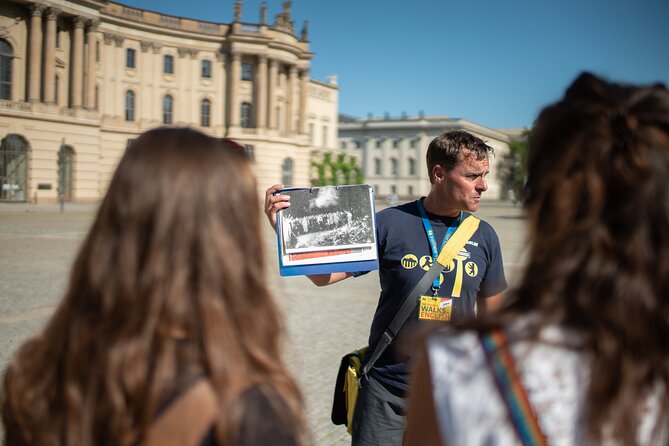
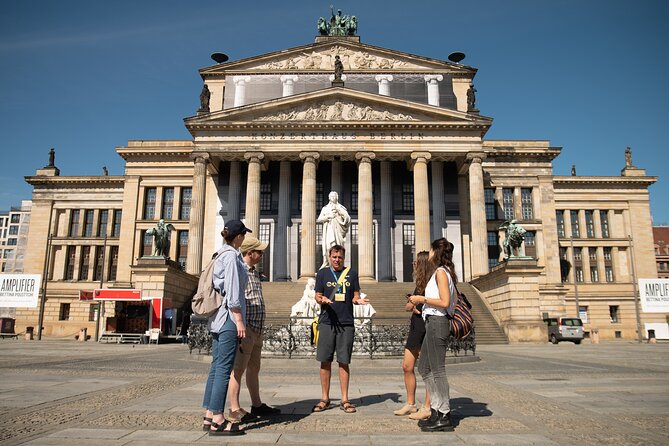
Bebelplatz is one of Berlin’s most beautiful squares, surrounded by landmarks from the Prussian period. The Staatsoper, built under Frederick the Great in 1743, and the Konzerthaus, completed in 1821, give the area a polished classical appearance.
That beauty makes the nearby Book Burning Memorial more affecting. In 1933, the Nazis burned tens of thousands of books here. The memorial is set below ground level, so you look down through a glass panel into an empty library.
The stop is short, but the guide’s explanation gives the square a second meaning. This is a good example of what the tour does best: it places a dark event directly beside grand architecture, showing that authoritarianism did not erase Berlin’s elegant public face. It operated within it.
A different side of Berlin on the same trip:
- Discover Berlin Half-Day Walking Tour
★ 5.0 · 9,624 reviews - Berlin: Hop-on Hop-off Bus Tour with Live Commentary
★ 4.3 · 8,579 reviews - Berlin: Government District around the Reichstag Guided Tour
★ 4.7 · 8,447 reviews - Berlin: Reichstag, Plenary Chamber, Cupola & Government Tour
★ 4.6 · 8,422 reviews
Gendarmenmarkt and the road to Checkpoint Charlie
Gendarmenmarkt brings you back to Berlin’s 18th and 19th-century city. The French Cathedral and German Cathedral face the square, reflecting a period of religious tolerance and the city’s mixed Protestant traditions.
The route then moves toward Checkpoint Charlie, the best-known crossing point between East and West Berlin during the Cold War. The checkpoint was used by civilians and military personnel, and it became the location of a tense tank confrontation between Soviet and American forces in 1961.
Checkpoint Charlie is one of Berlin’s most famous names, but the present-day setting can feel more commercial than historical. That is precisely why a guide helps. You need context to understand what the crossing meant before the Wall fell and why the site became such a powerful symbol.
You should also expect crowds and limited time for pictures here. The tour is designed to explain the place and keep moving, not to give you a long independent visit.
The Berlin Wall at the Topography of Terror
At the Topography of Terror, you see a roughly 200-meter section of the Berlin Wall. The location once sat beside the headquarters of the Gestapo and SS, so it connects the machinery of Nazi terror with the later division of the city.
That pairing is one of the most valuable parts of the route. Berlin’s history is not neatly divided into separate chapters. The same city center witnessed Nazi rule, wartime destruction, occupation, East German government, and the Cold War.
The nearby former Aviation Ministry adds another layer. The building served as Hermann Göring’s air force ministry, later became the East German house of ministers, and now houses the German Finance Ministry. The changing uses of the building show how political power can leave one government’s offices intact while the regime itself disappears.
Hitler’s bunker and the Holocaust Memorial
The stop at the Führerbunker is deliberately understated. You stand above the location where Hitler spent the final days of the Second World War, but there is no grand entrance or dramatic ruin to visit. The plain setting is part of the point. The site is treated as a place for explanation, not celebration.
A good guide can handle this subject with care. The strongest comments about the tour praise guides for making difficult material understandable, including explanations of the Holocaust that were described as especially moving. That kind of approach matters here. You need facts and context, not spectacle.
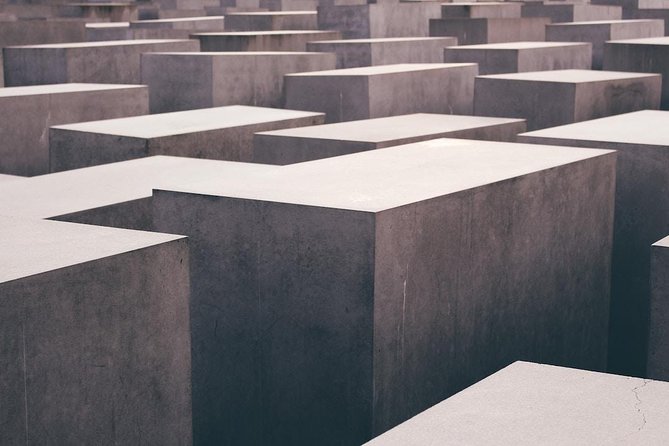
The next major stop is the Memorial to the Murdered Jews of Europe. Its field of concrete slabs creates a changing sense of scale as you walk among them. The memorial is open to the public, but this tour gives you only a short visit, so you may want to return later and spend more time there.
This is one place where the brisk format has a clear limit. Ten minutes can introduce the memorial, but it cannot replace a slower, personal visit or the underground information center. Still, seeing it with historical guidance helps you understand its place in Berlin’s central memorial zone.
Brandenburg Gate and the Reichstag quarter
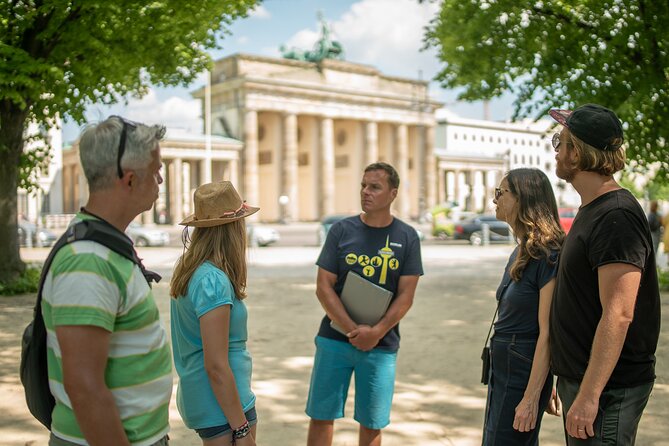
The walk finishes in the government quarter, with Brandenburg Gate and Pariser Platz as the final stops. You see the American and French embassies, Hotel Adlon, and the Academy of Fine Arts around the square.
Brandenburg Gate once symbolized division between East and West Berlin. Today it represents German unity and peace, making it one of the clearest examples of Berlin turning a symbol of separation into a national emblem.
The Reichstag Building, home of the German Parliament, is also part of the final government-quarter view. The information provided for this experience does not promise entry to the Reichstag or its dome. Treat it as an exterior sight near the end of the walk, not as a parliament visit.
The stated end point is Brandenburg Gate at Pariser Platz. That is a useful finish because you are left near several major sights and public transport connections. It also gives you a natural place to continue exploring on your own.
The guides make or break the experience
The tour uses different English-speaking guides, so the exact personality and delivery will vary. Names praised in the available feedback include Joseph, Klaus, Tina, Hannah, Jimmy, Paul, Rohan, Jef, Giles, Ru, Tom T, Pete F, Jasper, Brian, Georgia, Grayson, Artie, and Jorg.
The common strengths are clear speech, strong command of Berlin’s history, humor, patience, and openness to questions. Tina was noted for making several hundred years of history understandable while keeping the group on time. Jorg used personal anecdotes to make the past easier to relate to, while Jimmy was praised for being friendly, entertaining, and well informed.
There are also practical cautions. One person found the guide moved too quickly for photographs and became separated from the group. Another found the group too large and the guide too quiet when people had not gathered close enough.
You can reduce the risk by staying near the guide, asking for a repeat if you cannot hear, and taking photos during the planned pauses. A group of up to 25 is manageable, but it is not the same as a private walk.
Three hours, $24.07, and the real value
At $24.07 per person, this is a low-cost way to get a structured introduction to central Berlin. The value comes from the guide’s explanations and the efficient route, not from admissions or extended time at any one sight.
The tour covers a great deal for the price. You see major landmarks that would otherwise take careful map reading to connect, and you gain enough background to make later visits more rewarding. For a first day in Berlin, that is a strong deal.
The tradeoff is density. More than 20 stops in about three hours means some locations receive only five minutes. You will hear about the museums, but you will not explore them. You will see the Wall, but you will not spend a full afternoon at a Wall memorial. You will learn where the bunker was, but you will not enter it.
The walk is best for people who want a broad introduction and can keep moving. It may be tiring for older people or anyone who finds three miles difficult. One useful detail from the feedback is that guides may pause briefly during cold weather, but you should still dress for an outdoor walk.
Confirmation arrives when you book, service animals are allowed, and the route is near public transportation. Free cancellation is available until 24 hours before the start time. Cancellations or changes made less than 24 hours ahead are not refunded.
Who should book this Berlin walk
I would choose this tour if you are visiting Berlin for the first time, want a strong historical framework, or prefer learning from a local guide instead of reading plaques alone. It is also a good choice if you have only a short stay and want to see the central sights before choosing which ones deserve a longer visit.
Families with older children may find the route useful, especially if the children can manage the walking and serious subject matter. History fans will appreciate the links between the Nazi period and the Cold War, while architecture fans will enjoy the contrast between Museum Island, Bebelplatz, Gendarmenmarkt, and the government quarter.
I would skip it if your main goal is museum entry, quiet photography, or a slow architectural tour. You may also prefer a shorter option if a brisk three-hour walk is not comfortable.
Should you book it?
Book this walk for context, orientation, and value. It gives you Berlin’s major central sights in one route and explains why they matter, especially the places tied to Nazi rule, the Holocaust, and the Cold War.
Go in with realistic expectations. This is an outdoor overview with short stops, not a series of interior visits. Arrive early, verify the exact Friedrichstrasse meeting location, wear comfortable shoes, and plan to revisit the Holocaust Memorial, Wall sites, or museums that catch your attention.
FAQ
How long is the Berlin walking tour?
The tour lasts approximately three hours.
What is the price?
The listed price is $24.07 per person.
What language is the tour offered in?
The tour is offered in English with a local English-speaking guide.
Where does the tour begin?
The meeting information places the start in the Friedrichstrasse area and lists Reichstagufer 17, 10117 Berlin, Germany. Check the exact meeting instructions and map pin before arrival.
Where does the tour end?
The walk ends at Brandenburg Gate and Pariser Platz.
Is entry to the museums included?
No. The route passes the Pergamonmuseum, Neues Museum, and Altes Museum, but admission is not included.
Does the tour enter the Reichstag?
The experience includes the German Parliament and government quarter as sights near the end of the walk. Entry to the Reichstag is not stated as included.
How large can the group be?
The tour can have a maximum of 25 participants.
Can I cancel for a full refund?
Yes. You can cancel at least 24 hours before the start time for a full refund. Cancellations or changes made less than 24 hours before the experience are not refunded.
Just added around Berlin
- Berlin Highlights in One Day★ 5.0 · 3 reviews
- Private Berlin One Day Tour with a Local: See the City Unscripted★ 3.5 · 3 reviews
- Individual city tour Berlin for max. 8 persons★ 5.0 · 3 reviews
- Transfer from Berlin Schönefeld Airport (SXF) to Berlin city Hotels – ROUND TRIP★ 4.0 · 3 reviews
- Berlin: Museum Island Tour★ 5.0 · 3 reviews
- Private Analogue Photography Experience in Berlin★ 5.0 · 3 reviews
- Berlin: Local Food Tour in Secrets Hidden Gems★ 4.0 · 3 reviews
- Berlin & The Third Reich Private Guided Tour★ 5.0 · 3 reviews