
Review · BERLIN
The porcupine anniversary program: I still have a Tesla in Berlin
Berlin’s Die Stachelschweine cabaret turns a dark 2028 fantasy into a quick, musical attack on politics, debt, technology, and the city’s own habits. The plot imagines Chancellor Wagenknecht and Vice-Chancellor Pistorius trying to save Germany by selling off Berlin, while a famous electric-car developer and microblogging owner moves in.
I like the live, uncensored political satire and the way the show mixes music with sharp jokes rather than serving up a straight political lecture. I also like the compact two-hour format in a theater tucked beneath the Europacenter. The main catch is simple but important: the entire performance is in German, so you need strong German to follow the wordplay and political references.
In This Review
- Key points to know before you book
- Entering Die Stachelschweine beneath the Europacenter
- The 2028 crisis behind the comedy
- Pistorius’s budget-saving plan
- Berlin serenity meets black humor
- Three actors carrying a quick-moving script
- Why the German language matters so much
- Is $45 a fair price for two hours?
- Seating, access, and practical details
- Who should choose this cabaret?
- Should you book Ich hab’ noch einen Tesla in Berlin?
- FAQ
- Where does the performance take place?
- How long does the activity last?
- What language is the play performed in?
- Can I choose my exact seat?
- What do I receive with the booking?
- Do I need to exchange my voucher?
- Is the theater wheelchair accessible?
Key points to know before you book
- A 2028 Berlin gone wrong: The story uses national debt, high food prices, privatization, and Tesla ownership of major German car brands as comic fuel.
- Three named performers: Santina Maria Schrader, Mirja Henking, and Sebastian Stert appear in the anniversary production.
- Music with the satire: Luca Fazioli wrote the music, with arrangements by Martin Rosengarten.
- A basement theater in the Europacenter: The entrance is below the shopping complex, and the show finishes back at the theater.
- German is required: This is not a visual comedy where you can easily follow without the language.
- Two hours for $45: The price is reasonable for a live evening performance, especially if you value local theater and political humor.
Entering Die Stachelschweine beneath the Europacenter
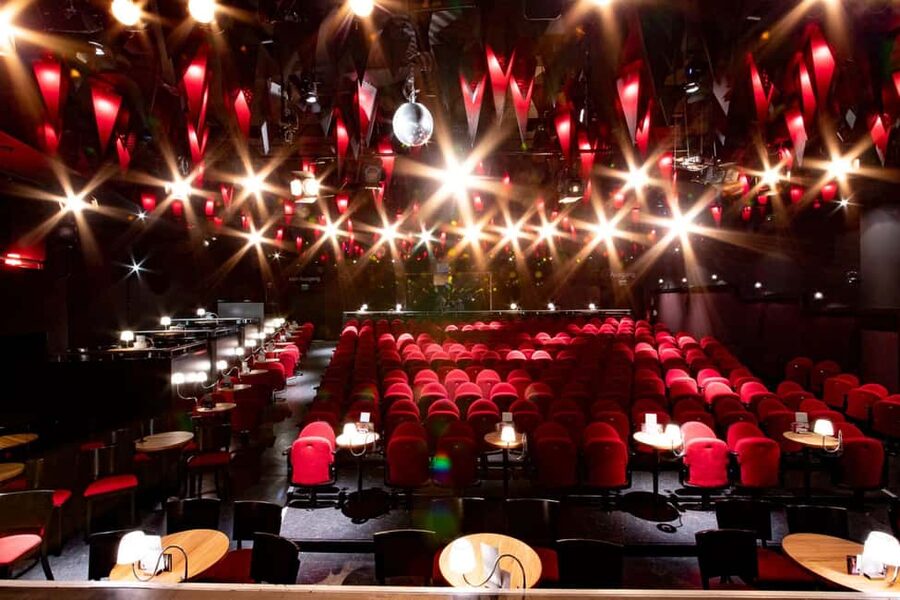
Your evening begins at the entrance to the theater in the basement of Berlin’s Europacenter. That setting tells you something about Die Stachelschweine before the curtain rises. This is not a grand opera house or a major concert hall. It is a cabaret venue built for close-up political comedy, where the performers can aim jokes directly at the room.
The theater is presented as Berlin’s first cabaret theater, and the anniversary production marks 75 years of STACHELSCHWEINE. That long run matters because cabaret in Germany is more than light entertainment. It often takes current politics, public frustration, and national contradictions and turns them into a fast-moving stage argument.
You receive a ticket for Ich hab’ noch einen Tesla in Berlin, with the seating category selected during booking. You do not choose the exact seat, so this is worth keeping in mind if sitting in a particular spot matters to you. Before the show starts, exchange your voucher at the box office. Allow enough time for that simple step instead of arriving at the last possible minute.
The activity lasts about two hours and ends where it begins. That makes it an easy add-on to an evening in central Berlin. You do not need to arrange transport between several venues, and there is no long tour route to manage after the performance.
Other Berlin tours people book alongside this one:
- Berlin: Reichstag, Dome and Government District Guided Tour
★ 4.7 · 18,288 reviews - Berlin: 1-Hour City Tour by Boat with Guaranteed Seating
★ 4.3 · 16,993 reviews - Berlin: Boat Tour Along the River Spree
★ 4.4 · 11,252 reviews
The 2028 crisis behind the comedy
The script opens its comic world in 2028, with Germany under heavy financial pressure. Chancellor Wagenknecht and Vice-Chancellor Pistorius face a national debt that keeps rising, while ordinary prices have become absurd. A cheese roll costs 14 euros, which is the kind of small detail that makes the larger crisis feel immediate.
The production piles on more trouble. BASF and Bayer have moved to Asia. Volkswagen and BMW belong to Tesla. Germany’s credit rating has fallen to BB, and half of the country’s taxes go toward interest payments.
You do not need to treat these details as a serious forecast. They are the raw material for political cabaret, where exaggeration helps expose real anxieties. The joke is not just that the future looks bad. It is that familiar political promises, economic fears, and corporate power can be pushed one step further until the whole system looks ridiculous.
That approach gives the show a useful rhythm. You get a recognizable Berlin and Germany, then a sudden turn into absurdity. If you enjoy satire that rewards attention to current affairs, the premise offers plenty to follow. If German politics is unfamiliar to you, some references may pass quickly.
Pistorius’s budget-saving plan
The central idea comes from Vice-Chancellor Pistorius. He calculates that Chancellor Wagenknecht could finance a long list of election promises with one sweeping program: retirement at 55, free public transport, and rent controls set at 1989 levels.
Those promises are intentionally bold. They touch three areas that can stir strong feelings in Germany and Berlin: work and retirement, the cost of getting around, and housing. By placing them inside a financial emergency, the script pokes at the gap between what politicians promise and what governments can actually pay for.
Then comes the secret plan. Berlin is to be sold off as Germany’s silverware. A major developer of electric cars and owner of a microblogging service responds at once. From there, the plot moves toward a familiar cabaret question: what could possibly go wrong?
The answer, naturally, is everything. That basic setup lets the actors move between political debate, farce, and social criticism without getting stuck in a single issue. The title’s Tesla reference is not just a technology joke. It points toward ownership, influence, privatization, and the uneasy idea that a capital city might be treated like a product.
Berlin serenity meets black humor
The show’s tone combines black humor with Berlin serenity. That balance is important. The material deals with national debt, corporate departures, downgraded credit, and the possible sale of the capital. A grim production could make those subjects feel heavy. Die Stachelschweine instead uses music, pace, and dry Berlin wit to keep the evening moving.
The comedy is described as fast-paced, topical, and subtle. Those words suggest a show that does not wait long between ideas. You should expect a steady flow of jokes and political turns rather than a slow character drama. The material may reward you more if you keep listening closely, since satire often depends on a phrase, a name, or a familiar public argument.
The performance also aims to be uncensored. That does not mean every joke will land for every person. Political comedy can be pointed, and the production’s purpose is to criticize public life rather than flatter it. I would choose this for an audience that enjoys a little friction and does not need every joke to be comfortable.
One audience response described the evening as both funny and thought-provoking, with the actors handling the material skillfully. That combination is the strongest reason to choose the show. You are not paying only for punchlines. You are getting a comic view of how political promises and economic panic can feed each other.
A different side of Berlin on the same trip:
- Discover Berlin Half-Day Walking Tour
★ 5.0 · 9,624 reviews - Berlin: Hop-on Hop-off Bus Tour with Live Commentary
★ 4.3 · 8,579 reviews - Berlin: Government District around the Reichstag Guided Tour
★ 4.7 · 8,447 reviews - Berlin: Reichstag, Plenary Chamber, Cupola & Government Tour
★ 4.6 · 8,422 reviews
Three actors carrying a quick-moving script
The anniversary program features Santina Maria Schrader, Mirja Henking, and Sebastian Stert. With three performers handling a politically crowded story, the production depends on timing, changes of voice, and the ability to shift between public figures, officials, and ordinary people caught in the crisis.
Frank Lüdecke and Sören Sieg wrote the program, and Lüdecke directs it. That shared connection between writing and direction can help a cabaret show keep its argument clear while still allowing room for comic turns. The material has many moving parts, from German finance to city policy to tech power, so pace matters.
Music comes from Luca Fazioli, with arrangements by Martin Rosengarten. The music is not an extra decoration added to a political talk. It is part of the program’s identity, helping break up spoken scenes and giving the evening a more varied shape.
You should not expect a museum lecture, a walking tour, or a staged historical drama. This is a performance built around actors speaking, singing, and pushing a current political premise toward absurd results. The appeal depends heavily on your taste for German cabaret and your ability to keep up with spoken German.
Why the German language matters so much
The language warning deserves more attention than it usually gets. The play is performed in German, and knowledge of German is required. That means you need more than basic phrases for ordering food or asking directions. Political satire often depends on speed, wordplay, names, double meanings, and small changes in tone.
If you understand German well, the show can offer a direct look at a local comic tradition. You hear Berlin and German politics handled from inside the language, rather than filtered through translation. That is a genuine strength for the right audience.
If your German is limited, you might still enjoy the music, acting, and visible energy, but you will miss much of the substance. This is not the best pick if you need subtitles or an English explanation. The supplied information does not indicate that translation or surtitles are available, so you should not count on them.
The political setting also assumes some familiarity with public figures and national debates. You do not need to know every detail of German government, but you will get more from the jokes if names such as Wagenknecht and Pistorius mean something to you.
Is $45 a fair price for two hours?
At $45 per person, the show sits in a sensible range for a two-hour live theater performance in central Berlin. The value depends on what you want from your night. If you are looking for a major sightseeing attraction with famous scenery, this will not fill that role. If you want a local cultural evening with actors, music, and political humor, the price is easier to justify.
The ticket includes admission to Ich hab’ noch einen Tesla in Berlin at Die Stachelschweine. You are paying for the performance itself, not transportation, food, or a broader Berlin tour. That keeps the arrangement clear, but you should plan any dinner or drinks separately.
A small group limit of six participants may make the booking feel more personal, although the show itself is a theater performance rather than a private presentation. The important benefit is the compact format. Two hours gives you a complete evening activity without taking over an entire day.
The free cancellation option up to 24 hours before the start also helps if your Berlin plans are still changing. You can reserve and pay later, which is useful when you are arranging several activities. Still, check the available start times before committing, since the schedule is not fixed in the information provided.
Seating, access, and practical details
You can choose a seating category, but not an exact seat. If you want a premium position or have a strong seating preference, pay attention to the category offered when you book. The voucher must be exchanged at the box office before the performance begins.
The theater is wheelchair accessible, which makes this a practical option for many people with mobility needs. The activity begins and ends at the theater entrance in the basement of the Europacenter, so the evening does not involve a complicated meeting point.
The small-group booking limit is six people. That is useful for couples, solo visitors, or a small circle of friends who want a straightforward cultural night. You are not joining a long coach excursion or a large city group.
Because the program is in German and the material is political, I would also plan for the language issue before considering the other details. Accessibility and central location help, but they cannot replace the ability to understand the show.
Who should choose this cabaret?
I would recommend this program to you if you enjoy political satire, German-language theater, and performances that react to present-day concerns. It suits people who want an evening with a distinctly Berlin character rather than a standard sightseeing stop.
It is also a good choice for visitors who already know some German politics. The imagined future uses recognizable names and public debates as its starting point, so your background knowledge can make the jokes land more sharply.
The production may suit you if you prefer a short, focused night out. Two hours is long enough for a full performance but short enough to fit around other plans in Berlin. The central Europacenter location also makes the meeting point easy to identify once you are in the complex.
I would not choose it for children unless they have strong German and already enjoy political comedy. I would also skip it if you want a quiet concert, a serious drama, or an English-language event. The show’s value comes from fast spoken humor and pointed commentary.
Should you book Ich hab’ noch einen Tesla in Berlin?
Book it if you understand German well and want to see how Berlin cabaret turns real political worries into sharp stage comedy. The anniversary setting, three named performers, music, and unusual 2028 plot give the evening more character than a generic comedy show.
Think twice if you need English support or prefer entertainment without political subjects. For the right audience, $45 buys two hours of live local theater with humor that aims to make you laugh and think. For everyone else, the language barrier may make the ticket poor value.
FAQ
Where does the performance take place?
The show takes place at Die Stachelschweine, with the entrance in the basement of the Europacenter in Berlin.
How long does the activity last?
The performance lasts about two hours.
What language is the play performed in?
The play is performed in German, and knowledge of German is required.
Can I choose my exact seat?
You can choose a seating category, but you cannot select the exact seat.
What do I receive with the booking?
You receive a ticket for Ich hab’ noch einen Tesla in Berlin at Die Stachelschweine.
Do I need to exchange my voucher?
Yes. Exchange your voucher at the box office before the performance begins.
Is the theater wheelchair accessible?
Yes, the activity is wheelchair accessible.
Just added around Berlin
- Berlin Highlights in One Day★ 5.0 · 3 reviews
- Private Berlin One Day Tour with a Local: See the City Unscripted★ 3.5 · 3 reviews
- Individual city tour Berlin for max. 8 persons★ 5.0 · 3 reviews
- Transfer from Berlin Schönefeld Airport (SXF) to Berlin city Hotels – ROUND TRIP★ 4.0 · 3 reviews
- Berlin: Museum Island Tour★ 5.0 · 3 reviews
- Private Analogue Photography Experience in Berlin★ 5.0 · 3 reviews
- Berlin: Local Food Tour in Secrets Hidden Gems★ 4.0 · 3 reviews
- Berlin & The Third Reich Private Guided Tour★ 5.0 · 3 reviews