
Review · TOURS
Rude Bastards tour of Berlin (CYHIT)
Berlin’s past is unusually concentrated in its streets, and this 3-hour-15-minute walking tour strings together the places that shaped modern Germany: the Brandenburg Gate, Hitler’s bunker site, the Holocaust Memorial, Checkpoint Charlie, the Berlin Wall, and Bebelplatz. Guides such as Alex, Kai, Arthur, Nicole, and Anna deliver the story with blunt humor and plain language rather than a formal lecture.
I like the small maximum of 10 people, which makes it easier to hear the guide and ask questions. I also like the planned 20-minute break at a Berlin shopping mall, a useful pause during a long walk. The main consideration is the tone: the jokes and strong language are part of the design, so this suits adults who enjoy irreverent comedy and can give serious memorials the respect they require.
In This Review
- Key points at a glance
- Berlin’s hardest stories, told without a classroom voice
- Starting at Potsdamer Platz
- Brandenburg Gate, Berlin’s great symbol
- The Holocaust Memorial and the weight of the site
- Hitler’s bunker site and the problem of empty places
- The Reichstag, Tiergarten, and the seat of power
- A 20-minute pause before the Cold War sites
- Checkpoint Charlie and the divided city
- Gendarmenmarkt, Bebelplatz, and the route’s final stretch
- Why the guide makes or breaks this walk
- Price, group size, and practical value
- Who should book this Berlin walking tour?
- Should you book the Rude Bastards tour?
- FAQ
- Where does the Rude Bastards Berlin tour begin?
- Where does the tour end?
- How long does the walking tour last?
- What language is the tour offered in?
- What major Berlin sights are included?
- Is there a break during the walk?
- How many people can join the tour?
- Can I cancel for a refund?
Key points at a glance
- Brandenburg Gate to Bebelplatz: The route links many of central Berlin’s key sights in one continuous walk.
- A sharp, informal style: Guides use jokes, plain speech, and occasional profanity alongside serious historical explanations.
- A long but manageable walk: The route lasts about 3 hours and 15 minutes, with a 20-minute break halfway through.
- Small groups: No more than 10 people are scheduled for each tour.
- Major Nazi and Cold War sites: You see the Holocaust Memorial, Hitler’s bunker location, Checkpoint Charlie, the Berlin Wall, and the Reichstag area.
- Very low advertised price: At $3.63 per person, the cost is remarkably small for a long guided walk, though you should confirm the current booking details before paying.
Berlin’s hardest stories, told without a classroom voice
The Rude Bastards tour takes a direct route through Berlin’s most important political and wartime sites. Instead of treating each monument as an isolated photo stop, the guide connects them: imperial Berlin, Nazi rule, the Second World War, Soviet occupation, the divided city, and reunification.
That approach matters because Berlin can feel scattered at first. A gate may look like a grand old monument, a vacant patch of ground may seem unremarkable, and a preserved section of wall may appear small. The guide’s job is to explain what happened there and why the place still matters.
The tone is deliberately casual. Alex is praised for making serious subjects feel real rather than scripted. Kai is described as funny and passionate about the subject, while Arthur brings plenty of energy and jokes. Nicole is especially good at shifting tone, using humor at the right moments and giving the solemn sites the space they need.
You should not expect a quiet, polished museum presentation. Expect real speech, colorful language, nicknames, banter, and a guide who may sound more like an entertaining friend than a professor. That can make difficult material easier to remember, but it will not suit every audience.
Other Berlin tours people book alongside this one:
- Berlin: Reichstag, Dome and Government District Guided Tour
★ 4.7 · 18,288 reviews - Berlin: 1-Hour City Tour by Boat with Guaranteed Seating
★ 4.3 · 16,993 reviews - Berlin: Boat Tour Along the River Spree
★ 4.4 · 11,252 reviews
Starting at Potsdamer Platz
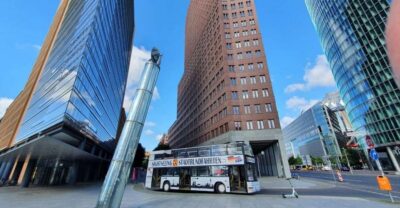
The walk begins at Potsdamer Platz, one of Berlin’s clearest examples of how the city changed after the Wall fell. This is a practical starting point because the route quickly moves from modern Berlin into the political center of the capital.
The opening section also takes in the Tiergarten, Berlin’s central park and one of Germany’s largest urban parks. It gives you a brief change of pace before the route reaches the heavier memorials and government buildings.
One listed stop is a WWII memorial honoring Soviet soldiers, with statues, tanks, and an obelisk. The memorial adds an important Soviet perspective to the war and helps explain why Berlin’s postwar story cannot be understood only through German or American history.
The exact order of every stop can vary with the guide and the pace of the group. The supplied route includes Potsdamer Platz, Tiergarten, the Soviet memorial, the Reichstag, Brandenburg Gate, the Jewish memorial, Hitler’s bunker site, the Luftwaffe headquarters, Checkpoint Charlie, the Berlin Wall, Gendarmenmarkt, Bebelplatz, and Museum Island.
Brandenburg Gate, Berlin’s great symbol
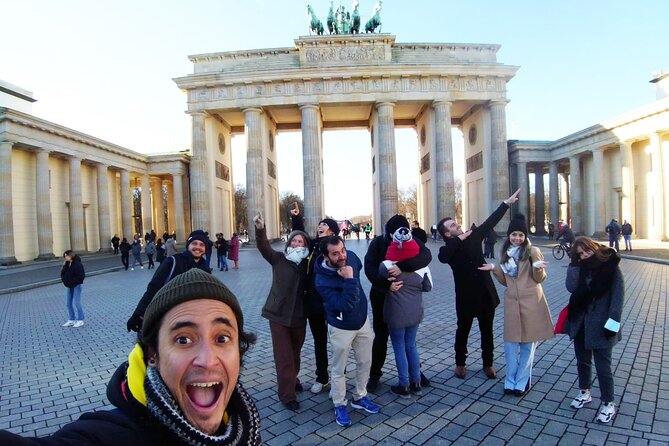
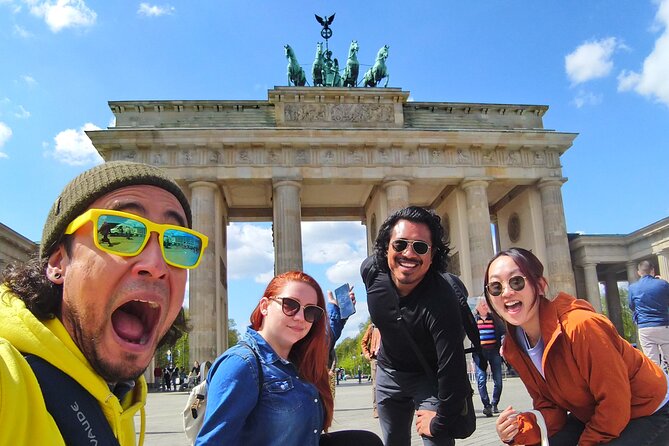
At Brandenburg Gate, you get the tour’s most instantly recognizable landmark. The gate once marked the main entrance to Berlin, but its meaning changed repeatedly as the city moved from Prussian capital to Nazi stage set, divided Cold War city, and reunified Germany.
The stop lasts about 15 minutes, with no admission charge. That is enough time for the guide to explain the gate and its political role while you take photographs and look along Unter den Linden.
I like this stop early in a Berlin orientation walk because it gives you a fixed point for the rest of your visit. From here, the surrounding streets lead toward the Reichstag, Bebelplatz, Museum Island, and other major sights.
Do not expect to go inside the gate or spend a long time exploring the surrounding buildings. This is a street-level explanation and photo stop, not an interior visit.
The Holocaust Memorial and the weight of the site
The Memorial to the Murdered Jews of Europe, often called the Holocaust Memorial, is one of the tour’s most serious moments. Its field of concrete blocks can feel confusing or unsettling, and that uncertainty is part of the place’s effect.
The scheduled stop is about 10 minutes, and admission is not included. The walking tour focuses on the outdoor memorial and its meaning rather than providing entry to an indoor exhibition.
This is one point where the guide’s judgment matters. The best delivery is not constant comedy. Nicole is specifically praised for knowing when to stop joking and hold space for serious conversation, and that balance is important here.
You may want extra time at the memorial after the tour. Ten minutes gives you the basic context, but it is short if you want to walk through the blocks slowly or visit any additional area on your own.
A different side of Berlin on the same trip:
- Discover Berlin Half-Day Walking Tour
★ 5.0 · 9,624 reviews - Berlin: Hop-on Hop-off Bus Tour with Live Commentary
★ 4.3 · 8,579 reviews - Berlin: Government District around the Reichstag Guided Tour
★ 4.7 · 8,447 reviews - Berlin: Reichstag, Plenary Chamber, Cupola & Government Tour
★ 4.6 · 8,422 reviews
Hitler’s bunker site and the problem of empty places
The Führerbunker stop is unusual because there is no grand ruin to visit. The location is associated with the bunker where Hitler spent the final three months of his life, but the visible site is not a dramatic underground attraction.
The stop lasts about 10 minutes and has no admission charge. The value comes from the explanation of what happened there and why the place is handled so cautiously today.
This is a good example of why a guide helps in Berlin. Without context, you might walk past an ordinary-looking area and miss its importance. With the story, the absence of a visible bunker becomes part of the lesson about memory, denial, and how cities deal with places linked to dictatorship.
The subject is grim, and the tour’s irreverent style needs to be handled carefully. The guides praised most highly manage to be funny around the subject without making the victims or the history into a joke.
The Reichstag, Tiergarten, and the seat of power
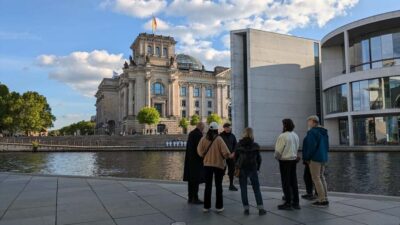
The route passes the Reichstag, Germany’s national parliament building, and the surrounding government quarter. The building helps connect the older imperial city with the modern Federal Republic.
You should not expect entry to the Reichstag on this tour. The information provided describes an exterior walking route, and the attraction is included as part of the broader story of Berlin’s political center.
The nearby Tiergarten offers a useful contrast. Berlin’s central park is broad, open, and easy to walk through, which helps keep the route from becoming a nonstop series of stone plazas and memorials.
The tour covers a lot of ground, but Berlin is notably flat. A review of the route describes the walk as easy despite its length. Still, wear comfortable shoes and plan for changing weather, since the tour continues in rain or cold unless conditions lead to a cancellation.
A 20-minute pause before the Cold War sites
A planned 20-minute break at a Berlin mall comes roughly halfway through the long walk. This is a small feature, but I see it as one of the tour’s practical strengths.
Three hours on foot is a lot, especially in winter or wet weather. The pause gives you time to use facilities, buy something, warm up, or simply sit down before the second half.
The break also makes the tour more flexible for groups with different energy levels. One guide may continue beyond the advertised route or add more locations, but guests are told they can leave if they need to move on to another plan.
You should still treat the tour as an active walking outing, not a relaxed sightseeing bus ride. A few reviews describe the walk as lasting around three and a half to four hours when extra places were included.
Checkpoint Charlie and the divided city
Checkpoint Charlie is the best-known former crossing point between the American and Soviet sectors of Berlin. The route explains it as an old customs checkpoint between the Soviet Communist and American Capitalist sides.
Today, the location can feel busy and commercial, which makes the historical explanation especially useful. The checkpoint’s fame comes from the tension of divided Berlin, not simply from the guardhouse or the photographs available nearby.
The guide helps place the crossing within the larger Cold War story. You learn how a city could be split into sectors, how movement was controlled, and why this particular crossing became such a potent symbol.
The tour also includes the Berlin Wall. That combination is valuable because Checkpoint Charlie represents a crossing point, while the Wall represents the physical barrier that shaped everyday life across the city.
Gendarmenmarkt, Bebelplatz, and the route’s final stretch
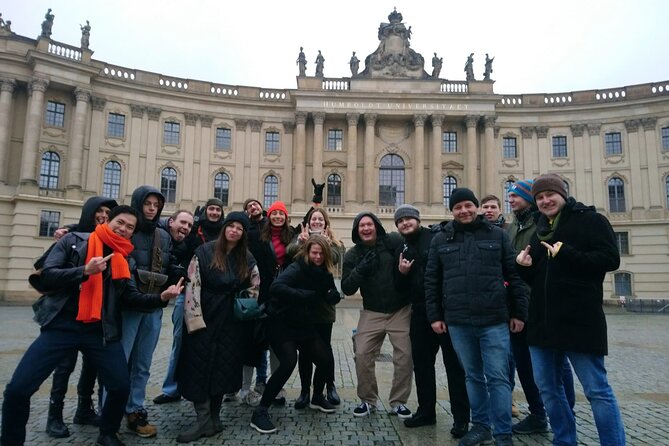
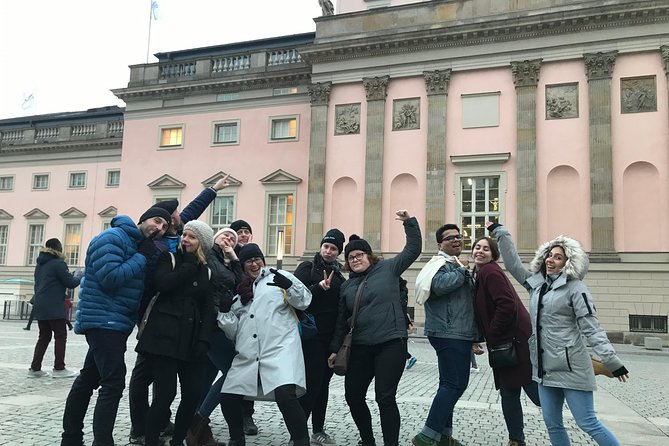
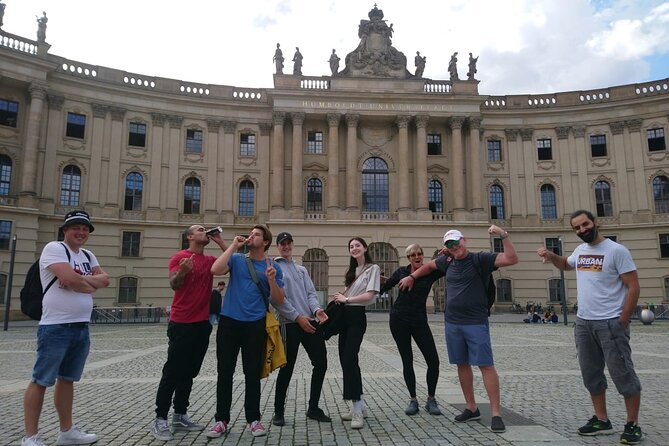
The walk continues through Gendarmenmarkt, an 18th-century square surrounded by important buildings, including the Opera House and the Law School of Humboldt University.
Gendarmenmarkt is one of central Berlin’s most elegant urban spaces, but the tour does not treat it as decoration alone. Its buildings help explain Berlin’s older civic and intellectual life before the route turns again toward the crimes of the Nazi period.
The final stop at Bebelplatz carries a darker story. The square is linked to a notorious Nazi episode and sits beside major buildings connected with Humboldt University and the Opera House.
Ending at Bebelplatz is convenient if you want to continue sightseeing along Unter den Linden. The finish point is listed as Bebelplatz, Unter den Linden, 10117 Berlin, close to Museum Island and other central attractions.
Why the guide makes or breaks this walk
The route covers a lot, but the delivery is the real product. Alex is repeatedly praised for being funny, direct, and easy to follow. Kai receives similar praise for combining humor with strong subject knowledge and for showing repeat visitors things they had not noticed before.
Arthur is described as energetic, entertaining, and generous with explanations. Anna is praised for a remarkable command of Berlin’s past and for making the tour memorable. Felix uses accessible language and avoids the formal phrasing that can make a long history walk feel stiff.
The guides do not all use exactly the same level of profanity. One account found Felix only mildly rude, while other guides are described as more colorful. That means the experience can depend on who leads your departure.
The strongest common feature is the conversational style. You get facts, but also a sense of why the guide cares about the subject. The best moments pair humor with clear respect at the Holocaust Memorial, the bunker site, and other solemn locations.
Price, group size, and practical value
At $3.63 per person, this is an unusually inexpensive way to spend more than three hours with an English-speaking guide. Even if you think of it as a city orientation rather than a complete history course, the amount of ground covered makes the price attractive.
The low price should not lead you to expect private guiding or long interior visits. You are paying for a group walking experience, with outdoor explanations and a broad sweep through central Berlin.
The group limit of 10 is a major plus. Small groups tend to make street crossings, questions, and changes in pace easier than a large crowd. It also lets the guide maintain the informal, conversational feel that defines the tour.
The meeting point is Potsdamer Platz 10, 10785 Berlin, and the end is at Bebelplatz. The tour is offered in English, uses a mobile ticket, and is near public transportation. Service animals are allowed, and most adults aged 18 or older can take part.
Free cancellation is available until 24 hours before the start time. If the minimum number is not reached and the activity is canceled, you are offered another date or experience, or a full refund.
Who should book this Berlin walking tour?
I would choose this tour at the start of a Berlin visit if I wanted a fast orientation to the city’s major twentieth-century stories. It gives you a useful map of central Berlin and helps you decide which sites deserve a longer return visit.
It is a strong fit for adults, young adults, history fans, and anyone who prefers a guide with personality. The relaxed delivery also works well for people who lose focus during formal lectures.
I would be cautious about booking it for children under 18, not only because the activity is for adults aged 18 and above, but also because of the adult humor and language. It may also be a poor match if you want a quiet, solemn tour with no jokes.
Allow more time afterward at the Holocaust Memorial, Checkpoint Charlie, Bebelplatz, or the Berlin Wall if one of those subjects interests you. The tour gives you a first layer of understanding, while independent time lets you look more closely.
Should you book the Rude Bastards tour?
Book it if you want Berlin’s major sights tied together by a funny, candid guide rather than a formal speech. Alex, Kai, Arthur, Nicole, Anna, and Felix have all been singled out for making the walk lively while still treating difficult subjects seriously.
The route is long, the language can be blunt, and the outdoor format means weather matters. But the small group, useful break, strong central route, and remarkably low price make this one of the better value choices for an adult seeking a first look at Berlin’s Nazi and Cold War past.
FAQ
Where does the Rude Bastards Berlin tour begin?
The tour begins at Potsdamer Platz 10, 10785 Berlin, Germany.
Where does the tour end?
The tour ends at Bebelplatz on Unter den Linden, 10117 Berlin, Germany.
How long does the walking tour last?
The advertised duration is approximately 3 hours and 15 minutes. Some tours may run longer when the guide includes additional locations.
What language is the tour offered in?
The tour is offered in English.
What major Berlin sights are included?
The route includes Brandenburg Gate, the Holocaust Memorial, Hitler’s bunker location, the Reichstag, Checkpoint Charlie, the Berlin Wall, Gendarmenmarkt, Bebelplatz, Museum Island, Potsdamer Platz, Tiergarten, and a Soviet WWII memorial.
Is there a break during the walk?
Yes. The tour includes a 20-minute break at a Berlin mall, generally around the middle of the walk.
How many people can join the tour?
The activity has a maximum of 10 participants.
Can I cancel for a refund?
You can cancel at least 24 hours before the start time for a full refund. Cancellations or changes made less than 24 hours before the start are not refunded or accepted.
Just added around Berlin
- Berlin Highlights in One Day★ 5.0 · 3 reviews
- Private Berlin One Day Tour with a Local: See the City Unscripted★ 3.5 · 3 reviews
- Individual city tour Berlin for max. 8 persons★ 5.0 · 3 reviews
- Transfer from Berlin Schönefeld Airport (SXF) to Berlin city Hotels – ROUND TRIP★ 4.0 · 3 reviews
- Berlin: Museum Island Tour★ 5.0 · 3 reviews
- Private Analogue Photography Experience in Berlin★ 5.0 · 3 reviews
- Berlin: Local Food Tour in Secrets Hidden Gems★ 4.0 · 3 reviews
- Berlin & The Third Reich Private Guided Tour★ 5.0 · 3 reviews
Tours, compared.
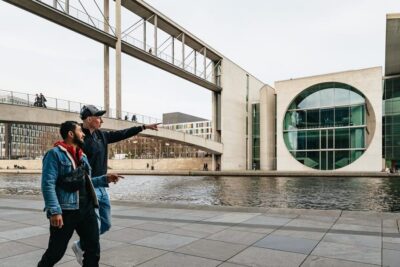
Reichstag, Dome and Government District Guided Tour
Read our review →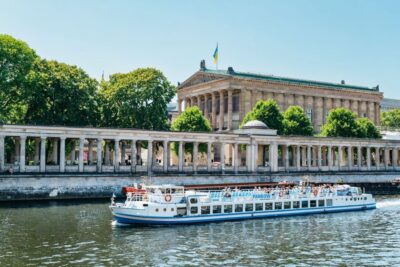
1-Hour City Tour by Boat with Guaranteed Seating
Read our review →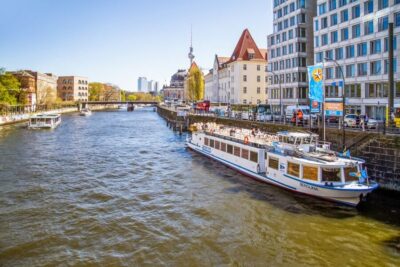

Reichstag, Plenary Chamber, Cupola & Government Tour
Read our review →