
Review · HISTORICAL TOURS
Berlin Protest History Tour: Rebels, Resistance, and Revolution
Berlin’s central streets hold a surprising record of dissent. On this small-group walk, you move from the Red Town Hall to Alexanderplatz while tracing Berlin’s uprisings, Nazi-era resistance, socialist rule, and the protests that helped bring down the Wall. The most striking feature is the way ordinary streets, statues, fountains, and public buildings become evidence in a much larger political story.
I like the short walking route, about 2 kilometers, and the small maximum group of 15. I also like the mix of famous sights and easily missed details, from the Rosenstraße monument to the East German timeline at Gasthaus Mutter Hoppe. The main consideration is that this is an outdoor, story-led tour, so poor weather can affect the schedule and there is little time for long stops inside buildings.
In This Review
- Key points
- Berlin’s protest story begins at Rotes Rathaus
- Nikolaiviertel and the remains of socialist Berlin
- The missing Berlin Wall at Gasthaus Mutter Hoppe
- Marx and Engels in the middle of the city
- Humboldt Forum and the March Revolution of 1848
- Rosenstraße and a rare act of German civil disobedience
- St. Mary’s Church and Martin Luther King Jr. in Berlin
- The 1989 protests at the Fountain of International Friendship
- Ending at the World Time Clock in Alexanderplatz
- What $30.04 buys you
- Group size, language, and practical planning
- Who will get the most from this walk
- Should you book the Berlin Protest History Tour?
- FAQ
- Where does the Berlin Protest History Tour start?
- Where does the tour end?
- How long is the tour?
- How far does the walk cover?
- What language is the tour offered in?
- How large is the group?
- What happens if the weather is poor?
Key points
- A protest story across several eras: Follow Berlin from the 1848 March Revolution through Nazi rule, East Germany, and the peaceful revolution of 1989.
- Two-hour central Berlin walk: Start at Rotes Rathaus and finish at the World Time Clock in Alexanderplatz, covering roughly 2 kilometers.
- Small groups of up to 15: The size should make it easier to hear the guide and ask questions.
- Sharp contrasts in public memory: Compare the Red Town Hall’s historical scenes with an East German timeline that leaves out the Berlin Wall.
- Powerful human stories: Learn about the Rosenstraße protest, young East German oppositionists, and Martin Luther King Jr.’s sermon in Berlin.
- Good value at $30.04: You pay for an expert guide and a focused history lesson, while every listed stop has free admission.
Berlin’s protest story begins at Rotes Rathaus
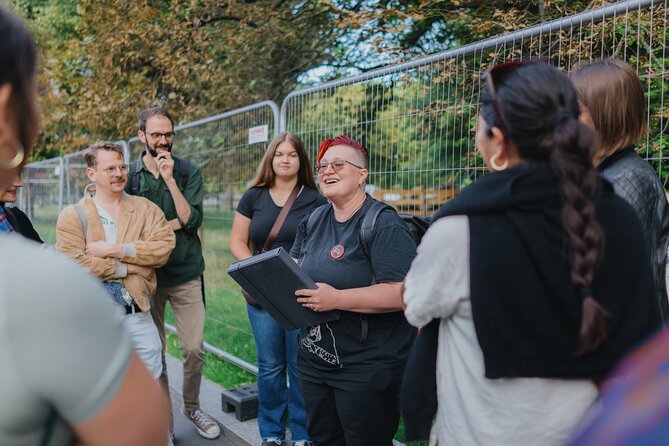
Meet at the sculpture Aufbauhelferin beside Rotes Rathaus on Jüdenstraße. The Red Town Hall is an easy central starting point, and the tour opens with a visual aid already built into the architecture: a long terracotta frieze showing scenes from Berlin’s past.
You’ll use this timeline to consider how a city tells its own story. It reaches back to Berlin’s beginnings and shows the cause of one of the most important early uprisings in the city. That makes the first stop more than a quick photo pause. It sets up the tour’s main question: who controls the public version of history, and what gets left out?
The stop lasts about 15 minutes. That is enough time to examine the artwork and hear its political context without turning the opening into a lecture. I would arrive a few minutes early, since the meeting point is tied to a specific sculpture near a large civic building.
More history walks in Berlin:
- Berlin: Natural History Museum Entrance Ticket
★ 4.6 · 3,382 reviews - Berlin: World Heritage Cruise to Potsdam
★ 4.5 · 1,435 reviews - Berlin Historical Highlights Walking Tour
★ 4.9 · 657 reviews
Nikolaiviertel and the remains of socialist Berlin
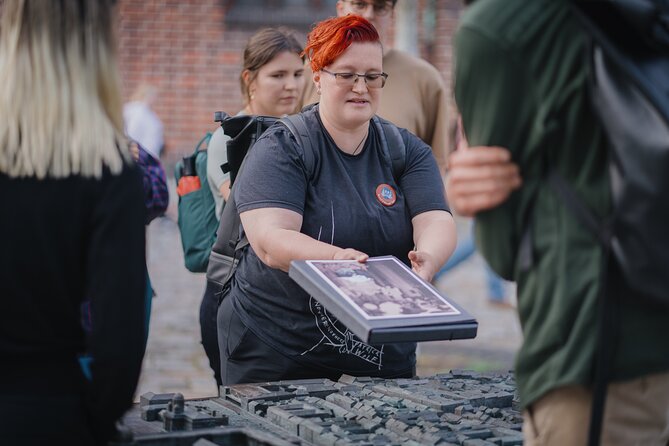
From Rotes Rathaus, the route moves into Nikolaiviertel. This area offers a sharp change in mood and style. You’ll see an example of the socialist reconstruction built for Berlin’s 750th anniversary, often described as socialist kitsch, along with the last remnants of the Palace of the Republic.
The Palace of the Republic once housed the East German parliament. It also served as one of the best-known entertainment venues in East Berlin. That combination matters. The building was not only a seat of government, but also part of daily social life in the socialist half of the city.
This stop is brief, about 10 minutes, but it helps you read Berlin as a city rebuilt more than once. The restored or reconstructed surfaces can look old at first glance, yet much of what you see reflects later political choices. If you enjoy architecture, public memory, and the question of what a city chooses to preserve, this part of the route should appeal to you.
The missing Berlin Wall at Gasthaus Mutter Hoppe
At Gasthaus Mutter Hoppe, you’ll see an East German answer to the Red Town Hall’s terracotta timeline. It presents important moments in the history of the socialist country, but one absence is impossible to ignore: the building of the Berlin Wall does not appear.
That omission gives the tour one of its clearest lessons. Propaganda does not always rely on a false statement. Sometimes it works by leaving out the event that would change how you understand everything else.
The stop takes only about five minutes. It is a quick look, not a long museum visit, but the comparison with the earlier timeline makes it especially effective. You will already have seen one public story of Berlin. Now you can compare it with a state-approved story that edits out a central fact of life in East Germany.
Marx and Engels in the middle of the city
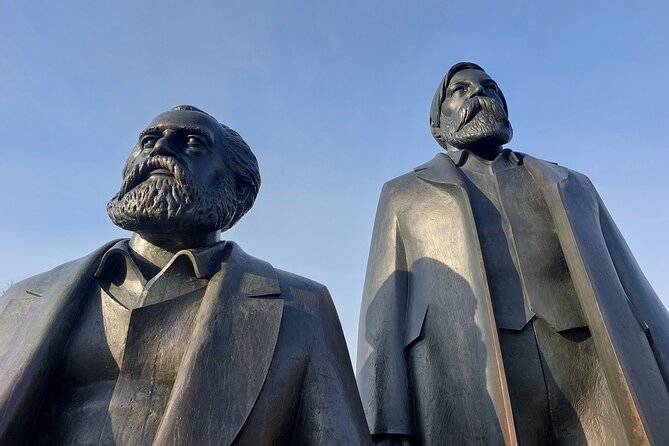
The Marx-Engels-Forum brings you face to face with Karl Marx and Friedrich Engels, the authors of The Communist Manifesto. Their large statue has been debated for years, which makes it a useful stop in a tour about protest and public memory.
The question is not simply where to place a statue. It is also whether political figures should remain in public view after the system they inspired has collapsed, and how later generations should deal with a difficult past. You’ll hear how the monument has been regarded and why it remains a subject of debate.
Plan on about 15 minutes here. The open setting gives the guide room to explain the statue’s meaning without requiring an admission ticket. This is also one of the places where the tour’s East European perspective can add useful context. Beyond and Beneath guides Martina and Simone are associated with the company’s history-focused walks, and the company’s approach places strong weight on lesser-known political details.
A different side of Berlin on the same trip:
- Berlin: Reichstag, Dome and Government District Guided Tour
★ 4.7 · 18,288 reviews - Berlin: 1-Hour City Tour by Boat with Guaranteed Seating
★ 4.3 · 16,993 reviews - Berlin: Boat Tour Along the River Spree
★ 4.4 · 11,252 reviews - Discover Berlin Half-Day Walking Tour
★ 5.0 · 9,624 reviews
Humboldt Forum and the March Revolution of 1848
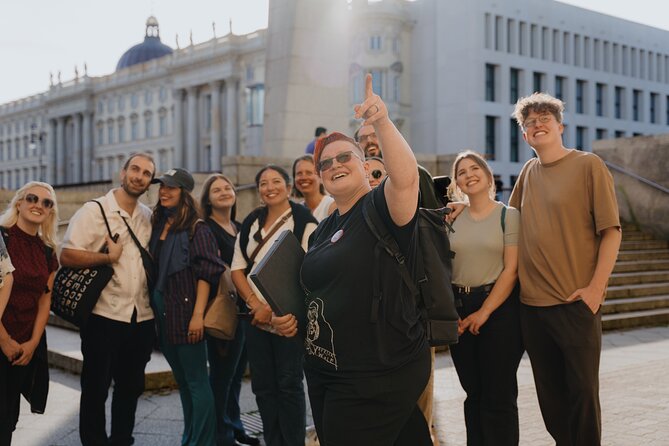
The Humboldt Forum occupies the site of the reconstructed Berlin Palace. The building looks grand, but the important point here is what the original palace witnessed. It was connected to several protests and revolutions, especially the March Revolution of 1848.
That uprising helped plant the seeds of democracy in Germany. The stop gives you a chance to look beyond the palace facade and think about the public pressure that shaped the country’s political development. A royal residence can appear fixed and permanent, yet its surroundings have repeatedly been altered by people demanding change.
The tour allows about 20 minutes here, the longest stop on the route. That extra time makes sense. The building carries several layers of meaning, and the guide can connect the palace to the wider sequence of rebellion and reform without rushing.
You should not expect a palace interior tour. The value is in the setting and the political story told around it. If you prefer tours that explain why a building matters rather than simply naming its architectural style, this is one of the stronger sections.
Rosenstraße and a rare act of German civil disobedience
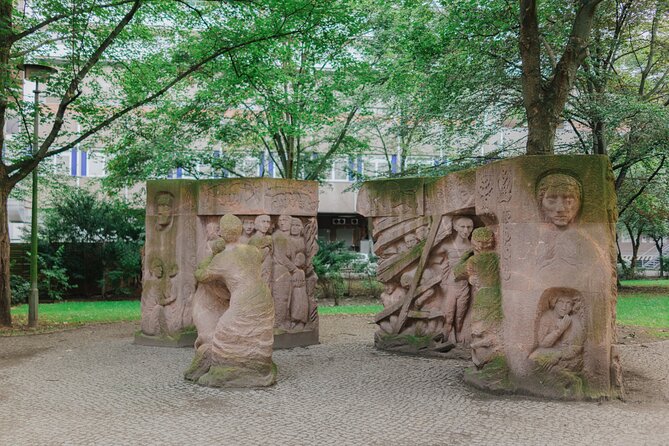
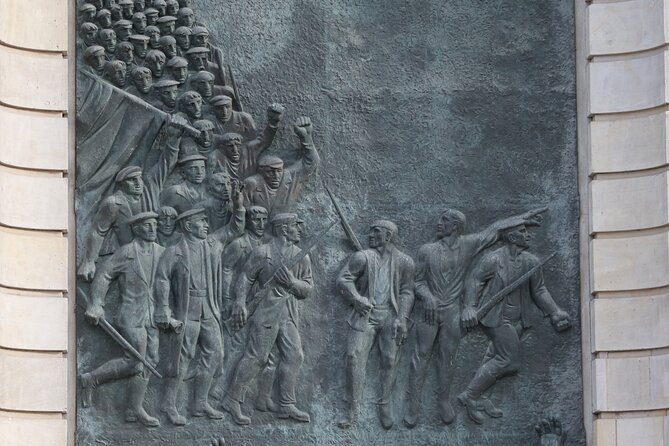
Rosenstraße is the emotional center of the walk. The monument here honors women who staged a courageous protest during the cold winter of 1943. They demanded the release of Jewish men held by the Nazi authorities, and their action is described as the only German protest against the Final Solution.
The story also opens a window onto Jewish life under Nazi rule. You’ll see the foundations of Berlin’s oldest synagogue, linking the protest to the broader Jewish presence that existed in the city before and during the Nazi period.
About 15 minutes is scheduled here. The monument is not a grand ruin or a huge memorial complex. Its power comes from the people represented and the risk they took. This is a stop where the guide’s storytelling matters more than the size of the site.
I would give this part your full attention. The tour does not treat protest as an abstract political theme. It shows how resistance could come from people with no army, office, or public platform, and how courage could take the form of standing in the street and refusing to leave.
St. Mary’s Church and Martin Luther King Jr. in Berlin
St. Mary’s Church is one of Berlin’s oldest churches. It also recalls a major modern protest voice: Martin Luther King Jr. delivered a sermon here to a huge crowd in 1964.
That detail broadens the tour beyond Berlin’s own revolutions. The church becomes a place where religion, civil rights, Cold War politics, and public protest meet. You’ll see a historic religious building, but the story attached to it reaches well beyond medieval or Reformation-era Berlin.
The planned stop is about 10 minutes. As with other parts of the route, the emphasis is on the setting and the guide’s explanation rather than an extended indoor visit. If you want a tour devoted only to medieval churches, this is not that. If you like seeing familiar buildings through a political lens, it adds a worthwhile layer.
Nearby, you’ll also catch sight of the Berlin Television Tower. The tower is one of the city’s best-known landmarks and a symbol of communist power. It helps explain how architecture and infrastructure could serve as political messaging in East Berlin.
The 1989 protests at the Fountain of International Friendship
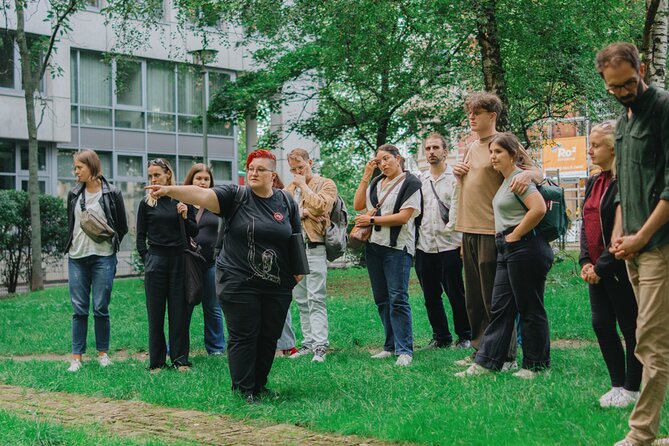
The route then turns to the Brunnen der Völkerfreundschaft, or Fountain of International Friendship, for the story of the Peaceful Revolution of 1989. You’ll trace the events that led to the Fall of the Wall and hear about young East German oppositionists who staged a T-shirt protest by the fountain in autumn 1989.
This is exactly the kind of small story that can disappear beneath the headline of the Wall’s fall. The famous event is easy to remember. The quieter acts that helped build pressure are harder to see unless someone points out where they happened.
The stop lasts about 15 minutes. The fountain is a public place, not a formal museum, so you will need to listen closely and picture the scene through the guide’s account. The reward is a more human understanding of 1989. Change did not arrive only through speeches by famous leaders. Young people also used simple, visible acts to test what the authorities would tolerate.
Ending at the World Time Clock in Alexanderplatz
The tour ends at the Weltzeituhr, or World Time Clock, in Alexanderplatz. This rotating clock shows the time in 148 cities around the world and has long served as one of East Berlin’s most popular meeting places.
It is a fitting final stop. The clock points outward to the wider world, while its location recalls a city once split between two political systems. After hearing about the Wall, East German opposition, and the peaceful revolution, you can see Alexanderplatz less as a shopping and transport hub and more as a public stage shaped by Cold War history.
The last stop is planned for about 15 minutes. From here, you are already in a useful part of central Berlin for continuing your day. The endpoint is clearly given as the World Time Clock in Alexanderplatz, so you will not need to return to the starting point.
What $30.04 buys you
At $30.04 per person, this is a reasonable price for a two-hour private-history-style walk in central Berlin, especially with a maximum group of 15. Every listed stop has free admission, so the cost goes toward the guide, research, and the structure of the experience rather than entrance tickets.
That distinction matters. You could walk past most of these sites without paying anything, but you would miss the connections between them. The value lies in learning why a terracotta panel, an absent event, a statue, a church, and a fountain belong in the same story.
The tour also has a good time-to-distance ratio. The route covers about 2 kilometers in roughly two hours, with stops ranging from five to 20 minutes. You are not being hurried from one major sight to the next, nor are you spending a whole day on a single theme.
Still, you should know what you are buying. This is not a ticketed museum tour, and it does not promise extended visits inside the Humboldt Forum, St. Mary’s Church, or other buildings. If you want indoor exhibits or a broad survey of all Berlin history, choose a different format. If you want careful explanations at public sites, the price is easier to justify.
Group size, language, and practical planning
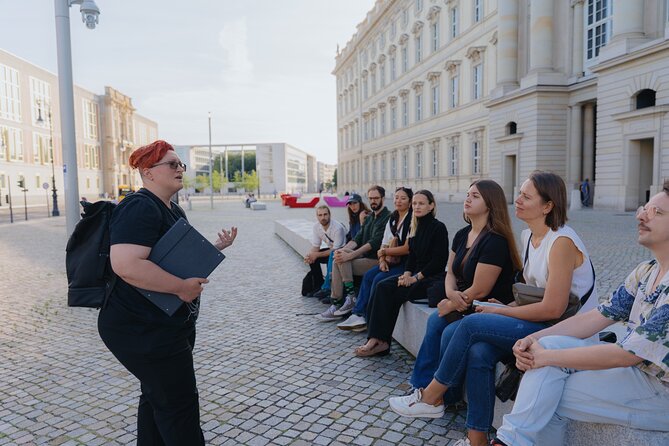
The tour is offered in English and includes an expert guide. The maximum group is 15, which is small enough for a more personal walk while still being a group experience rather than a private tour.
A mobile ticket is provided, and confirmation comes at booking. The route is near public transportation, and most people can participate. Service animals are allowed. Specific details about step-free access, seating, or restroom stops are not provided, so you should ask the operator if those points matter to you.
Plan for outdoor conditions. The experience requires good weather, and it may be moved or canceled if conditions are poor. You can cancel for a full refund up to 24 hours before the start time, but cancellations or changes made inside that window are not refunded or accepted.
I would schedule this early in your Berlin stay if you are interested in the city’s political past. The route gives you useful bearings around the center, and you can return later to any site that catches your attention. Wear comfortable shoes, but do not expect a strenuous hike. The walk is short, with time spent listening at each stop.
Who will get the most from this walk
This tour suits you if Berlin’s political history is a main reason for your visit. It is especially useful if you want more than the standard Wall photographs and Cold War talking points.
You will likely appreciate it if you enjoy:
- Stories about resistance by ordinary people
- The contrast between Nazi, socialist, and democratic public memory
- Architecture that carries political meaning
- Lesser-known details in familiar central Berlin locations
- Small groups and a guide-led walking format
- A focused tour that fits into half a day
It can also work well for people already living in Berlin. The route is short, and its purpose is not to show you every major sight. Instead, it can make places you pass often feel new again. The company’s guides, including Martina and Simone, are noted for careful research and for explaining smaller details that are easy to miss.
You may want another tour if you dislike discussions of political conflict, Nazi persecution, or the failures of state systems. The subject matter is serious, even when the walk moves through lively central streets. You should also choose something else if you need a fully indoor activity or a tour with guaranteed operation in bad weather.
Should you book the Berlin Protest History Tour?
Book it if you want a compact, thoughtful walk that links several eras of Berlin’s past. The best parts are the comparison between the two historical timelines, the Rosenstraße story, and the account of the small 1989 protest at the fountain. Those details give the tour a sharper edge than a basic city-center orientation.
At $30.04, I consider it good value for an English-language walk with an expert guide and a 15-person limit. The free sites keep the experience simple, but they also mean the tour depends heavily on the quality of the storytelling.
Skip it if you want major interior attractions, a general introduction to Berlin, or a weather-proof plan. For history-minded visitors, local residents, and anyone who likes to understand the story behind a facade, this is a strong choice.
FAQ
Where does the Berlin Protest History Tour start?
The tour starts at the sculpture Aufbauhelferin beside Rotes Rathaus on Jüdenstraße, 10178 Berlin, Germany.
Where does the tour end?
It ends at the World Time Clock, or Weltzeituhr, in Alexanderplatz.
How long is the tour?
The experience lasts approximately two hours.
How far does the walk cover?
The walk covers about 2 kilometers.
What language is the tour offered in?
The tour is offered in English.
How large is the group?
The tour has a maximum of 15 participants.
What happens if the weather is poor?
The experience requires good weather. If it is canceled because of poor weather, you will be offered another date or a full refund.
Just added around Berlin
- Berlin Highlights in One Day★ 5.0 · 3 reviews
- Private Berlin One Day Tour with a Local: See the City Unscripted★ 3.5 · 3 reviews
- Individual city tour Berlin for max. 8 persons★ 5.0 · 3 reviews
- Transfer from Berlin Schönefeld Airport (SXF) to Berlin city Hotels – ROUND TRIP★ 4.0 · 3 reviews
- Berlin: Museum Island Tour★ 5.0 · 3 reviews
- Private Analogue Photography Experience in Berlin★ 5.0 · 3 reviews
- Berlin: Local Food Tour in Secrets Hidden Gems★ 4.0 · 3 reviews
- Potsdam Highlights – Private sightseeing tour by minibus★ 5.0 · 3 reviews
Historical Tours, compared.

Berlin Private Complete History All Day Walking Tour
Read our review →


Small group Potsdam: A Journey Through History and Palaces
Read our review →Browse the lists this tour appears in