
Review · HISTORICAL TOURS
Explore Berlin Tour: History and Highlights
Berlin’s story is unusually visible on the street. A few steps can take you from Prussian grandeur to Nazi ruins, then on to Cold War border posts and today’s reunited capital. This three-hour walk links those chapters at the very places where they happened, rather than treating Berlin as a collection of disconnected photo stops.
I like the wide sweep of the route, which covers the Brandenburg Gate, Reichstag, Holocaust Memorial, Hitler’s bunker, Checkpoint Charlie, Gendarmenmarkt, Bebelplatz, Unter den Linden, and Museum Island. I also like the guide-led approach, especially for visitors who want more than dates and building names. Al, one of the guides, is an Irishman who has lived in Berlin for many years and has tailored his explanations to suit the people in his group.
The main drawback is pace. One guest found the talk so continuous that there was little time for photos or quiet looking. You should also arrive early at the meeting point, outside Hopfingerbräu at Ebertstr. 24, since one guest had trouble spotting the guide when no flag was being held.
In This Review
- Key points to know before you book
- Why this Berlin walk works as a first look at the city
- Starting at the Brandenburg Gate and Reichstag
- Facing the Holocaust Memorial and Hitler’s bunker
- The German Finance Ministry and the Topography of Terror
- Checkpoint Charlie and the memory of divided Berlin
- Gendarmenmarkt, Bebelplatz, and Unter den Linden
- Ending on Museum Island
- How much history fits into three hours
- Is $31 a fair price?
- Who should book this Berlin history tour?
- Should you book Explore Berlin Tour: History and Highlights?
- FAQ
- Where does the tour start?
- How long is the tour?
- What language is the tour conducted in?
- Which sights are included?
- Does the tour include food or drinks?
- Is the tour wheelchair accessible?
- Can I cancel the booking?
Key points to know before you book
- Three hours cover a huge amount of central Berlin, so expect a focused walk rather than long visits inside museums.
- The route joins several difficult chapters, from Prussian rule and World War I through Nazi Germany, the Berlin Wall, and reunification.
- Hitler’s bunker and the Topography of Terror add serious historical weight beyond the usual postcard sights.
- Guide quality matters here, and Al has been praised for clear, tailored explanations and regular checks on the group’s comfort.
- The tour costs $31 per person, a fair price if you want a strong first orientation to Berlin’s historic center.
- The tour is in English and wheelchair accessible, with free cancellation up to 24 hours before the start.
Why this Berlin walk works as a first look at the city
Berlin can be hard to read at first. Its old center was damaged by war, divided by politics, rebuilt in different styles, and then reshaped after reunification. A walking guide helps connect the bare spaces, modern buildings, memorials, and surviving monuments.
This route is especially useful because it does not focus on just one period. You move from imperial Berlin to the Nazi era, then to the Cold War and the present-day capital. That sequence gives you a working map of the city and helps you understand why central Berlin looks so unlike a preserved medieval center.
The tour begins beside the Brandenburg Gate, so you are already in the historic heart of town. From there, the route reaches the Reichstag, the Holocaust Memorial, Hitler’s bunker, the German Finance Ministry, the Topography of Terror, Checkpoint Charlie, Gendarmenmarkt, Bebelplatz, Unter den Linden, and Museum Island before returning to Ebertstraße.
I like that structure. You are not simply ticking off famous buildings. You are following the changing role of Berlin through time.
More history walks in Berlin:
- Berlin: Natural History Museum Entrance Ticket
★ 4.6 · 3,382 reviews - Berlin: World Heritage Cruise to Potsdam
★ 4.5 · 1,435 reviews - Berlin Historical Highlights Walking Tour
★ 4.9 · 657 reviews
Starting at the Brandenburg Gate and Reichstag
Meet outside Hopfingerbräu at Ebertstr. 24, right beside the Brandenburg Gate. This is a practical starting point because the gate is one of Berlin’s clearest landmarks, but you still need to look for the guide rather than assume the meeting point will be obvious.
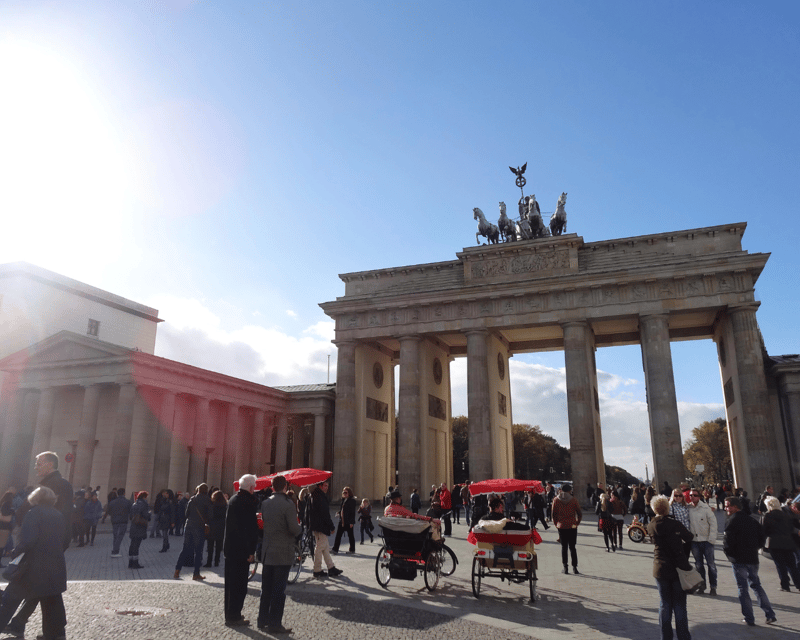
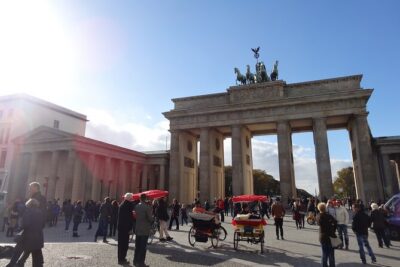
The Brandenburg Gate receives about 20 minutes of guided attention. That is enough time to understand why this neoclassical gate matters and how its meaning changed across different periods. It began as a symbol of Prussian power, later became linked with Nazi spectacle, and eventually served as one of the strongest images of German division and reunification.
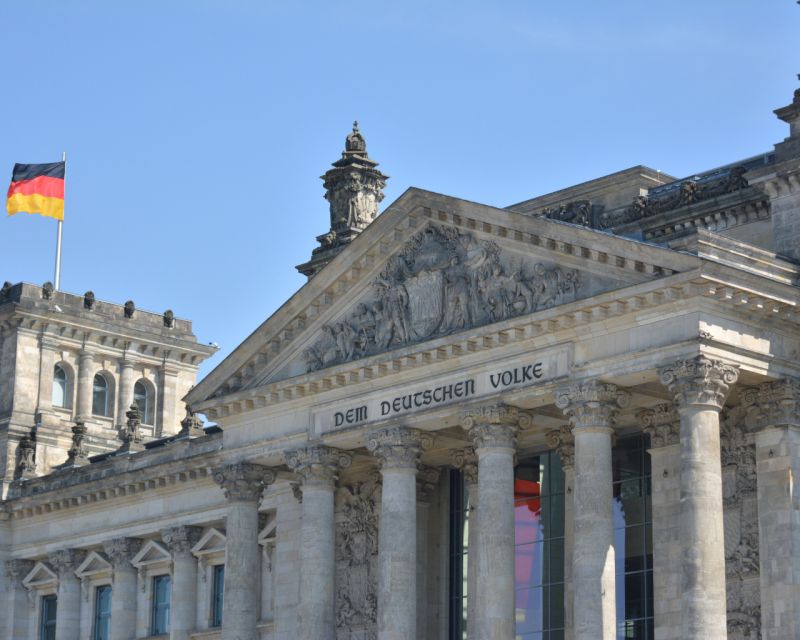
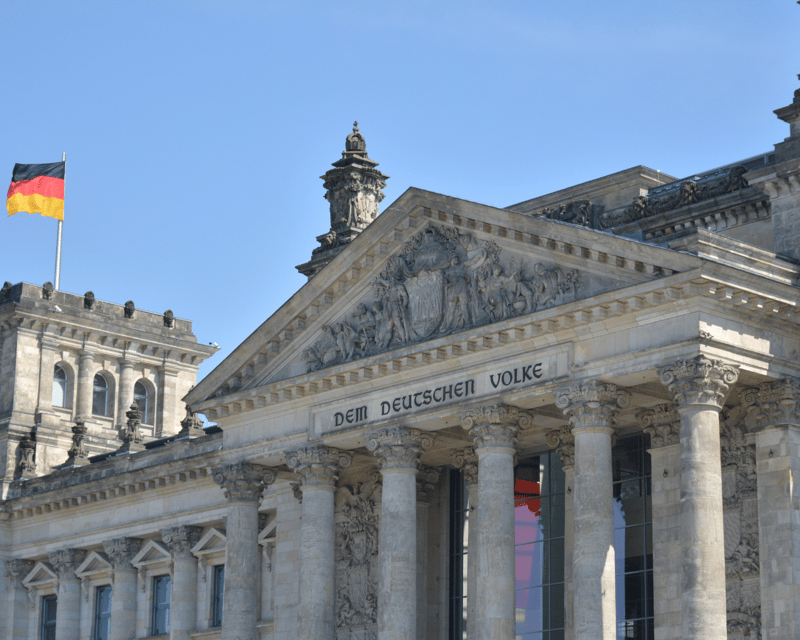
The Reichstag follows, with about 20 minutes of sightseeing. You will see the seat of Germany’s parliament and hear how the building fits into Berlin’s political story. The itinerary does not promise entry to the Reichstag, so think of this as an exterior stop with historical explanation, not a dome visit.
This early section gives you a useful contrast: the Brandenburg Gate represents imperial ceremony and national symbolism, while the Reichstag points toward modern parliamentary Germany. Your guide’s job is to make that change clear.
Facing the Holocaust Memorial and Hitler’s bunker
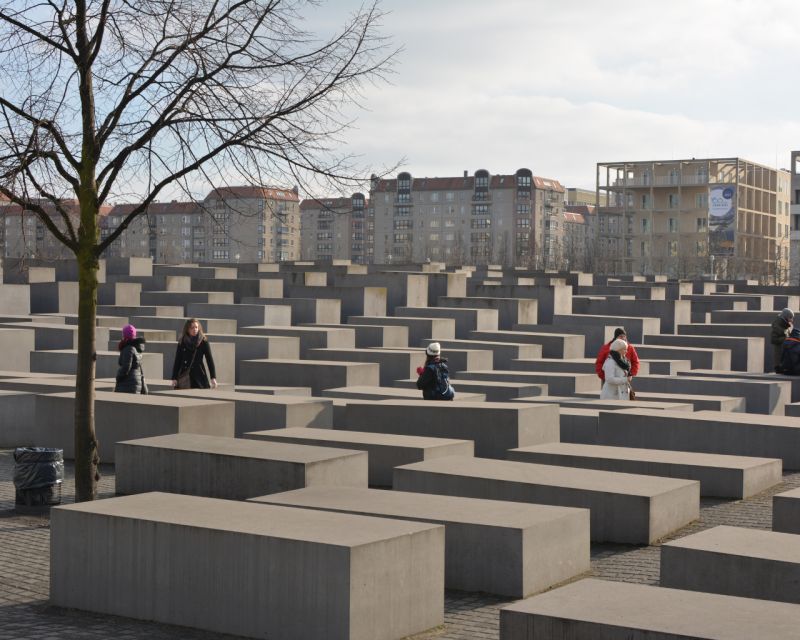
The Memorial to the Murdered Jews of Europe is one of the most powerful stops on the route. Its field of concrete blocks invites you to move through an uneven space without an easy central viewpoint. The guide has about 15 minutes here, enough to explain the memorial’s purpose and the Nazi persecution it commemorates.
This is a place where a guide can add context, but you should also allow yourself a little silence. If the group moves quickly, you may want to return later on your own. The memorial is open and central, making a second visit easy.
Nearby, the tour points out the location of Hitler’s bunker. The physical remains are not presented as a grand attraction, and that is part of the point. The site is tied to the final days of Nazi rule, yet there is no dramatic monument inviting spectacle.
You receive about 15 minutes of sightseeing here. That may feel brief, but the value is in understanding the location and the deliberate way postwar Berlin has handled it. This stop also shows why Berlin often requires explanation: important history can sit beneath an ordinary-looking street.
The German Finance Ministry and the Topography of Terror
The German Finance Ministry offers another layer of Berlin’s past. The building is connected to the former Nazi government district and later became part of East Germany’s state administration. A stop here helps you see how political power changed hands while buildings remained in use.
The tour allows about 15 minutes for sightseeing. Do not expect a long indoor visit based on the details provided. Instead, expect your guide to use the building and its setting to explain the shifting governments that ruled Berlin in the twentieth century.
The Topography of Terror receives about 20 minutes of guided time. This is one of the route’s strongest historical stops. The documentation center occupies the former site of Nazi institutions involved in terror and persecution, including the Gestapo and SS.
I value this part of the walk because it moves beyond famous names and monuments. You are given a sense of how a dictatorship operated through offices, police structures, and administration. The visit also places Nazi history in the city itself, where the machinery of repression once functioned.
The schedule is tight, so you should not expect to read every display at length. If the subject matters to you, return later for a slower visit. The guided stop gives you a foundation, then you can decide which museums or memorials deserve more of your time.
A different side of Berlin on the same trip:
- Berlin: Reichstag, Dome and Government District Guided Tour
★ 4.7 · 18,288 reviews - Berlin: 1-Hour City Tour by Boat with Guaranteed Seating
★ 4.3 · 16,993 reviews - Berlin: Boat Tour Along the River Spree
★ 4.4 · 11,252 reviews - Discover Berlin Half-Day Walking Tour
★ 5.0 · 9,624 reviews
Checkpoint Charlie and the memory of divided Berlin
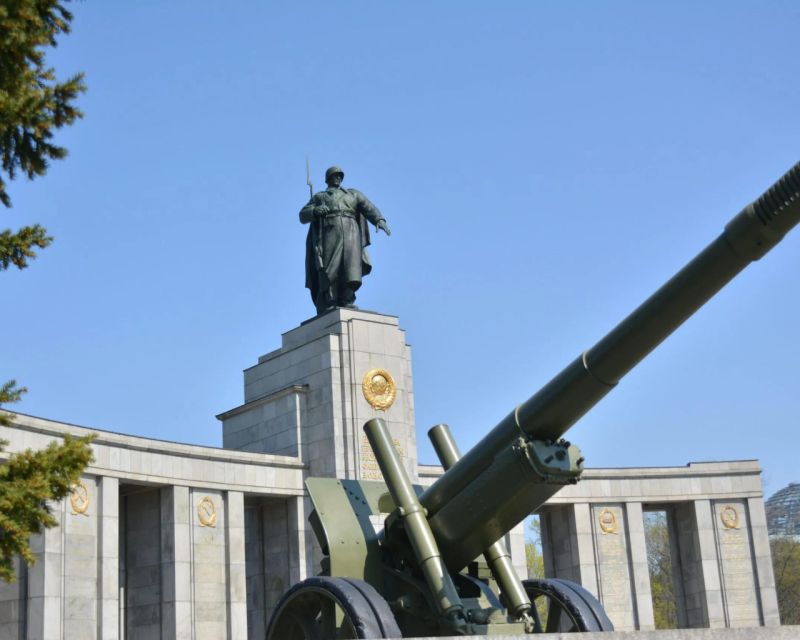
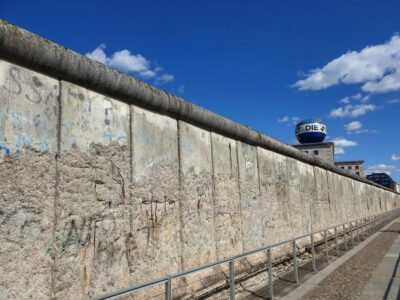
Checkpoint Charlie is one of Berlin’s best-known Cold War locations. The tour spends about 20 minutes here, using the former crossing point to explain the Berlin Wall and the division of the city.
The site can feel crowded with modern tourism, signs, and photo opportunities. That makes historical framing important. Your guide can help separate the genuine political importance of the crossing from the commercial activity that surrounds it today.
This is also a good place to ask questions about daily life in divided Berlin. The tour description promises coverage of the Wall and reunification, and Checkpoint Charlie gives that story a clear physical anchor. You see how a city street became an international border and a symbol of the conflict between East and West.
One guide-led review praised the way the tour connected past and present. That is the right expectation here. You are not only looking at what once stood at the crossing. You are considering how Berlin remembers a border that disappeared, even though its effects remain part of the city’s identity.
Gendarmenmarkt, Bebelplatz, and Unter den Linden
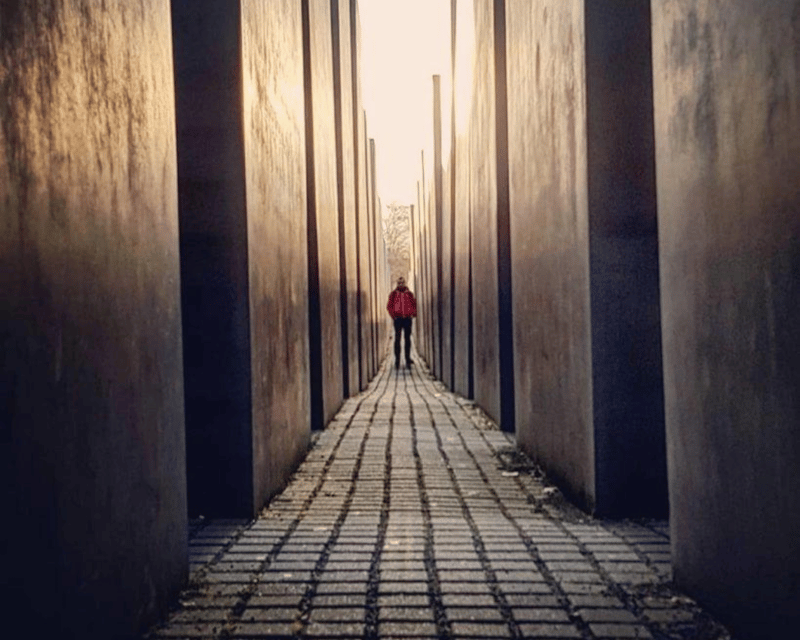
Gendarmenmarkt brings you back to Berlin’s grander architectural side. With about 15 minutes of guided time, you will see one of the city center’s major squares and hear how it fits into the history of Prussian and imperial Berlin.
The square is a useful change of mood after the darker stops. Its formal design and monumental buildings show the city as a royal and administrative center. At the same time, the brief stop means you may not have much time to linger or photograph every angle.
Bebelplatz receives another 15 minutes. This square carries a painful connection to the Nazi book burning of 1933. The location is often remembered through the underground memorial, which evokes empty bookshelves and the destruction of ideas.
Your guide can place that event within the wider story of censorship and Nazi control. It is a compact stop, but an important one because it shows that persecution was not limited to prisons and police offices. It also targeted education, literature, art, and public thought.
The route then continues along Unter den Linden, Berlin’s famous historic boulevard. You will have about 20 minutes of guided explanation here. The avenue links several major institutions and landmarks, making it a natural thread through the old center.
I like this part because you can see the city as a sequence of grand plans and political messages. Unter den Linden is not only a pleasant walk. It helps connect Bebelplatz, Museum Island, and the wider royal center.
Ending on Museum Island
Museum Island is the final sightseeing stop before the walk returns to Ebertstraße. Its museums and monumental setting make it one of Berlin’s essential areas, though this tour does not include museum admission or an extended indoor visit.
The stop is useful for orientation. You can learn where Berlin’s major collections are concentrated and decide if you want to return for a longer museum visit. If you are planning to see the Pergamon Museum or another institution, check current opening information separately rather than assuming the walking tour includes entry.
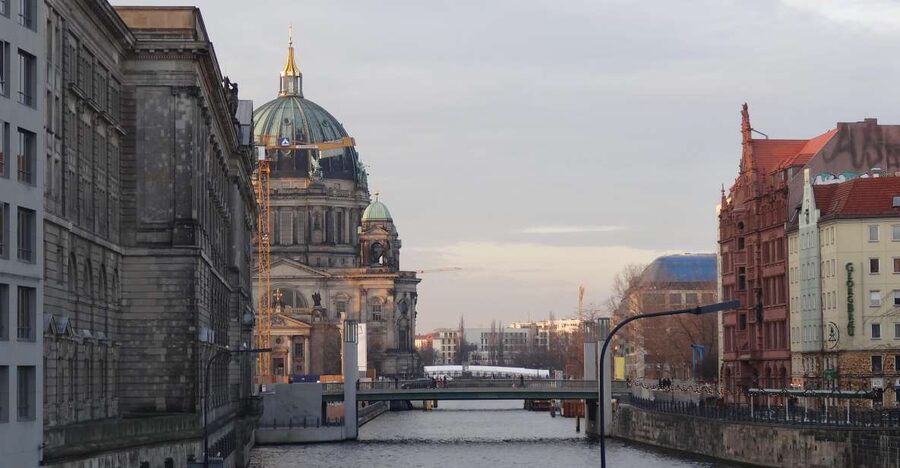
Ending here makes sense. After seeing Berlin’s political and traumatic twentieth-century history, Museum Island brings you back to the city’s older cultural ambitions. It also leaves you in a central area with plenty of options for the rest of your day.
The return to Ebertstraße means the tour forms a practical loop. You finish near the Brandenburg Gate, where you can continue toward the Tiergarten, Reichstag area, Unter den Linden, or nearby public transport connections.
How much history fits into three hours
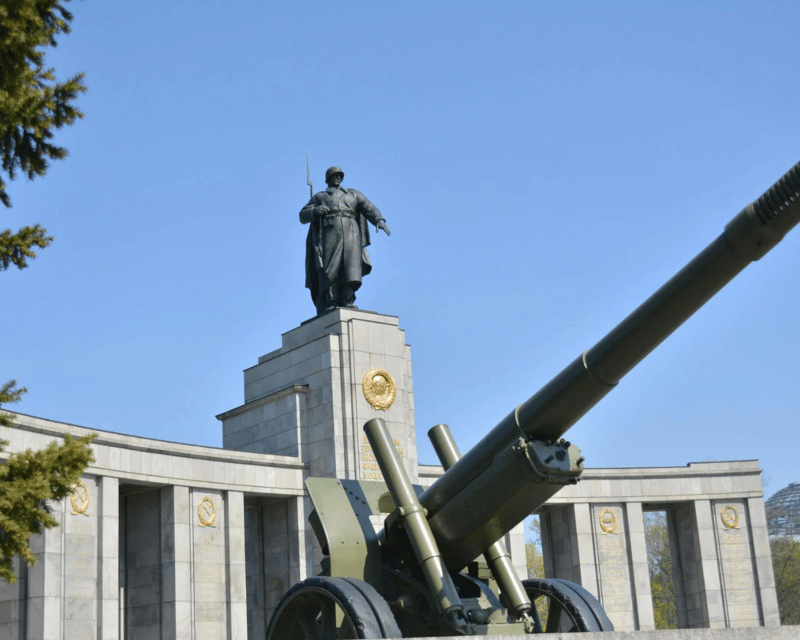
The route covers a lot. The listed stops add up to a demanding sequence, and the tour is advertised as three hours. That tells you to expect a brisk pace with regular standing and walking.
This format suits you if you want a strong first framework for Berlin. It is less suitable if you prefer to spend 30 minutes at each memorial, take many photographs, or read every museum panel during the same outing.
One review praised a guide for going beyond standard textbook material, adapting his explanations to the people in the group, and keeping track of everyone’s comfort. Another review had the opposite experience, finding the presentation too much like a classroom lecture and wanting more free time.
Both points are useful. The guide is central to the value of this tour, and a history-heavy walk will naturally include a fair amount of talking. If you prefer active listening and asking questions, that is a strength. If you need frequent pauses for photos, tell the guide early and keep your own expectations realistic.
The tour is wheelchair accessible, but the information does not explain the exact pavement conditions, rest opportunities, or route adjustments. If you use a wheelchair, confirm any specific mobility needs before booking.
Is $31 a fair price?
At $31 per person, this is reasonably priced for a three-hour guided walk covering so many major sites. You are paying for a live English-speaking guide and a carefully connected route, not for food, drinks, museum admission, or private transport.
The value is strongest if this is your first or second day in Berlin. You can use the tour to learn the city’s basic layout, then return to the places that deserve more time. It may save you from treating each landmark as an isolated stop.
The price is less compelling if you already know central Berlin well or want long indoor visits. In that case, you might prefer a focused museum tour or a smaller walk devoted only to the Berlin Wall, Nazi history, or royal Berlin.
You can reserve now and pay later, which helps if your schedule is still shifting. Free cancellation is available up to 24 hours before the start for a full refund. Food and drinks are not included, so carry water and plan a meal before or after the walk.
Who should book this Berlin history tour?
I would choose this tour for a first-time visitor who wants the major sights explained in one sitting. It also suits families with older children or teenagers who can manage three hours of walking and sustained listening. One booking included a 21-year-old daughter, and the group found the format worked well for all of them.
History-minded visitors will get the most from the route. You move through Prussian Berlin, World War I and World War II, Nazi rule, the Cold War, the Berlin Wall, and reunification without needing several separate excursions.
The tour may be less suitable for very young children, travelers who dislike lectures, or anyone who wants a slow photo walk. The single negative account points to the clearest risk: too much explanation and not enough time to look around.
Arrive early at Ebertstraße 24 and make sure you can identify your guide. Since the meeting point is beside Hopfingerbräu and no flag was held on one occasion, do not wait until the exact start time to begin searching.
Should you book Explore Berlin Tour: History and Highlights?
Book it if you want a solid historical framework, a central route, and a guide who can connect Berlin’s most important sites into one story. The strongest feature is not any single landmark. It is the way the walk links the Brandenburg Gate to the Holocaust Memorial, Hitler’s bunker, the Topography of Terror, Checkpoint Charlie, and Museum Island.
I would treat it as an orientation tour, not a complete visit to every attraction. Listen closely, take a few key photos, note the places you want to revisit, and save extra time for the memorials and museums that catch your attention.
At $31, the tour offers good value for a history-focused introduction to Berlin. Just allow for a fast pace, arrive early, and let the guide know if you need more time between explanations.
FAQ
Where does the tour start?
The meeting point is outside Hopfingerbräu at Ebertstr. 24, 10117 Berlin, right next to the Brandenburg Gate.
How long is the tour?
The walking tour lasts three hours.
What language is the tour conducted in?
The live tour guide speaks English, and English is the listed tour language.
Which sights are included?
The route includes the Brandenburg Gate, Reichstag, Holocaust Memorial, Hitler’s bunker, German Finance Ministry, Topography of Terror, Checkpoint Charlie, Gendarmenmarkt, Bebelplatz, Unter den Linden, and Museum Island.
Does the tour include food or drinks?
No. Food and drinks are not included.
Is the tour wheelchair accessible?
Yes, the activity is listed as wheelchair accessible.
Can I cancel the booking?
Yes. You can cancel up to 24 hours in advance for a full refund. You can also reserve now and pay later.
Just added around Berlin
- Berlin Highlights in One Day★ 5.0 · 3 reviews
- Private Berlin One Day Tour with a Local: See the City Unscripted★ 3.5 · 3 reviews
- Individual city tour Berlin for max. 8 persons★ 5.0 · 3 reviews
- Transfer from Berlin Schönefeld Airport (SXF) to Berlin city Hotels – ROUND TRIP★ 4.0 · 3 reviews
- Berlin: Museum Island Tour★ 5.0 · 3 reviews
- Private Analogue Photography Experience in Berlin★ 5.0 · 3 reviews
- Berlin: Local Food Tour in Secrets Hidden Gems★ 4.0 · 3 reviews
- Potsdam Highlights – Private sightseeing tour by minibus★ 5.0 · 3 reviews
Historical Tours, compared.

Berlin Private Complete History All Day Walking Tour
Read our review →


Small group Potsdam: A Journey Through History and Palaces
Read our review →Browse the lists this tour appears in