
Review · BERLIN RICKSHAW TOURS
Private Guide Up to Group 6 – ONE Rickshaw, (E)Bikes, E-Scooters
Berlin is easier to grasp when you can cover a lot of ground without spending the whole day on foot. This private ride links the TV Tower, Museum Island, Checkpoint Charlie, the Holocaust Memorial, and Brandenburg Gate, with time to stop for photos and stories.
I like the choice of vehicles, especially the rickshaw for anyone who cannot comfortably cycle. I also like the guide-led approach: Levi brings humor, answers questions, and can conduct the tour in Dutch. The main consideration is pace. With many stops packed into about three hours, you will see each place briefly rather than explore museums or interiors.
In This Review
- Key Points
- A Private Ride Through Berlin Mitte
- Why the Vehicle Choice Matters
- From the TV Tower to Berlin’s Old Center
- Museum Island and Unter den Linden
- Gendarmenmarkt and the Former Border
- Nazi Berlin at the Topography of Terror
- The Holocaust Memorial and Brandenburg Gate
- Guide Style, Families, and Dutch-Language Tours
- Who Gets the Best Value
- Booking Details and Cancellation
- Should You Book This Berlin Rickshaw and Bike Tour?
- FAQ
- How long does the Berlin private vehicle tour last?
- Where does the tour begin and end?
- How many people can join the private tour?
- Which vehicles are available?
- Is the tour suitable for someone with limited mobility?
- What happens if I need to cancel?
Key Points
- One private group: The tour is reserved for your party, with a stated capacity of up to six.
- Several ways to ride: The vehicle mix includes bikes, e-bikes, e-scooters, and a rickshaw.
- Strong central route: You cover Berlin Mitte’s major political, royal, Cold War, Nazi-era, and reunification sights.
- Guide Levi’s personal style: Expect humor, stories, questions, and Dutch-language guiding when arranged.
- Helpful for limited mobility: The rickshaw brings you close to monuments and requires only a few steps to enter.
- Good family option: The guide involves children and may provide water and pretzels, based on the experience described.
A Private Ride Through Berlin Mitte
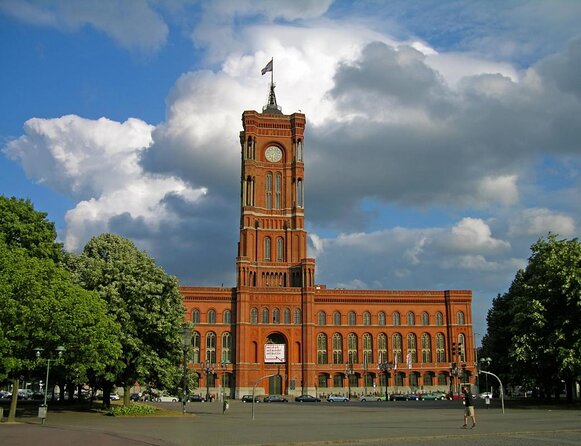
The appeal here is simple: you get a private guide, a flexible mix of vehicles, and a quick look at the core sights of central Berlin. One person can ride in the rickshaw while others use bikes or e-scooters, then the group reunites at each stop for the same explanation.
The listed price is $465.43 per group, rather than per person. At the stated limit of six, that works out to about $77.57 each if your group is full. That is not a cheap sightseeing ride for one or two people, but it can be fair for a full group that wants a private guide and does not want to coordinate several separate tours.
The booking details also mention two regular bikes, three e-bikes, and one rickshaw for up to seven people. Elsewhere, the capacity is given as six, so I would confirm the exact vehicle mix and maximum party size before paying. This matters most for a group of six or seven, or for a party with more than one person who needs the rickshaw.
The tour begins at Weinbergsweg 6 and returns there. The broader route starts at or meets near the TV Tower in the itinerary description, so confirm the exact pickup arrangement with Berlin-Rickshaw / Berlin-Excursions. You receive confirmation at booking, and the meeting point is near public transportation.
More rickshaw rides in Berlin:
- Berlin: Private Guided E-Rickshaw Tour
★ 4.9 · 157 reviews - Individual City Tour – Rickshaw Sightseeing in Berlin
★ 5.0 · 120 reviews - Berlin Express: Private 1-Hour E-Rickshaw Ride
★ 5.0 · 116 reviews
Why the Vehicle Choice Matters
A standard walking tour can make Berlin’s center feel scattered. The TV Tower, Museum Island, Bebelplatz, the former Nazi government district, and Brandenburg Gate are close enough to link, but far enough apart that your feet may protest before the history lesson is over.
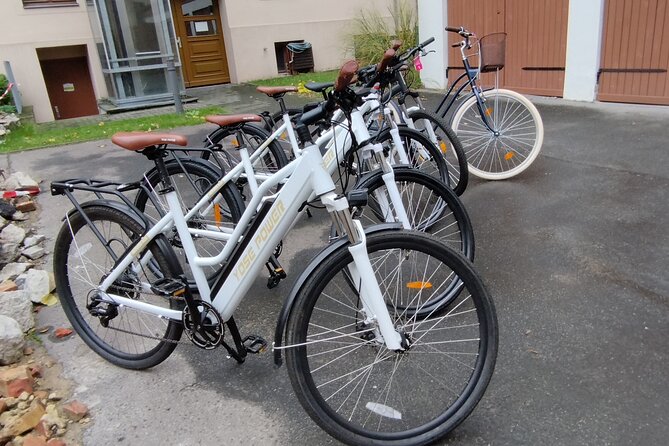
Here, you can cover those stretches by bike, e-bike, e-scooter, or rickshaw. An e-bike reduces the effort for longer stretches, while a normal bike suits someone who wants a more active ride. The e-scooter gives another option for riders comfortable with that format.
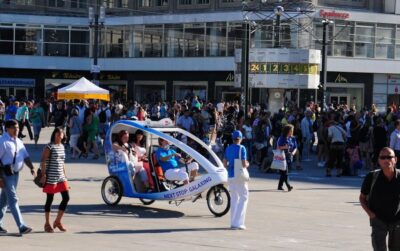
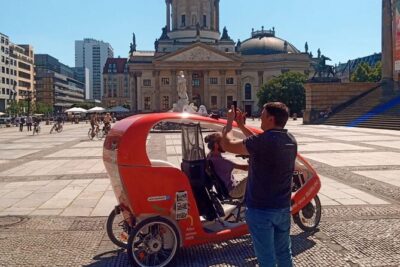
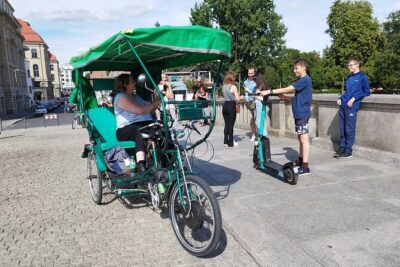
The rickshaw is the most distinctive choice. It can help a person with limited mobility stay part of a private group instead of waiting at the hotel or taking a separate vehicle. The tour description says you need only a few steps to enter, and the rickshaw can stop close to monuments for photographs. You may even remain seated while taking in some sights.
The vehicle setup also helps mixed-age groups. Parents can ride with children, stronger cyclists can use bikes, and someone who prefers not to pedal can use the rickshaw. The group still stops together and receives the same information.
One practical point: the experience is described as about three hours, while one account describes riding for more than three and a half hours. Treat three hours as the working plan, but allow extra time if your guide spends longer on questions or your group moves at a relaxed pace.
From the TV Tower to Berlin’s Old Center
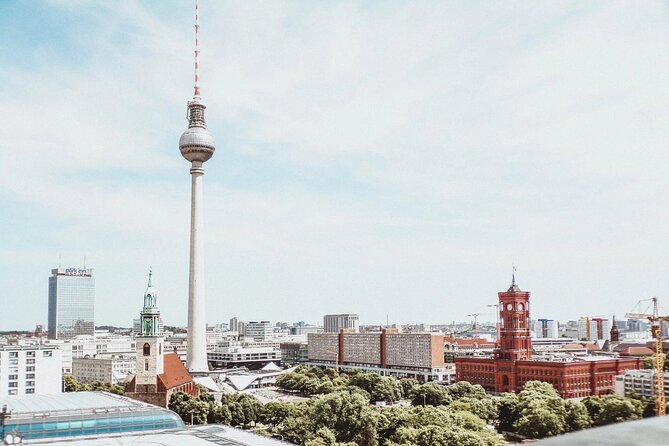
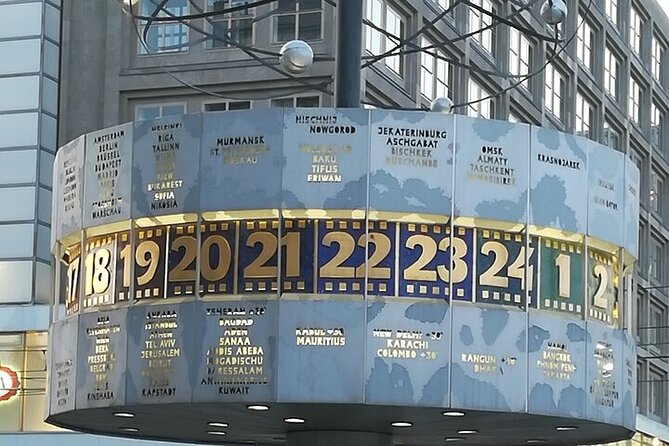
The TV Tower, or Fernsehturm, is a useful starting marker. Rising about 368 meters above Alexanderplatz, its silver sphere is one of the easiest sights to recognize in Berlin. It was built during the East German period and remains a strong symbol of the city’s modern identity.
You do not need to go up the tower for this tour. The value is the outside view and the guide’s explanation of why this structure matters. If you want the observation deck, restaurant, or 360-degree city view from about 203 meters, that is a separate visit and would not fit into this short riding itinerary.
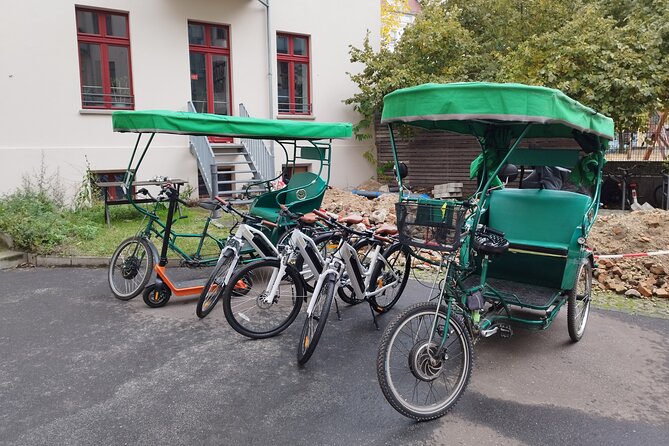
The route also passes Berlin’s City Hall, the Rotes Rathaus. Its red brick exterior and central role in city government make it a useful stop between modern Alexanderplatz and the older royal district. The guide can connect Berlin’s present-day administration with the city’s changing political story.
Next comes the Stadtschloss, or Berlin City Palace. The original palace began as a royal residence in the 15th century and was tied to the Hohenzollern rulers of Prussia. After severe wartime damage and later demolition, the site became the subject of a long argument about what Berlin should preserve and what it should leave behind.
The modern building, used for the Humboldt Forum, combines a Baroque-style exterior with modern interior spaces. The scheduled stop is about 15 minutes and has no admission charge. That is enough to understand the building’s unusual story and take photographs, but not enough to tour the interior in any meaningful way.
Museum Island and Unter den Linden
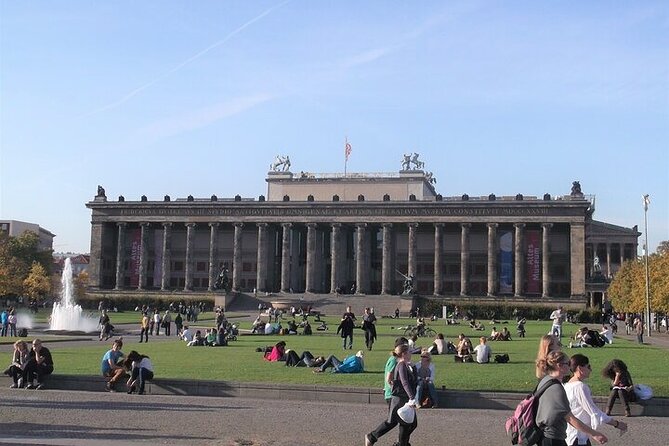
Museum Island is one of Berlin’s major cultural areas and a UNESCO World Heritage site. Several important museums sit together on the island, making this one of the best places to return to after the ride if you want art, archaeology, and longer indoor visits.
The tour allows about 20 minutes here. I see that as a quick orientation, not a museum tour. You get the setting, the architecture, and a sense of which museums you might choose later. Admission is not included, but no admission ticket is needed for the brief outside stop.
From there, the ride follows Unter den Linden, Berlin’s grand east-west boulevard. Its buildings reflect several periods, including Baroque, Neoclassical, and modern architecture. The route brings you past major landmarks such as the Berlin State Library and the Kronprinzenpalais.
Ten minutes is enough for a guide to point out the key buildings and explain how the boulevard links Museum Island with Brandenburg Gate. It is not enough to study every façade, so keep your camera ready and listen for the details that interest you most.
Bebelplatz brings a darker subject. In May 1933, Nazi authorities and supporters burned thousands of books here because they were labeled un-German. A memorial by Micha Ullman sits below ground level. Through a glass panel, you see empty bookshelves, a quiet reminder of censorship and the deliberate attack on free thought.
This is a brief stop of about ten minutes, but it deserves your attention. The memorial is easy to miss if you are rushing across the square. Ask the guide to explain what you are looking at, especially if children are with you. The subject is serious, but the site offers a clear way to discuss how propaganda and censorship affect ordinary life.
A few more Berlin tours worth weighing up
- Berlin: Thrilling E-Scooter Adventure Tour
★ 4.4 · 66 reviews - 2-H Berlin: Top Sights Guided E-Scooter Tour
★ 4.3 · 48 reviews - Berlin: Ultimate E-Scooter Adventure Tour
★ 4.5 · 35 reviews - Berlin: 3-H Top Sights Guided E-Scooter Tour
★ 4.6 · 33 reviews
Gendarmenmarkt and the Former Border
Gendarmenmarkt is one of Berlin’s most handsome squares, framed by the Konzerthaus, the French Cathedral, and the German Cathedral. The ten-minute stop gives you a quick look at the balanced architecture and the square’s role in Berlin’s cultural life.
The French Cathedral reflects the city’s Huguenot past. The German Cathedral completes the pair across the square, while the Konzerthaus sits between them. You will not attend a concert or visit the cathedral museums during this tour, but the guide can help you read the square as a whole rather than as three unrelated buildings.
Checkpoint Charlie changes the tone again. This was one of the best-known crossing points between East and West Berlin during the Cold War. The name came from the NATO phonetic alphabet, and the crossing became a symbol of the division between the American and Soviet sectors.
The guardhouse now at the site is a replica, with actors sometimes dressed as U.S. military police. That can make the stop feel theatrical, and you should know that the original Cold War checkpoint is not preserved here as an untouched historical scene. The nearby Mauermuseum offers more context, but its admission is not part of this tour.
The scheduled stop is about 15 minutes. That works well for a first explanation and a photograph, but anyone especially interested in the Berlin Wall or escape stories should return later with more time. The guide’s role is most useful here in separating the real history from the modern tourist display.
Nazi Berlin at the Topography of Terror
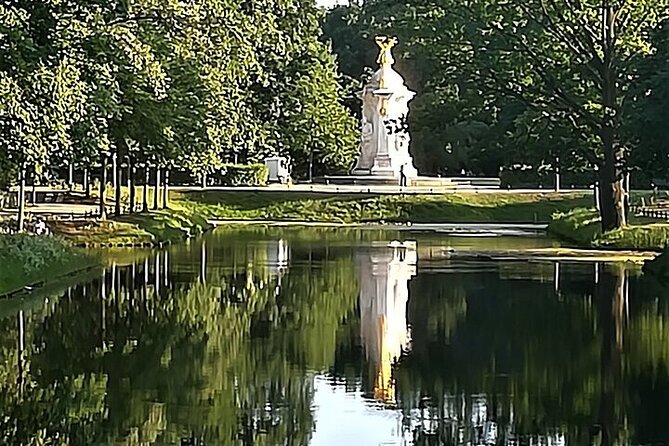
The Topography of Terror is one of the most important stops on the route. The museum occupies the former site of the Gestapo and SS headquarters and uses documents, photographs, and remaining traces of the buildings to explain Nazi crimes.
The tour allows about 20 minutes. I would treat that as an introduction rather than a full museum visit. The subject is too large for a quick stop, and the exhibits deserve quiet reading. Still, seeing the location in person helps connect the regime’s crimes to an actual place in central Berlin.
This is also where a private guide can add value. You can ask questions without holding up a large group, and the guide can adjust the explanation for adults or children. The experience described with Levi places strong emphasis on questions, humor, and making history understandable, but the guide should use a respectful tone at a site dealing with state terror and mass murder.
The nearby Führerbunker site is even less visible. The bunker complex lay beneath the former Reich Chancellery garden, where Hitler spent the final months of the Second World War. Today, the location is beneath a parking area near In den Ministergärten and Gertrud-Kolmar-Straße.
There is no visible bunker to enter. Much of the site was removed after the war to prevent it becoming a pilgrimage place for neo-Nazis. The ten-minute stop is therefore about orientation and explanation, not ruins or an underground tour. This is worth knowing so you do not arrive expecting a dramatic structure.
The Holocaust Memorial and Brandenburg Gate
The Memorial to the Murdered Jews of Europe is made up of 2,711 concrete slabs arranged across a sloping field. As you walk between them, the ground falls away and the city’s noise can feel more distant. The effect is intentionally uneasy and disorienting.
You have about ten minutes here. That is enough to enter the memorial and sense its design, but not enough for a slow visit or the underground information center. The memorial calls for quiet attention, and you may prefer to spend more time here after the tour rather than treating it as a quick photo stop.
The final major sight is Brandenburg Gate. Completed in 1791, the Neoclassical arch was commissioned by King Frederick William II of Prussia as a symbol of peace. Later, it became linked to imperial power, Nazi rule, Cold War division, and German reunification.
Its meaning changed with Berlin. During the Wall years, it sat near the divided city’s restricted zone. Today, it is one of the clearest symbols of a reunited capital. The ten-minute stop lets you see the gate and hear that broad story before returning to the starting point.
The route covers difficult subjects, from book burning and Nazi terror to the Holocaust and Cold War division. That makes the tour more than a light city ride. You should book it for historical context and a broad first look, not only for pretty buildings.
Guide Style, Families, and Dutch-Language Tours
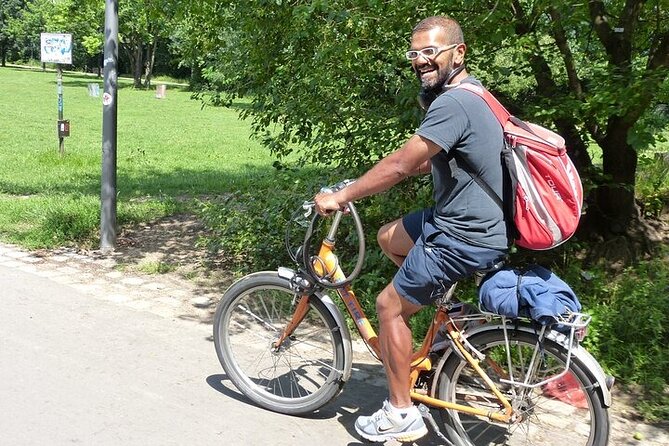
Guide Levi is the central personality of this experience. The information provided about his tours points to a personal style, a good sense of humor, and plenty of room for questions. He can also guide in Dutch, which is a major advantage for Dutch-speaking families or work groups.
The family angle is strong. Levi has been described as involving children in the explanations and using interesting stories rather than delivering a dry lecture. Water and pretzels may also be provided, though I would not treat snacks as guaranteed unless you confirm them when booking.
The private format gives you more control than a large group tour. You can ask for a photograph, pause for a question, or spend a little longer at a site if time allows. The tradeoff is that a private tour costs more than a shared walking tour, especially for a couple or solo visitor.
The included bottled water is useful on a moving tour, and WiFi on board is listed among the inclusions. An air-conditioned vehicle is also listed, though the exact role of that vehicle alongside the bikes and rickshaw is not explained. Ask for clarification if climate control or transport setup is important to you.
Who Gets the Best Value
I think this works best for a full group of friends, a family, or a small work group that wants one private experience. Six people sharing the group price receive much better value than one or two people paying the same total.
It is also a smart choice for mixed-mobility parties. The rickshaw lets someone with limited mobility stay close to the main sights, and the guide can stop near monuments for pictures. The activity notes that most people can participate, and it is near public transportation.
Cycling ability still matters. If you use a bike or e-bike, you should be comfortable riding in an urban setting. If you prefer not to cycle, select the rickshaw or discuss the vehicle plan before the day of the tour.
This is not the right pick if you want long museum visits, extensive time at each memorial, or a slow architectural walk. The route gives you a smart overview, but several stops last only 10 minutes. Plan follow-up visits to Museum Island, the Topography of Terror, or the Mauermuseum if those subjects catch your interest.
Booking Details and Cancellation
The experience is mobile-ticket based, and confirmation is provided at the time of booking. Free cancellation is available if you cancel at least 24 hours before the local start time. Within 24 hours, the payment is not refunded, and changes are not accepted.
The tour begins at Weinbergsweg 6, 10119 Berlin, Germany, and ends back at the meeting point. Since the route description also refers to meeting near the TV Tower, confirm the precise meeting instructions before setting out.
Lunch is not included. Three hours can pass quickly, so eat beforehand or plan food after returning. The ride includes bottled water, but no meal is part of the price.
Should You Book This Berlin Rickshaw and Bike Tour?
Book it if you want a private, flexible overview of Berlin Mitte, especially with six people, children, Dutch-speaking family members, or someone who finds walking difficult. The mix of vehicles is unusual and practical, while Levi’s humor and willingness to answer questions can make a long list of landmarks feel more personal.
Think twice if you are a couple watching every euro, or if you want to spend real time inside museums and memorial centers. The price is easiest to justify when divided among a full group, and the short stops are best viewed as an introduction.
My advice is to use this as your first Berlin orientation, then return on foot to the places that matter most to you. It gives you the big picture, saves tired legs, and leaves you with a clear plan for the rest of your visit.
FAQ
How long does the Berlin private vehicle tour last?
The tour is advertised as approximately three hours. One described experience lasted more than three and a half hours, so you should allow some extra time in case your group spends longer on questions or photographs.
Where does the tour begin and end?
The stated meeting point is Weinbergsweg 6, 10119 Berlin, Germany. The activity ends back at the meeting point. The route information also refers to the TV Tower as a meeting example, so confirm the exact pickup instructions before the tour.
How many people can join the private tour?
The tour is described as private for your group, with a stated capacity of up to six people. The included vehicle information refers to up to seven people, so groups larger than six should confirm the exact limit with the provider.
Which vehicles are available?
The vehicle options are regular bikes, e-bikes, e-scooters, and a rickshaw. The included setup lists two bikes, three e-bikes, and one rickshaw.
Is the tour suitable for someone with limited mobility?
Yes. The rickshaw is intended to help people who have trouble getting around. The activity says that entering requires only a few steps, and the rickshaw can stop close to monuments for photographs.
What happens if I need to cancel?
You receive a full refund if you cancel at least 24 hours before the local start time. Cancellations or changes made within 24 hours are not accepted and are not refunded.
Just added around Berlin
- Berlin Highlights in One Day★ 5.0 · 3 reviews
- Private Berlin One Day Tour with a Local: See the City Unscripted★ 3.5 · 3 reviews
- Individual city tour Berlin for max. 8 persons★ 5.0 · 3 reviews
- Transfer from Berlin Schönefeld Airport (SXF) to Berlin city Hotels – ROUND TRIP★ 4.0 · 3 reviews
- Berlin: Museum Island Tour★ 5.0 · 3 reviews
- Private Analogue Photography Experience in Berlin★ 5.0 · 3 reviews
- Berlin: Local Food Tour in Secrets Hidden Gems★ 4.0 · 3 reviews
- Berlin & The Third Reich Private Guided Tour★ 5.0 · 3 reviews
Berlin Rickshaw Tours, compared.
Individual City Tour – Rickshaw Sightseeing in Berlin
Read our review →
Rickshaw Tours Berlin – Groups of up to 16 people with several rickshaws
Read our review →
One Up to 3 Rickshaws(6 GUESTS)-Taylor Made Rickshaw Berlin Tour
Read our review →
Berlin Rickshaw Tours Historical & Photo City Tour 120min – Sightseeing
Read our review →Browse the lists this tour appears in