
Review · POTSDAM DAY TRIPS
Private taxi tour to Potsdam and Sanssouci 6-8h
Sanssouci is not one grand palace surrounded by empty lawns. It is a whole royal world spread across Potsdam: vineyard terraces, fountains, Roman ruins, a Chinese tea house, a Dutch neighborhood, and a Cold War spy bridge. Guide Gunter Bauer takes you from Berlin by private taxi and adjusts the day to your interests.
I like the door-to-door pickup, which saves you a train connection and lets you see far more than Sanssouci alone. I also like Gunter’s conversational approach, historical detail, and habit of taking photos at major sights. The main catch is pace: six to eight hours can feel tight if you want to enter many palaces, and most admissions are extra unless you choose Sanssouci+.
In This Review
- Key points to know before booking
- Why Potsdam works so well as a Berlin day trip
- Sanssouci Palace and the vineyard terraces
- Sanssouci Park, where the real wandering begins
- The New Palace and Prussian royal theater
- From royal retreat to Potsdam’s city center
- Cecilienhof and the 1945 Potsdam Conference
- Alexandrowka, the palaces by the lakes, and spy history
- What the private format adds
- Is the $179 price good value?
- Who should book this Potsdam tour?
- FAQ
- How long does the private Potsdam tour last?
- Where does pickup take place?
- What time does the tour start?
- Is the tour private?
- Is Sanssouci Palace admission included?
- Is Sanssouci Park admission included?
- Are parking and transportation included?
- What should I wear?
- Should you book it?
Key points to know before booking
- Private taxi from your Berlin accommodation: Your group rides in an air-conditioned vehicle, with parking included.
- Sanssouci is only part of the day: Expect Potsdam’s gates, Dutch Quarter, New Palace, Cecilienhof, and Cold War sites as well.
- Gunter Bauer leads the tour: He focuses on architecture, royal history, wartime damage, rebuilding, and unusual details.
- Castle admissions need attention: The basic tour includes Sanssouci Park, but palace interiors require separate tickets or the Sanssouci+ option.
- Wear proper walking shoes: Paths around the palaces are often unpaved, and the park is large.
- Flexible private format: You travel only with your own party, with room to request places such as Alexandrowka or a café stop.
Why Potsdam works so well as a Berlin day trip
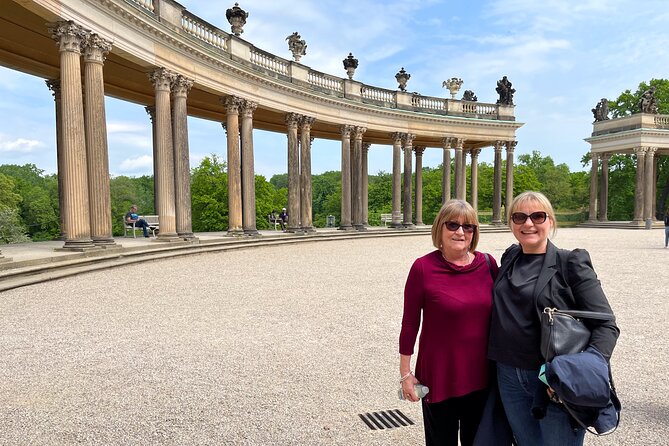
Berlin can feel heavy with museums, memorials, grand avenues, and twentieth-century history. Potsdam changes the mood. Here, Prussian kings built country residences where they could garden, play music, entertain philosophers, impress relatives, and escape Berlin’s court life.
This tour makes sense because Potsdam is spread out. The royal sites do not sit in one compact square. A private taxi cuts down the time spent changing trains or walking between distant parks, while still giving you plenty of time on foot.
The day begins around 10:30 a.m., with pickup from your hotel or accommodation. You are asked to wait indoors until Gunter sends an SMS or WhatsApp message, then come out to the street. Include a working mobile number when booking.
The route can last six to eight hours, though one particularly full outing reached about nine hours. That tells you something useful: the schedule has room to grow if you enjoy asking questions or add a stop. It also means you should not plan a tight evening reservation immediately afterward.
More Potsdam and Sanssouci days:
- Potsdam: City and Castles Tour
★ 4.7 · 3,721 reviews - Potsdam: Palace Tour by Boat
★ 4.5 · 2,369 reviews - Potsdam: Sanssouci Palace and Prussian Palaces Entry Ticket
★ 4.5 · 2,101 reviews
Sanssouci Palace and the vineyard terraces
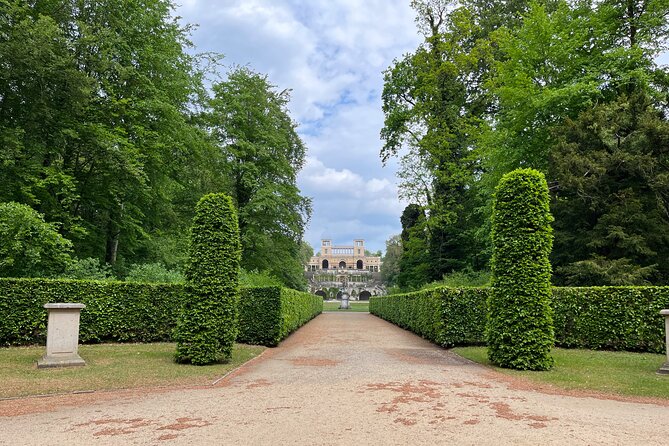
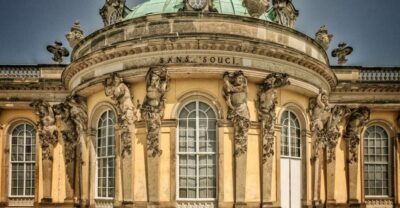
Sanssouci Palace is the emotional center of the tour. Frederick the Great wanted a retreat that felt private rather than imposing, and the result is surprisingly small. The rococo palace has only eight main rooms, each opening toward the garden.
That small scale is part of its charm. This was not a residence designed for a huge court. Frederick came here with his dogs, musicians, and selected male visitors, including the French philosopher Voltaire. French was the language of conversation, and the king played the flute and composed music.
The palace sits above a long run of vineyard terraces. The vines were protected behind glass, an ingenious answer to Potsdam’s northern climate. The arrangement gives you the famous postcard view: the palace above, the terraces below, and the fountain aligned in front.
The main stop at Sanssouci Palace is listed at about 30 minutes, with admission not included. That is enough for an exterior visit and an introduction, but not enough for a slow palace inspection if you want to study every room. If interiors matter to you, choose the Sanssouci+ option or confirm exactly which admission is included in your booking.
At the foot of the terraces, the large fountain is supplied by a higher pond. Frederick’s builders disguised the engineering with the Ruinenberg, a theatrical ruined structure. It looks like a romantic relic, but it also hides a very practical water system.
The historic windmill adds a good human story. Its owner fought the king in court over the mill and won at the first stage. The building still grinds grain, and a visit offers a fine view across the park. Only about 10 minutes are assigned here, and the mill’s own admission is not included, so treat it as a quick stop unless you arrange more time.
Sanssouci Park, where the real wandering begins
The park links the vineyard and Sanssouci Palace to the New Palace over roughly two kilometers. This is where the day becomes less about checking off buildings and more about following royal taste through gardens, paths, fountains, and small structures.
The park stop is listed at 45 minutes and admission is included. That is useful, but it is also the clearest sign that the standard schedule favors an overview. You can see the main design and several highlights, but the park rewards extra time.
The Chinese House is one of the most memorable small buildings. It was not simply a tea pavilion. Gold decoration, Chinese porcelain, and life-sized gilded figures created an eighteenth-century European fantasy of China. It is ornate, playful, and easy to appreciate even if you know little about garden design.
The Roman Baths continue the park’s love of imagined antiquity. Bathing was not really the point. These buildings were made to please the eye and feed the imagination, much like the grottoes, colonnades, and romantic ruins found in other royal gardens of the period.
The Orangery Palace occupies the ridge and gives a broad view over the grounds. Its practical role was to shelter exotic plants in winter, but it was designed as another grand visual marker. The same blend of usefulness and display runs through almost every building here.
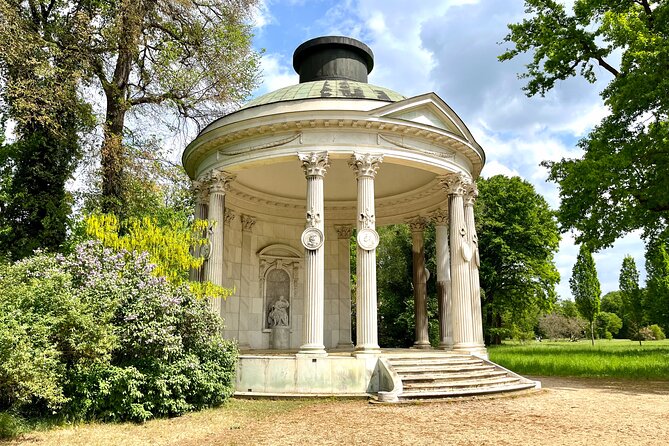
The Friendship Temple offers a smaller, more intimate stop. These garden buildings were often destinations for a short walk, a picnic, or a private meeting. They help you understand that the park was meant to be used, not simply admired from a distance.
The New Palace and Prussian royal theater
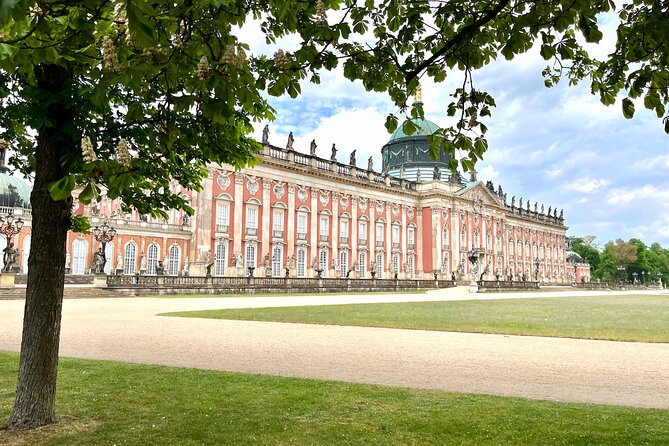
At the western end of the park, the New Palace delivers a different kind of royal message. Frederick the Great reportedly dismissed its showy style as fanfanery, or boastful display. That was exactly the point: the palace was meant to impress relatives and visiting rulers after the Seven Years’ War.
The New Palace contains about 600 rooms, divided into apartments for royal family members. These included reception rooms, music rooms, bedrooms, writing rooms, and some early bathrooms tucked into small adjoining cabinets. Kitchens were kept in separate service buildings, called the Communs, so cooking smells would not reach the royal apartments.
You can see the social structure in the architecture. The grand palace housed the family and formal guests, while servants, kitchen workers, guards, and officers occupied the buildings around the courtyards. Today, parts of the Communs are connected with the University of Potsdam, giving students an unusual academic address.
The New Palace is one of the places where admission matters. A taxi tour can show you the exterior and grounds, but the interior visit requires a ticket. Ask before booking if you want the New Palace included, since the general description separates included park access from palace admissions.
Another curious feature is the so-called mosque, which hides the chimney of a steam-powered electrical plant. The technology was modern, but the industrial machinery was disguised in a romantic oriental form. It is a perfect Potsdam detail: practical infrastructure dressed up as fantasy.
A few more Berlin tours worth weighing up
- Berlin: Private Reichstag and Glass Dome Tour
★ 4.8 · 2,226 reviews - Berlin Private Complete History All Day Walking Tour
★ 5.0 · 474 reviews - Private Walking Tour Berlin Third Reich Hitler and World War II
★ 5.0 · 360 reviews - Private Berlin: Iconic Sights and Hidden Gems Walking Tour
★ 5.0 · 292 reviews
From royal retreat to Potsdam’s city center
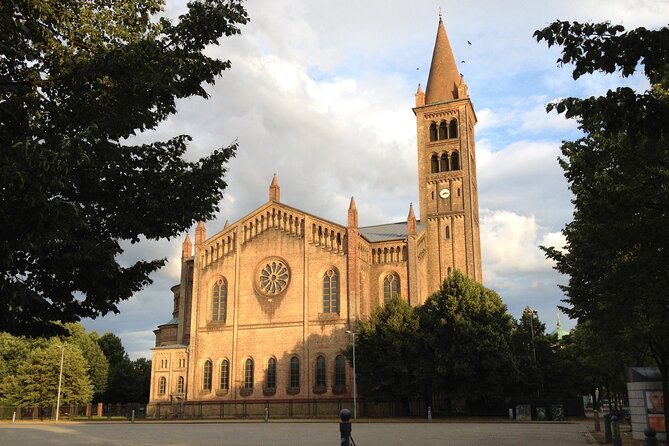
After the park, the tour moves into Potsdam itself. The city has its own Brandenburg Gate, built in the classical style and smaller than Berlin’s famous gate. The Nauen Gate is more imposing, with medieval Romanesque forms and towers that rise above the lower buildings around it.
The square by Nauen Gate has cafés and restaurants, making it a sensible place for a break. Snacks are not included, so plan to buy your own food or ask Gunter about a café stop. One outing included coffee and Viennese cakes at Café Heider in the Dutch Quarter, and another added a restaurant visit in Alexandrowka at the group’s request.
The Dutch Quarter is one of Potsdam’s most enjoyable walks. Frederick William I brought Dutch canal builders and skilled workers to Prussia, and the red brick homes created for them still give the district a clear Dutch character. Small shops, cafés, bars, craft businesses, and antique stores make this more than a row of decorative façades.
Potsdam’s main pedestrian street continues the same theme. Baroque townhouses, small independent shops, and an Art Nouveau glass roof create a city center that is easy to explore on foot. The streets were laid out in strict geometric blocks, so you can wander without losing the sense of order that shaped royal Potsdam.
The City Palace and Garrison Church also carry the marks of war and later political change. Both disappeared from the city center after wartime damage and socialist-era rebuilding plans. The City Palace has since been reconstructed with a baroque exterior and now houses the Brandenburg state parliament.
The Garrison Church is being carefully recreated as well. The rebuilding has drawn support from private patrons, including Günter Jauch and Hasso Plattner. This part of Potsdam is worth seeing because it raises a real question: how should a city rebuild buildings tied to monarchy, war, religion, and political memory?
Cecilienhof and the 1945 Potsdam Conference
Cecilienhof Palace lies away from the main Sanssouci group, so it is easy to miss without a vehicle. Built for Crown Prince Wilhelm and Crown Princess Cecilie, it looks like an English country house rather than a traditional Prussian palace.
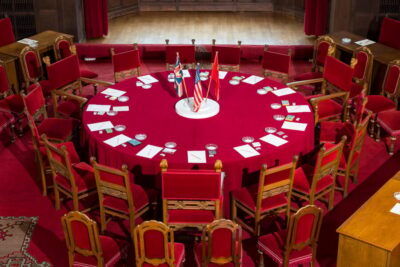
Inside, it offered modern comforts such as central heating and bathrooms. A room designed to resemble a ship’s cabin reflected Cecilie’s love of sea travel. But the palace is best known for what happened there in 1945, when Stalin, Truman, and Churchill met at the Potsdam Conference.
The conference room remains furnished in its historic arrangement, and the outdoor setting is part of the visit. This stop gives the day a sharp change in focus. You move from Frederick the Great’s private retreat to the political decisions that shaped postwar Europe.
If twentieth-century history is your priority, tell Gunter early. His tour can include the conference site while still covering the royal buildings. If your main interest is rococo interiors and gardens, you may need to limit other stops because Potsdam offers more than one full day’s worth of material.
Alexandrowka, the palaces by the lakes, and spy history
The route can include additional sights depending on time and your interests. Alexandrowka, a Russian colony of wooden homes, recalls a gift exchange between Prussian and Russian rulers. Its residents were connected with a Russian choir that performed for a royal wedding, and descendants are still said to live there.
Babelsberg Palace is another major highlight. Built in an English medieval style for the crown prince and his wife Augusta, it later became associated with Kaiser Wilhelm II. Its towers and battlements look like storybook architecture, while the views over Potsdam’s royal sites explain why it was placed on a hill.
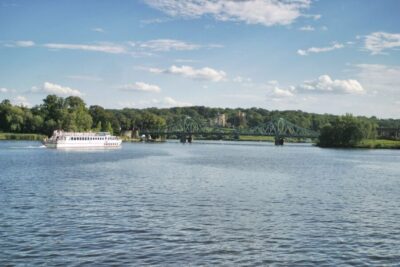
Glienicke Bridge adds modern political drama. During the Cold War, it marked the border between West Berlin and East Germany and became famous for the exchange of spies and prisoners between the United States and the Soviet Union. Hollywood later used the bridge as a film setting, but its real history is more compelling than its screen image.
On the Berlin side, Glienicke Palace sits near the bridge and the water crossing between the Tiefen See and Griebnitzsee. Its Italian design, formal courtyard, and separate casino reflect the taste of Prince Carl, who used the property as a retreat.
These additions are valuable because they show Potsdam as more than a palace park. They connect royal leisure, immigration, twentieth-century power, and Cold War borders. The tradeoff is time. You cannot give every palace a full visit during a single six-to-eight-hour outing.
What the private format adds
Gunter’s greatest strength is the amount of context he can provide while driving between sites. He explains buildings damaged in the war, points out different architectural styles, and connects Potsdam’s royal past with Berlin’s wider story.
The commentary is conversational rather than a fixed script. That suits you if you enjoy stopping to ask why a building looks Italian, why a ruin was built beside a pond, or why a palace’s kitchen was kept far away. It is less ideal if you prefer long, quiet stretches with little explanation.
The private format also helps solo visitors and families. You can set the pace, ask for photographs, and request a place such as Alexandrowka or a café. Gunter has been praised for taking photos at important sites and sending them afterward, a small service that is especially useful when you are traveling alone.
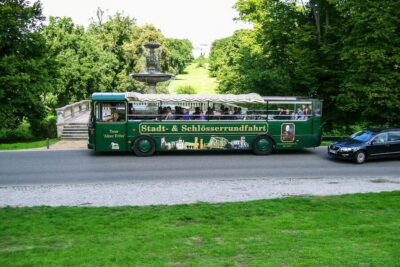
The vehicle is air-conditioned, parking fees are included, and pickup is available at your hotel or apartment. Baby car seats can be requested. Service animals are allowed, and most people can take part, but the walking paths mean you should bring sturdy shoes rather than sandals.
Dogs can ride under stated conditions, though large dogs may use the rear space and leave no room for luggage. Strollers must have a removable cradle and foldable frame, with reduced space for suitcases.
Is the $179 price good value?
At about $179.01 per person, this is not the cheapest way to reach Potsdam. Public transport costs less, and independent visitors can walk through much of the park without paying for a private guide.
The value comes from what the price combines: pickup, private transport, parking, a dedicated guide, and a route covering both Sanssouci and wider Potsdam. Taxi travel is charged with 7 percent VAT, while the city tour carries 19 percent VAT, and both are included.
The calculation improves with a small group because the experience is private and group discounts are offered. It also makes more sense if you want several distant stops in one day, or if changing trains and buses would be tiring.
Remember to budget for palace admissions and food. The standard arrangement does not include snacks, and admission to Sanssouci Palace, the New Palace, the windmill, and other interiors may not be covered unless you select the Sanssouci+ option. Confirm the exact ticket package before paying.
Who should book this Potsdam tour?
I would choose this tour if you want a broad introduction to Potsdam, prefer door-to-door travel, or care as much about stories and architecture as about entering every palace. It is also a strong choice for solo visitors who want control over the pace and help with photographs.
Families may appreciate the private vehicle and flexible stops. History-minded visitors get a useful sweep from Frederick the Great through the 1945 conference and the Cold War. Architecture fans will find rococo, baroque, classical, Italian, Dutch, English medieval, Chinese, Roman, and mosque-inspired forms in one day.
I would hesitate if your goal is a slow, detailed palace study. Six to eight hours passes quickly, and the itinerary contains enough sites to tempt you into rushing. For that kind of visit, ask Gunter to focus on fewer interiors, perhaps Sanssouci, the New Palace, and Cecilienhof.
Free cancellation is available up to 24 hours before the start time. The tour is offered in English, with mobile tickets and confirmation at booking.
FAQ
How long does the private Potsdam tour last?
The tour lasts approximately six to eight hours. A particularly full day can run longer, so avoid scheduling an evening activity too close to the expected return.
Where does pickup take place?
Pickup is available from your hotel, apartment, or another desired location in Berlin. Wait inside until Gunter sends an SMS or WhatsApp message, then come out to the street.
What time does the tour start?
The stated start time is 10:30 a.m.
Is the tour private?
Yes. Only your own group participates in the activity.
Is Sanssouci Palace admission included?
Admission to Sanssouci Palace is not included in the standard arrangement. You can book the Sanssouci+ option, which includes admission fees for all castle tours.
Is Sanssouci Park admission included?
Yes. The listed Sanssouci Park stop includes admission.
Are parking and transportation included?
Yes. The air-conditioned vehicle, parking fees, taxi ride, and city tour are included in the stated tour arrangement.
What should I wear?
Wear good walking shoes. Many paths in the park and around the palaces are unpaved, so sandals are not recommended.
Should you book it?
Book this tour if you want Potsdam in one well-organized day and value a private guide more than the lowest possible price. Gunter Bauer’s strength is connecting small details, such as a hidden water system or a disguised power plant, to the larger story of Prussian life.
Before booking, decide what matters most: palace interiors, gardens, Cold War history, or city streets. Tell Gunter your priorities, confirm which admissions are included, and leave room for a café stop. With that planning, this private taxi tour can give you both Sanssouci’s beauty and a far more complete sense of Potsdam.
Just added around Berlin
- Berlin Highlights in One Day★ 5.0 · 3 reviews
- Private Berlin One Day Tour with a Local: See the City Unscripted★ 3.5 · 3 reviews
- Individual city tour Berlin for max. 8 persons★ 5.0 · 3 reviews
- Transfer from Berlin Schönefeld Airport (SXF) to Berlin city Hotels – ROUND TRIP★ 4.0 · 3 reviews
- Berlin: Museum Island Tour★ 5.0 · 3 reviews
- Private Analogue Photography Experience in Berlin★ 5.0 · 3 reviews
- Berlin: Local Food Tour in Secrets Hidden Gems★ 4.0 · 3 reviews
- Berlin & The Third Reich Private Guided Tour★ 5.0 · 3 reviews
Potsdam Day Trips, compared.
Sanssouci Palace and Prussian Palaces Entry Ticket
Read our review →
Sachsenhausen Concentration Camp and Potsdam Tour
Read our review →
Browse the lists this tour appears in