
Review · BERLIN RICKSHAW TOURS
Rickshaw Tour-Cruise Ship guests arrive 9.30 upto 11.30 am Berlin
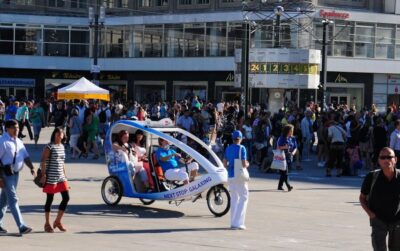
Berlin’s central sights line up remarkably well for a private rickshaw tour. You start near the TV Tower at Alexanderplatz and roll through the city’s biggest chapters, from Prussian Berlin to the Nazi era, the Berlin Wall, and today’s government district. It is sightseeing with a moving front-row seat rather than a bus window.
I like the flexible route and the easy access. Your guide can adjust the beginning, stops, and focus around your interests, while the rickshaw can get close to monuments and pause for photographs. The main consideration is time: three hours gives you a useful overview, but most stops are brief and major museums are viewed from outside.
In This Review
- Key points to know before you book
- Why a rickshaw works so well in Berlin Mitte
- From the TV Tower to Museum Island
- Unter den Linden and the book-burning memorial
- Gendarmenmarkt and Berlin’s grand civic face
- Checkpoint Charlie and the former Wall border
- Topography of Terror and Potsdamer Platz
- The Holocaust Memorial and Brandenburg Gate
- The Reichstag, Sinti and Roma memorial, and government district
- The Führerbunker site and the royal street
- What three hours really gives you
- Comfort, access, and pickup details
- Who will get the most from this tour
- Should you book the Berlin rickshaw tour?
- FAQ
- How long does the Berlin rickshaw tour last?
- What is the price of the tour?
- Is hotel pickup available?
- Can cruise ship passengers use this tour?
- Is the tour private?
- Which Berlin sights are included?
- Are museum and monument admission tickets included?
- Is the tour suitable for someone with limited mobility?
- What refreshments are included?
Key points to know before you book
- Alexanderplatz start: Begin beneath Berlin’s famous TV Tower, then follow a logical route through historic Mitte.
- Private experience: The price is $264.35 for up to two people, with only your party in the rickshaw.
- Strong history focus: Expect clear context at Bebelplatz, Checkpoint Charlie, the former Gestapo and SS headquarters, the Holocaust Memorial, and the Reichstag.
- Useful for limited mobility: You can enter in just a few steps, bring a walker, and stop close to sights for photographs.
- Flexible duration: The advertised ride lasts about three hours, while two-hour, four-hour, and full-day arrangements are also described.
- Cruise-friendly timing: Pickup can be arranged for Berlin cruise ship arrivals between 9:30 and 11:30 a.m., subject to the agreed meeting point.
Why a rickshaw works so well in Berlin Mitte
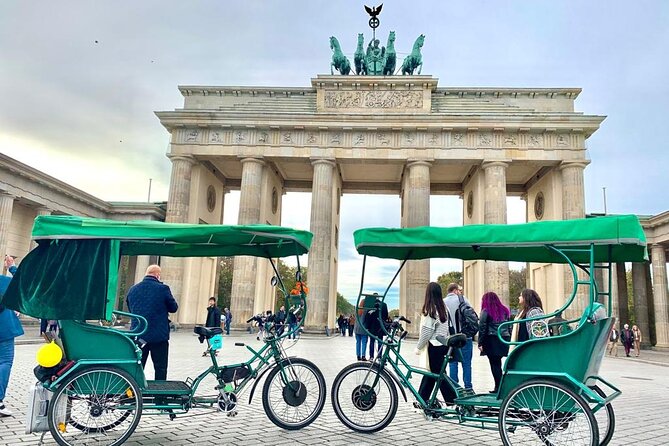
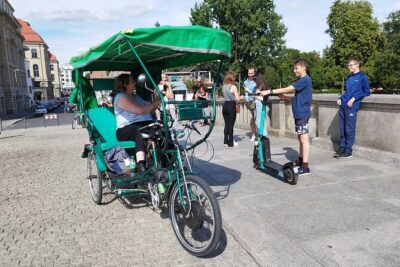
Berlin’s center is spread out enough to make walking tiring, yet compact enough that a small vehicle can connect the major sights quickly. A rickshaw gives you the useful middle ground. You are outside, close to the streets, and able to stop far more easily than a coach.
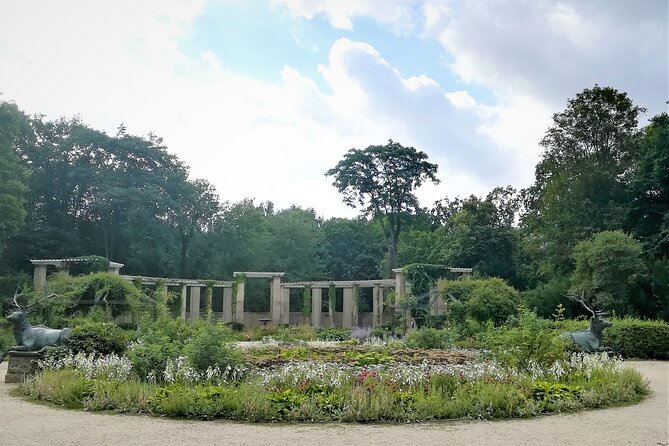
I especially like the chance to pass through places that do not fit neatly into a standard bus route. One four-hour arrangement includes Tiergarten Park and the River Spree, and a rickshaw can use smaller routes that make the ride feel less mechanical. You are not simply being delivered from one major monument to the next.
The private format also matters. Your guide can spend more time on subjects you care about, such as the Third Reich, the Berlin Wall, royal Berlin, architecture, or modern reunification. Guides named in the tour information include Levent Aydin, Gregor, and Levi. Their approach includes history, personal service, humorous stories, and help with photographs.
The price is $264.35 per group of up to two people. That is not a cheap way to get from one place to another, but it can be fair value if you want a private guide and an efficient first look at central Berlin. You are paying for the driver-guide, the vehicle, the tailored route, pickup, and the ability to stop close to sights.
More rickshaw rides in Berlin:
- Berlin: Private Guided E-Rickshaw Tour
★ 4.9 · 157 reviews - Individual City Tour – Rickshaw Sightseeing in Berlin
★ 5.0 · 120 reviews - Berlin Express: Private 1-Hour E-Rickshaw Ride
★ 5.0 · 116 reviews
From the TV Tower to Museum Island
The tour begins at the Berliner Fernsehturm, Berlin’s 368-meter TV Tower on Alexanderplatz. You do not need to go up the tower for this experience, and admission is not included. Still, it is a strong starting point because the square gives you an immediate sense of Berlin’s postwar scale.
From Alexanderplatz, the rickshaw passes the Red Town Hall, St. Mary’s Church, and Neptune Fountain before reaching Museum Island. This opening stretch gives you a quick visual shift from the broad socialist-era square to the older core of Berlin.
Museum Island is a UNESCO World Heritage Site and one of the city’s most important cultural areas. From the rickshaw, you can see the Berlin Cathedral, the reconstructed City Palace, the Old Museum, the Old National Gallery, the Pergamon Museum, and the Bode Museum.
The stop is listed as about ten minutes, so think of it as an introduction and photo opportunity rather than a museum visit. Admission to the outdoor stop is free, but individual museums require their own tickets. If you want to enter a museum, ask about a longer or full-day version before booking.
Unter den Linden and the book-burning memorial
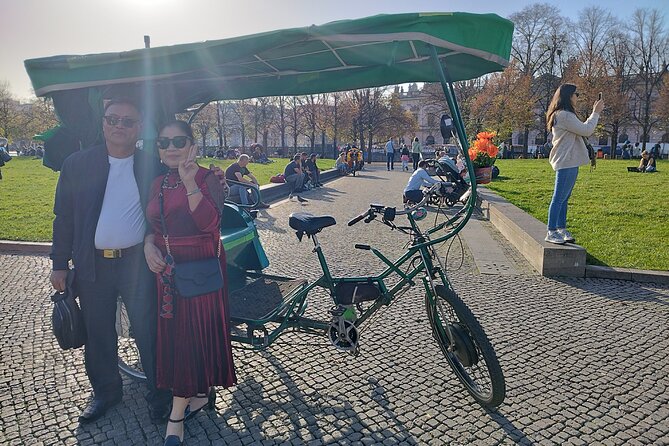
The route continues along Unter den Linden, Berlin’s grand royal boulevard. The avenue connects Museum Island with the Brandenburg Gate and gives you a useful sense of how the city’s political and ceremonial center was laid out.
You then reach Forum Fridericianum, an important group of buildings that includes the State Opera, Humboldt University, the State Library, and St. Hedwig’s Cathedral, Berlin’s first Catholic church. This is one of the places where the guide’s explanation can make a real difference, since the buildings are close together but represent different parts of Berlin’s intellectual, royal, and religious life.
At Bebelplatz, a memorial recalls the Nazi book burning of May 10, 1933. The event involved the destruction of roughly 25,000 books. The memorial is set into the square, and its design is easy to miss if you do not know where to look.
The stop lasts about ten minutes. That is enough for an explanation and a photograph, but not for a long visit to the surrounding buildings. I would pay close attention here because the square looks open and calm today, while its historical meaning is severe.
Gendarmenmarkt and Berlin’s grand civic face
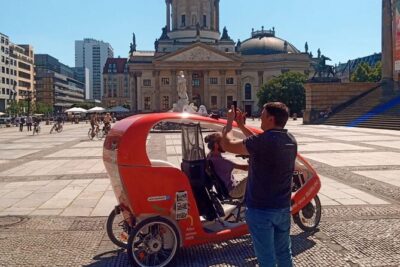
Gendarmenmarkt is one of the prettiest squares in central Berlin. The former Royal Concert Hall sits between the German Cathedral and French Cathedral, creating a formal composition that feels very different from Alexanderplatz’s wide modern spaces.
The rickshaw stop is about ten minutes, with free admission to the square. You can take in the facades and hear how the square fits into Berlin’s former royal center without spending time queuing or arranging transport.
Gendarmenmarkt can be affected by restoration work or events, so the exact view may change. The tour’s flexible style helps here, since your guide can update the route’s opening or emphasis if conditions change.
More boat trips in Berlin:
- Berlin: 1-Hour City Tour by Boat with Guaranteed Seating
★ 4.3 · 16,993 reviews - Berlin: Boat Tour Along the River Spree
★ 4.4 · 11,252 reviews - Berlin: 3.25-Hour Spree & Landwehrkanal Boat Tour
★ 4.6 · 4,311 reviews - Berlin: Hop-On Hop-Off Sightseeing Bus with Boat Options
★ 4.3 · 4,012 reviews
Checkpoint Charlie and the former Wall border
Checkpoint Charlie is one of Berlin’s best-known Cold War sites. The former crossing once marked a tense border between East and West Berlin and became associated with the possibility of a much wider conflict.
Your stop is short, around five minutes, and admission is free. That makes it ideal for a quick explanation and photograph, though you should not expect a museum visit. The current checkpoint display is surrounded by commercial activity, so the historical background is more valuable than the small guardhouse-style attraction itself.
The rickshaw then follows part of the former border strip to the Topography of Terror. Along the way, you can see original sections of the Berlin Wall. This is a useful contrast to Checkpoint Charlie because the Wall remnants give you a more direct sense of the physical barrier that divided the city.
Topography of Terror and Potsdamer Platz
The Topography of Terror documentation center occupies the former headquarters area of the SS and Gestapo. It deals with the machinery of Nazi persecution, making it one of the most serious stops on the route.
The tour includes a five-minute stop outside, with free admission. If this subject is important to you, consider booking extra time. Five minutes allows for orientation, but the documentation center deserves much longer if you plan to read its displays.
Nearby are Martin-Gropius-Bau, known for major exhibitions, and the former Prussian Parliament. The route then moves to Potsdamer Platz, a symbol of Berlin’s postwar division and reconstruction.
Potsdamer Platz was once heavily damaged and later became one of Europe’s largest construction zones. Today, its skyscrapers and futuristic buildings, including the Sony Center, show a very different Berlin. The stop lasts about ten minutes. It is good for seeing how quickly Berlin can change from one architectural period to another.
The Holocaust Memorial and Brandenburg Gate
The Memorial to the Murdered Jews of Europe consists of a large field of concrete slabs near the Brandenburg Gate. It commemorates the murder of more than six million Jews under National Socialism.
You can walk among the slabs, or simply view the memorial from the rickshaw if mobility is limited. The stop is about ten minutes and admission is free. The underground information center is separate, so ask if you want time there. The memorial is more effective when you move quietly through it rather than treat it as a quick photo backdrop.
The Brandenburg Gate follows naturally. This neoclassical landmark once marked the edge of Berlin and later became a powerful symbol of division and reunification. It is one of the city’s essential photographs, but the guide’s historical explanation is what gives the site real weight.
Because the gate is a major public space, conditions can be crowded. A rickshaw helps by bringing you close and saving you a long walk between nearby sights.
The Reichstag, Sinti and Roma memorial, and government district
After the Brandenburg Gate, the route enters Berlin’s government district. You see the Reichstag, home of the Bundestag, and the Chancellery area. The tour also includes the Memorial to the Sinti and Roma of Europe Murdered under National Socialism.
The Reichstag is free to visit in some circumstances, but this rickshaw experience does not include entry. The stop is about five minutes, so you will view the building from outside. If you want to visit the dome or interior, arrange that separately and allow more time.
The government district is a useful final chapter for the historical route. You have seen royal institutions, dictatorship, division, and now the buildings of modern German democracy. The distance between these places is short by rickshaw but meaningful in political terms.
The Führerbunker site and the royal street
The itinerary also includes a parking stop at the Führerbunker site, listed at around ten minutes. There is no visible bunker interior to visit here. The value comes from understanding the location and the events connected with the final days of the Nazi regime.
The route returns toward Unter den Linden, the former royal street, and the Opera House. This gives you another look at the boulevard from a different part of the tour. The exact order can change because the operator adjusts the program to your chosen duration and interests.
The Berlin Cathedral appears again as a final major sight. Its dome and elaborate exterior make it one of the most recognizable buildings on Museum Island. The Cathedral stop is listed at about ten minutes, with admission free for the outdoor visit. Entrance inside is not included.
What three hours really gives you
The standard duration is about three hours, though the stop list contains many locations. You should treat this as a panoramic introduction, not a series of full visits.
Some stops last only five minutes, while others last ten. That rhythm works well for photographs and orientation. It is less suitable if you want to read museum exhibits, enter churches, or spend quiet time at memorials.
The operator describes a two-hour version focused on the historical highlights of Berlin-Mitte. A four-hour route can add Tiergarten Park and the River Spree, giving you more space between the main sights. A full-day booking can include places such as the East Side Gallery, museum access, and less familiar parts of Berlin.
For a first visit, I would choose three or four hours. Two hours may feel rushed if you want explanations at the memorials. A full day makes sense only if you want a private vehicle and guide for a much wider plan.
Comfort, access, and pickup details
Pickup is offered from your hotel or another agreed meeting point. For cruise ship arrivals, the stated arrival window is 9:30 to 11:30 a.m. Confirm the exact pickup time and location when booking, especially if your ship schedule is tight.
The rickshaw has a cozy blanket, bottled water, Berlin sparkling wine, Berlin beer, and soft drinks. Berlin weather can shift quickly, so the blanket is a useful touch, particularly during a cold or windy ride. Tips are not included.
This is one of the better options in the supplied information for someone who cannot manage long walks. Entry takes only a few steps, a walker can be carried, and the vehicle can stop close to monuments for photographs. You can also remain seated and view some sights without getting out.
That does not mean the ride is fully step-free or suitable for every mobility need. Ask the operator about your specific situation before booking. The information says most people can participate and that the tour is near public transportation.
For groups of three or four, two rickshaws are arranged. Groups of five or six use three rickshaws, and larger groups should contact the operator about additional vehicles. The price shown applies to one group of up to two people.
Who will get the most from this tour
I would recommend this ride to a couple who wants a private overview on the first day in Berlin, especially if walking is difficult or time is limited. It also suits cruise ship passengers who need a clear route through central Berlin before returning to the ship.
History-minded visitors should find the route particularly useful. The sequence from Museum Island to Bebelplatz, the Wall border, Nazi sites, the Holocaust Memorial, and the Reichstag gives you a strong framework for later visits.
Families may appreciate the short stops and open-air format, though the serious memorials require a respectful pace. You can ask the guide to keep the explanations lively and adjust the balance between history, architecture, and photographs.
I would not choose this as your only Berlin experience if you mainly want museum interiors or long visits at memorials. Instead, use it to get oriented, then return on foot or by public transport to the places that deserve more time.
Should you book the Berlin rickshaw tour?
Book it if you want private, flexible sightseeing with a guide who can bring the vehicle close to the sights and adapt the route to your interests. Levent Aydin, Gregor, and Levi are named as guides associated with the experience, and the service includes pickup, refreshments, blankets, and a route built around your group.
The strongest reason to choose it is efficiency without giving up the street-level view. The main caution is that $264.35 for two people is a premium price, and the short stops do not replace museum visits.
For a first look at Berlin-Mitte, limited walking, or a cruise stop, I think the value can be strong. Ask for four hours if you want Tiergarten and the River Spree, or book a longer day if the East Side Gallery, museums, and less familiar districts matter more than simply checking off the main sights.
FAQ
How long does the Berlin rickshaw tour last?
The listed experience lasts about three hours. The operator also describes two-hour, four-hour, and full-day options, depending on your interests and the distance you want to cover.
What is the price of the tour?
The price is $264.35 per group of up to two people. Tips are not included.
Is hotel pickup available?
Yes. Pickup is offered from your hotel or another agreed meeting point. The tour ends back at the meeting point.
Can cruise ship passengers use this tour?
Yes. The supplied timing is for Berlin cruise ship guests arriving between 9:30 and 11:30 a.m. Confirm the exact meeting point and start time with the operator.
Is the tour private?
Yes. Only your group participates in the private activity.
Which Berlin sights are included?
The route can include the TV Tower and Alexanderplatz, Museum Island, Bebelplatz, Gendarmenmarkt, Checkpoint Charlie, the Topography of Terror, Potsdamer Platz, the Holocaust Memorial, Brandenburg Gate, the Reichstag, the Führerbunker site, Unter den Linden, the Opera House, and Berlin Cathedral.
Are museum and monument admission tickets included?
The listed stops have free outdoor admission or no admission ticket included. Entry to the TV Tower, museums, and other indoor sites is not included.
Is the tour suitable for someone with limited mobility?
The operator describes it as suitable for less mobile people. You enter the rickshaw in a few steps, a walker can be carried, and the vehicle can stop close to monuments. Ask the operator about your specific mobility needs before booking.
What refreshments are included?
The tour includes a cozy blanket, bottled water, Berlin sparkling wine, Berlin beer, and soft drinks.
Just added around Berlin
- Berlin Highlights in One Day★ 5.0 · 3 reviews
- Private Berlin One Day Tour with a Local: See the City Unscripted★ 3.5 · 3 reviews
- Individual city tour Berlin for max. 8 persons★ 5.0 · 3 reviews
- Transfer from Berlin Schönefeld Airport (SXF) to Berlin city Hotels – ROUND TRIP★ 4.0 · 3 reviews
- Private Analogue Photography Experience in Berlin★ 5.0 · 3 reviews
- Berlin: Museum Island Tour★ 5.0 · 3 reviews
- Berlin: Local Food Tour in Secrets Hidden Gems★ 4.0 · 3 reviews
- Berlin & The Third Reich Private Guided Tour★ 5.0 · 3 reviews
Berlin Rickshaw Tours, compared.
Individual City Tour – Rickshaw Sightseeing in Berlin
Read our review →
Rickshaw Tours Berlin – Groups of up to 16 people with several rickshaws
Read our review →
One Up to 3 Rickshaws(6 GUESTS)-Taylor Made Rickshaw Berlin Tour
Read our review →
Berlin Rickshaw Tours Historical & Photo City Tour 120min – Sightseeing
Read our review →Browse the lists this tour appears in