
Review · BERLIN RICKSHAW TOURS
Promotion Berlin Rickshaw Shared Guide (Combo Vehicle Group)
Berlin’s historic centre is spread across wide avenues, parks, squares, and memorial sites. This rickshaw tour gives you a comfortable seat while your guide pedals between the major sights, stopping for photos and stories along the way. It is a smart way to cover ground without spending four hours on foot.
I like the easy access to places such as Museum Island, Checkpoint Charlie, and the Brandenburg Gate, plus the chance to ask questions as the city passes by. I also like the practical touches: free water and soft drinks, blankets in cold weather, and room for a walker. The main drawback is simple: at $235 for up to two people, this is not a budget tour, and the open vehicle leaves you exposed to hot, cold, or wet weather.
In This Review
- Key points about the Berlin rickshaw tour
- Why a rickshaw makes sense in central Berlin
- Starting at Weinbergsweg 6 near Rosenthaler Platz
- Alexanderplatz and the route into Berlin’s centre
- Berlin Cathedral and Museum Island
- Unter den Linden and the book-burning memorial
- Checkpoint Charlie and the Topography of Terror
- Hitler’s bunker site and the Holocaust Memorial
- Brandenburg Gate and the Reichstag
- What the guide adds to the ride
- Comfort, access, and the small-group setup
- Weather, timing, and what to bring
- Who should book this Berlin rickshaw experience?
- Should you book the $235 rickshaw tour?
- FAQ
- Where does the Berlin rickshaw tour start?
- How long does the tour last?
- How many people can join?
- Which languages are available?
- Is the tour suitable for people who cannot cycle?
- What landmarks are included?
- What is included in the price?
Key points about the Berlin rickshaw tour
- A four-hour route covers Berlin Mitte’s biggest landmarks, from Alexanderplatz to the Reichstag and back to Weinbergsweg 6.
- Guide Levent is praised for both cycling and commentary, handling a long route in hot weather and stopping for strong photo angles.
- The rickshaw works well for less mobile visitors, including people who cannot or do not want to ride a bicycle.
- You can travel through squares, parks, and bicycle roads, bringing you close to monuments without the strain of a walking tour.
- Photo stops are built into the route, with time for postcards and extra pictures at selected places.
- The tour is limited to six participants, while the advertised rickshaw booking is for one or two people.
Why a rickshaw makes sense in central Berlin
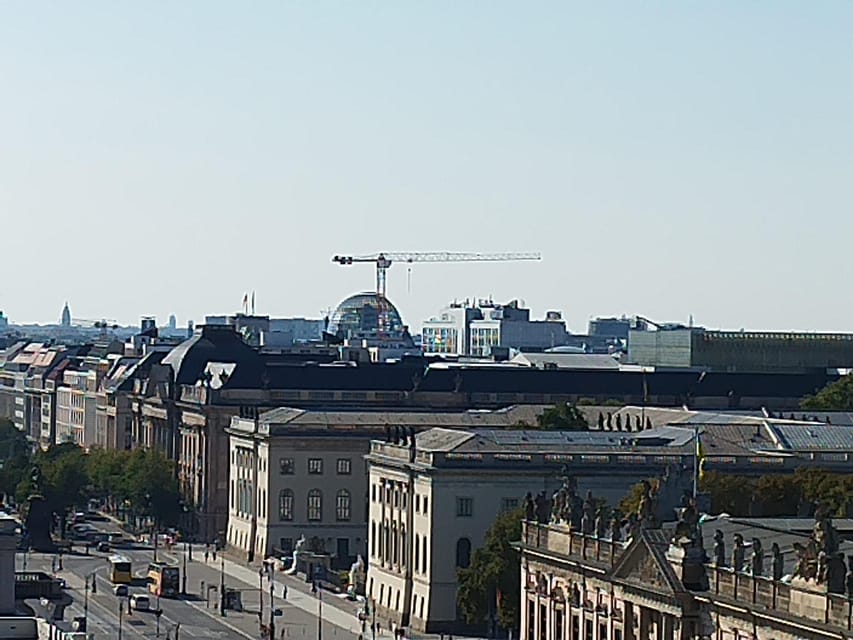
Berlin is not a compact old town where every major sight sits around one pretty square. The historic centre stretches from Alexanderplatz in the east to the Brandenburg Gate and Reichstag in the west, with important stops scattered between them.
That distance can wear you down. You may walk past grand buildings, cross broad roads, wait at traffic lights, and still have several memorials ahead. A rickshaw solves much of that problem. You sit back, watch the streets pass, and save your energy for the places where you actually want to stop.
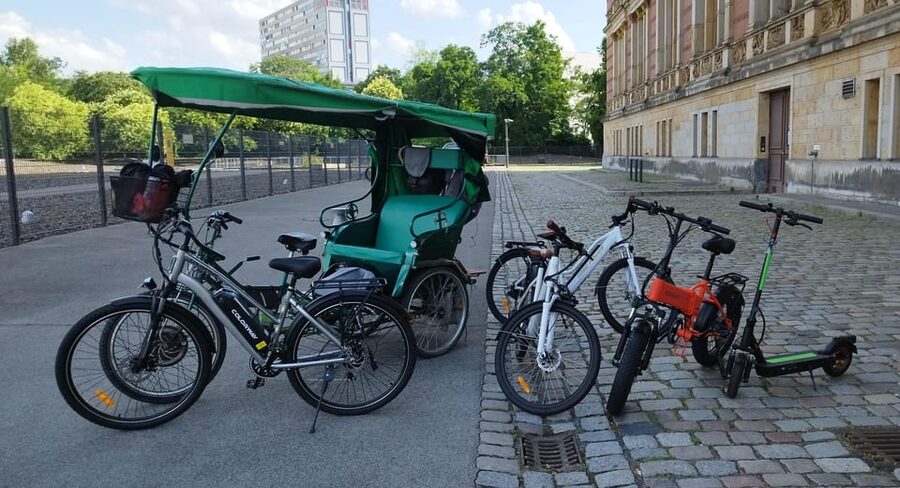
The route also suits anyone who finds a standard bicycle tour too demanding. You do not need to pedal, balance, or keep pace with a group. The rickshaw can carry a walker, and you can remain seated while getting close to several monuments.
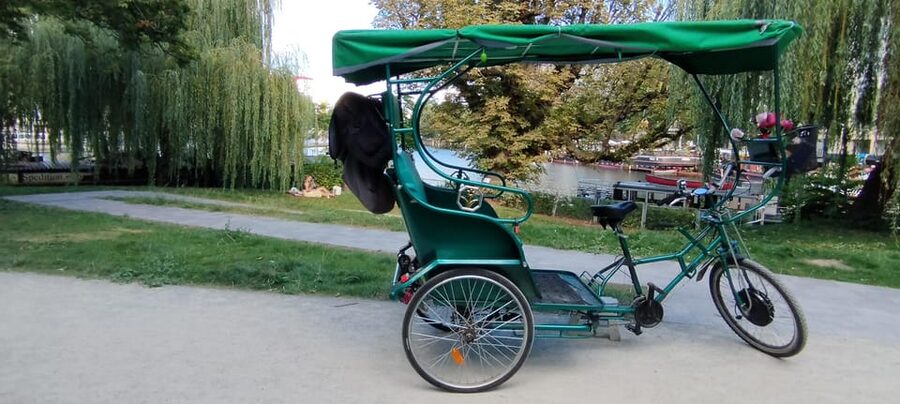
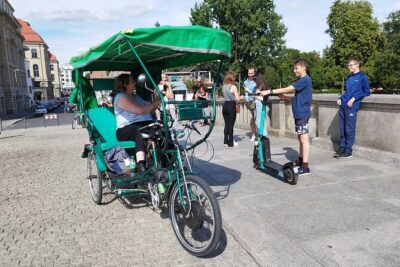
The vehicle is described as a traditional rickshaw and an environmentally friendly way to see Berlin. The experience is quieter and more personal than a large coach tour. You also get a better view than you would from inside a bus, with open-air access to the streets and frequent photo stops.
This is not a fast transfer between landmarks. The guide and driver are the same person, so the pace depends on the cyclist. That is part of the charm, but it also means the full route takes about 210 minutes.
More rickshaw rides in Berlin:
- Berlin: Private Guided E-Rickshaw Tour
★ 4.9 · 157 reviews - Individual City Tour – Rickshaw Sightseeing in Berlin
★ 5.0 · 120 reviews - Berlin Express: Private 1-Hour E-Rickshaw Ride
★ 5.0 · 116 reviews
Starting at Weinbergsweg 6 near Rosenthaler Platz
The meeting point is Weinbergsweg 6, close to Rosenthaler Platz in Berlin’s Mitte district. Look for the meeting point near the U-Bahn station and Weinbergsweg.
Rosenthaler Platz is a useful starting area. Cafes, bars, shops, and street art give it a lively Berlin feel, while Weinbergsweg and Weinbergspark offer a calmer setting nearby. If you arrive early, you can wait in the area rather than standing beside a major monument.
The tour returns to the same address, which keeps the day simple. You do not need to arrange a separate ride back from the Reichstag or Brandenburg Gate. Public transport around Rosenthaler Platz is well connected, though the exact departure time depends on availability.
Dress for the conditions. The rickshaw is open to the air, so a warm day can feel hot and a cold day can feel sharper than expected. In December, guide Levent brought blankets, but you should still wear proper cold-weather clothing. On a hot day, the cyclist has to work hard for the full three hours, so bring the provided water and use the stops as a chance to rest.
Alexanderplatz and the route into Berlin’s centre
Alexanderplatz is the first major sight. It is one of Berlin’s best-known public squares, with broad open space, modern buildings, and the famous television tower nearby. The stop gives you an immediate sense of the city’s mixture of old political history and postwar urban planning.
Your guide provides a general explanation and time for pictures. Do not expect a long museum-style talk here. The value is seeing the square as part of a larger route, then moving on without having to work out the next connection yourself.
From Alexanderplatz, the rickshaw heads toward Berlin’s monumental centre. The route is designed to show you how the city’s districts and landmarks connect, rather than treating each sight as an isolated stop.
Berlin Cathedral and Museum Island
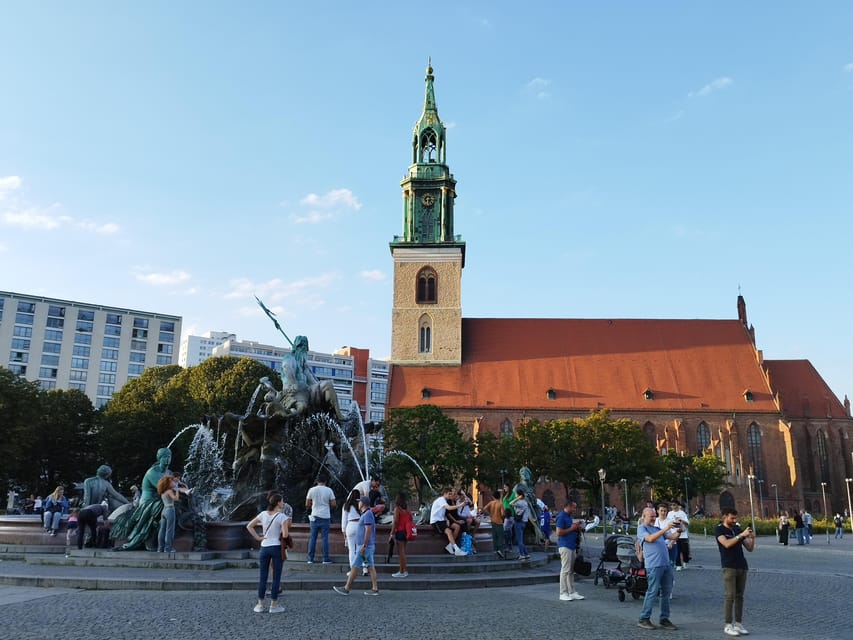
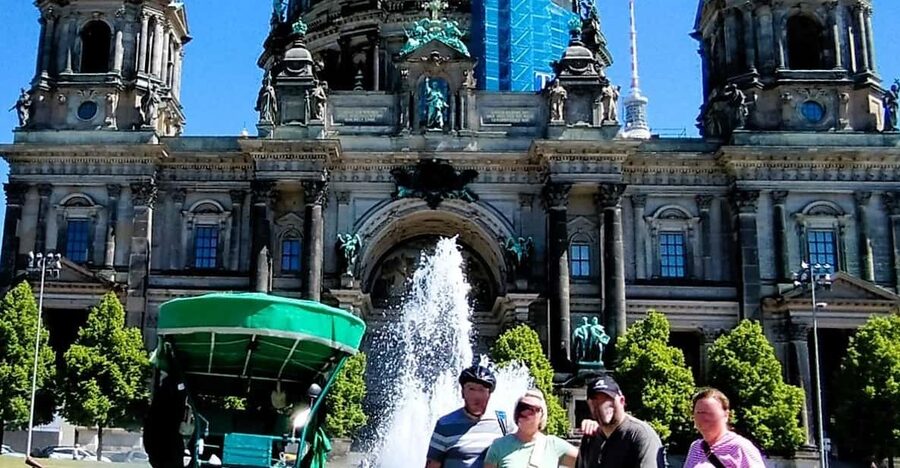
Berlin Cathedral is one of the most striking buildings along the route. Its large dome and ornate exterior make it an easy photo stop, especially when viewed from the surrounding open spaces.
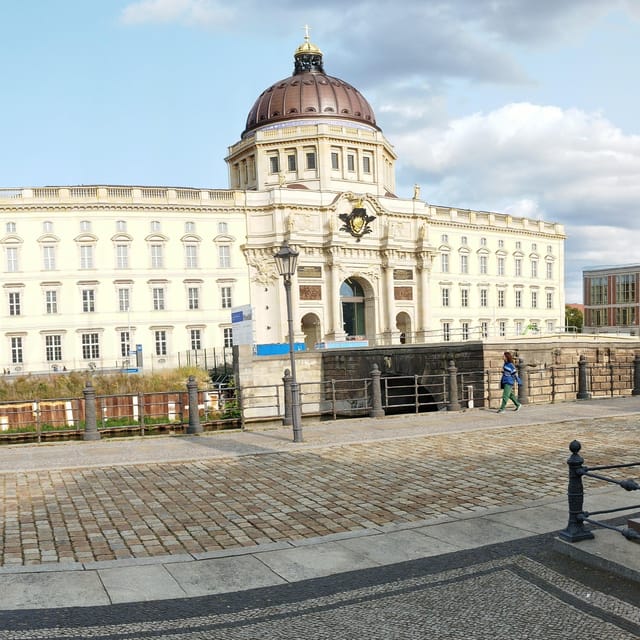
The rickshaw then reaches Museum Island, the group of museums on the Spree River. You will get an outside view and commentary rather than entry into the museums. That distinction matters. If you want to see the Pergamon Museum collections or spend time inside another museum, you need a separate visit and additional time.
I like this part of the tour because it places architecture, river views, and Berlin’s cultural centre in one stretch. You can take photographs without having to find a place to park a bicycle or worry about holding up a larger group.
A few more Berlin tours worth weighing up
- Berlin: Reichstag, Dome and Government District Guided Tour
★ 4.7 · 18,288 reviews - Berlin: Government District around the Reichstag Guided Tour
★ 4.7 · 8,447 reviews - Berlin: Hidden Backyards Guided Walking Tour
★ 4.8 · 5,360 reviews - Berlin: 1-Hour Boat Tour with Bilingual Live Guide
★ 4.7 · 3,629 reviews
Unter den Linden and the book-burning memorial
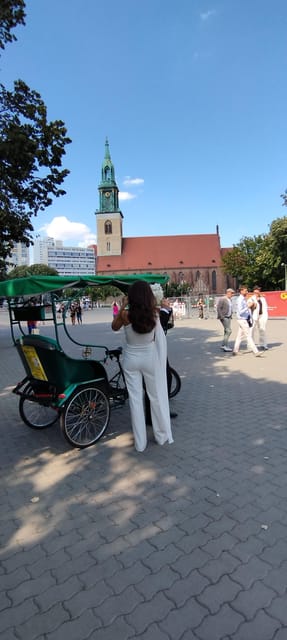
Unter den Linden is Berlin’s grand historic boulevard, linking Museum Island with the Brandenburg Gate. The avenue brings together state buildings, cultural landmarks, and long views toward the centre of the city.
One of the more sobering stops is the memorial to the Nazi book burning of May 10, 1933. The site recalls the public destruction of books by Jewish, liberal, and other writers whose ideas the Nazi regime rejected. Your guide can give the place context, which is important because the memorial itself is easy to miss if you are simply passing by.
This is one reason I prefer a guided ride to an unplanned cycle around Berlin. The city has many plain-looking spaces where major events took place. A good guide helps you notice them and explains why they matter.
Checkpoint Charlie and the Topography of Terror
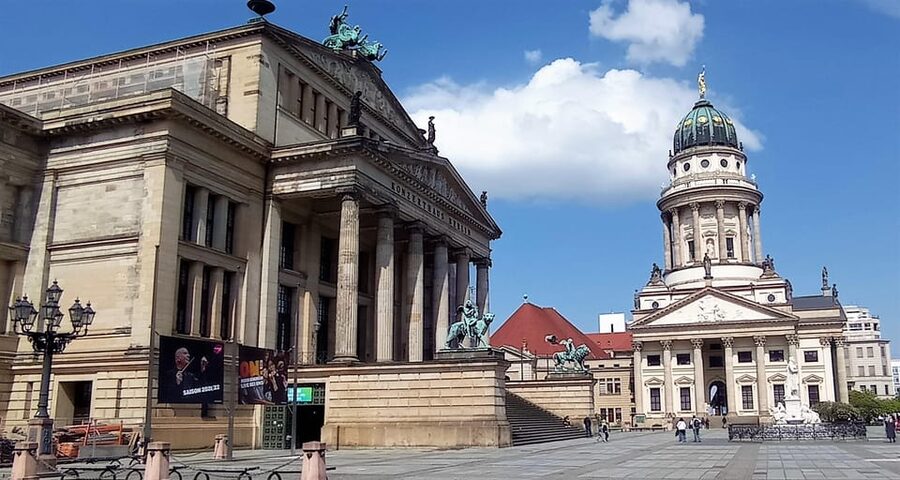
Checkpoint Charlie is one of Berlin’s most famous Cold War locations. The former crossing point between East and West Berlin has a strong place in the city’s modern story, though the area today is also commercial and crowded with visitors.
The rickshaw lets you stop, take photos, and hear the background without committing to a long walk through the surrounding streets. If you want a more detailed look at the Berlin Wall and Cold War era, treat this as an introduction rather than a full museum visit.
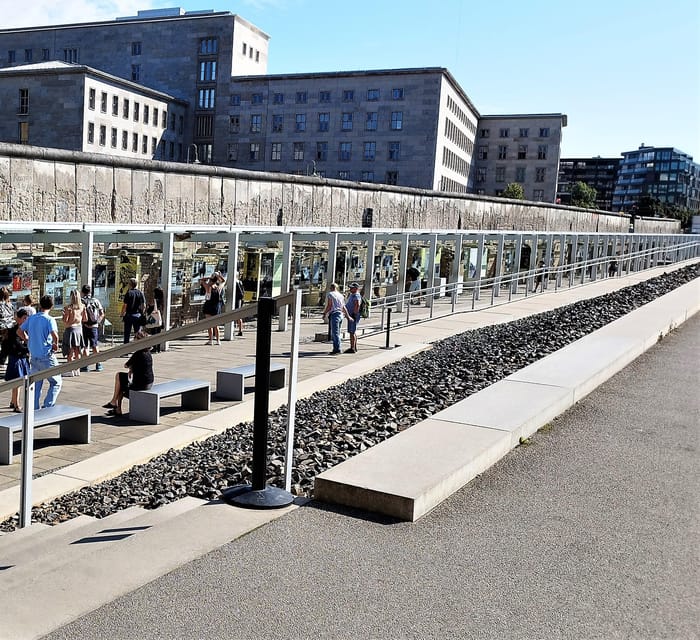
The next important stop is the Topography of Terror. This documentation centre focuses on the institutions and crimes of the Nazi regime. The exterior area and the nearby remains of the former Nazi offices offer a serious counterpoint to the more celebratory sights along Unter den Linden.
You may find that the overall tour moves quickly through difficult subjects. That is unavoidable on a route covering so many places in one afternoon. If the Nazi period is your main interest, plan extra time at the Topography of Terror after the ride.
Hitler’s bunker site and the Holocaust Memorial
The former Hitler bunker site is another place where the physical setting can be surprising. There is no grand preserved monument to visit. The location is associated with the bunker beneath an ordinary urban area, and the guide’s explanation gives meaning to a site that otherwise looks unremarkable.
That contrast is useful. Berlin often presents its history through gaps, fragments, plaques, and unadorned streets rather than polished monuments. A guide can point out what you are looking at and explain the events connected with it.
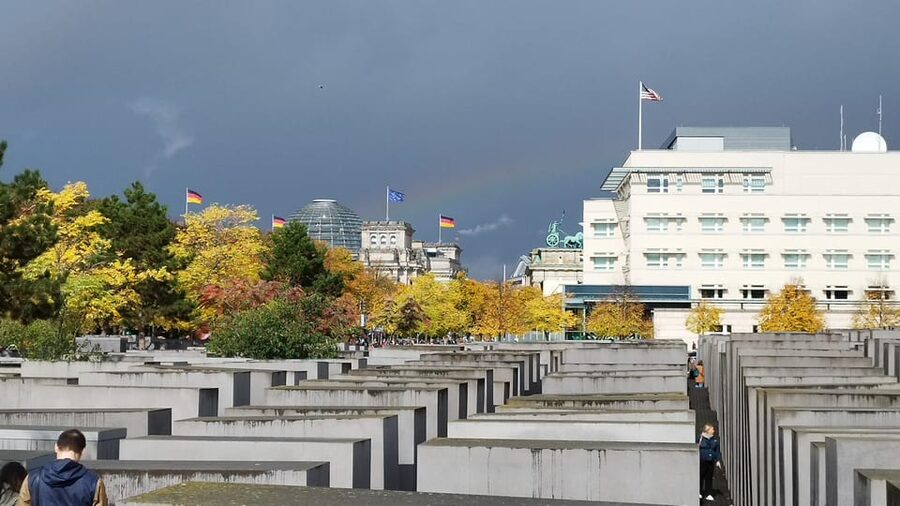
The Holocaust Memorial is a more visible and powerful stop. Its field of concrete slabs creates an uneven walking space close to the Brandenburg Gate. The tour includes sightseeing and a photo stop, though you should be respectful here and avoid treating the memorial as a simple backdrop.
You may be able to leave the rickshaw and walk among the stelae, but the supplied details do not promise a set amount of walking time. If you want to explore the memorial fully, ask your guide how long the stop allows.
Brandenburg Gate and the Reichstag
The Brandenburg Gate is the best-known finish to Berlin’s central monument route. Its columns and chariot-topped design make it one of the easiest places for memorable photographs. The area also connects the former royal city, the divided Cold War capital, and today’s Germany.
The rickshaw can bring you close to the monument, which is helpful if you have limited mobility. The guide can also help find a good angle for pictures. One of the strongest features of this tour is the built-in photography help. The guides are described as almost professional photographers, and the stops are planned with pictures in mind.
The Reichstag comes next. Germany’s parliament building combines a historic exterior with a modern glass dome. This tour provides outside sightseeing and commentary. It does not include entry to the building or a dome reservation, so arrange that separately if you want to go inside.
After the Reichstag, the rickshaw returns to Weinbergsweg 6. The route gives you a broad first look at Berlin’s political, cultural, Nazi-era, and Cold War landmarks without asking you to change transport several times.
What the guide adds to the ride
The guides are certified under DIN EN 15565, and the activity is offered in Dutch, English, German, or Turkish. The guide is also the driver, so you receive a single point of contact for directions, stories, safety, and photographs.
Levent is the guide name attached to the strongest personal accounts of the ride. He is described as handling the pedalling well in both December cold and September heat, while explaining the sights and answering questions. One particularly useful tip was to visit the tourist centre near the Berlin Wall area, use the restroom, and warm up there in cold weather.
The commentary is aimed at both local Berliners and international visitors. That suggests a flexible style rather than a fixed speech only. You can ask questions, request a photo stop, or ask for more information about a site that interests you.
The guide also helps with the practical rhythm of the day. There is time for photographs and, when requested, time to buy postcards. Free water and soft drinks are included, and the description says people in the rickshaw may enjoy a beer or sparkling wine. Drink sensibly, since this remains an active ride and the vehicle is open to the street.
Comfort, access, and the small-group setup
The rickshaw booking is for one or two people, with the listed price of $235 per group. The wider activity is limited to six participants, so this is not a large coach experience. Confirm the exact vehicle arrangement when booking if you are travelling with more than two people, since the price and rickshaw description focus on a two-person booking.
For two people, the cost works out to $117.50 each. That is expensive beside a public bus or self-guided walk, but the comparison is not quite fair. You are paying for a private rickshaw seat, a guide and driver, a long route, tailored stops, and help with photographs.
I see the strongest value for a couple, parent and adult child, or two friends who want one efficient overview of Berlin. It can also be good value for a less mobile pair who would otherwise need several taxis or a much slower walking plan.
The vehicle is especially useful for people who cannot or do not want to cycle. A walker can be taken along, and you can stay seated while viewing monuments. Still, accessibility is not the same as full step-free access. The supplied details do not describe the rickshaw’s exact step height, seating dimensions, or arrangements for wheelchairs, so ask before booking if those details are important.
Weather, timing, and what to bring
The tour lasts 210 minutes, close to three and a half hours, and the route description also refers to four hours. Allow at least four hours in your day so you are not rushing afterward.
The open design is pleasant in mild weather, but it exposes you to the elements. Wear layers, bring sun protection in warm weather, and dress warmly in winter. Blankets may be available in cold conditions, but they are an extra comfort rather than a replacement for a coat.
Bring a phone or camera with enough battery. There are repeated photo stops, and the guide may help with framing. Water and soft drinks are provided, but you might still want personal snacks if you need them during a long ride.
The route includes serious historical sites, so this is not only a light sightseeing outing. You will hear about Nazi persecution, the book burning, Hitler’s bunker, the Holocaust, and the division of Berlin. The mix of pleasant riding and difficult history is very Berlin, but it may not suit someone seeking a purely relaxed city tour.
Who should book this Berlin rickshaw experience?
I would choose this tour if you want to see the main sights in one booking and prefer not to spend the day walking. It is a strong choice for first-time visitors, couples, families, older visitors, and people with limited mobility.
It also suits anyone who enjoys asking questions and taking pictures. The small group format should feel more personal than a large guided bus, and the guide can stop at places that catch your interest.
I would choose something else if you want long visits inside museums, a specialist focus on Nazi or Cold War history, or a very low-cost way to get around. The ride gives you orientation and context, not full museum time.
The free cancellation option up to 24 hours before departure and the reserve-now, pay-later policy add useful flexibility. Starting times vary, so check availability before building the rest of your day around it.
Should you book the $235 rickshaw tour?
Book it if comfort, coverage, and personal guiding matter more to you than keeping costs low. For two people, the price buys a long, well-planned ride through Berlin’s central landmarks, with a guide, drinks, photo help, and a practical solution for anyone who cannot manage a bicycle or a long walk.
The best reason to choose it is the combination of access and scale. You can move from Alexanderplatz to the Reichstag while sitting comfortably, then stop close to the places that give Berlin its strongest sense of place.
Skip it if you want to spend hours inside museums or prefer exploring at your own slow pace. For everyone else, especially a pair visiting Berlin for the first time, this is an efficient and unusually personal way to get oriented.
FAQ
Where does the Berlin rickshaw tour start?
The meeting point is Weinbergsweg 6 near U-Bahn Rosenthaler Platz in Berlin’s Mitte district. The tour also returns to Weinbergsweg 6.
How long does the tour last?
The stated duration is 210 minutes, or about three and a half hours. The route description also refers to four hours, so allow roughly four hours in your schedule.
How many people can join?
The activity is limited to six participants. The advertised rickshaw booking is for one or two people, and the listed price covers a group of up to two.
Which languages are available?
Live guiding is available in Dutch, English, German, and Turkish.
Is the tour suitable for people who cannot cycle?
Yes. You do not need to ride a bicycle, and the rickshaw is suggested for less mobile people or anyone who does not want to bike. A walker can be taken along.
What landmarks are included?
The route includes Alexanderplatz, Berlin Cathedral, Museum Island, Unter den Linden, the May 10, 1933 Nazi book-burning memorial, Checkpoint Charlie, the Topography of Terror, Hitler’s bunker site, the Holocaust Memorial, Brandenburg Gate, and the Reichstag.
What is included in the price?
The price includes a rickshaw for up to two people, an experienced guide in your booking language, commentary, photo stops, and free water and soft drinks. The description also says beer or sparkling wine may be enjoyed in the rickshaw.
Just added around Berlin
- Berlin Highlights in One Day★ 5.0 · 3 reviews
- Private Berlin One Day Tour with a Local: See the City Unscripted★ 3.5 · 3 reviews
- Individual city tour Berlin for max. 8 persons★ 5.0 · 3 reviews
- Transfer from Berlin Schönefeld Airport (SXF) to Berlin city Hotels – ROUND TRIP★ 4.0 · 3 reviews
- Berlin: Museum Island Tour★ 5.0 · 3 reviews
- Private Analogue Photography Experience in Berlin★ 5.0 · 3 reviews
- Berlin: Local Food Tour in Secrets Hidden Gems★ 4.0 · 3 reviews
- Berlin & The Third Reich Private Guided Tour★ 5.0 · 3 reviews
Berlin Rickshaw Tours, compared.
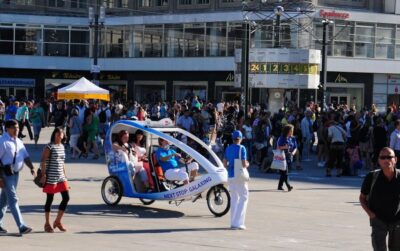
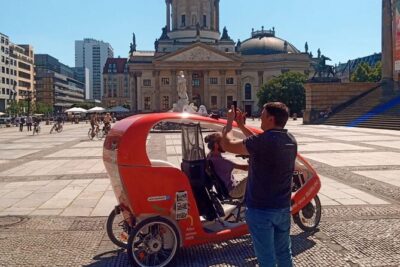
Individual City Tour – Rickshaw Sightseeing in Berlin
Read our review →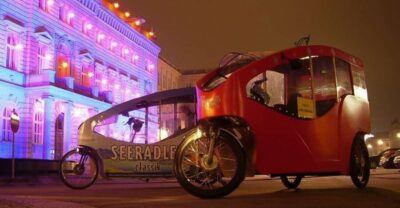
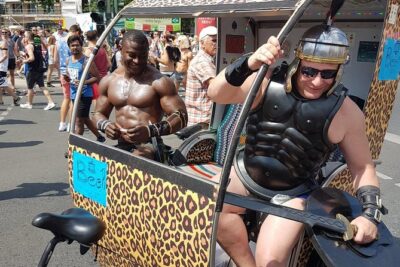
Rickshaw Tours Berlin – Groups of up to 16 people with several rickshaws
Read our review →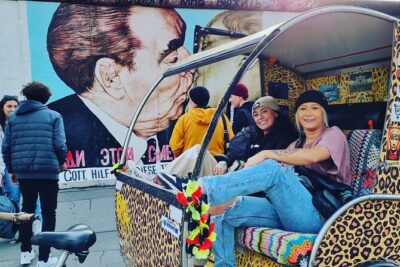
One Up to 3 Rickshaws(6 GUESTS)-Taylor Made Rickshaw Berlin Tour
Read our review →
Berlin Rickshaw Tours Historical & Photo City Tour 120min – Sightseeing
Read our review →Browse the lists this tour appears in