
Review · SACHSENHAUSEN MEMORIAL TOURS
Berlin: Sachsenhausen Concentration Camp Bus Tour in English
Sachsenhausen is not a casual sightseeing stop. It is a place where the organized machinery of Nazi terror becomes painfully clear, from the entrance gate and prisoner barracks to the crematoria, infirmary rooms, and execution trench. This four-hour tour gives you that difficult history with an English-speaking guide and avoids the long walk from Oranienburg station to the memorial.
I especially like the air-conditioned bus, which gives you a useful 50-minute lesson about Berlin and Oranienburg before you arrive. I also like the guides’ careful handling of the subject. Names such as Ariel, Paul, Jamie, Lewis, Nickolai, and Gregory appear among the assigned guides, and the strongest praise centers on clear explanations, patience, and respect.
The main drawback is time. You get about two hours at Sachsenhausen, enough for a guided overview but not enough for a slow, independent visit to every exhibit. The $49 price is fair if you value door-to-door transport and interpretation, but public transport and a self-guided visit can cost less if you have extra time and prefer to set your own pace.
In This Review
- Key points to know before you book
- Why Sachsenhausen belongs on a Berlin itinerary
- Meeting at Friedrichstraße and riding to Oranienburg
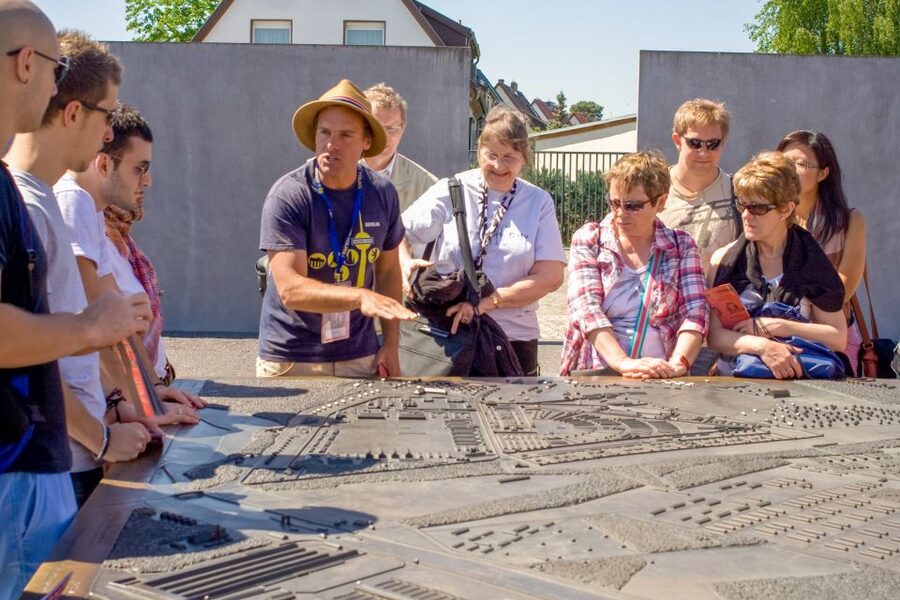
- Reading the camp through its planned layout
- The infirmary barracks and medical abuse
- Crematoria, gas chamber, and execution trench
- What the two-hour guided visit feels like
- Is the bus worth the $49 price?
- Practical details that make the day easier
- Who should book this Sachsenhausen tour?
- Should you book it?
- FAQ
- How long does the Sachsenhausen bus tour last?
- Where does the tour meet in Berlin?
- How do I find the guide?
- Is transportation included?
- Is hotel pickup included?
- What languages are available?
- What is included at Sachsenhausen?
- How much time do I spend at the memorial?
- What should I bring?
- Can I cancel the booking?
Key points to know before you book
- The bus saves a tiring connection: You travel from central Berlin to Sachsenhausen in about 50 minutes, rather than taking the train to Oranienburg and walking onward to the memorial.
- Two hours covers the main grounds: Your guide leads you through Tower A, barracks, infirmaries, punishment areas, the gas chamber site, crematoria, and execution trench.
- The camp was planned for control: Sachsenhausen was the first concentration camp designed and built from the ground up around a strategic layout intended to control prisoners and allow expansion.
- Guide quality matters here: Guides including Ariel, Paul, Jamie, Lewis, Nickolai, and Gregory are praised for calm delivery, strong historical context, and thoughtful answers.
- This is a serious memorial visit: The subject includes murder, disease, abuse, medical experimentation, forced labor, and systematic camp administration. Prepare yourself emotionally.
- The meeting point is central: Meet outside Friedrichstraße train station, on the square beside the Tränenpalast, with a guide holding a yellow umbrella.
Why Sachsenhausen belongs on a Berlin itinerary
Berlin has no shortage of museums and memorials connected to the Nazi period. Sachsenhausen adds something different: it takes you outside the capital and shows you the physical system built to imprison, exploit, punish, and kill people.
The camp was established near Oranienburg and designed as a model for the Nazi concentration camp system. Its layout was not accidental. The buildings, central sightlines, guard positions, and controlled access all served the goal of maximum surveillance and discipline.
That planning is one reason a guide helps. A bare collection of ruins can be hard to read. With context, the grounds become a map of power. You begin to understand where prisoners lived, where officers worked, how punishment operated, and how the camp connected to a much wider network.
The visit also raises a difficult local question: what did people outside the wire know? The tour addresses how the camp affected life beyond its fences and how local populations encountered, ignored, or understood the camp system. That wider view keeps the visit from becoming only a sequence of grim buildings.
Germany today teaches this past openly through memorial sites, museums, school programs, and public remembrance. Sachsenhausen is part of that process. You are not visiting a preserved Nazi attraction. You are visiting a place arranged to explain crimes and remember the people who suffered there.
More Sachsenhausen memorial visits:
- Berlin: Sachsenhausen Concentration Camp Tour in English
★ 5.0 · 5,711 reviews - Berlin: Sachsenhausen Concentration Camp Memorial Tour
★ 4.7 · 3,716 reviews - Sachsenhausen Concentration Camp Bus Tour in English from Berlin
★ 5.0 · 1,962 reviews
Meeting at Friedrichstraße and riding to Oranienburg
The standard meeting point is outside Friedrichstraße train station, on the square between the station and the Tränenpalast, also called the Palace of Tears. Look for a guide wearing a blue lanyard and yellow name tag, usually holding a yellow umbrella.
This detail matters. Friedrichstraße is a busy central transport hub, and the area has several exits and open spaces. Arrive early enough to find the square rather than waiting inside the station. The yellow umbrella is the clearest visual marker.
Once everyone is gathered, the group boards a private air-conditioned vehicle. The ride to Sachsenhausen takes about 50 minutes. This is not wasted transfer time. Guides often begin explaining Berlin’s wartime and political setting while you are still in the city, then add background about Oranienburg and the camp’s place in the Nazi system.
Several guides receive particular praise for making the bus journey useful. Jamie is noted for continuing the explanation during both transfers, while Joseph is praised for discussing Berlin sights on the way and offering practical suggestions for the rest of the day. The exact guide changes, but the format gives you historical framing before you reach the grounds.
You should bring a light snack and a drink. The visit involves outdoor walking, and the memorial is not a place where you will want to rely on finding a café at the right moment. Wear comfortable shoes and clothing suited to the weather. Rain and wind can make the open grounds feel especially stark.
Reading the camp through its planned layout
Sachsenhausen was the first concentration camp designed and constructed from the ground up according to a strategic plan. Its shape and arrangement were meant to help guards control prisoners and support future expansion.
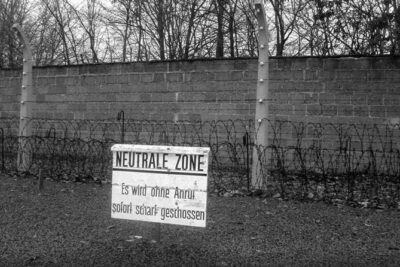
Your guide uses the layout to explain how the camp worked. You will see the entrance through Tower A, the barracks area, administrative structures, punishment spaces, medical facilities, and killing facilities. Each part had a role, and together they reveal how violence was organized through rules, schedules, surveillance, labor, and punishment.
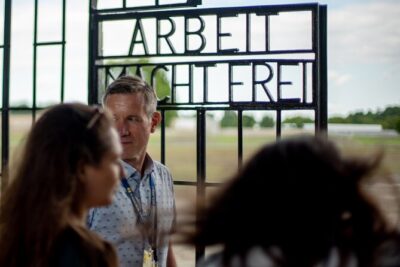
At the entrance, the phrase Arbeit Macht Frei remains above Tower A. Its false promise is hard to miss. The words suggested that work could bring freedom, while the camp’s actual system used forced labor as a tool of control and destruction.
The barracks show the daily side of imprisonment. Here you learn about cramped living conditions, harsh routines, brutality, and the treatment of prisoners as numbers within an administrative system. The experience is stronger when your guide connects a building to the people forced to live there, rather than treating the site as a collection of empty rooms.
You will also hear about the different functions of the camp system and the people imprisoned within it. The supplied details emphasize that approximately 35,000 people were murdered or died from disease at Sachsenhausen. That figure is not an abstract statistic when the guide points out the places where prisoners were held, worked, punished, and treated.
The infirmary barracks and medical abuse
The infirmary barracks are among the most difficult areas on the route. They were meant to deal with illness and injury, yet they were also places where medical experimentation took place during the war.
This is an important distinction. A camp infirmary was not simply a hospital in the normal sense. Medical spaces existed inside a system built around forced labor, deprivation, punishment, and racial persecution. Your guide explains how the sick and vulnerable could be treated within that system and how medicine itself was abused.
The subject is distressing, so the tone of the guide matters. The strongest guides named in the feedback, including Maria, Rebecca, Scott, and Dr. Thomas, are praised for clear, respectful explanations and for answering questions without turning the visit into spectacle.
Expect the guide to pause at serious points. This is not a fast parade from one building to another. Still, two hours means the group must keep moving. If you want to read every panel or spend extended time in each room, you may feel hurried once the guided portion ends.
A different side of Berlin on the same trip:
- Berlin: Reichstag, Dome and Government District Guided Tour
★ 4.7 · 18,288 reviews - Berlin: 1-Hour City Tour by Boat with Guaranteed Seating
★ 4.3 · 16,993 reviews - Berlin: Boat Tour Along the River Spree
★ 4.4 · 11,252 reviews - Discover Berlin Half-Day Walking Tour
★ 5.0 · 9,624 reviews
Crematoria, gas chamber, and execution trench
The killing facilities are the most sobering part of the visit. The route includes the crematoria, gas chamber site, and execution trench, along with punishment cells and isolation areas.
These places show how the camp’s system moved from imprisonment and labor to deliberate killing. Your guide provides the operational and historical context needed to understand what happened, but you should expect the visit to remain restrained. This is a memorial, not a theatrical presentation.
The execution trench is especially stark because its purpose is direct and easy to understand. The crematoria area points to the effort to manage and hide the physical evidence of mass death. The gas chamber site requires the same care: you are looking at a place connected to murder, and the right response is quiet attention rather than dramatic reaction.
The punishment and isolation areas add another layer. Camp control depended not only on mass killing but also on daily terror. Prisoners could be separated, punished, abused, and kept under threat. Seeing those spaces alongside the barracks helps you understand how the camp operated as a complete structure of coercion.
If you have visited another camp memorial, such as Auschwitz, the guide can help place Sachsenhausen within the larger camp network. One guide, Ariel, was particularly appreciated for helping prepare someone for a later Auschwitz visit. Even without another camp on your schedule, that wider context is useful.
What the two-hour guided visit feels like
The guided portion lasts about two hours. That is a practical length for a first visit, particularly if you have limited time in Berlin, but it requires focus.
You will spend much of the time outside, walking between memorial buildings and sites. The memorial’s wide spaces can make distances feel longer than expected, and weather matters. Comfortable shoes are essential. A camera is permitted according to the supplied information, but the subject calls for judgment and restraint. You may decide that taking notes is more useful than photographing every location.
The guide leads rather than leaves you to decode the site alone. That is the tour’s main value. Paul and Martin are praised for placing Sachsenhausen within German political and wartime history, while Nickolai and Jamie are praised for careful explanations and sensitivity. Names are not guaranteed, but they give you a sense of the range of guide styles used by the operator.
English and Spanish tours are available. This review concerns the English option. You should confirm the language and starting time when booking, since the guide assignment and schedule depend on the selected departure.
The group may be private or small group, depending on the option you choose. A smaller group usually makes it easier to ask questions and hear the guide, while the standard option keeps the price lower. The supplied price of $49 per person is based on the advertised experience, so check the exact option before paying.
Is the bus worth the $49 price?
For $49, you receive a professional licensed guide, private air-conditioned transport, a driver, entry to the Sachsenhausen Memorial, a $3 donation per person to the memorial, and a map of the former camp.
The transport is the strongest part of the value. Reaching Sachsenhausen independently means taking public transport to Oranienburg and then making your way to the memorial entrance. The bus removes that extra planning and uses the ride to provide historical commentary.
You are also paying for interpretation. At a site this serious, a map alone cannot explain the camp’s structure, the relationship between the buildings, or the lives of the people imprisoned there. A good guide helps you connect the physical remains to the system behind them.
The tradeoff is flexibility. The bus follows a set schedule, and the guided visit lasts about two hours. If you want to linger quietly at one barrack, read every display, or explore at your own speed, an independent visit may suit you better.
For a short Berlin stay, I think the price is reasonable. You get a four-hour round trip from central Berlin, a guide for the core visit, memorial entry, and transport back to the city. For visitors who are comfortable planning public transport and have more time, the tour is less essential.
Practical details that make the day easier
The tour lasts four hours in total, with roughly 50 minutes by bus each way and two hours at Sachsenhausen. Starting times vary, so check availability for the date you want.
Hotel pickup and drop-off are not included in the standard tour. You meet at Friedrichstraße station and return to the meeting point area, with the listed Berlin drop-off at Reichstagufer 17. Private options may include pickup, with the guide arriving five minutes before the start time.
Cancellation is flexible up to 24 hours in advance for a full refund. Reserve now and pay later is also available, which helps if your Berlin plans are still moving around.
Bring:
- Comfortable walking shoes
- Weather-appropriate clothing
- A light snack and drink
- A camera, if you want one
Alcohol and drugs are not allowed. That is obvious for a memorial site, but it is worth noting because this is a place that calls for respectful conduct throughout.
Do not schedule a tightly timed museum or dinner immediately afterward. The tour is listed as four hours, but a visit of this nature can leave you needing quiet time before moving on. You may want to keep the rest of the afternoon open.
Who should book this Sachsenhausen tour?
I recommend it for a first visit to Sachsenhausen, especially if you have only a few days in Berlin, want English commentary, or dislike navigating unfamiliar regional transport.
It also suits you if you want the history explained in a clear, human way. The most praised guides, including Ariel, Paul, Jamie, Lewis, Nickolai, and Gregory, are described as approachable, respectful, and willing to answer questions. That personal guidance can make a difficult subject easier to understand without making it feel lighter than it is.
Families with older children and teenagers may find the tour valuable, though parents should decide whether the subject is appropriate for their children. The tour deals plainly with murder, disease, punishment, and experimentation.
I would choose a private or small-group option if you want more time for questions and a quieter feel. Choose the standard group if price matters most and you are happy to follow a fixed route.
Should you book it?
Book this tour if you want efficient transport, a structured two-hour visit, and an English-speaking guide who can explain how Sachsenhausen functioned within the Nazi camp system.
Skip it if you prefer complete independence, need several hours for personal reflection, or already know the site well. The bus is convenient, but convenience comes with a fixed schedule.
For most first-time visitors to Berlin who want to visit Sachsenhausen without losing a full day to logistics, this is a strong choice. Go prepared for a serious memorial visit, wear good shoes, bring water, and give yourself space afterward to think about what you have seen.
FAQ
How long does the Sachsenhausen bus tour last?
The activity lasts four hours, including approximately 50 minutes by bus from Berlin, two hours at the Sachsenhausen Memorial, and approximately 50 minutes back.
Where does the tour meet in Berlin?
Meet outside Friedrichstraße train station, on the square between the station and the Tränenpalast, also called the Palace of Tears, at Reichstagufer 17, 10117 Berlin.
How do I find the guide?
Look for a guide wearing a blue lanyard and yellow name tag and holding a yellow umbrella.
Is transportation included?
Yes. Transportation is provided by private air-conditioned vehicle, with a driver.
Is hotel pickup included?
Hotel pickup and drop-off are not included in the standard tour. Pickup is available for private options only.
What languages are available?
Live guided tours are available in English and Spanish.
What is included at Sachsenhausen?
The tour includes entry to the Sachsenhausen Memorial, a €3 donation per person to the memorial, and a map of the former concentration camp.
How much time do I spend at the memorial?
The guided visit at Sachsenhausen lasts about two hours.
What should I bring?
Bring comfortable shoes, weather-appropriate clothing, a light snack, and a drink. A camera is also allowed according to the activity information.
Can I cancel the booking?
Yes. You can cancel up to 24 hours in advance for a full refund. Reserve now and pay later is also available.
Just added around Berlin
- Berlin Highlights in One Day★ 5.0 · 3 reviews
- Private Berlin One Day Tour with a Local: See the City Unscripted★ 3.5 · 3 reviews
- Individual city tour Berlin for max. 8 persons★ 5.0 · 3 reviews
- Transfer from Berlin Schönefeld Airport (SXF) to Berlin city Hotels – ROUND TRIP★ 4.0 · 3 reviews
- Berlin: Museum Island Tour★ 5.0 · 3 reviews
- Private Analogue Photography Experience in Berlin★ 5.0 · 3 reviews
- Berlin: Local Food Tour in Secrets Hidden Gems★ 4.0 · 3 reviews
- Berlin & The Third Reich Private Guided Tour★ 5.0 · 3 reviews
Sachsenhausen Memorial Tours, compared.
Sachsenhausen Concentration Camp Tour in English
Read our review →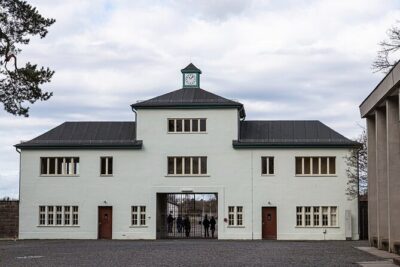
Sachsenhausen Concentration Camp Memorial Tour
Read our review →
Sachsenhausen Concentration Camp Bus Tour in English from Berlin
Read our review →Sachsenhausen Concentration Camp Tour in English
Read our review →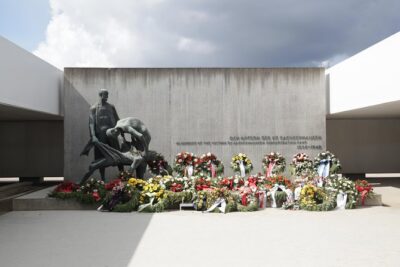
Sachsenhausen Concentration Camp Memorial Tour (Max. 15 Guests)
Read our review →
Sachsenhausen Concentration Camp and Potsdam Tour
Read our review →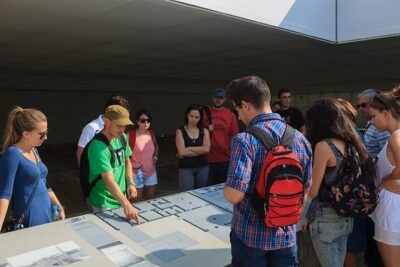
Visita en español al campo de concentración Sachsenhausen
Read our review →Browse the lists this tour appears in