
Review · HISTORICAL TOURS
Private Taxi Tour City East & West History and Architecture 3-4h
Berlin makes more sense when you see its grand avenues, scarred monuments, Cold War borders, and rebuilt squares in one connected sweep. This private taxi tour with Gunter Bauer links both sides of the city, from Charlottenburg and the Ku’damm to the Brandenburg Gate, Museum Island, Alexanderplatz, and Checkpoint Charlie.
I like the warm, practical comfort of seeing Berlin from a private car, especially in winter or bad weather. I also like the flexible approach: you can ask for the history and sights that matter most to you, and Gunter can explain them in fluent English while handling the driving.
The main consideration is pace. Three to four hours is enough for a broad introduction, but not for extended visits inside every museum or monument on this long route. You will see many places from the car, with short stops at selected sights.
In This Review
- Key points to know before booking
- Why a private car works well in Berlin
- Charlottenburg, the Memorial Church, and Berlin’s western face
- Tauentzien, Nollendorfplatz, and the green Tiergarten
- The Victory Column and the Reichstag quarter
- Hackesche Höfe and the former East Berlin
- Brandenburg Gate, Gendarmenmarkt, and the old royal center
- Humboldt Forum, Alexanderplatz, and Nikolaiviertel
- Potsdamer Platz, the Wall, and Checkpoint Charlie
- Price, timing, and who gets the best value
- Should you book this Berlin taxi tour?
- FAQ
- How long is the private taxi tour?
- What language is the tour offered in?
- Is hotel pickup included?
- Is transportation private?
- What is included in the price?
- Is lunch included?
- Is admission to the Humboldt Forum included?
- Are child seats available?
- Can I cancel for a full refund?
Key points to know before booking
- Private taxi with hotel pickup: Pickup within Berlin’s S-Bahn ring, from a hotel or apartment, is included.
- A citywide history lesson: The route connects Prussian royalty, World War II, the Berlin Wall, East Germany, and reunification.
- Comfort in changing weather: The air-conditioned vehicle is heated in cold weather and includes WiFi.
- Flexible sightseeing: You can focus on architecture, Berlin’s divided past, major highlights, or a mix of all three.
- Two planned longer stops: Hackesche Höfe and the Humboldt Forum are listed with time for a closer look.
- A strong family and senior option: Child seats are available, and the private format allows a gentler pace for older adults.
Why a private car works well in Berlin

Berlin is spread out. The Kaiser Wilhelm Memorial Church, Brandenburg Gate, East Side history, government quarter, Museum Island, and Checkpoint Charlie are not arranged in one tidy walking loop. Public transport can get you between them, but changing trains and navigating large stations takes time.
A private taxi removes much of that friction. You can begin at your chosen city hotel, settle into an air-conditioned vehicle, and watch Berlin change outside the window. One moment you are passing elegant western shopping streets, and soon you are looking at former East Berlin housing blocks, embassy buildings, socialist monuments, or a rebuilt royal palace.
This is not a tour built around a single museum. It is a moving overview of Berlin, with Gunter explaining what you are seeing and why the city looks so different from one neighborhood to the next. The private setting also helps if your group has its own interests. You can ask for more on the Hohenzollerns, Nazi history, the Wall, architecture, or daily life in divided Berlin.
The vehicle includes WiFi and parking fees. Pickup from the BER airport or locations outside the S-Bahn ring costs extra, and the tour price combines the taxi ride with the city tour.
More history walks in Berlin:
- Berlin: Natural History Museum Entrance Ticket
★ 4.6 · 3,382 reviews - Berlin: World Heritage Cruise to Potsdam
★ 4.5 · 1,435 reviews - Berlin Historical Highlights Walking Tour
★ 4.9 · 657 reviews
Charlottenburg, the Memorial Church, and Berlin’s western face
The western section begins around Charlottenburg and the Kurfürstendamm, commonly shortened to Ku’damm. This is the Berlin of department stores, theaters, grand commercial streets, and postwar West German identity.
The Kaiser Wilhelm Memorial Church gives the tour an immediate historical anchor. Its damaged tower and west portal were preserved after World War II, despite plans to clear the entire site. The surviving entrance portal is filled with sculpted figures whose faces are said to resemble Prussian kings and emperors, a reminder that the church was originally a memorial to Wilhelm I, not simply a war memorial.
Beside it, Egon Eiermann’s modern church building creates one of Berlin’s most memorable contrasts. Its blue glass blocks give the interior a calm, almost mysterious light, while the double-wall construction helps keep out the traffic noise from Breitscheidplatz. The Berlin nicknames for the old and new buildings, lipstick and powder compact, are a good example of the city’s habit of treating architecture with both affection and sarcasm.
You also pass Berlin Zoological Garden, one of Germany’s oldest zoos. Its historic entrances are easy to spot from outside, especially the elephant gate and lion gate. The zoo grew from royal hunting grounds and an earlier collection of animals kept on Peacock Island. Buildings were designed in styles associated with the animals’ home regions, though wartime damage changed much of the original setting.
Nearby, the Theater des Westens recalls the grand move of Berlin’s wealthy population toward the greener western districts in the late nineteenth and early twentieth centuries. The ornate building looks almost too decorative from the street, with its confectioner-like exterior and imperial box inside. Today it serves as a musical theater.
The route then shifts from Kantstrasse to Ku’damm. Once modeled partly on the Champs Élysées, the boulevard stretches nearly five kilometers toward Halensee. It was once lined with villas, cafés, cinemas, and entertainment venues. Today it is mainly a shopping street, with luxury names, modern flagship stores, and the large department store Kaufhaus des Westens, better known as KaDeWe.
KaDeWe is a useful short stop if you enjoy food halls and department stores. Its gourmet floor offers champagne, oysters, chocolate, bread, cheese, and other high-end treats. You do not need to buy anything to appreciate the scale, though it is easy to lose track of time here.
Tauentzien, Nollendorfplatz, and the green Tiergarten
After the Memorial Church, the tour continues along Tauentzienstrasse, often treated as an extension of Ku’damm. The street is named after a general associated with the wars against Napoleon and is lined with more affordable shopping than the luxury end of Ku’damm.
Nollendorfplatz provides a glimpse of Berlin’s early transport network. Several subway lines meet here, and the station reflects the city’s long history of underground rail. The old railway route also tells a social story: wealthy Charlottenburg residents once resisted having a noisy, dirty train run beside their villas.
At Urania, Gunter explains the work of the organization founded to make science understandable to a broad audience. Outside is an unusual arch representing a section of a circle, a gift from France for Berlin’s 750th anniversary. Nearby, Lützowplatz and its wide green strip reflect an old dream of turning Berlin into a car-friendly city with elevated throughways. Thankfully, the proposed transformation never took place.
The Tiergarten offers a very different side of Berlin. It began as a fenced royal hunting ground, then opened to the public under Friedrich II. Later, the garden designer Peter Joseph Lenné shaped it into an English-style public park, using the Landwehr Canal to drain swampy ground and create paths, water, and open views.
World War II devastated the park. Trees were destroyed, and food crops were planted near the Reichstag. Allied assistance later helped restore the trees. From the taxi, you get the broad setting rather than a long park walk, but the story helps explain why this large green area matters so much in a dense capital.
The House of World Cultures is another quick architectural lesson. Built as a gift from the United States to West Berlin in the 1950s, its curved roof earned the nickname Pregnant Oyster. The roof collapsed in 1980, killing a journalist, but the building was reconstructed and now hosts non-European arts, concerts, and cultural events.
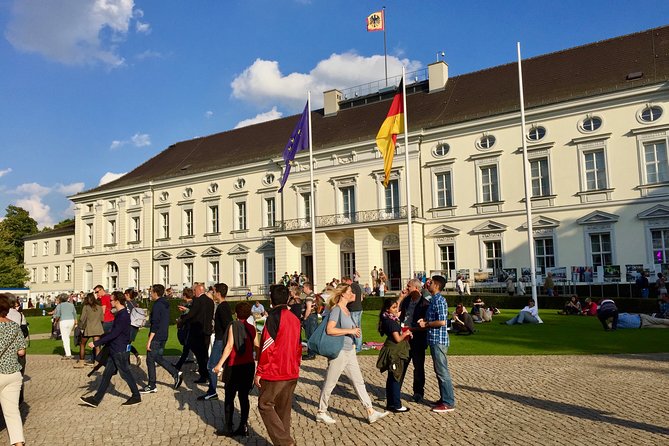
You then pass Bellevue Palace, the official Berlin residence of the Federal President. It was originally built for August Ferdinand, the younger brother of Friedrich II, and once had a view toward Charlottenburg Palace. That view has disappeared behind modern development. The palace was later adapted for federal use, although only one president is described as having actually lived there.
The Victory Column and the Reichstag quarter
Berlin’s Victory Column began in front of the Reichstag and originally had three drum sections. Each commemorated a Prussian victory over Denmark, Austria, and France. A fourth section was added during the Nazi period after the column was moved to its present position.
That history gives the monument a complicated tone. It celebrates the wars that helped create the German Empire, yet its later relocation was tied to Hitler’s plans for an enormous new capital. The surrounding Tiergarten was damaged during the war and later replanted by the Allies.
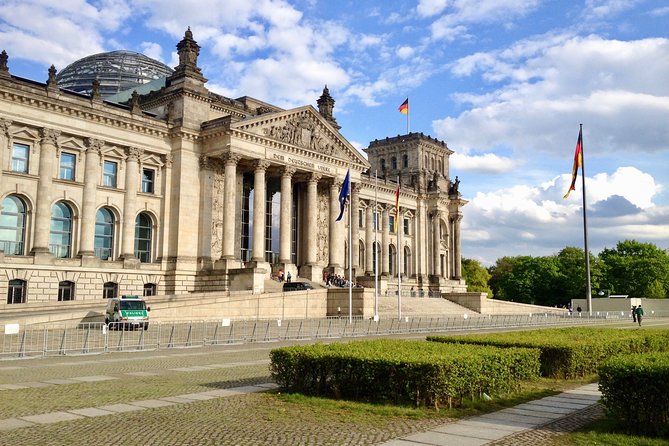
The Reichstag is one of the essential stops. This grand Wilhelmine building was mocked by some as a chat room or monkey house, but it became one of the strongest symbols of German reunification. Red Army soldiers raised a flag here at the end of World War II, although the famous photograph was staged again for the camera.
After reunification, the building was gutted and redesigned for the Bundestag. Christo’s wrapping project drew worldwide attention, and the glass dome added by architect Norman Foster became a symbol of a more open political system. The dome is not listed as a full visit on this taxi route, so ask Gunter in advance if entering it is important to you.
The nearby Paul-Löbe Building is the working engine of parliament. Committees meet in its offices and glass-lined sections, while the Reichstag chamber is used for major debates and votes. The Federal Chancellery follows, a huge modern complex with hundreds of offices and a prominent rotunda. The tour also passes the press area where government briefings are held.
A few more Berlin tours worth weighing up
- Berlin: Private Reichstag and Glass Dome Tour
★ 4.8 · 2,226 reviews - Berlin Private Complete History All Day Walking Tour
★ 5.0 · 474 reviews - Private Walking Tour Berlin Third Reich Hitler and World War II
★ 5.0 · 360 reviews - Private Berlin: Iconic Sights and Hidden Gems Walking Tour
★ 5.0 · 292 reviews
Hackesche Höfe and the former East Berlin
Hackesche Höfe offers a closer stop and a welcome change from monumental government buildings. Built in 1908, the connected courtyards mixed workshops, small factories, printing operations, shops, and apartments. The idea was to combine work and home life in a carefully designed urban setting.
The courtyards deteriorated during the East German years and were later restored after the Wall fell. Today, workshops have largely given way to shops selling selected goods, including Königliche Porzellan-Manufaktur porcelain and East Berlin’s famous Ampelmännchen products. You have about ten minutes here, enough to see the courtyards and browse briefly, but not enough for a relaxed meal or serious shopping session.
The route also passes Berlin Central Station, a vast five-level transport hub with underground and elevated tracks. Its opening changed the balance of the city’s railway system. Bahnhof Zoo, once the key station of West Berlin, lost its long-distance trains, and many residents of Charlottenburg felt pushed farther from the main rail network.
At Invalidenhafen, the taxi crosses one of the former East-West border areas. The port was restricted during the Wall years, and Günter Litfin became one of the first people killed while trying to escape across the water. This is a brief stop in a much larger Wall story, but it shows how even canals and harbors became dangerous border zones.
Oranienburger Strasse and the surrounding Spandauer Vorstadt bring you into an area shaped by Jewish life, nightlife, restaurants, and small shops. The New Synagogue is recognizable by its Moorish details and golden dome. The main synagogue was destroyed in World War II, but the front section has been rebuilt and now contains an exhibition about Jewish life in Berlin.
Security is strict. Expect airport-style checks before entering the exhibition area. The synagogue’s original construction reflected the improved legal position of Prussian Jews in the nineteenth century, and Otto von Bismarck attended its inauguration in 1866.
Brandenburg Gate, Gendarmenmarkt, and the old royal center
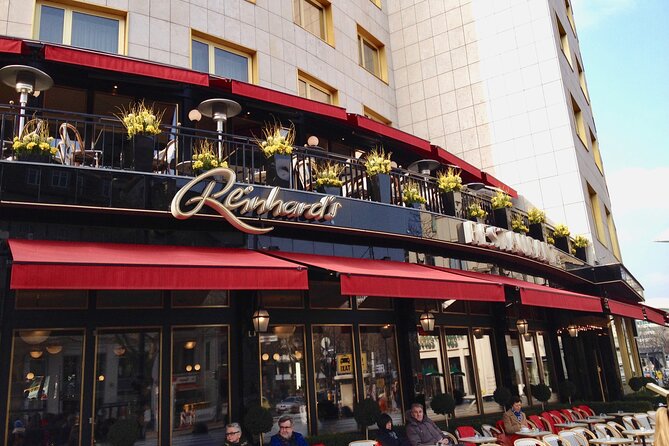
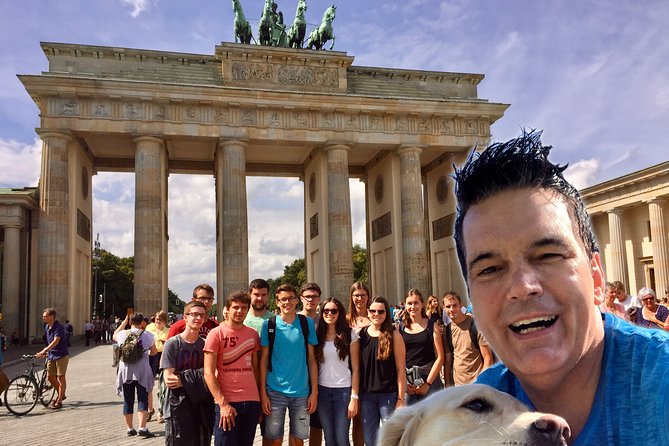
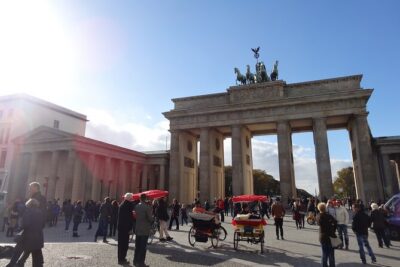
Brandenburg Gate is Berlin’s great symbolic doorway. It sits on Pariser Platz, once a formal urban parlor for visiting dignitaries. War, demolition, the Wall, and decades of separation left the gate isolated, but the surrounding buildings have since been rebuilt in similar dimensions.
The rebuilt square now includes the Academy of the Arts, the French and American embassies, the Liebermannhaus, and the Hotel Adlon. The modern buildings are not old survivors, so you should see the area as a reconstruction of a historic setting rather than an untouched old quarter.
Unter den Linden leads east from the gate. It began as a royal riding path from the Berlin Palace to the hunting grounds, then became the city’s grand boulevard. The linden trees won out over a proposed planting of nut trees, saving Berlin from the unfortunate name Unter den Nüssen.
Along the avenue are the State Library, Humboldt University, the State Opera, former royal palaces, and the Neue Wache memorial. The guardhouse once held soldiers from the royal castle. Today it contains Käthe Kollwitz’s enlarged sculpture of a grieving mother, dedicated to victims of war and tyranny.
Bebelplatz, part of the Forum Fridericianum, brings together the former Royal Library, St. Hedwig Cathedral, the State Opera, and Humboldt University. A glass panel in the pavement reveals an empty underground library, recalling the Nazi book burning of May 10, 1933.
Gendarmenmarkt is one of Berlin’s finest squares. The German Cathedral and French Cathedral frame the concert hall, though neither church is technically a cathedral. The German building now contains a museum about German parliamentary history. The French Cathedral still serves a French-speaking Reformed congregation and includes a small Huguenot museum.
The former armory, now home to the German Historical Museum, adds a darker note. Its exterior and courtyard decorations include replicas of death masks from dying soldiers. It is a powerful reminder that the grand royal center also carries the weight of military history.
Humboldt Forum, Alexanderplatz, and Nikolaiviertel
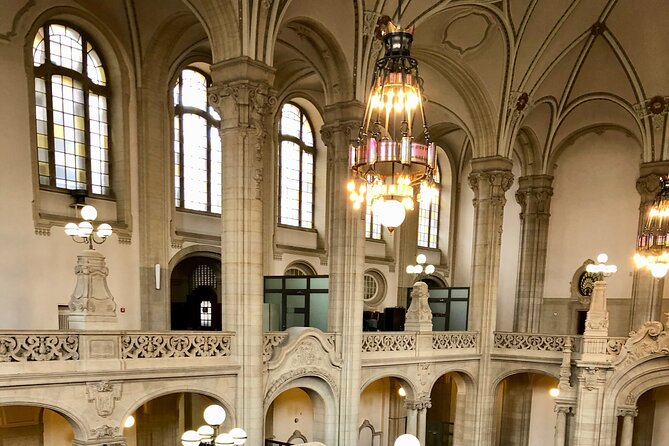
The Humboldt Forum occupies the site of the former Berlin Palace. The palace burned during World War II and was later demolished by East German authorities, despite its importance as a major example of North German Baroque architecture.
The present building combines a modern interior with a reconstructed exterior and courtyard. It houses non-European collections and holdings connected with Humboldt University. The planned visit here is listed at about 30 minutes, with admission included, making it the most substantial indoor stop on the route.
Alexanderplatz shows the scale of East Berlin’s socialist redesign. Its earlier name was Ochsenplatz, linked to cattle trading, but the postwar square was rebuilt as a broad space for parades and state displays. The surrounding buildings represented socialist modernity, while the television tower served as a highly visible symbol of engineering and power.
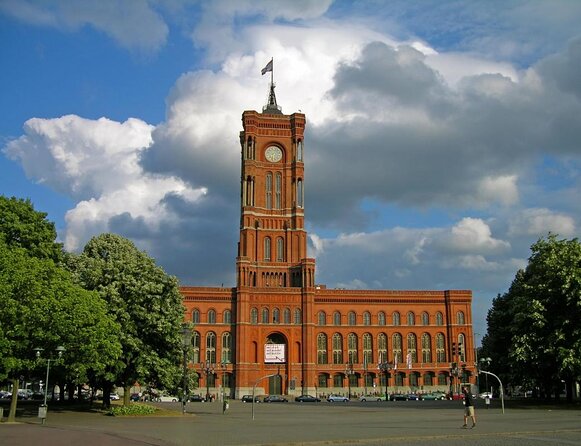
Nearby, the Red City Hall gets its name from its red brick, not from the political party of Berlin’s mayor. It was built in the 1870s in a neo-Gothic style and remains an important civic building. Some rooms can be visited free of charge.
Nikolaiviertel is a reconstructed version of old Berlin. Much of the historic quarter had disappeared, and the district was rebuilt in the 1980s with old-style facades and about 2,000 apartments in a small area. The Nikolaikirche, Berlin’s oldest church, now serves as a city museum.
The Knoblauchhaus provides a more intimate look at domestic life. Its Biedermeier rooms show how a cloth-making family might have lived, while nearby restaurants offer food beside the Spree. The setting is partly theatrical, but that does not make it useless. It helps you picture the medieval core that modern Berlin often hides.
Potsdamer Platz, the Wall, and Checkpoint Charlie
The route through Leipziger Strasse and Potsdamer Platz shows how much Berlin was rebuilt after reunification. Old streets such as Molkenmarkt and Spittelmarkt are being reconsidered, while large East German apartment blocks remain nearby.
Potsdamer Platz was once one of Europe’s busiest intersections, with cinemas, restaurants, hotels, and around-the-clock activity. After the Wall years, it became a showcase for new construction, including the Sony Center, the former Daimler complex, hotels, and Deutsche Bahn’s tower.
The result is impressive but somewhat artificial. You can see the money and ambition in the glass buildings, yet the lively street culture of the 1920s has not fully returned.
The Kulturforum provides the western counterpart to Museum Island. It includes the Philharmonie, the New State Library, the New National Gallery, museums of musical instruments and decorative arts, and the Picture Gallery. The Picture Gallery holds major old-master works by artists including Titian, Caravaggio, and Rembrandt.
The Landwehr Canal helps explain Berlin’s geography. The city has about 200 kilometers of waterways, and canals were used for shipping, drainage, and shortcuts through the winding Spree. A boat tour can show many sights from the water, but this taxi route gives you a faster citywide view.
The former Reichsmarineamt and later army high command now house part of the Ministry of Defense. The courtyard is linked to the July 20, 1944 plot against Hitler, when Claus Schenk Graf von Stauffenberg and others were executed after the attempt failed.
The embassy district adds architectural variety. Italy occupies a pink palazzo, Japan has a monumental building with an imperial sun, and the five Nordic countries share a modern wooden complex. Nearby is the InterContinental, once the only West Berlin hotel with a presidential suite and still designed around strict security needs.
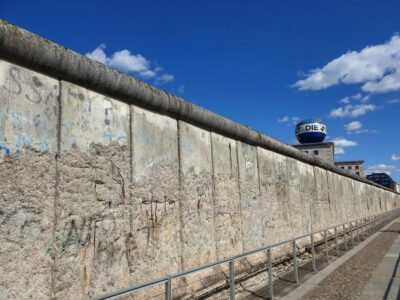
At the Topography of Terror, you get a short but serious stop. The site combines former Prussian and Imperial buildings, Nazi administrative offices, excavated torture-cell foundations, an open-air exhibition, and a surviving section of the Berlin Wall. Toilets are available here, a small but useful point during a long drive.
Checkpoint Charlie is mainly a photo stop. The guard hut and sign are replicas, not original Cold War equipment, but the location still matters. In October 1961, American and Soviet tanks faced each other here in one of the most dangerous moments of the Cold War.
The tour can finish near the Aquarium and Europa Center, depending on the route. The Aquarium is known for its large collection and a walk-through design that leads from local aquatic life toward tropical sea environments. The hotel elevator passing through the South Sea aquarium is an especially unusual feature.
Price, timing, and who gets the best value
The listed price is $150.18 per person. Since this is a private tour, the value improves as your group gets larger. For one person, it is a costly way to see the city. For a family or small group that would otherwise pay for several guided tours, taxis, and transport tickets, the price can make more sense.
You are paying for private transportation, an English-speaking guide, air conditioning, WiFi, parking fees, and pickup within the S-Bahn ring. The taxi fare and guiding service are both included. Lunch is not included, and airport pickup or service outside the S-Bahn ring costs extra.
The tour runs about three to four hours, although the exact timing depends on traffic, questions, and how many stops you make. It is booked on average about 23 days ahead, so reserve early if your dates are fixed.
Bring water. One useful tip from the experience is to keep a bottle in the car, since talking, driving, and frequent short stops can make a half-day feel surprisingly long.
The private format works especially well for older adults, families with younger children, and anyone who dislikes large groups. A toddler seat for ages six months to three years and a booster for older children are available. Service animals are allowed, and most people can take part.
Should you book this Berlin taxi tour?
Book it if you want to understand Berlin’s layout quickly, prefer a private guide, or are visiting in cold or wet weather. It is also a smart first-day choice for a family or older group that wants to cover both former East and West Berlin without spending hours on trains.
Choose a walking tour or museum-focused tour instead if you want long visits inside the Reichstag, Jewish Museum, German Historical Museum, or other major attractions. This experience gives you context and range, not hours of quiet study at each site.
The strongest reason to book is Gunter’s personal approach. He is described as a friendly, fluent English-speaking guide who adjusts the route, answers questions, helps with practical matters, and may take photographs during the tour and send them afterward. That extra care matters when you are seeing a city as complicated and spread out as Berlin.
FAQ
How long is the private taxi tour?
The tour lasts approximately three to four hours.
What language is the tour offered in?
The tour is offered in English.
Is hotel pickup included?
Pickup is included from hotels or apartments within Berlin’s S-Bahn ring. Pickup from BER Airport or locations outside the ring costs extra.
Is transportation private?
Yes. The activity is private, and only your group participates.
What is included in the price?
Private transportation, WiFi, an air-conditioned vehicle, parking fees, and pickup within the S-Bahn ring are included. The taxi fare and city tour taxes are also included.
Is lunch included?
No. Lunch is not included.
Is admission to the Humboldt Forum included?
Yes. Admission to the Humboldt Forum is listed as included, with approximately 30 minutes planned for the stop.
Are child seats available?
A toddler seat for children from six months to three years and a booster seat for older children are available. A Maxi-Cosi baby seat can be brought on request.
Can I cancel for a full refund?
Yes. You can cancel up to 24 hours before the local start time for a full refund. Cancellations or changes made less than 24 hours before the tour are not refunded or accepted.
Just added around Berlin
- Berlin Highlights in One Day★ 5.0 · 3 reviews
- Private Berlin One Day Tour with a Local: See the City Unscripted★ 3.5 · 3 reviews
- Individual city tour Berlin for max. 8 persons★ 5.0 · 3 reviews
- Transfer from Berlin Schönefeld Airport (SXF) to Berlin city Hotels – ROUND TRIP★ 4.0 · 3 reviews
- Berlin: Museum Island Tour★ 5.0 · 3 reviews
- Private Analogue Photography Experience in Berlin★ 5.0 · 3 reviews
- Berlin: Local Food Tour in Secrets Hidden Gems★ 4.0 · 3 reviews
- Berlin & The Third Reich Private Guided Tour★ 5.0 · 3 reviews
Historical Tours, compared.

Berlin Private Complete History All Day Walking Tour
Read our review →

Small group Potsdam: A Journey Through History and Palaces
Read our review →Browse the lists this tour appears in