
Review · DDR & EAST BERLIN TOURS
Berlin Self-Drive Trabi Tour with Guide
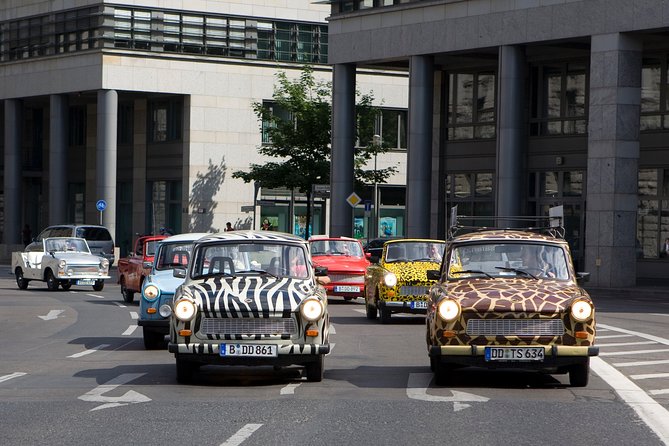
A Trabant tour gives you Berlin from behind the wheel of a tiny East German car that rattles, vibrates, and attracts photographs wherever it goes. You follow a guide-led convoy past the Brandenburg Gate, Berlin Cathedral, the Berlin Wall, and Checkpoint Charlie while getting a quick lesson in the car’s unusual manual gearbox.
I like the odd, hands-on history lesson and the way this tour lets you see central Berlin while doing something playful. I also like the relaxed pace, patient guides such as Thomas, Matthias, George, and Axel, and the simple thrill of becoming part of a colorful Trabi convoy. The main drawback is clear: the cars can be fiddly to drive, loud inside, and hard to understand over the radio.
In This Review
- Key points to know before you book
- Why driving a Trabant changes the Berlin sightseeing tour
- Starting at TrabiWorld Berlin on Zimmerstrasse
- The 10-minute briefing and the famous awkward gearbox
- Potsdamer Platz and Berlin’s changing center
- Brandenburg Gate and Unter den Linden
- Berlin Cathedral, Rotes Rathaus, and the TV Tower
- East Side Gallery and the remaining Berlin Wall
- Oberbaum Bridge and the former border crossing
- What the tour feels like on the road
- Who will enjoy this most
- Is $95.58 good value for 75 minutes?
- Practical planning for the start time
- Should you book the Berlin Trabi tour?
- FAQ
- Where does the Berlin Trabi tour start and finish?
- How long does the tour last?
- What time does the tour start?
- Do I drive my own Trabant?
- Do I need a driving license?
- How many people can ride in each car?
- Is the tour suitable for children?
Key points to know before you book
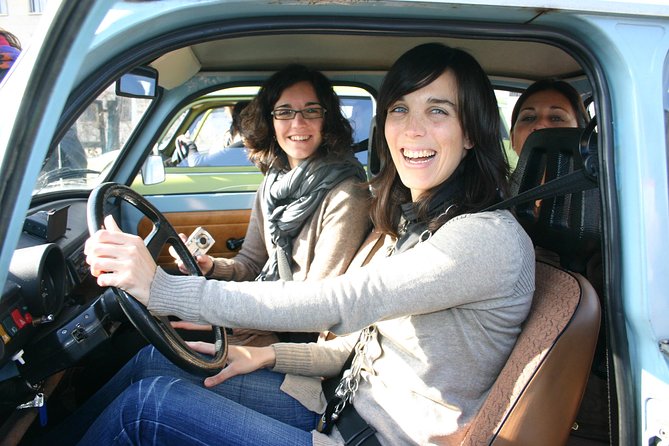
- You drive the Trabant yourself: This is not a sightseeing ride. You take the wheel of a manual East German car.
- The route covers major Berlin sights: Expect Potsdamer Platz, Brandenburg Gate, Unter den Linden, Berlin Cathedral, Rotes Rathaus, the TV Tower, East Side Gallery, Oberbaum Bridge, and Checkpoint Charlie.
- The gearbox takes practice: A short briefing helps, but confident stick-shift driving will make the tour much easier.
- The convoy is small: The group can include up to 12 people, with a maximum of four people in each car.
- The guide controls the pace: A radio system carries the commentary, and the convoy stops or waits if cars fall behind.
- Arrive early: Plan to be at TrabiWorld Berlin at least 15 minutes before the 11:30 a.m. start.
Why driving a Trabant changes the Berlin sightseeing tour
Most city tours ask you to look outward. This one asks you to manage a clutch, shift gears, watch traffic, and keep a tiny car moving while Berlin passes around you.
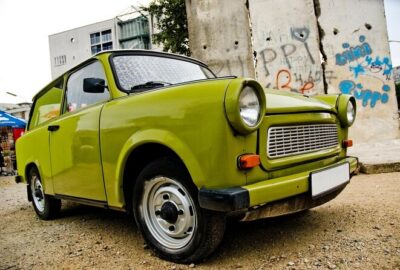
That makes the tour less polished than a bus ride, but far more memorable. The Trabant was an everyday car in East Germany, and its modest design is part of the point. It feels light, basic, noisy, and a little agricultural. The engine sound, smoke, vibration, and distinctive smell give the ride its character.
You do not simply hear about the former East Germany. You handle one of its best-known objects. That physical connection gives the history some bite, especially as the convoy crosses parts of the former East Berlin and passes the Berlin Wall.
The cars also turn you into a moving attraction. People along the route often take photographs as the convoy rolls by. You see Berlin, but Berlin also notices you.
More East Berlin and DDR history:
- Berlin: DDR Museum Tickets
★ 4.3 · 3,443 reviews - Berlin: 75-minute Trabi Safari
★ 4.8 · 2,854 reviews - Berlin: East and West Hop-On Hop-Off Bus Tour
★ 4.2 · 2,195 reviews
Starting at TrabiWorld Berlin on Zimmerstrasse
The tour begins at TrabiWorld Berlin, at Zimmerstrasse 97 to 100, in central Berlin. The meeting point is close to public transport and within walking distance of several sights, so you can make good use of the area before or after the drive.
Come early. One person who arrived at the stated start time found that Berlin timing meant arriving 10 to 15 minutes ahead. That early arrival matters because the staff needs to organize cars, check driving credentials, and get everyone ready.
The base has bathrooms and a shop, though the surrounding area may look a little untidy. Do not judge the entire outing by the meeting point. The interesting part begins once you get into the car.
The activity ends back at the same location. Hotel pickup and drop-off are not included, so you need to make your own way there and back.
The 10-minute briefing and the famous awkward gearbox
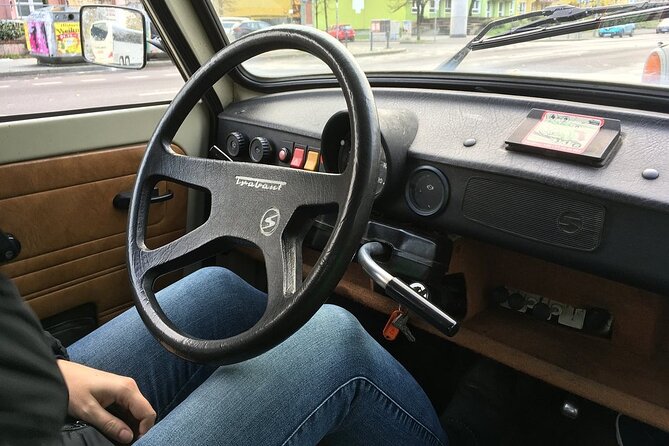
Before setting off, you receive an orientation to the Trabant’s controls. The car has a standard manual gearbox and a four-stroke engine. An automatic car is available only after prior consultation, so you should not assume that option will be ready on the day.
You need proof of a valid license for a non-automatic car. The minimum age is 18, and children must be with an adult. Children up to age 17 are free when accompanied by at least one adult, but the driving rules still mean the adult needs to handle the car.
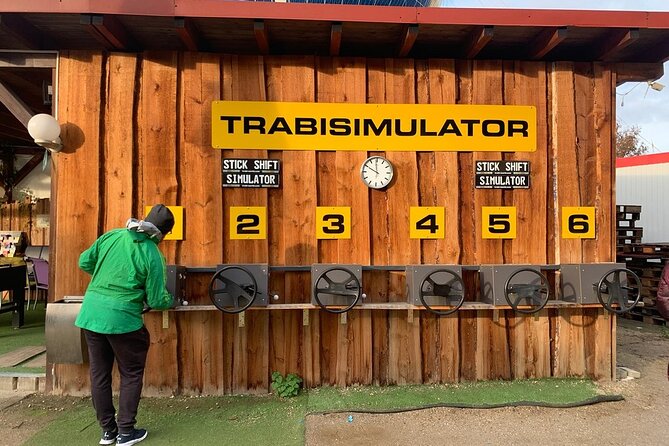
The gearbox is the biggest practical issue. It is not the smooth, forgiving transmission you may know from a modern rental car. Several people needed time to find the right rhythm between clutch and gear lever. Others found it easier than expected after using the simulator and listening to the instructions.
If you can drive a manual car, you have a good starting point. Still, give yourself a few minutes to adjust. Do not panic if the first gear changes feel clumsy. The guides are used to nervous drivers and can keep the convoy moving at an easy pace.
The guide communicates through a radio system. You can hear instructions and commentary, but the setup may not let you speak back. The engine is loud, and some of the radio commentary can be difficult to catch, especially if you are concentrating on shifting.
Potsdamer Platz and Berlin’s changing center
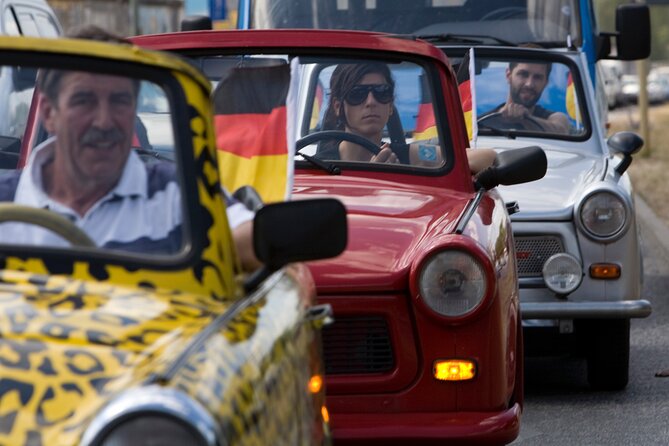
Once the convoy leaves the base, the route takes you through some of Berlin’s best-known central districts. Potsdamer Platz is a useful first landmark because it captures the city’s modern transformation.
Before the Second World War, this was a major traffic junction. After the war and the division of Berlin, the area became a bleak, empty zone beside the Wall. Today, it is filled with large buildings and busy streets.
You may not have much time to stop and study the architecture. This is a driving tour, not a walking tour. But passing through the area gives you a quick sense of how dramatically Berlin changed after reunification.
That contrast is one of the tour’s strengths. The Trabant represents the old East German system, while Potsdamer Platz represents the new Berlin that rose after the Wall came down.
A few more Berlin tours worth weighing up
- Berlin: Reichstag, Dome and Government District Guided Tour
★ 4.7 · 18,288 reviews - Berlin: Government District around the Reichstag Guided Tour
★ 4.7 · 8,447 reviews - Berlin: Hidden Backyards Guided Walking Tour
★ 4.8 · 5,360 reviews - Berlin: 1-Hour Boat Tour with Bilingual Live Guide
★ 4.7 · 3,629 reviews
Brandenburg Gate and Unter den Linden
The route continues toward the Brandenburg Gate, Berlin’s famous neoclassical monument. The gate once marked the edge of the city and later became one of the most powerful symbols of division. After reunification, it became a symbol of a city joined again.
From the car, you get an orientation rather than a full visit. The convoy moves through the streets, and you need to keep your attention on traffic and the guide. If you want photographs without the pressure of driving, return to the gate later on foot.
Unter den Linden provides another strong Berlin view. This grand boulevard runs through the historic center, linking the Brandenburg Gate with the museum district and the former royal areas.
Driving here is a good reminder that Berlin is a city of big spaces. The boulevard, formal buildings, and long sight lines make the small, noisy Trabant feel even more out of place. That mismatch is part of the fun.
Berlin Cathedral, Rotes Rathaus, and the TV Tower
The route also passes Berlin Cathedral, one of the city’s most recognizable buildings. Its large dome and grand setting make it easy to spot, even during a moving tour.
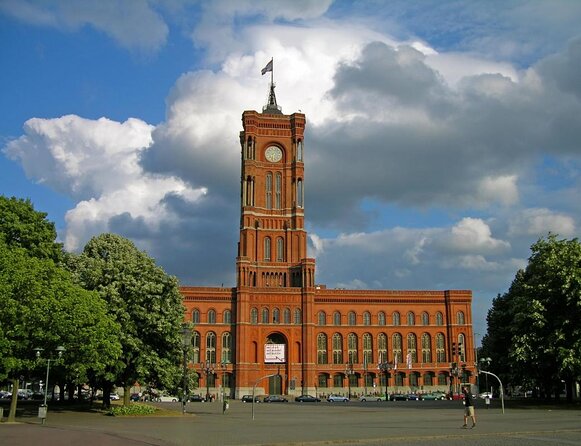
You then see Rotes Rathaus, the Red Town Hall, built in the 19th century. Its red brick exterior gives it a different look from the pale neoclassical buildings around the boulevard.
The Berlin TV Tower rises above the city near Alexanderplatz. It is one of the easiest landmarks to use for orientation, and it helps you understand where the former East Berlin center lies.
This section is especially useful if you are new to Berlin. In roughly 75 minutes, you connect several districts that would take much longer to cover on foot. You will not explore each one in detail, but you get a practical map in your head.
That is why I see the tour as a good first or second-day activity. It helps you decide which areas deserve a longer visit later.
East Side Gallery and the remaining Berlin Wall
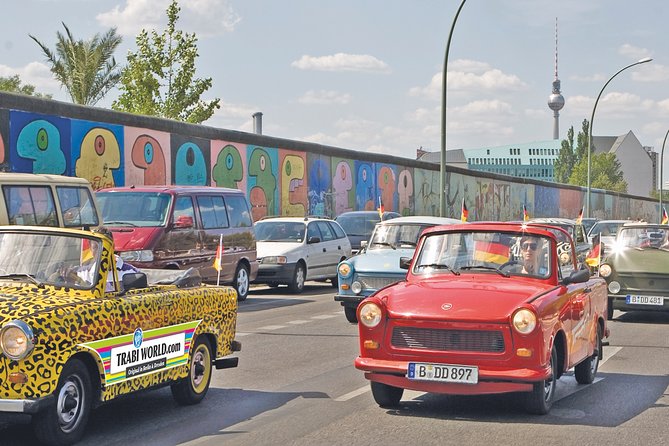
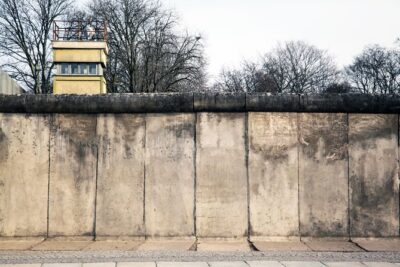
The convoy reaches East Side Gallery, an open-air gallery painted on a 1,316-meter section of the Berlin Wall. The murals turn the old concrete barrier into a long public art display.
The scheduled stop here is brief, about five minutes. That is enough for a quick look, but not enough to study many murals or walk a long section of the Wall. If East Side Gallery is a major reason for your visit, plan to return independently.
Still, seeing it as part of a Trabant tour has meaning. The car is tied to East Germany, and the Wall was the physical line that divided the city. Those two pieces of the past come together in a way that a standard city drive cannot match.
The stop also gives you a short break from the controls. You can stretch, look around, and take photographs before getting back in the car.
Oberbaum Bridge and the former border crossing
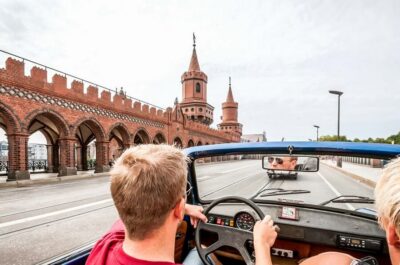
Oberbaum Bridge crosses the River Spree and is one of Berlin’s most distinctive bridges. Its brick towers and red tones make it easy to recognize, and the river crossing gives the route a welcome change of scenery.
The bridge also connects districts that once sat on different sides of divided Berlin. Crossing it in a Trabant adds another small historical layer to the trip.
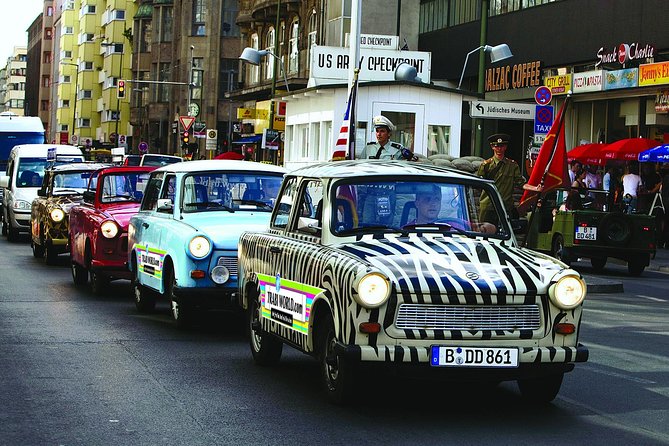
Checkpoint Charlie comes near the end of the route. This former border crossing is one of Berlin’s most famous Cold War sites. The modern setting can feel crowded and commercial, but the location remains important because it recalls the controlled border between East and West Berlin.
The tour does not replace a proper visit to the nearby museums or historical displays. What it does well is link Checkpoint Charlie with the Wall, East Berlin landmarks, and the experience of driving an East German car.
What the tour feels like on the road
The Trabant is part of the entertainment. It is not quick, quiet, or refined. You will feel more vibration than in a modern car, and the engine noise can make conversation difficult.
That old-car behavior can be tiring for some people. You need to focus on gears, traffic, the convoy, and the guide’s instructions. If you want to absorb every fact about Berlin, a walking tour or museum visit will serve you better.
But the rough edges are also why the experience works. The car does not merely carry you through a story about East Germany. It gives you a small sample of the country’s everyday transport.
Guides such as Thomas are praised for keeping a calm eye on safety while adding humor and city information. Matthias is noted for patience with drivers who struggle with the gears. George and Axel are also named as friendly, engaging leaders.
The guide drives ahead and sets the route. You follow in formation, with the radio carrying directions and commentary. The leader watches the group and can pull over to wait for cars that fall behind. There is also a phone number to use if you lose the convoy.
The car behind the guide may have the easiest job because it can copy the lead vehicle closely. If you are assigned near the back, you may need to pay more attention at junctions. This is another reason to arrive early and listen carefully during the briefing.
Who will enjoy this most
I would choose this for a confident driver who wants a Berlin activity with a strong sense of place. It suits people interested in cars, Cold War history, unusual transport, or simply a tour that does not feel like a standard sightseeing circuit.
Families can also enjoy it, especially with older children riding in the back. Each car holds up to four people, though the driver must meet the age and license rules.
You should think twice if you dislike manual transmissions, feel anxious in unfamiliar traffic, or want quiet time with a guide. The car requires attention, and the short radio commentary may be hard to follow over the engine.
The maximum group size is 12 people, which keeps the convoy fairly small. Even so, this is a shared road experience. You are not free to stop whenever you want, and you need to stay with the group.
Is $95.58 good value for 75 minutes?
At $95.58 per person, this is not a cheap way to cover Berlin’s sights. You can walk through much of central Berlin for far less, and public transport costs a fraction of the price.
The value comes from the car and the guided format. You are paying to drive a historic Trabant, receive instruction, join a convoy, and cover a useful stretch of Berlin in about an hour and 15 minutes. For a couple or family that sees the drive itself as the main event, the price can make sense.
It is less convincing if you view it only as transport between landmarks. The commentary is helpful, but the tour is not designed for long stops or detailed museum visits.
I also like that the experience gives you a quick city orientation. If you are short on time, it shows you where several important sights are located. You can then return to Brandenburg Gate, East Side Gallery, Checkpoint Charlie, or the TV Tower on your own.
An accident carries a co-payment of EUR 850. That is an important financial condition, so read the terms carefully before booking and drive within your ability.
Practical planning for the start time
The stated start time is 11:30 a.m. The tour offers morning or afternoon departure choices in general, but you should rely on the time shown for your booking.
Arrive at least 15 minutes early. Bring the required driving license evidence, and do not count on hotel transport. The start and finish are both at TrabiWorld Berlin.
Food and drinks are not included. The activity is short, so this is easy to manage, but plan ahead if you need a meal before or after.
Child seats are not supplied. If you need one, you must provide it yourself. Each vehicle has a maximum combined weight of 770 pounds, or 350 kilograms, and no more than four people can ride in one car.
The experience is offered in English with a live guide. Service animals are allowed, and most people can participate, but the driving demands mean you should be realistic about comfort and confidence behind the wheel.
The booking is non-refundable and cannot be changed. Make sure your group can attend, your driver is eligible, and your plans are firm before paying.
Should you book the Berlin Trabi tour?
Book it if you want Berlin sightseeing with a steering wheel in your hands, not a quiet ride past monuments. The Trabant, the convoy, and the Cold War setting make this a rare kind of city tour.
I would especially recommend it early in a Berlin visit, when the route can help you get your bearings. Just keep your expectations straight: this is a fun driving adventure with historical commentary, not a detailed guided tour at every stop.
Choose another activity if you cannot drive a manual car, dislike noisy vehicles, or want plenty of time at East Side Gallery and Checkpoint Charlie. For everyone else, arrive early, practice the gears, listen to the guide, and enjoy the fact that Berlin will probably be taking your picture as you pass.
FAQ
Where does the Berlin Trabi tour start and finish?
The tour starts and ends at TrabiWorld Berlin, Zimmerstrasse 97 to 100, 10117 Berlin, Germany.
How long does the tour last?
The tour lasts approximately 1 hour and 15 minutes.
What time does the tour start?
The provided departure time is 11:30 a.m. Morning and afternoon departure options may be offered, depending on the booking.
Do I drive my own Trabant?
Yes. You drive your own Trabant with a standard manual gearbox. An automatic gearbox is available only after prior consultation.
Do I need a driving license?
Yes. All drivers must provide evidence of a license for non-automatic cars.
How many people can ride in each car?
A maximum of four people can ride in one vehicle. The full activity can have up to 12 participants, and each vehicle has a maximum weight limit of 770 pounds, or 350 kilograms.
Is the tour suitable for children?
Children must be accompanied by an adult. The minimum age is 18 for drivers, and children up to age 17 accompanied by at least one adult are free of charge. Any required child seat must be provided by the customer.
Just added around Berlin
- Berlin Highlights in One Day★ 5.0 · 3 reviews
- Private Berlin One Day Tour with a Local: See the City Unscripted★ 3.5 · 3 reviews
- Individual city tour Berlin for max. 8 persons★ 5.0 · 3 reviews
- Transfer from Berlin Schönefeld Airport (SXF) to Berlin city Hotels – ROUND TRIP★ 4.0 · 3 reviews
- Berlin: Museum Island Tour★ 5.0 · 3 reviews
- Private Analogue Photography Experience in Berlin★ 5.0 · 3 reviews
- Berlin: Local Food Tour in Secrets Hidden Gems★ 4.0 · 3 reviews
- Berlin & The Third Reich Private Guided Tour★ 5.0 · 3 reviews
DDR & East Berlin Tours, compared.


East Berlin and the Berlin Wall 2-Hour Walking Tour
Read our review →
East Berlin Food & History Tour with Eating Europe
Read our review →
Browse the lists this tour appears in