
Review · HISTORICAL TOURS
Karl-Marx-Allee Walking Tour: Berlin’s Socialist History
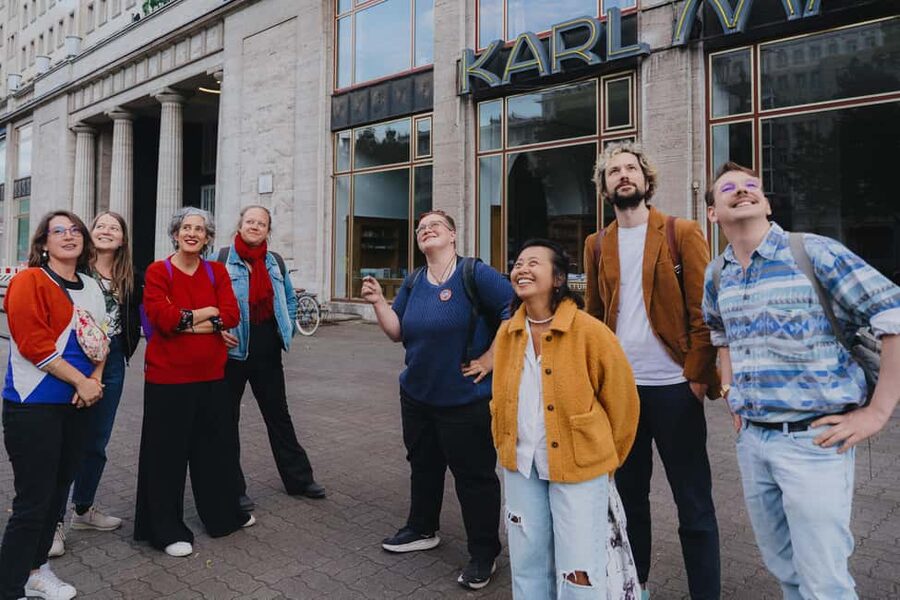
Karl-Marx-Allee is not just a grand avenue lined with oversized apartment blocks. It is a record of East Germany’s ambitions, fears, and failures, built in stone and ceramic tile across the heart of former East Berlin. You’ll walk through the setting of a workers’ uprising, see where socialist prestige met everyday life, and learn how the Stasi watched from behind the walls.
I like this tour for two clear reasons: the architecture tells the political story, and the route connects big Cold War events to ordinary homes, shops, cafes, and streets. I also like the human touch supplied by guides such as Martina, who is praised for paying close attention to curious questions rather than simply reciting a script. The main consideration is that this is a history-heavy walk, so children under 10 cannot join and anyone wanting a quick architectural photo stop may find the discussion more demanding than expected.
In This Review
- Key points to know
- Why Karl-Marx-Allee explains East Germany so well
- Meeting at Frankfurter Tor and getting oriented
- The first socialist street and its grand building program
- Postwar modernism beneath the monumental facades
- The 1953 uprising and the cost of reconstruction
- The Stasi behind the ideal home
- Film locations and the avenue’s afterlife
- What $23 buys you in two hours
- Who should book this Karl-Marx-Allee walk?
- Final recommendation
- FAQ
- Where does the Karl-Marx-Allee Walking Tour begin?
- Where does the tour finish?
- How long does the tour last?
- What languages are available?
- Is the tour wheelchair accessible?
- Can children join the tour?
Key points to know
- Frankfurter Tor begins the story: Meet outside the U-Bahn station at the corner of Warschauer Straße and Karl-Marx-Allee, near the guide with an orange umbrella.
- Monumental socialist classicism: See the most ambitious building project of former East Berlin and understand why the avenue was designed to impress.
- The 1953 uprising matters here: The construction project helped trigger a mass workers’ revolt that nearly brought down the young East German government.
- A polished public image hid private control: Learn how wiretaps and attic listening stations supported Stasi surveillance.
- The avenue has changed again: Former Stalinallee is now linked to protests over gentrification and rising housing costs.
- The tour costs $23: For two hours with a live guide, that is a fair price if you want context rather than only photographs.
Why Karl-Marx-Allee explains East Germany so well
Berlin has plenty of Cold War sights, but Karl-Marx-Allee gives you something different. Instead of isolated memorials or museum displays, you walk through a functioning urban district designed to express a political system.
The avenue was planned as the main project of East Germany’s postwar rebuilding program. Berlin had been badly damaged, and the new socialist government wanted more than repaired streets. It wanted a powerful public statement: the state could rebuild, organize, and provide homes for workers.
That message is hard to miss. The apartment blocks feel enormous, especially when you walk at street level. Their scale was intentional. The avenue had to look important enough for parades and official ceremonies, while also presenting the idea that working people deserved generous, attractive housing.
I find the contrast especially useful. The buildings project confidence, but the history beneath them is uneasy. The avenue was created with thousands of volunteers working day and night, yet the work helped spark the 1953 uprising. The street was supposed to prove the strength of socialism. Instead, it exposed frustration with the government and its labor demands.
A guide can make that contradiction clear in a way a photograph cannot. You are not simply looking at large facades. You are asking who they were built for, who paid the price, and what life looked like behind the carefully planned exterior.
More walking tours in Berlin:
- Discover Berlin Half-Day Walking Tour
★ 5.0 · 9,624 reviews - Berlin: Third Reich and Cold War 2 Hour Walking Tour
★ 4.9 · 6,830 reviews - Berlin: Discover Berlin Walking Tour
★ 4.9 · 5,998 reviews
Meeting at Frankfurter Tor and getting oriented
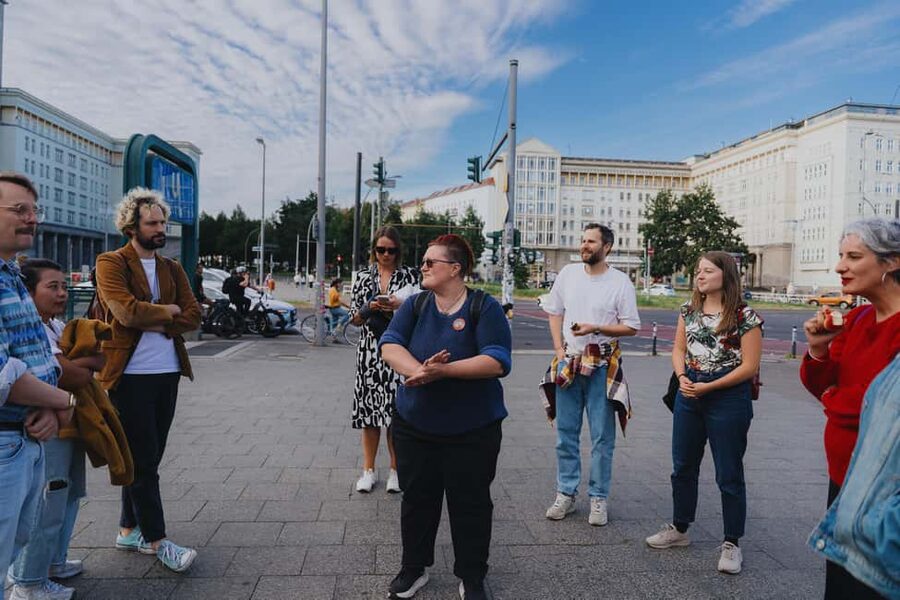
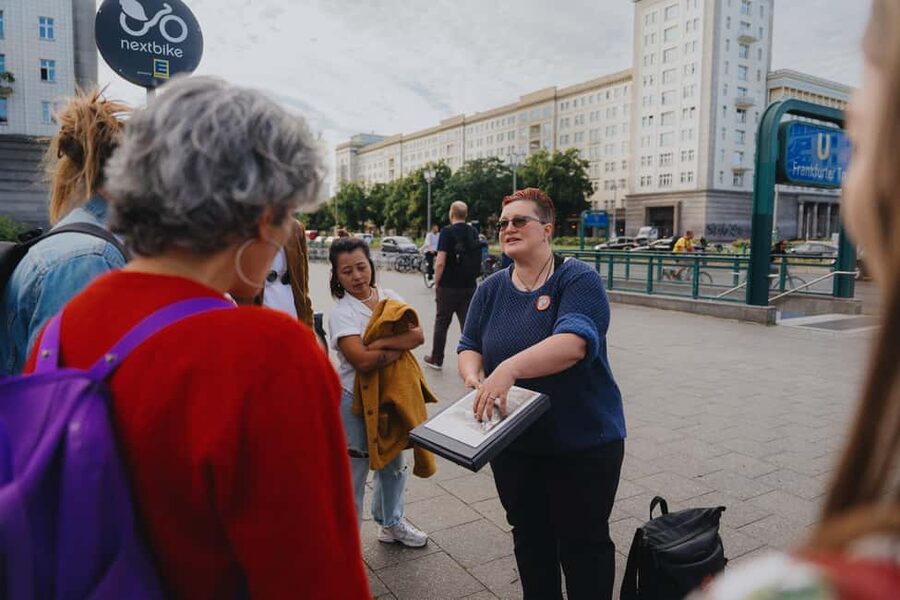
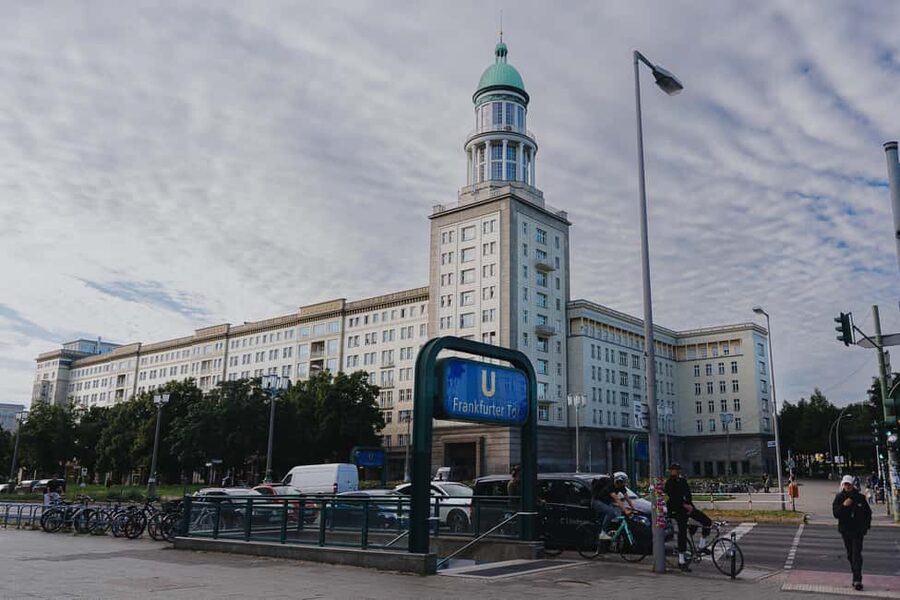
The tour begins outside Frankfurter Tor U-Bahn station, at the corner of Warschauer Straße and Karl-Marx-Allee. Look for the guide holding an orange umbrella. That detail matters because the intersection can feel busy, and a clear meeting marker saves time at the start.
Frankfurter Tor is an effective opening point. It gives you a strong first view of the avenue and places you close to some of its most recognizable architecture. You begin with the visual shock of the boulevard before the guide fills in the political background.
Plan to arrive in comfortable shoes. The full activity lasts two hours, with about 1.5 hours listed for the guided walk itself. The remaining time likely allows for meeting and movement, but you should still treat this as a proper walking tour rather than a short orientation.
The tour is offered in English or German. The guide is live, which makes a real difference on a subject filled with difficult terms, competing interpretations, and small details that are easy to miss. Martina is one guide associated with the experience, and the available feedback points to her habit of responding carefully to questions. That is useful here because the best questions often come from comparing the polished avenue with the less polished reality of East German life.
The first socialist street and its grand building program
Karl-Marx-Allee was once called Stalinallee, and it was presented as the first socialist street in Germany. The name changed, but the purpose of the project remained visible in its architecture.
The style is often called socialist classicism. It uses monumental proportions and decorative details to make modern apartment buildings look like a ceremonial avenue. The result is not modest. You are meant to feel small beside the blocks, and that feeling is part of the design.
The buildings were intended to provide homes while also serving as a public display of state power. The avenue offered cafes, restaurants, and well-stocked shops, creating a picture of comfort and abundance in socialism. For residents, access to these amenities could make the area seem like the best East Berlin had to offer.
That is an important point to keep in mind during the walk. The avenue was not only a parade route or government showcase. People lived here. Families shopped, ate, met friends, and returned to apartments that were presented as proof of the system’s care.
At the same time, the carefully chosen shops and public spaces created an image that did not represent every East German. The tour helps you see how architecture and retail could work together as political messaging. A well-stocked display window was not just convenient. It was evidence the state wanted you to notice.
Postwar modernism beneath the monumental facades
The avenue’s story reaches further back than the grand buildings of the 1950s. After the war, modernist ideas shaped parts of the rebuilding effort. These earlier buildings reflected utopian plans for a new city rising from the ruins of Berlin.
The later East German regime rejected that approach and embraced a more imposing vision of socialist living. Fast-growing poplar trees were later used to hide the earlier modernist buildings from passersby. That detail gives the tour an unusual angle: the city was not merely rebuilt, it was edited.
As you walk, you can consider how each architectural choice carried a political message. Modernism suggested a clean break with the past and a rational new city. Socialist classicism offered ceremony, order, and historical weight. The change in style reflected a change in what the government wanted people to believe about the future.
This section is especially valuable if you normally see architecture as decoration. Here, the buildings reveal internal arguments within the new state. You can follow the shift from postwar idealism to a more controlled and theatrical public image.
Do not expect every detail to be obvious from the street. Some of the earlier structures were deliberately screened by trees, and much of the story depends on the guide pointing out what the planners wanted people to see and what they preferred to hide.
More history walks in Berlin:
- Berlin: Natural History Museum Entrance Ticket
★ 4.6 · 3,382 reviews - Berlin: World Heritage Cruise to Potsdam
★ 4.5 · 1,435 reviews - Berlin Historical Highlights Walking Tour
★ 4.9 · 657 reviews - Berlin Private Complete History All Day Walking Tour
★ 5.0 · 474 reviews
The 1953 uprising and the cost of reconstruction

One of the tour’s most important subjects is the East German uprising of June 1953. Workers who were dissatisfied with government policies began a mass revolt that spread beyond a single construction site.
The building of Karl-Marx-Allee played a part in this crisis. The huge reconstruction effort demanded intense labor, and disgruntled workers challenged increased production requirements. What began as a labor dispute grew into a wider protest against the socialist government.
The revolt nearly toppled the young East German state. That makes the avenue more than a symbol of rebuilding. It is also a place where the state’s claim to represent workers met open resistance from workers themselves.
I like this part of the tour because it prevents the architecture from becoming a simple story of progress. The buildings may look stable and permanent, but the political order behind them was vulnerable. A street built to show socialist unity became connected to one of the most serious challenges the government faced.
The guide can also help you understand why the uprising matters beyond a single date. It shows that dissatisfaction in East Germany was not limited to private grumbling. People could organize, protest, and demand change, even when the state responded with force and suppression.
The Stasi behind the ideal home
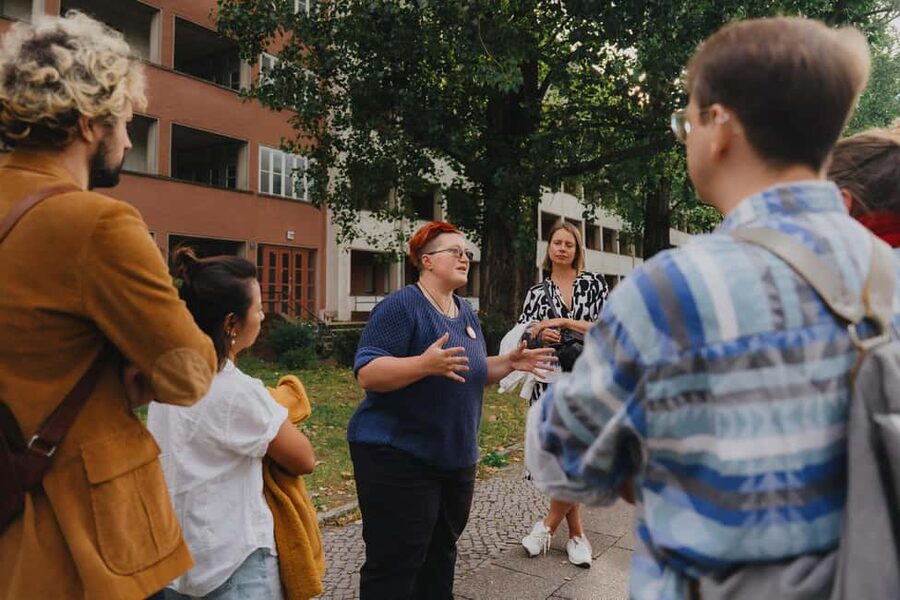
The avenue’s public face was carefully managed. Its private spaces were not as free as the bright shops and grand facades suggested.
The tour examines the surveillance system operated by the Stasi, East Germany’s secret police. Wiretaps in apartments and listening stations in attics were part of the hidden infrastructure. These tools were not meant to be visible from the street, which is precisely why they are so important to the story.
You may look at an apartment block and see a comfortable socialist home. The guide asks you to consider how that home could also become a place of observation. Conversations, visitors, and private doubts might be monitored without the residents knowing.
This is where the walk moves from urban design into daily life. The Stasi was not an abstract institution operating somewhere far away. Its presence could reach into ordinary flats and shared buildings.
The subject is serious, but the street setting makes it easier to grasp. You can connect the surveillance system to the actual buildings where people lived, rather than treating it as a distant chapter in a museum. I find that direct connection one of the strongest reasons to choose this tour.
The discussion also adds balance to the avenue’s claims of comfort. Good shops and large apartments did not cancel out restrictions on privacy or speech. The tour keeps both facts in view.
Film locations and the avenue’s afterlife

Karl-Marx-Allee has also become useful to filmmakers. The route includes locations connected with The Lives of Others and The Queen’s Gambit. If you know either production, you’ll get an extra layer of interest from recognizing the settings.
The film references should not dominate the tour. Their value is that they show how the avenue’s architecture continues to communicate a particular mood: controlled, monumental, and marked by the Cold War. You can enjoy the screen connection while still focusing on the real people and events tied to the street.
After the Berlin Wall fell, the avenue lost its role as a central boulevard for socialist parades. For a time, its worn appearance made it seem like an awkward leftover from a failed system. That period is part of the story too. Cities often decide what to preserve only after neglect has already changed the place.
Berlin’s housing crisis brought new attention. Real estate interest increased, and the avenue became part of current arguments about who can afford to live in central Berlin. Local protests over gentrification and rising living costs now use a former socialist parade route as a stage.
That shift gives the tour a useful present-day ending. Karl-Marx-Allee is not frozen in East German history. Its buildings are still homes, and its public spaces are still used for political expression. The ideology has changed, but the question of who controls urban life remains.
What $23 buys you in two hours

At $23 per person, this is a reasonably priced specialist walk. You get two hours of focus on one area, a live guide, and an explanation that links architecture, labor politics, surveillance, film, and present housing concerns.
The value depends on what you want from Berlin. If you only need a quick look at the avenue, you can walk it independently for free. You can also take photographs without booking a tour.
I would pay for the guided version if you want to understand why the street looks the way it does. The cost is modest compared with a major museum ticket, and the experience gives you access to connections that are not immediately visible. The 1953 uprising, the earlier modernist buildings, the Stasi listening stations, and the present protests all make more sense when presented as one continuous story.
The tour is also flexible from a booking point of view. You can cancel up to 24 hours before the start for a full refund, and you can reserve now while paying later. Those policies are useful in Berlin, where weather and changing plans can affect a walking day.
The group size is not stated, so I would not book this expecting a private tour or a guaranteed small group. The guide’s willingness to answer questions matters more than a fixed promise about group size. The available feedback gives Martina particular credit for listening to curious participants, which is exactly the quality you want on a history walk.
Who should book this Karl-Marx-Allee walk?
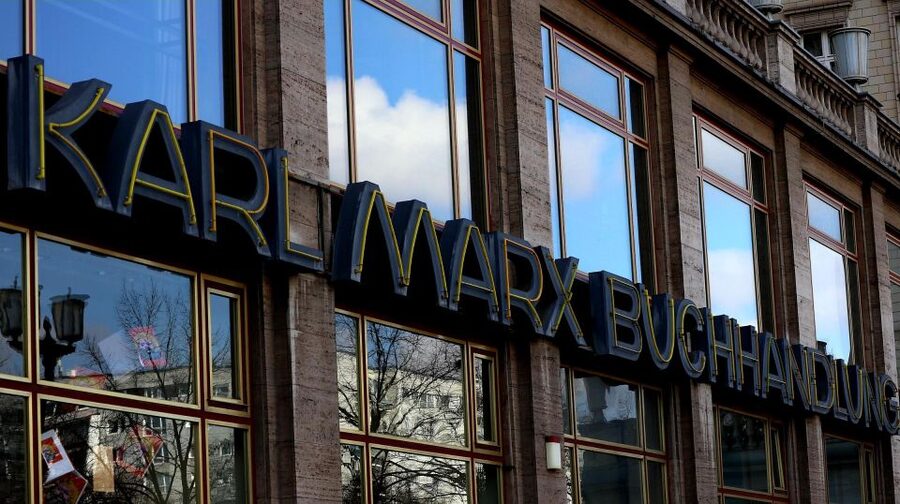
I recommend it most for adults and older teenagers interested in architecture, Cold War politics, urban planning, or modern German history. It suits you if you like seeing where events happened and then discussing how the physical setting shaped daily life.
It is also a good choice if you have already visited central Berlin’s best-known memorials and want a different part of the city. Karl-Marx-Allee is not presented as a single dramatic ruin or memorial. It is an ordinary working district with an extraordinary political past.
You may want another activity if you dislike long explanations or prefer a tour built around quick photo stops. The material includes ideology, government control, labor unrest, and surveillance, so the tone is thoughtful rather than light.
Children under 10 are not permitted. The route is wheelchair accessible, which makes the experience available to more visitors, although you should still expect an outdoor walk and bring suitable shoes.
The advertised route describes the guided walk from U Frankfurter Tor toward U Strausberger Platz. Another meeting note says the activity ends back at the meeting point, so confirm the final stopping place when booking if your onward plans depend on it.
Final recommendation
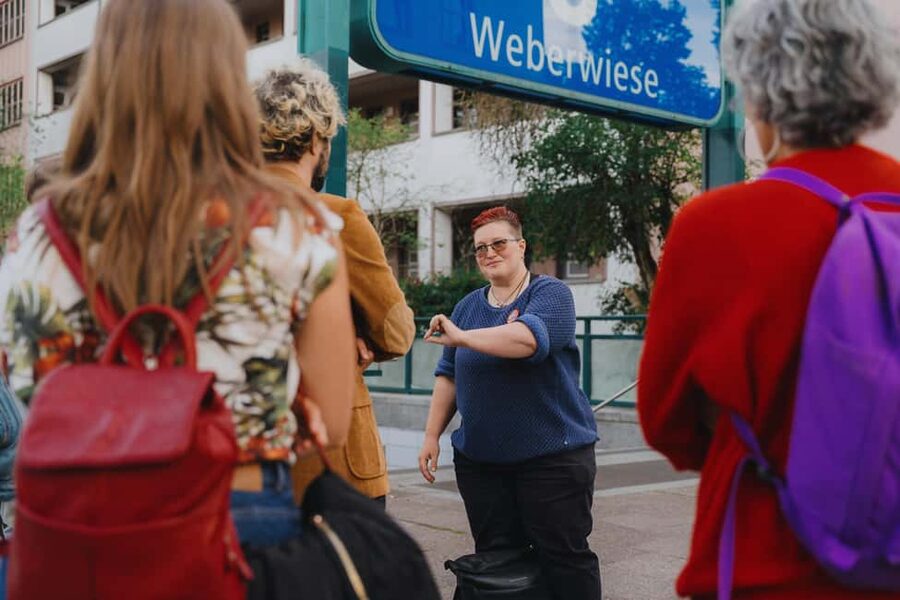
Book this tour if you want Karl-Marx-Allee to make sense, not merely look impressive. For $23, you get a focused explanation of East Berlin’s largest building project, the 1953 uprising, Stasi surveillance, changing architecture, film history, and today’s housing protests.
Skip it if you want a short, casual stroll with little political discussion. For everyone else, this is one of the more useful ways to understand how an entire ideology can be built into a street, and how ordinary residents can continue to reshape that street long after the ideology is gone.
FAQ
Where does the Karl-Marx-Allee Walking Tour begin?
Meet outside Frankfurter Tor U-Bahn station, on the corner of Warschauer Straße and Karl-Marx-Allee. Look for the guide holding an orange umbrella.
Where does the tour finish?
The route information describes the guided walk ending at U Strausberger Platz. The meeting information also says the activity ends back at the meeting point, so confirm the final location when booking.
How long does the tour last?
The activity lasts two hours. The guided portion of the Karl-Marx-Allee walk is listed as 1.5 hours.
What languages are available?
The live tour guide can lead the experience in English or German.
Is the tour wheelchair accessible?
Yes, the activity is listed as wheelchair accessible.
Can children join the tour?
Children under 10 are not permitted. Comfortable shoes are recommended for all participants.
Just added around Berlin
- Berlin Highlights in One Day★ 5.0 · 3 reviews
- Private Berlin One Day Tour with a Local: See the City Unscripted★ 3.5 · 3 reviews
- Individual city tour Berlin for max. 8 persons★ 5.0 · 3 reviews
- Transfer from Berlin Schönefeld Airport (SXF) to Berlin city Hotels – ROUND TRIP★ 4.0 · 3 reviews
- Berlin: Museum Island Tour★ 5.0 · 3 reviews
- Private Analogue Photography Experience in Berlin★ 5.0 · 3 reviews
- Berlin: Local Food Tour in Secrets Hidden Gems★ 4.0 · 3 reviews
- Berlin & The Third Reich Private Guided Tour★ 5.0 · 3 reviews
Historical Tours, compared.


Berlin Private Complete History All Day Walking Tour
Read our review →


Small group Potsdam: A Journey Through History and Palaces
Read our review →Browse the lists this tour appears in