
Review · BERLIN WALL TOURS
The Cold War and The Wall – Private Tour with Jacob
Berlin’s Cold War story is best understood by moving through the city, and this private tour does exactly that. In less than three hours, you connect the Brandenburg Gate, Checkpoint Charlie, the Palace of Tears, and Alexanderplatz with the events that split Berlin for four decades.
I like the personal format, which lets you ask questions and adjust the pace within your group of up to six. I also like the unusual stops, including the East German Trabi Museum and the Aviation Ministry, rather than a tour that sticks only to the famous wall sites. The main consideration is pace: ten stops in about 2 hours 45 minutes leaves limited time at each place.
In This Review
- Key points to know before booking
- Why this Berlin Cold War tour works
- Starting at the Victory Column and Straße des 17. Juni
- Brandenburg Gate and the Wall’s rise and fall
- Potsdamer Platz and a city cut in half
- The Aviation Ministry and stories of escape
- The Trabi Museum and everyday East Germany
- Checkpoint Charlie and the main East-West crossing
- Friedrichstrasse and the city’s checkpoint street
- Unter den Linden, East Berlin’s main avenue
- The Palace of Tears and controlled departures
- Alexanderplatz, the TV Tower, and the space race
- What the $310 group price really buys
- Timing, transport, and walking expectations
- Who should book this private Berlin tour
- Should you book The Cold War and The Wall?
- FAQ
- How long does the tour last?
- How much does the private tour cost?
- Is public transportation included?
- Can I be picked up at my hotel?
- Where does the tour end?
- Who is the guide?
- Are admission fees included?
- Is this a private activity?
- Does the tour operate in bad weather?
- Can I cancel for a full refund?
Key points to know before booking
- A private group of up to six: The $310 price covers the group, not each person, so the value improves sharply when shared by four to six people.
- A citywide Cold War route: You travel from the Victory Column and Brandenburg Gate to Potsdamer Platz, Checkpoint Charlie, Friedrichstrasse, and Alexanderplatz.
- Jacob or Nadav Jacobs may guide you: The experience is built around a personal guide who can answer questions and suggest further places to visit.
- Public transport is not included: Budget about €3 to €11 for a two-hour or day ticket, depending on the ticket you need.
- Useful printed orientation aids: You receive an A3 picture folder and a large subway map, handy for continuing your Berlin sightseeing.
- Outdoor sightseeing in any weather: Bring an umbrella or rain protection, since the tour operates in all weather conditions.
Why this Berlin Cold War tour works
The subject can feel scattered when you see Berlin on your own. One wall fragment is here, a checkpoint is there, and a former government building sits several blocks away. This route gives those places a shared thread: the rise of East Germany, the border between East and West Berlin, the pressure placed on ordinary residents, and the city’s return to openness after 1989.
The private setup is especially useful for this subject. You can ask Jacob, or Nadav Jacobs, to explain a point again, connect one site to another, or suggest places to visit later. The guide also provides an A3 picture folder and a large subway map, which add a useful visual layer to a story that includes changing borders, vanished buildings, and a city split in two.
The tour has earned a 4.8 rating from six reviews, with particular praise for the guide’s information, personal attention, and suggestions for seeing more of Berlin. One person described the tour as a strong introduction that only scratched the surface, which is a fair way to view it. This is a focused orientation tour, not a full study of every Cold War site in the city.
More of the Berlin Wall, end to end:
- Skip-the-Line: Berlin Wall Museum at Checkpoint Charlie
★ 4.1 · 2,041 reviews - Berlin: East Side Gallery Spree Cruise in a Solar Catamaran
★ 4.0 · 1,039 reviews - Cold War, Berlin Wall, Spies and the East Side Gallery
★ 5.0 · 1,024 reviews
Starting at the Victory Column and Straße des 17. Juni
The first stop is the Siegessäule, or Victory Column, in the middle of the Tiergarten. You spend about 15 minutes here, with no admission fee.
The focus is not simply the column itself. The guide uses Straße des 17. Juni and the East German uprising of 1953 to introduce the political tension of the early Cold War. The date refers to the workers’ revolt in East Germany, a key moment in understanding how economic pressure, political control, and public anger could meet in the streets.
This is a short opening stop, so expect a briefing rather than a long visit to the monument. It works well as a first chapter because it places Berlin inside the wider story of East German rule before the route moves toward the Wall and the border.
Brandenburg Gate and the Wall’s rise and fall
At the Brandenburg Gate, the tour turns to the most recognizable symbol of divided Berlin. You have around 10 minutes here, again without an admission charge.
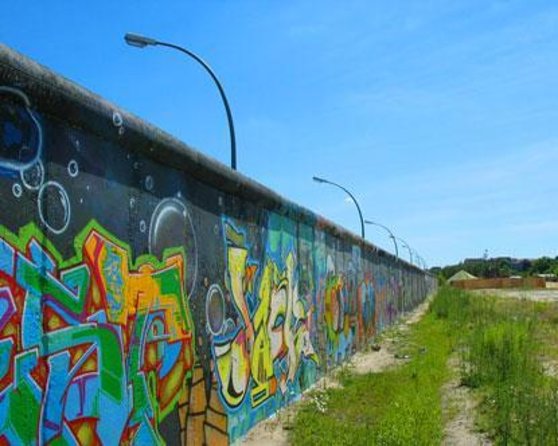
The guide covers both the erection and fall of the Berlin Wall. That pairing matters. The gate was not only a grand city monument. During the division, it became part of a sealed border zone and a powerful image of Berlin’s split identity.
Ten minutes is enough to set the scene and hear the main explanation, but not enough for a long photo stop or detailed architectural discussion. If you want a quiet look at the area, you will need to return on your own. The tour’s purpose here is to tie the gate to the Wall, not to explore every period of the monument’s past.
Potsdamer Platz and a city cut in half
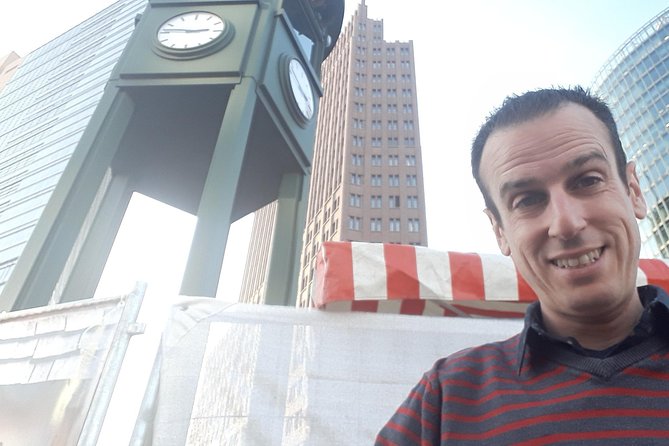
Potsdamer Platz receives about 15 minutes. The stop focuses on the former city divide and a post-Cold War freedom concert.
This location is useful because it helps you picture how dramatically Berlin changed. Potsdamer Platz was once split by the border and later became a symbol of the city’s renewed connection. The contrast between division and reunification is one of the clearest themes of the tour.
The stop also brings in the culture of the post-Cold War period. You are not just looking at a line on a map. You are considering how public celebrations and music helped express the feeling of a city opening again.
More Cold War Berlin:
- Berlin: Third Reich and Cold War 2 Hour Walking Tour
★ 4.9 · 6,830 reviews - Berlin’s Best: 2 Hour Walking Tour Third Reich and the Cold War
★ 5.0 · 5,486 reviews - Berlin: Cold War Walking Tour on Berlin Wall Route
★ 4.8 · 437 reviews - Berlin: Cold War Era History Guided Bike Tour
★ 4.8 · 413 reviews
The Aviation Ministry and stories of escape
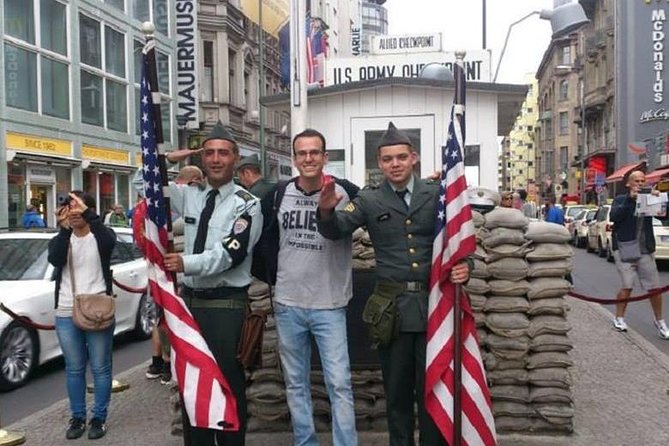
The former Aviation Ministry of Berlin is a ten-minute stop. The subjects here include Max Lingner’s communist utopian mural and Heinz Holzapfel’s escape attempt.
This is one of the route’s less obvious locations, and that is part of its value. Famous landmarks can explain the broad story, but a government building and an escape story show how ideology and personal risk operated at street level.
The short visit means you will rely heavily on the guide’s explanation. A private guide is helpful here because you can ask about the mural, the building’s political role, or the escape attempt instead of simply passing by a facade with no context.
The Trabi Museum and everyday East Germany
The Trabi Museum gets the longest stop so far, about 30 minutes, with admission listed as free. The subject is the Trabant, East Germany’s famously modest car.
This gives the tour a welcome change of scale. After monuments, government sites, and border crossings, the Trabi points to everyday life. The car became associated with East German industry, limited consumer choice, and the practical realities of living behind the Iron Curtain.
Thirty minutes allows more time to look around than you receive at most of the outdoor stops. Still, do not expect a full museum visit with a long independent exploration period. It is one part of a wider route, and the guide’s comments help connect the car to the social and economic system around it.
Checkpoint Charlie and the main East-West crossing
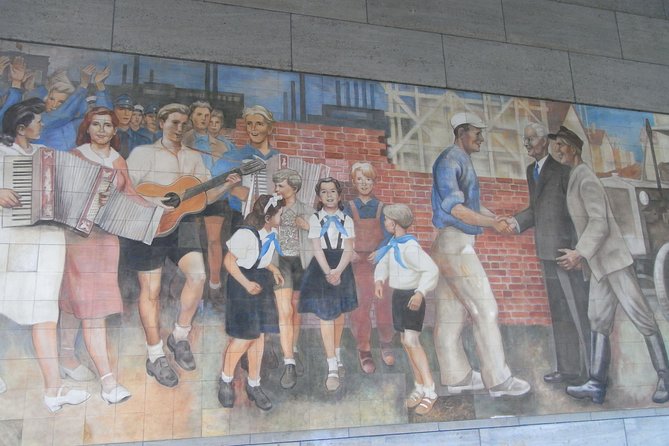
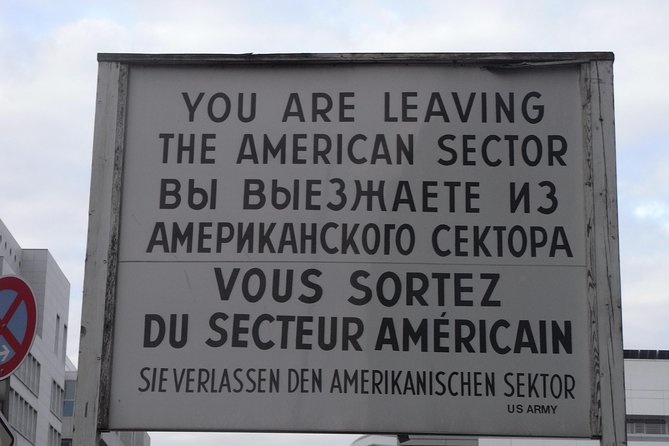
Checkpoint Charlie is allotted about 10 minutes. This was the main crossing point between East and West Berlin and one of the best-known Cold War border sites.
The name carries a great deal of weight, but the current experience is centered on explanation and location. You will learn about the checkpoint’s role in the Cold War and its place on the main route between the two sides.
A practical warning: this is a quick stop in a very famous area. If you want extensive time for photographs or to visit additional nearby displays, plan to return independently. The guide’s job here is to explain why the crossing mattered, then keep the larger route moving.
Friedrichstrasse and the city’s checkpoint street
Friedrichstrasse receives around 20 minutes. The name means Frederick Street, but on this tour it is presented as the checkpoint street, linking the commercial center with the mechanisms of border control.
This stop helps explain that the division was not confined to one famous booth at Checkpoint Charlie. It affected streets, stations, crossings, and the ordinary movement of people. A private guide can make those connections in a way that a quick photograph cannot.
Twenty minutes gives you a little more breathing room. You can listen, ask questions, and get your bearings before the route continues along Unter den Linden.
Unter den Linden, East Berlin’s main avenue
The tour spends about 20 minutes on Unter den Linden, the major avenue leading toward the border. The avenue is important not only for its buildings and broad route, but for its role in East Berlin’s public life and connection to the frontier.
Here, the guide places the capital of East Germany within the city you are seeing today. You get a sense of how the eastern side organized its ceremonial and political spaces, and how movement toward the border shaped the avenue’s meaning.
This is another stop where context matters more than a single object. The route is designed to help you read Berlin’s streets as evidence of the former division. You may find the visual details easier to understand after the earlier stops at the Wall and Potsdamer Platz.
The Palace of Tears and controlled departures
The Palace of Tears is scheduled for about 20 minutes. Its name refers to the emotional farewells that took place at this checkpoint, where people leaving East Berlin said goodbye to family and friends who could not go with them.
The site represents a more personal side of the Cold War. Checkpoint Charlie brings to mind military tension and international confrontation. The Palace of Tears brings the subject down to visits, departures, paperwork, and the pain of separation under a controlled border system.
The tour describes it as a main checkpoint for citizens and a place of communist control. That makes it one of the most meaningful stops for understanding how political division affected families. Allow yourself time to listen closely here, since the human story can be easy to miss when you focus only on buildings and border lines.
Alexanderplatz, the TV Tower, and the space race
The tour ends at Alexanderplatz after about 10 minutes there. The focus includes the television tower and the space race, two useful symbols of East German public identity and competition with the West.
The TV Tower was designed to project the strength and modernity of East Berlin. The space race added another layer, turning scientific achievement into political display. Together, they show how governments used technology, architecture, and public spectacle to present their system as the future.
Ending at Alexanderplatz is practical. The area is well connected and gives you a clear place to continue your day. It also brings the route back to daily city life after a tour centered on borders, control, and political conflict.
What the $310 group price really buys
The price is $310 per group of up to six people. For one or two people, that is a substantial cost. For a group of four to six, it becomes more reasonable because you are sharing the private guide rather than paying six separate full tour prices.
The value comes from the guide’s time and flexibility, not from paid admissions. Every listed stop has no admission fee, and the main expenses outside the tour are public transport, around €3 to €11 for a two-hour or day ticket. A private van and driver can be arranged on request, but that is an extra cost.
Pickup is offered from a Berlin hotel, apartment, train station, or airport. The tour ends at Alexanderplatz, so you should understand that pickup and drop-off are not necessarily the same place. If you need a van, have luggage, or want a different end point, ask about the added charge before booking.
For a small family or group of friends who want one guide and a shared conversation, the price can work well. If you are alone and mainly want to see the major sights, a group tour or self-guided route may cost less.
Timing, transport, and walking expectations
The stated duration is about 2 hours 45 minutes. Ten stops are packed into that time, with the stop lengths ranging from 10 to 30 minutes. The schedule therefore favors broad coverage over long visits.
This is described as a private walking tour, but the separate public transport fee makes it sensible to expect transit between some parts of the route. Budget for the required ticket and wear comfortable shoes. The large subway map supplied by the guide is useful both during the tour and afterward.
Pickup adds convenience, especially if you are new to Berlin or arriving at a station. At the same time, airport pickup may not be the best use of a short sightseeing tour if you are carrying luggage or dealing with arrival delays. Confirm the pickup details and allow enough time to begin without rushing.
The tour runs in all weather. Bring an umbrella and a jacket suitable for outdoor stops. Much of the value comes from seeing streets and spaces directly, so poor weather may make the experience less comfortable even though it does not cancel the activity.
Who should book this private Berlin tour
I would choose this tour for a first visit to Berlin when you want a clear introduction to the Cold War without spending a full day in museums. It suits families, couples, and small groups who prefer to ask questions rather than follow a large crowd.
It is also a good fit if you want more than the usual Brandenburg Gate and Checkpoint Charlie circuit. The Victory Column, Aviation Ministry, Trabi Museum, Friedrichstrasse, and Palace of Tears add range to the subject.
You should think twice if you want long visits at each site, detailed museum time, or a slow photography walk. The itinerary covers a lot of ground, and ten stops in under three hours will feel brisk. The experience works best as a first layer, followed by independent visits to the places that interest you most.
The guide can also offer ideas for future sightseeing. That is useful if you have several days in Berlin and want help deciding what to see next. The supplied subway map and picture folder make that follow-up planning easier.
Should you book The Cold War and The Wall?
Book it if you want a personal, citywide introduction to divided Berlin, especially with a group large enough to share the $310 cost. The route covers the major symbols but also includes human stories, everyday East German life, and less familiar political sites.
Skip it if your priority is the lowest possible price or a slow visit to only one section of the Wall. The short timing at several stops may leave you wanting more, but that is also the point: this tour gives you the framework, then helps you choose where to spend your own time afterward.
The strong guide-focused feedback is important here. Jacob and Nadav Jacobs are named guides associated with the experience, and the best reason to book is the chance to have a real conversation about Berlin’s past rather than simply collect landmark photos.
FAQ
How long does the tour last?
The tour lasts approximately 2 hours and 45 minutes.
How much does the private tour cost?
The price is $310 per group of up to six people.
Is public transportation included?
No. Public transport costs about €3 to €11, depending on whether you need a two-hour ticket or a day ticket.
Can I be picked up at my hotel?
Yes. Pickup is offered from hotels, apartments, train stations, and the airport in Berlin.
Where does the tour end?
The tour ends at Alexanderplatz, at 10178 Berlin.
Who is the guide?
The experience is associated with Nadav Jacobs Berlin experience. The named guides include Jacob and Nadav Jacobs.
Are admission fees included?
The listed stops have no admission ticket fee. Public transportation and a private van with driver are not included.
Is this a private activity?
Yes. Only your group participates, with a maximum group size of six under the stated price.
Does the tour operate in bad weather?
Yes. It operates in all weather conditions, and you should bring an umbrella or suitable rain protection.
Can I cancel for a full refund?
Yes, if you cancel at least 24 hours before the experience start time. Cancellations or changes made less than 24 hours before the start are not accepted for a refund.
Just added around Berlin
- Berlin Highlights in One Day★ 5.0 · 3 reviews
- Private Berlin One Day Tour with a Local: See the City Unscripted★ 3.5 · 3 reviews
- Individual city tour Berlin for max. 8 persons★ 5.0 · 3 reviews
- Transfer from Berlin Schönefeld Airport (SXF) to Berlin city Hotels – ROUND TRIP★ 4.0 · 3 reviews
- Berlin: Museum Island Tour★ 5.0 · 3 reviews
- Private Analogue Photography Experience in Berlin★ 5.0 · 3 reviews
- Berlin: Local Food Tour in Secrets Hidden Gems★ 4.0 · 3 reviews
- Berlin & The Third Reich Private Guided Tour★ 5.0 · 3 reviews
Berlin Wall Tours, compared.

Skip-the-Line: Berlin Wall Museum at Checkpoint Charlie
Read our review →
East Side Gallery Spree Cruise in a Solar Catamaran
Read our review →
Cold War, Berlin Wall, Spies and the East Side Gallery
Read our review →

Guided Bike Tour of the Berlin Wall and Third Reich
Read our review →

Browse the lists this tour appears in