
Review · THIRD REICH & WWII SITES
Berlin and National Socialism: Berlin under Nazism
Berlin under Nazism is best understood as a citywide story, not a single museum visit. This four-hour route links government buildings, memorials, wartime sites, and places tied to the final days of Hitler’s regime, giving you a clear way to connect the pieces.
I like the Spanish-speaking guide, especially if you want careful explanations of difficult subjects in your strongest language. I also like the route’s range: the Sinti and Roma memorial and Soviet Memorial broaden the story beyond the familiar Nazi leadership narrative. The main drawback is pace. Six stops across Berlin mean some visits are brief, and the AB transport ticket is not included.
In This Review
- Key points to know before booking
- Why this route helps make sense of Nazi-era Berlin
- Starting at the Bundestag and the seat of power
- Remembering Sinti and Roma victims
- The Soviet Memorial in the Tiergarten
- Tempelhof and Berlin’s changing airport story
- Topography of Terror and the machinery of repression
- The Führerbunker site and the regime’s final hours
- Ending at the Memorial to the Murdered Jews of Europe
- How the timing affects the experience
- The Spanish-speaking guide makes a real difference
- Is $25.54 a good price?
- Who should book this Berlin history tour?
- Should you book Berlin under Nazism?
- FAQ
- How long does the Berlin under Nazism tour last?
- What language is the tour conducted in?
- Where does the tour start?
- What time does the tour begin?
- Where does the tour end?
- Is public transportation included?
- Are admission tickets included?
- What is the maximum group size?
- Can I cancel for a full refund?
Key points to know before booking
- A four-hour route across central Berlin: You cover six major locations, with time spent both walking and moving between districts.
- A Spanish-speaking guide: Julia, Júlia, Helena, and Celia are among the guides associated with this experience.
- The Nazi period is placed in a wider wartime setting: The route includes victims of genocide, Soviet soldiers, government buildings, and postwar memory.
- Short visits at several stops: The Sinti and Roma memorial receives about five minutes, while Topography of Terror receives about fifteen.
- Admission tickets are included: The tour price is about $25.54 per person, though Berlin public transport is extra.
- A maximum group size of 25: Large enough for a social tour, but smaller than many mass-market city walks.
Why this route helps make sense of Nazi-era Berlin
Berlin can feel confusing when you try to follow its twentieth-century story on your own. A parliament building, a memorial beside the Tiergarten, a former airport, and an unmarked bunker site may seem unrelated until someone explains how they fit into the rise, rule, defeat, and memory of National Socialism.
That is the useful idea behind this tour. It does not focus only on Hitler or military events. You also consider the people targeted by the Nazi state, the Soviet victory over Berlin, the destruction of the city, and the ways modern Germany remembers those crimes.
I would choose this experience early in a Berlin visit if the Third Reich is a main interest. The guide’s explanations can give you a framework for later visits to places such as the Memorial to the Murdered Jews of Europe, which is also the ending point.
The subject is heavy, and the tone needs care. The guides named in the available information, including Julia, Júlia, Helena, and Celia, are described as warm, prepared, attentive, and respectful. Some use photographs and videos to help place you in the period. That can make the material easier to follow, though it also means the experience depends strongly on the individual guide and the size of the group.
More Third Reich sites in Berlin:
- Berlin: Third Reich and Cold War 2 Hour Walking Tour
★ 4.9 · 6,830 reviews - Berlin: Berlin Story Bunker Entry Ticket
★ 4.6 · 6,759 reviews - Berlin’s Best: 2 Hour Walking Tour Third Reich and the Cold War
★ 5.0 · 5,486 reviews
Starting at the Bundestag and the seat of power
The meeting point is by the Berlin TV Tower at Panoramastraße 1A, with a 10:00 a.m. start. That location is close to public transportation, but the tour does not include your AB transport ticket, so plan to have the correct Berlin transit fare before setting out.
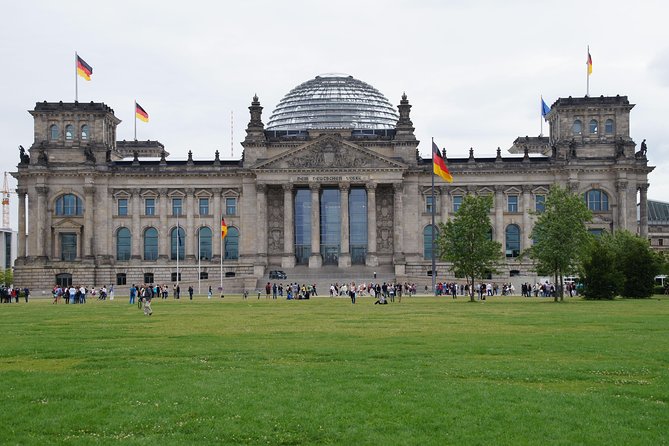
The Bundestag is a striking first stop because it links Nazi-era Berlin with the country’s present-day democracy. The building was damaged and left in ruins for years after the war. It received partial protection and renovation in the 1960s, but full reconstruction waited until German reunification on October 3, 1990.
Architect Norman Foster led the later reconstruction, completed in 1999. The building then became the meeting place of the modern German parliament again. That timeline gives the guide a natural opening: you begin with a symbol of state power and end up considering how Germany rebuilt political life after dictatorship and war.
The scheduled stop is about 20 minutes. Admission is listed as free, but you should not assume this means a full interior visit. The supplied details describe the building and its reconstruction, not a reserved dome entry or parliamentary tour. Treat this as a guided historical stop unless your booking confirmation says otherwise.
I like this beginning because it avoids presenting Nazism as an isolated, sealed-off period. The Bundestag lets you think about what happened to German government, what survived the war, and how the country’s political center changed after reunification.
Remembering Sinti and Roma victims
The next stop is the Memorial to the Sinti and Roma Victims of National Socialism. This is one of the most important places on the route because it widens your understanding of Nazi persecution beyond the groups most often discussed in introductory tours.
The monument honors the estimated 220,000 to 500,000 Sinti and Roma people murdered during the Nazi genocide, known as Porraimos. The short five-minute visit may seem limited, but the memorial itself is quiet and focused. The value comes from the guide’s context, which can help you understand why this group’s suffering belongs at the center of any serious account of the period.
Five minutes is enough for an introduction and a moment of reflection, not a long study session. If this subject matters especially to you, note the memorial’s location so you can return later at your own pace.
This stop also shows one of the tour’s strengths. You are not simply collecting famous Nazi sites. You are being asked to remember people who were persecuted and murdered by the same state system, even if their story receives less attention in many standard Berlin itineraries.
The Soviet Memorial in the Tiergarten
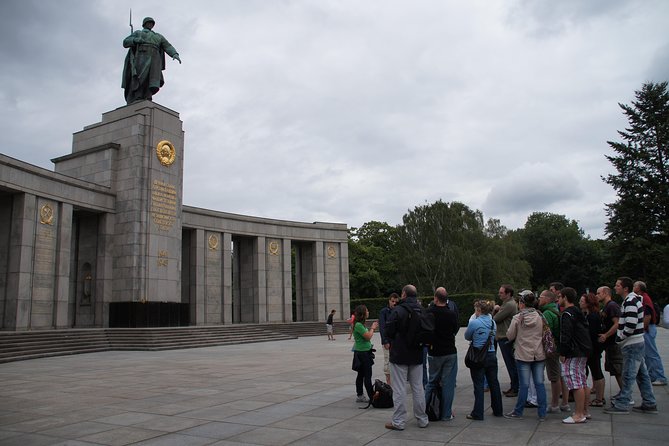
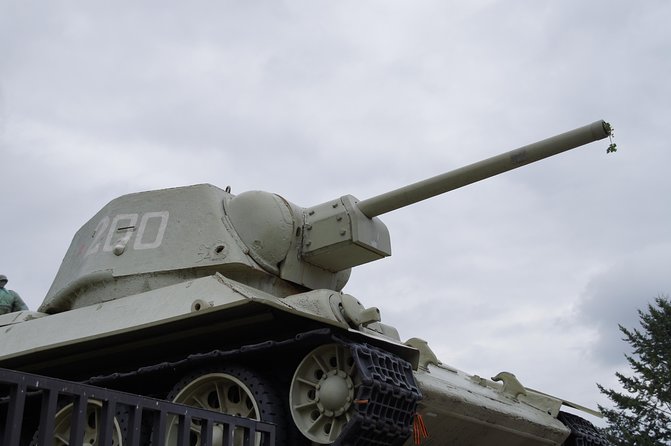
The Soviet Memorial Tiergarten brings the war’s final phase into view. It commemorates Soviet soldiers who died during the Battle of Berlin in April and May 1945, including about 80,000 members of the Soviet Armed Forces.
The memorial is one of several Soviet war memorials in Berlin. Its location in the Tiergarten makes it an important reminder that the defeat of Nazi Germany came through a massive military struggle, with enormous loss of life on the Soviet side.
The planned visit lasts about 15 minutes. That is a sensible amount of time for a guided introduction, photographs, and questions, but not for a detailed study of the entire Battle of Berlin. I would listen for the guide’s explanation of how the Soviet victory shaped the city after 1945 and how this monument fits into Berlin’s postwar divisions.
This is also a useful counterweight to the more familiar Nazi headquarters and bunker sites. The tour is not only about the perpetrators’ buildings. It shows the forces that defeated the regime and the memorial choices made by the victorious Soviet Union.
A different side of Berlin on the same trip:
- Berlin: Reichstag, Dome and Government District Guided Tour
★ 4.7 · 18,288 reviews - Berlin: 1-Hour City Tour by Boat with Guaranteed Seating
★ 4.3 · 16,993 reviews - Berlin: Boat Tour Along the River Spree
★ 4.4 · 11,252 reviews - Discover Berlin Half-Day Walking Tour
★ 5.0 · 9,624 reviews
Tempelhof and Berlin’s changing airport story
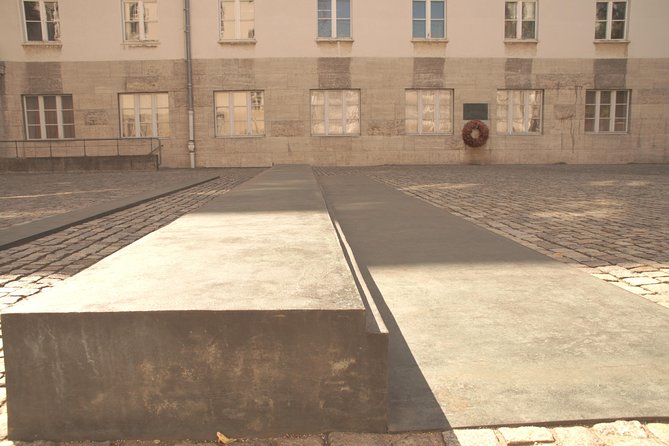
Tempelhof is an unusual inclusion. Many visitors associate it with later Berlin history, but the airport also reaches back to the early years of aviation and the city’s development in the twentieth century.
In 1926, Tempelhof handled ten flights a day and was considered the largest airport in Europe. The scheduled visit lasts around 25 minutes, making it one of the longer outdoor stops on the route.
The airport helps show how modern infrastructure and political power can overlap. It was an important gateway for Berlin, and its scale reflects the ambitions of the city during a period of rapid change. Your guide can place the airport within the larger story of Berlin before and during the Nazi era, rather than treating it as a detached aviation curiosity.
The practical point is that this stop adds variety. After memorials and government buildings, Tempelhof gives you a different setting and a chance to understand the city’s physical growth. It also means the tour is not a compact walk around one small district. You are covering ground, and the transport portions are part of the experience.
Topography of Terror and the machinery of repression
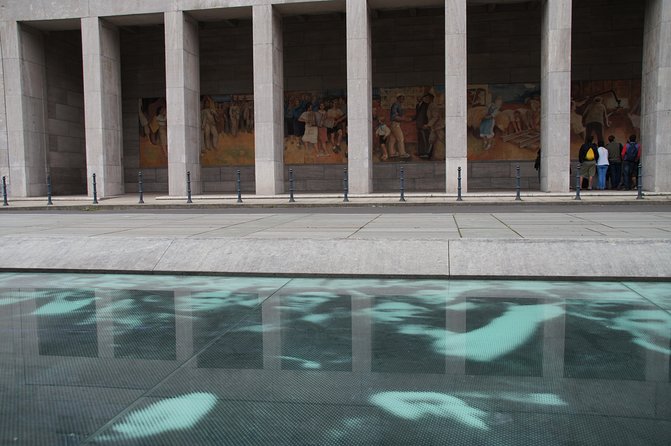
The Topography of Terror is an indoor and outdoor history museum, located at the former site of Nazi institutions connected with terror and repression. It is one of the route’s most direct stops for understanding how the dictatorship operated.
The planned visit is about 15 minutes. That is short for a museum, so do not expect to read every panel or explore the site in full. Instead, use the guide’s introduction to identify the main themes and decide if you want to return independently.
I see this as one of the most valuable stops for visitors who know the broad outline of Nazism but want to understand the system behind it. The period was not shaped only by speeches and battlefield decisions. It also depended on offices, police structures, records, orders, and people carrying out persecution.
The indoor and outdoor format is helpful because the site connects documents and explanations with the actual Berlin setting. Still, the limited time is a real constraint. If museums are your main reason for booking, you may want to schedule a separate visit after the tour.
The Führerbunker site and the regime’s final hours
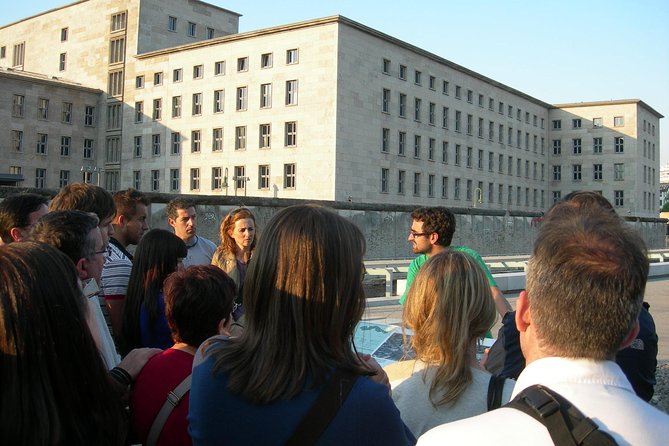
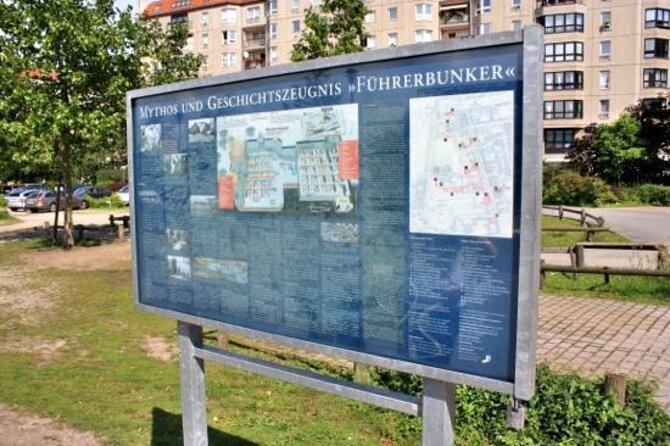
The stop at the Führerbunker site is about 15 minutes. You visit the area where Hitler had his refuge during his final hours alive.
There is no grand surviving bunker interior to explore here. The significance lies in the location and in the guide’s explanation of what happened as the Nazi regime collapsed. A good guide can help you understand the difference between the physical remains you can see today and the historical importance attached to the site.
This stop often draws strong interest, but it is worth keeping expectations in check. The area itself is not a conventional attraction with a dramatic interior. Its power comes from knowing what took place beneath the ground and from considering how the city has chosen to mark, or limit, public attention to the site.
The guide’s tone matters here. The available comments repeatedly emphasize clear explanations, empathy, and respect. That is exactly what you want at a place connected so closely with dictatorship and mass murder. The focus should remain on historical understanding, not fascination with Hitler as a personality.
Ending at the Memorial to the Murdered Jews of Europe
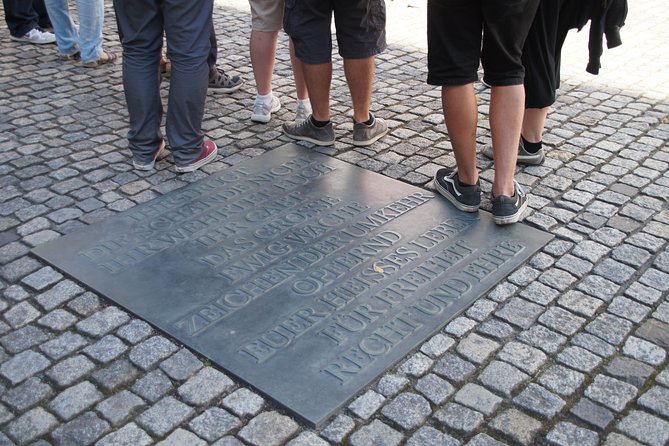
The tour ends at the Memorial to the Murdered Jews of Europe on Cora-Berliner-Straße. Even though it is not listed as a timed stop in the itinerary, ending there gives the route a strong final point.
The memorial is one of Berlin’s best-known sites of remembrance, and its position near the government quarter makes it easy to continue exploring afterward. You can use the end of the tour to ask the guide follow-up questions or to plan another visit nearby.
The ending also brings the route back to the victims. You have moved from the state and its institutions through genocide, military defeat, and the remains of the regime. Finishing at a memorial dedicated to Jewish victims keeps the moral center of the visit clear.
Because the tour does not list a visit inside the memorial’s information center, check what your guide plans to cover. The route’s central value is the guided explanation across several sites, not a long, detailed museum session at the end.
How the timing affects the experience
The tour lasts about four hours, but the listed time at the six stops adds up to roughly 95 minutes. The rest is used for travel, transitions, and the guide’s explanations along the way.
That arrangement has two advantages. First, you can see a broad range of locations in one morning. Second, the movement between sites can help you understand Berlin as a connected city rather than a set of unrelated monuments.
The tradeoff is that several stops are introductions. You will not have much time to linger at the Sinti and Roma memorial, Topography of Terror, or Führerbunker site. If you prefer to spend an hour reading museum displays or sitting quietly at each memorial, this tour may feel brisk.
The group limit is 25 people. That is not a private tour, but it is more manageable than a very large city group. You should still expect to stay close to the guide, especially near busy streets and public transport connections.
Comfortable shoes are sensible because the route involves several stops and movement across Berlin. Since the tour runs outdoors in part, rain or cold can affect the experience. One group completed it in cold, rainy weather, even with a brief snowfall, and still found the guide’s explanations kept the morning engaging. That does not make bad weather pleasant, so check the forecast and dress for it.
The Spanish-speaking guide makes a real difference
The included guide is Spanish-speaking, which is a major reason to choose this particular experience. Nazi history involves legal terms, political changes, military events, and sensitive distinctions. Hearing the material clearly in Spanish can make the tour more useful than trying to follow a fast explanation in a second language.
The guides connected with the experience have different strengths. Julia and Júlia are described as detailed, friendly, and ready to answer questions. Helena is noted for turning the four-hour route into an enjoyable and memorable morning. Celia is praised for warmth, historical understanding, practical city advice, and a respectful approach to tragic events.
You cannot choose a specific guide from the information provided, so treat those names as examples of the guiding style available rather than a promise about your date. The repeated pattern is clear: expect a guide who explains context, uses stories or visual material when helpful, and may suggest other ways to explore Berlin afterward.
I especially value the practical recommendations. A good city guide does more than deliver facts. If you have questions about extending your visit, the guide may help you choose what to see next.
Is $25.54 a good price?
At about $25.54 per person, this is a strong value if you want an organized introduction to Nazi-era Berlin. Admission tickets are included, and you see six significant places in roughly four hours. Booking about 36 days ahead on average also suggests that planning early is sensible, especially if your dates are fixed.
The price does not cover the AB transport ticket. That extra cost matters because the route crosses different parts of Berlin rather than staying within one compact walking area. Add the local transport fare to your budget before comparing this with a walking-only tour.
I would not judge the value by minutes spent inside attractions. The main purchase is the guide’s structure and interpretation. You are paying to connect the Bundestag, memorials, airport, museum, bunker site, and final memorial into one understandable story.
The value is lower if you already know Berlin’s Nazi-era sites well or want long, independent time at museums. In that case, you may prefer to visit the Topography of Terror and memorials on your own. For a first focused introduction, the price is reasonable.
Who should book this Berlin history tour?
I would recommend it to you if you want a serious but accessible introduction to the Third Reich, especially in Spanish. It suits history enthusiasts, first-time Berlin visitors, and anyone who wants help understanding how war, genocide, dictatorship, and remembrance connect.
It is also a good choice for people who dislike planning complicated sightseeing routes. The tour gathers several important locations into one morning and ends near a major memorial in central Berlin.
I would think twice if you need an entirely indoor activity, dislike public transportation, or prefer a slow museum visit with lots of reading time. The route covers ground, includes outdoor stops, and gives some locations only a short introduction.
You can cancel for a full refund if you do so at least 24 hours before the 10:00 a.m. start. Changes or cancellations made later are not accepted for a refund, so keep that deadline in mind when arranging your Berlin schedule.
Should you book Berlin under Nazism?
Book this tour if you want clear historical context in Spanish and a broad look at Berlin’s Nazi-era sites without spending days planning the route yourself. The combination of the Bundestag, the Sinti and Roma memorial, Soviet Memorial, Tempelhof, Topography of Terror, and Führerbunker site gives you more range than a simple Hitler-focused walk.
Skip it if your priority is extended time inside museums or a private, slow-paced visit. For most visitors seeking a thoughtful first look at this difficult period, the four-hour format, included admissions, and guide-led explanations make the $25.54 price worthwhile.
FAQ
How long does the Berlin under Nazism tour last?
The experience lasts approximately four hours.
What language is the tour conducted in?
A Spanish-speaking guide is included.
Where does the tour start?
It starts at the Berlin TV Tower, Panoramastraße 1A, 10178 Berlin, Germany.
What time does the tour begin?
The stated start time is 10:00 a.m.
Where does the tour end?
It ends at the Memorial to the Murdered Jews of Europe, Cora-Berliner-Straße 1, 10117 Berlin, Germany.
Is public transportation included?
No. The AB transport ticket is not included.
Are admission tickets included?
Yes, admission tickets are included where applicable. The Bundestag, Soviet Memorial Tiergarten, and Führerbunker site are listed without an admission charge.
What is the maximum group size?
The activity allows a maximum of 25 participants.
Can I cancel for a full refund?
Yes. You must cancel at least 24 hours before the local start time for a full refund. Cancellations or changes made less than 24 hours before the start are not accepted for a refund.
Just added around Berlin
- Berlin Highlights in One Day★ 5.0 · 3 reviews
- Private Berlin One Day Tour with a Local: See the City Unscripted★ 3.5 · 3 reviews
- Individual city tour Berlin for max. 8 persons★ 5.0 · 3 reviews
- Transfer from Berlin Schönefeld Airport (SXF) to Berlin city Hotels – ROUND TRIP★ 4.0 · 3 reviews
- Berlin: Museum Island Tour★ 5.0 · 3 reviews
- Private Analogue Photography Experience in Berlin★ 5.0 · 3 reviews
- Berlin: Local Food Tour in Secrets Hidden Gems★ 4.0 · 3 reviews
- Berlin & The Third Reich Private Guided Tour★ 5.0 · 3 reviews
Third Reich & WWII Sites, compared.



Berlin’s Best: 2 Hour Walking Tour Third Reich and the Cold War
Read our review →
Third Reich Berlin: Hitler and WWII Walking Tour
Read our review →

Berlin Third Reich Sites: Half-Day Walking Tour
Read our review →
Guided Bike Tour of the Berlin Wall and Third Reich
Read our review →
Hitler’s Germany: Berlin During the Third Reich & WWII
Read our review →Browse the lists this tour appears in