
Review · THIRD REICH & WWII SITES
Hitler’s Berlin – the rise and fall (Small Group)
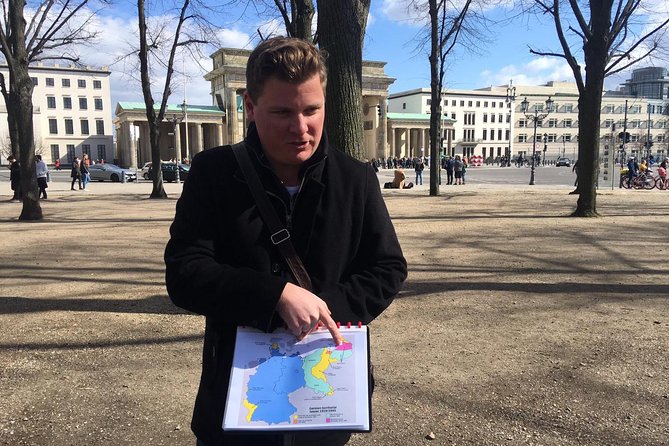
Berlin’s Nazi past is not tucked away in a distant museum. It is woven through the center of the city, often beside Germany’s grandest government buildings and public squares. This walking tour connects those places into a clear story, from the Nazi rise to power and the persecution of minorities to the Battle of Berlin and Hitler’s final days.
I like the small maximum group of 15, which gives you a fair chance to ask questions. I also like the use of historic maps and Then & Now photographs, since Berlin’s wartime destruction and postwar rebuilding can otherwise make the past hard to picture. The main drawback is that the tour covers a difficult subject at a steady walking pace, with no promise of regular seating and some information-heavy stops.
In This Review
- Key points at a glance
- What Hitler’s Berlin is really trying to show you
- Starting at Brandenburg Gate and the Sinti and Roma memorial
- The Reichstag and the mechanics of Nazi power
- The Soviet Memorial and the Battle of Berlin
- The Holocaust Memorial and the meaning of remembrance
- A brief stop at the homosexuals’ memorial
- The Führerbunker site and Hitler’s final days
- Johann Georg Elser and the question of resistance
- The Aviation Ministry and the physical remains of dictatorship
- Finishing at the Topography of Terror
- How the small-group format affects the experience
- Walking conditions, weather, and value
- Who should book this Berlin history walk?
- Should you book Hitler’s Berlin?
- FAQ
- Where does the tour begin?
- Where does the tour end?
- How long does the tour last?
- What language is the tour offered in?
- How large is the group?
- What sites are included?
- Is admission to the stops included?
- Do I need to be fit for the walk?
- Does the tour operate in bad weather?
- What is the cancellation policy?
Key points at a glance
- A compact route through central Berlin: Begin at Brandenburg Gate and finish at the Topography of Terror.
- Nine historically important stops: See memorials, government buildings, the Führerbunker site, and the former Gestapo headquarters.
- A guide-led history lesson: Guides such as Scott, Jochen, Johan, Matt, and Roshana have been praised for clear explanations and thoughtful discussion.
- Small-group attention: The tour accepts no more than 15 people, allowing for questions and conversation.
- Serious, respectful subject matter: The focus is on Nazi power, persecution, resistance, war, and remembrance, not spectacle.
- Bring sensible clothing and shoes: The tour runs in all weather and includes varied walking surfaces.
What Hitler’s Berlin is really trying to show you
This is not a tour built around Nazi memorabilia or dramatic storytelling for its own sake. Its purpose is to explain how an extremist political movement gained power, how the dictatorship worked, who it persecuted, and how Berlin became the final battlefield of the war.
That approach matters. A stop such as the Reichstag helps explain the political process that brought Hitler to power. A memorial for Sinti and Roma victims shows that Nazi persecution began with social and racial theories that targeted several groups. The Holocaust Memorial then places the murder of Europe’s Jews at the center of the story, as it should.
The route also gives room to discuss resistance. At the Johann Georg Elser Memorial, you learn about one man who tried to kill Hitler, along with the wider problem of opposing a dictatorship that controlled much of public life. The tour does not present German history as a simple tale of villains and victims. It asks how ordinary institutions, political choices, propaganda, fear, and obedience helped create the catastrophe.
That makes this a useful first or second activity in Berlin for anyone who wants the city’s monuments to make more sense. You will not get every detail of the Second World War in two and a half hours, but you will gain a framework for understanding the places around you.
More Third Reich sites in Berlin:
- Berlin: Third Reich and Cold War 2 Hour Walking Tour
★ 4.9 · 6,830 reviews - Berlin: Berlin Story Bunker Entry Ticket
★ 4.6 · 6,759 reviews - Berlin’s Best: 2 Hour Walking Tour Third Reich and the Cold War
★ 5.0 · 5,486 reviews
Starting at Brandenburg Gate and the Sinti and Roma memorial
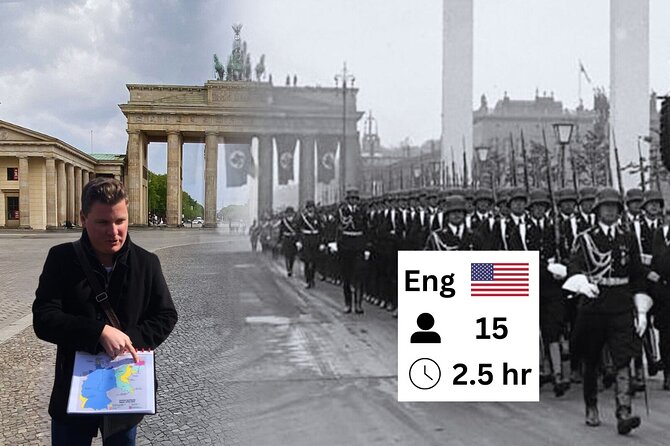
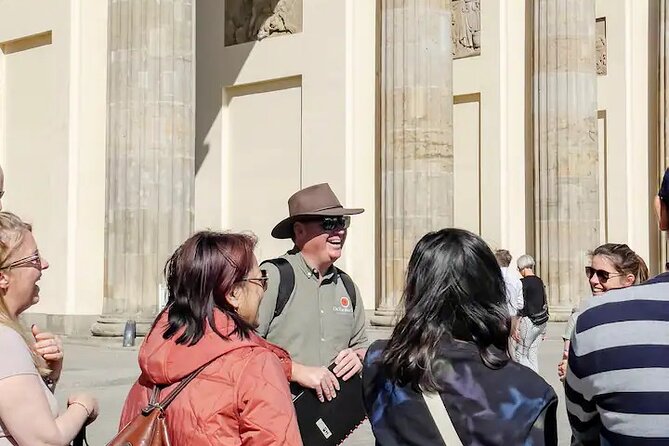
The meeting point is Brandenburg Gate, at Pariser Platz. This is one of Berlin’s most recognizable locations, and it is an effective place to begin because the gate has witnessed imperial rule, Nazi ceremony, war, division, and reunification.
From there, the first stop is the Memorial to the Sinti and Roma Victims of National Socialism. The short visit lasts about 10 minutes, but its subject is important. You will learn how Nazi racial thinking classified Sinti and Roma as enemies of the state and helped prepare the way for imprisonment, deportation, and mass murder.
This opening gives the tour a wider frame. The Nazi genocide was not directed at one group alone. Political opponents, disabled people, homosexual men, Jehovah’s Witnesses, Sinti and Roma, Jews, and others were persecuted under different laws and policies.
Because the stop is outdoors and brief, the guide’s explanation carries much of the weight. Pay close attention and ask questions here if you want a clearer explanation of the Nazi social theories behind the persecution.
The Reichstag and the mechanics of Nazi power
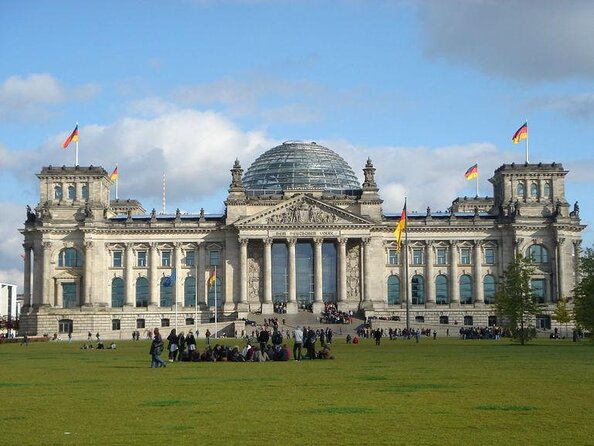
At the Reichstag Building, Germany’s parliament, the discussion shifts from persecution to politics. You will learn how the Nazi Party was elected into power and how Hitler became Führer.
This is one of the most valuable parts of the walk because it pushes back against the idea that Hitler simply seized Germany overnight. The route uses the Reichstag to examine the political conditions that allowed the Nazi Party to gain influence and then dismantle democratic government.
You will view the building from outside, with about 15 minutes devoted to the stop. The tour does not include entry to the Reichstag or its glass dome, so you should not expect an interior visit here. Its value is the historical setting and the guide’s explanation of what happened around it.
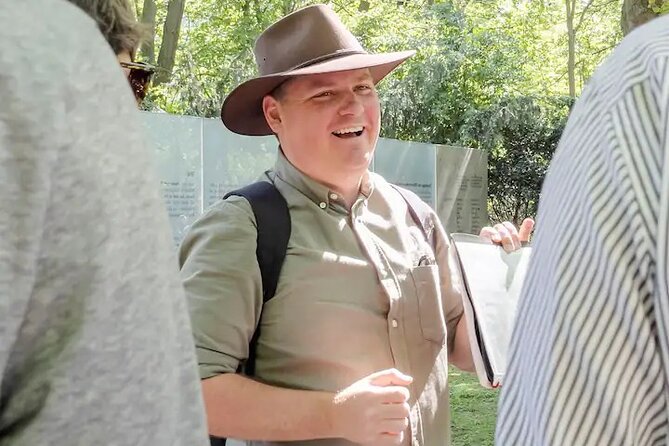
Guides with an academic background in Second World War history are assigned to the experience. The strongest guides, including Scott and Jochen, have been praised for explaining politics in a clear way and answering many questions. One useful feature is that the guide can adjust the discussion to the group, though the amount of detail means you need to listen closely.
The Soviet Memorial and the Battle of Berlin
The Soviet Memorial in Tiergarten brings the story to the final phase of the war. Here the guide discusses the Battle of Berlin, one of the bloodiest operations of the conflict, and the way the battle has been remembered since 1945.
The memorial itself is a large postwar statement of Soviet victory. It is also a place where military history and political memory meet. You will hear about the brutal fighting for Berlin and the enormous human cost of the final weeks.
The scheduled stop lasts about 15 minutes. That is enough for an overview, but not enough for a full military study of the battle. If you want detailed information about troop movements, weapons, or day-by-day operations, you may find this section too short. For most people, though, the stop provides a useful bridge between the Nazi regime’s crimes and its violent collapse.
Historic photographs and maps are especially useful here. Berlin looks very different now, and visual comparisons help you understand how much of the city was destroyed, altered, or rebuilt.
A different side of Berlin on the same trip:
- Berlin: Reichstag, Dome and Government District Guided Tour
★ 4.7 · 18,288 reviews - Berlin: 1-Hour City Tour by Boat with Guaranteed Seating
★ 4.3 · 16,993 reviews - Berlin: Boat Tour Along the River Spree
★ 4.4 · 11,252 reviews - Discover Berlin Half-Day Walking Tour
★ 5.0 · 9,624 reviews
The Holocaust Memorial and the meaning of remembrance
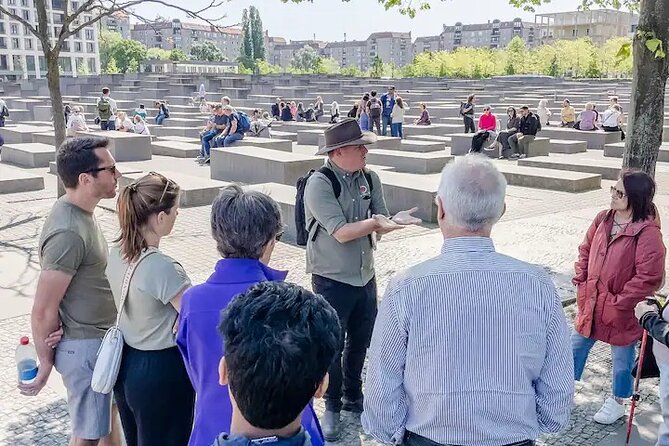
The Memorial to the Murdered Jews of Europe is the emotional center of the walk. Its field of concrete stelae is deliberately open to interpretation, and the guide gives you time to discuss what the design may communicate.
You will learn about the Jewish victims of the Third Reich and the process that led to the Holocaust. This is not simply a stop for taking photographs. The guide’s role is to help you think about why Germany placed a major memorial in the heart of the capital and how public remembrance works in a modern city.
The stop lasts around 15 minutes. You may also want to return on your own later, since a short guided visit cannot cover the memorial’s background, design, and underground information center in full. No separate admission charge is listed for the tour stops.
A respectful attitude is essential. The memorial is a place of mourning, and the tour treats it as such. I value that the discussion centers on the people targeted and murdered, rather than making Hitler the only subject of the story.
A brief stop at the homosexuals’ memorial
The Monument to Homosexuals Persecuted Under National Socialist Regime is a shorter visit, lasting about five minutes. It recognizes people persecuted by the Nazi regime because of their sexuality.
The brief timing means you will receive an introduction rather than a long examination of Nazi law and social control. Still, the stop is a useful reminder that Nazi persecution affected groups in different ways and that these stories deserve a place in Berlin’s public memory.
If this subject interests you, note the location and consider returning later at your own pace. The tour’s schedule has to keep moving, and this is one of the places where the explanation is necessarily concise.
The Führerbunker site and Hitler’s final days
The next stop is the site of the Führerbunker, where Hitler spent his last days during the Second World War. The bunker itself is not presented as a tourist attraction, and the location is marked in a restrained way rather than turned into a shrine.
That restraint is appropriate. The site helps explain the final collapse of the Nazi leadership and the conditions in Berlin at the end of the war. It also gives the guide a chance to separate fact from the myths and dramatic stories that have grown around Hitler’s final days.
The visit lasts about 15 minutes. You will not enter the bunker, and there is no grand ruin to explore. The value is in understanding the location and its place in the final chapter of the regime.
This is a good point to keep your attention on the broader human cost. The tour is strongest when it treats Hitler’s end as part of a much larger disaster, not as the climax of a thriller.
Johann Georg Elser and the question of resistance
At the Johann Georg Elser Memorial, the tour turns to resistance against Hitler. Elser attempted to assassinate Hitler before the war, and the memorial provides an opportunity to discuss his actions and the efforts of others who opposed the Nazi regime.
This stop adds needed complexity. The history of resistance is not a simple list of successful heroes. Attempts failed, people disagreed about methods, and many paid with their lives. The guide can explain how Elser’s actions fit alongside other forms of opposition.
The scheduled time is about 15 minutes. I would pay attention to the guide’s treatment of motive and timing, since this is where a well-presented tour can show that resistance took many forms. It also challenges the lazy idea that nobody in Germany opposed Hitler.
The Aviation Ministry and the physical remains of dictatorship
The former Aviation Ministry offers a different kind of evidence. Built in 1936, it was once the largest office building in Europe and housed the German Ministry of Aviation under Hermann Göring.
The building’s scale and purpose show how the Nazi state depended on offices, departments, paperwork, and administration. Dictatorship was not only speeches and uniforms. It was also a system of ministries and officials carrying out policy.
The stop lasts roughly five minutes, so expect a quick explanation from outside. The building is valuable because it connects the political story to the physical city. You are looking at a surviving structure from the Nazi period, even though the surrounding streets and institutions have changed.
Finishing at the Topography of Terror
The tour ends at the Topography of Terror on Niederkirchnerstraße. The site once held the headquarters of the Gestapo, the SS, and other central Nazi security agencies. Today, it contains an important documentation center focused on the institutions and crimes of the regime.
The guided visit lasts about 20 minutes, and there is time for a break, coffee or tea, and the use of restrooms. That pause is welcome after a concentrated walk and a heavy subject.
The tour does not include food or drinks, so you pay for anything you want during the break. You may also choose to spend more time at the Topography of Terror after the walking portion ends. The exhibition can help you continue the subject with photographs, documents, and institutional detail.
The end point is practical as well as historical. Ask your guide for the best connection to your next destination, since the tour does not return to Brandenburg Gate.
How the small-group format affects the experience
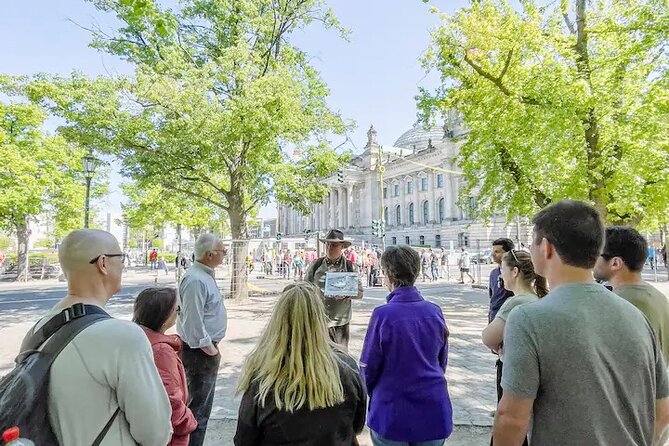
The group maximum is 15 people. That is small enough for a guide to take questions and keep the discussion personal, though it is not the same as a private tour.
The best guides make good use of the format. Scott has been praised for tailoring the discussion to the group and making a difficult subject understandable. Johan, Jochen, Matt, and Roshana have also been singled out for strong presentation, warmth, or subject knowledge.
There is one practical caution. You need to listen carefully because the tour covers a large amount of political and historical information in 150 minutes. A few people have found accents or street noise difficult at times, and there is no guarantee that every guide will use a microphone.
Walking conditions, weather, and value
The experience costs $54.44 per person. For a 2.5-hour small-group tour with an expert local guide, historic maps, Then & Now images, and nine significant stops, that is a reasonable price if you want a guided introduction rather than a self-led walk.
The value depends on your style. If you already know Berlin’s Nazi history well, some explanations may repeat familiar material. If you want a clear route and the chance to ask questions, the cost is easier to justify than paying for a large group tour with little discussion.
Wear comfortable shoes and dress for the forecast. The tour operates in all weather, and the route includes different types of walking surfaces. A moderate level of physical fitness is required. You may not sit often, so anyone who needs regular seating should take that into account.
The walk is compact, described by one participant as covering roughly four or five city blocks, but compact does not mean effortless. You are outside, standing, listening, and moving between stops. Cold weather can make the experience harder, so warm layers matter.
Free cancellation is available up to 24 hours before the start time. If poor weather or a failure to reach the minimum group size forces cancellation, you are offered another date or a full refund.
Who should book this Berlin history walk?
I would recommend it to first-time visitors who want to understand central Berlin beyond its famous buildings. It also suits families with older children and teenagers who can follow a serious historical discussion. One family with a teenager found the guide especially good at answering questions.
History-minded visitors will get the most from the tour, particularly if you enjoy politics, wartime history, memorial design, and the story of resistance. The guide’s discussion can also help you connect the Nazi period with present-day questions about fascism, public responsibility, and how countries remember their crimes.
I would think twice if you want a light sightseeing walk, a museum-heavy experience, or a tour with plenty of time to sit. The subject is emotionally demanding, and the presentation includes a lot of detail. It is not entertainment, though a good guide may use gentle humor carefully to keep the discussion human and focused.
Should you book Hitler’s Berlin?
Book this tour if you want a serious, compact introduction to Nazi Berlin and value conversation with a well-prepared guide. The strongest part is the way it links political power, persecution, war, resistance, and public remembrance across a small section of central Berlin.
Choose it early in your visit if you want context for later museum visits. Just bring good shoes, warm or rainproof clothing, and the attention span for a fast-moving history lesson. At $54.44, it is a sound choice for a small group experience, provided you prefer substance and discussion over a relaxed sightseeing stroll.
FAQ
Where does the tour begin?
It begins at Brandenburg Gate, at Pariser Platz, 10117 Berlin, Germany.
Where does the tour end?
The tour ends at the Topography of Terror, Niederkirchnerstraße 8, 10963 Berlin, Germany.
How long does the tour last?
The experience lasts approximately 2 hours and 30 minutes.
What language is the tour offered in?
The tour is offered in English.
How large is the group?
The maximum group size is 15 people.
What sites are included?
The route includes the Memorial to the Sinti and Roma Victims of National Socialism, Reichstag Building, Soviet Memorial Tiergarten, Holocaust Memorial, Monument to Homosexuals Persecuted Under National Socialist Regime, Führerbunker site, Johann Georg Elser Memorial, former Aviation Ministry, and Topography of Terror.
Is admission to the stops included?
The listed guided stops have no admission charge. The tour does not include food or drinks.
Do I need to be fit for the walk?
You should have a moderate level of physical fitness. The tour involves walking on different types of surfaces and may include standing for extended periods.
Does the tour operate in bad weather?
The tour operates in all weather conditions, so you should dress appropriately. If the experience is canceled because of poor weather, you are offered another date or a full refund.
What is the cancellation policy?
You can cancel up to 24 hours before the experience begins for a full refund. Cancellations or changes made less than 24 hours in advance are not accepted for a refund.
Just added around Berlin
- Berlin Highlights in One Day★ 5.0 · 3 reviews
- Private Berlin One Day Tour with a Local: See the City Unscripted★ 3.5 · 3 reviews
- Individual city tour Berlin for max. 8 persons★ 5.0 · 3 reviews
- Transfer from Berlin Schönefeld Airport (SXF) to Berlin city Hotels – ROUND TRIP★ 4.0 · 3 reviews
- Berlin: Museum Island Tour★ 5.0 · 3 reviews
- Private Analogue Photography Experience in Berlin★ 5.0 · 3 reviews
- Berlin: Local Food Tour in Secrets Hidden Gems★ 4.0 · 3 reviews
- Berlin & The Third Reich Private Guided Tour★ 5.0 · 3 reviews
Third Reich & WWII Sites, compared.



Berlin’s Best: 2 Hour Walking Tour Third Reich and the Cold War
Read our review →
Third Reich Berlin: Hitler and WWII Walking Tour
Read our review →

Berlin Third Reich Sites: Half-Day Walking Tour
Read our review →
Guided Bike Tour of the Berlin Wall and Third Reich
Read our review →
Hitler’s Germany: Berlin During the Third Reich & WWII
Read our review →Browse the lists this tour appears in