
Review · WALKING TOURS
An Introduction to Berlin Walking Tour
Berlin’s story comes into sharp focus on this three-hour small-group tour, which connects Prussian power, Nazi-era memory, Cold War division, and modern Germany. You move from the Reichstag and Brandenburg Gate to Museum Island, Potsdamer Platz, the Holocaust Memorial, and the courtyards around Hackescher Markt.
I like the small cap of eight people, since it gives you a better chance to ask questions and keep a steady pace. I also like the mix of famous sights and broader city context, especially the explanation of how early Prussian militarism shaped later Berlin. The main consideration is price: at $156.53 per person, this is a premium introduction, and public transit costs extra.
In This Review
- Key points to know before you book
- What this Berlin tour is really trying to do
- Starting on Unter den Linden and reaching the Reichstag
- Brandenburg Gate and the many powers that passed through it
- Museum Island and Berlin’s royal ambitions
- Potsdamer Platz and the city rebuilt after the Wall
- Unter den Linden, Prussia, and the road toward the gate
- Tiergarten and a pause from Berlin’s stone center
- The Holocaust Memorial requires a slower kind of attention
- Hackescher Markt and the surviving courtyards
- How the public transit affects the experience
- Is $156.53 a fair price?
- Who will get the most from this experience?
- Should you book this Berlin introduction?
- FAQ
- Where does the tour start?
- Where does the tour end?
- How long does the tour last?
- What language is the tour offered in?
- How many people can join the tour?
- Is public transportation included?
- How much does Berlin public transportation cost?
- Are meals included?
- Is hotel pickup and drop-off provided?
- Can I cancel for a full refund?
Key points to know before you book
- A historian leads the three-hour visit: Your guide may be a professor, doctoral student, journalist, architect, or another local host with a strong interest in Berlin.
- The group is limited to eight people: That is small enough for direct questions and a more flexible pace than a large coach tour.
- You cover major Berlin landmarks: The route includes the Reichstag, Brandenburg Gate, Museum Island, Potsdamer Platz, Unter den Linden, Tiergarten, the Holocaust Memorial, and Hackescher Markt.
- Public transit is part of the plan: Some distances are too great to walk, so bring or buy an AB day pass.
- The tour links several eras: You hear about Prussian rule, the city’s 20th-century conflicts, the Berlin Wall, reunification, and modern democratic Germany.
- The price includes guiding, not transport or meals: Food, drinks, hotel transfers, and metro fares are separate.
What this Berlin tour is really trying to do
This is not simply a walk from one photo stop to the next. It is built around a central question: how did Berlin become the political symbol it is today?
Your guide sets the stage with Prussia, the kingdom that helped shape Berlin’s military and political character. That background matters because later events in the city did not appear from nowhere. The old royal boulevard, grand civic buildings, monuments, and military traditions all help explain the setting for the 20th century.
The route then moves through sites tied to democracy, dictatorship, division, Jewish memory, and reunification. I like that range. You are not left with a postcard version of Berlin made only of grand buildings and Cold War souvenirs.
The experience is offered in English and lasts about three hours. Since the group can have no more than eight people, you should get more attention than you would on a large public tour. That matters most at places such as the Holocaust Memorial, where a short explanation can help you think about the space without turning it into a rushed photo stop.
The guide pool includes professors, doctoral students, journalists, and enthusiastic local hosts. One guide named Dan is an architect, and that background can add a useful layer to the buildings and urban spaces. If architecture interests you, ask at booking if a particular guide is available, but do not assume a specific guide is guaranteed.
More walking tours in Berlin:
- Discover Berlin Half-Day Walking Tour
★ 5.0 · 9,624 reviews - Berlin: Third Reich and Cold War 2 Hour Walking Tour
★ 4.9 · 6,830 reviews - Berlin: Discover Berlin Walking Tour
★ 4.9 · 5,998 reviews
Starting on Unter den Linden and reaching the Reichstag
The meeting point is Unter den Linden 42, at 10117 Berlin. This puts you in the center of Berlin’s historic core, on the grand boulevard that runs toward the Brandenburg Gate.
The first listed stop is the Reichstag Building, home of the Bundestag, Germany’s lower house of parliament. You have about 15 minutes here, with no admission charge included or required for this outdoor stop.
The building is especially useful for understanding modern Germany. Its glass dome, added in the 1990s by Norman Foster, is meant to express openness and democratic government. You are looking at a historic building with a modern political message layered onto it.
Do not expect a full interior visit during this short stop. The value comes from your guide’s explanation of the building and its role, along with the chance to place it within Berlin’s changing political story.
Brandenburg Gate and the many powers that passed through it
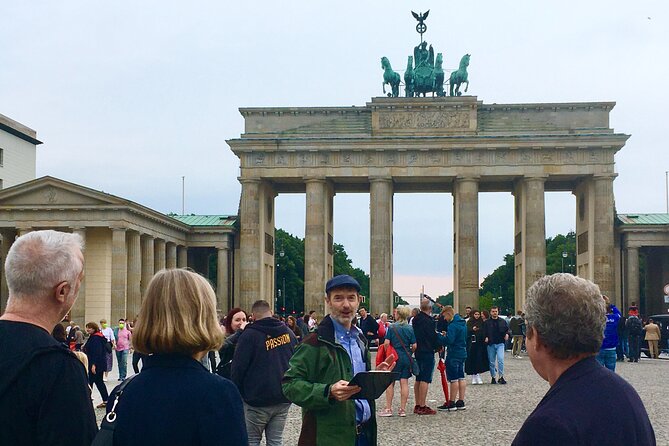
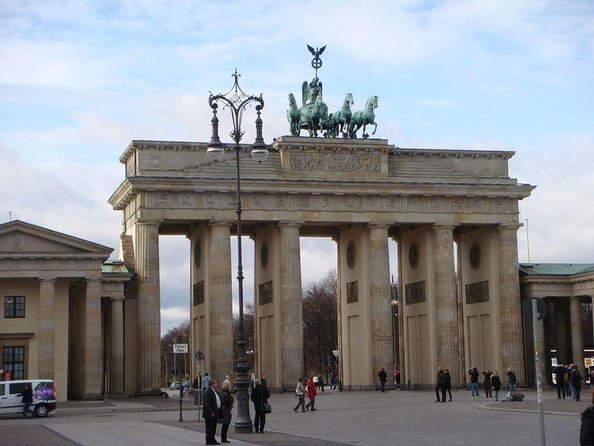
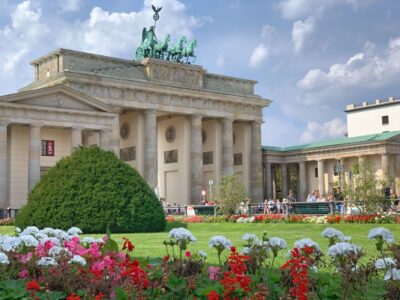
The Brandenburg Gate receives about 20 minutes. This neoclassical monument was ordered by Prussian king Frederick William II in the 18th century, so it takes you back to the period when Prussia was building its public image and political strength.
The gate later witnessed a long list of turning points. Napoleon entered Berlin through it after his victory, and Ronald Reagan used the site for a famous Cold War speech. These details show why the gate carries more weight than its elegant columns might suggest.
I like this stop because it can connect architecture to power without requiring a museum visit. The open space also gives your guide room to explain how the gate changed meaning over time.
It can be crowded around the monument, and the 20-minute visit will feel short if you want detailed photographs. Still, the location is essential, and a good guide can keep the story moving rather than letting the stop become a long pause for pictures.
Museum Island and Berlin’s royal ambitions
Museum Island gets about 25 minutes. This group of buildings on Spree Island includes five major museums created under Prussian rulers, including the Pergamon Museum, Neues Museum, and Alte Nationalgalerie.
You will not have time to visit the collections during this tour. Instead, you see the ensemble from outside and learn why these museums were placed here. Their scale and arrangement reflect the ambitions of Prussian Berlin, where rulers used architecture and culture to project authority.
This is one of the tour’s most useful stops if you plan to return to Berlin’s museums later. You get a basic map of the area and a reason to choose which building deserves your time. Museum Island can otherwise feel like a collection of impressive facades without a clear story.
The short visit is also the main limitation. Anyone hoping to see ancient objects or paintings will need a separate ticket and another block of time.
A different side of Berlin on the same trip:
- Berlin: Reichstag, Dome and Government District Guided Tour
★ 4.7 · 18,288 reviews - Berlin: 1-Hour City Tour by Boat with Guaranteed Seating
★ 4.3 · 16,993 reviews - Berlin: Boat Tour Along the River Spree
★ 4.4 · 11,252 reviews - Berlin: Hop-on Hop-off Bus Tour with Live Commentary
★ 4.3 · 8,579 reviews
Potsdamer Platz and the city rebuilt after the Wall
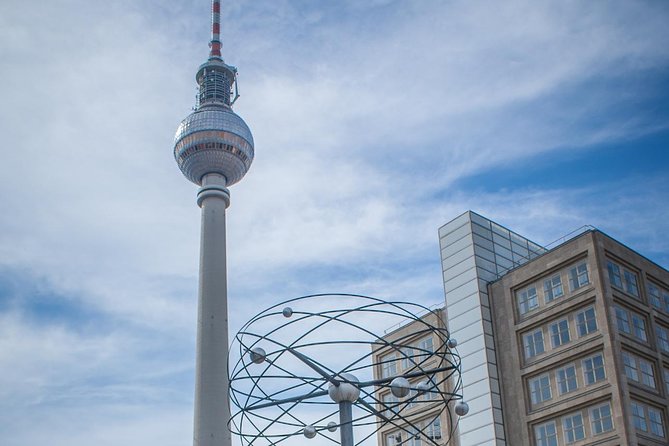
At Potsdamer Platz, you spend about 15 minutes looking at one of Berlin’s clearest examples of post-reunification change. The area was reshaped after the Berlin Wall fell and is now filled with entertainment, restaurants, and shops.
The stop helps you picture the gap between old Berlin and new Berlin. Potsdamer Platz is not mainly about preserved historic fabric. Its importance comes from how quickly a divided, damaged area became a modern urban center.
I appreciate its place in the route because Berlin can sometimes be presented as if every important building survived intact. Potsdamer Platz corrects that impression. It shows a city that has repeatedly been erased, rebuilt, and given new purposes.
The drawback is that the stop may feel less atmospheric than Brandenburg Gate or the Holocaust Memorial. If you prefer medieval streets or preserved old buildings, this is more about urban change than traditional charm.
Unter den Linden, Prussia, and the road toward the gate
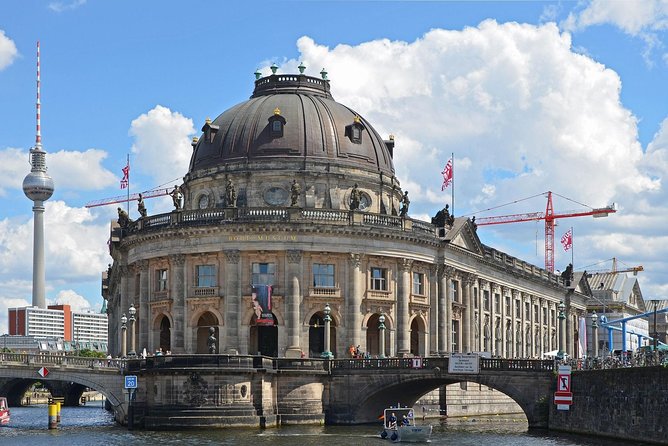
The tour gives Unter den Linden about 30 minutes, making it one of the longer stops. The boulevard is named for the linden trees that line it and runs from the City Palace toward Brandenburg Gate.
It was Berlin’s answer to the Champs-Élysées, and the comparison helps you understand its role. This was a ceremonial route, a public stage for royal power, military display, and civic ambition.
Here, your guide can tie together several parts of the tour. Prussian rulers shaped the avenue, museums and monuments reinforced its importance, and later governments inherited the same grand setting. You can look at the boulevard as a physical record of Berlin’s political changes.
This section should suit you if you enjoy walking while listening to a larger explanation. It is less useful if you want frequent interior visits, since most of the experience focuses on streets, buildings, and public spaces.
Tiergarten and a pause from Berlin’s stone center
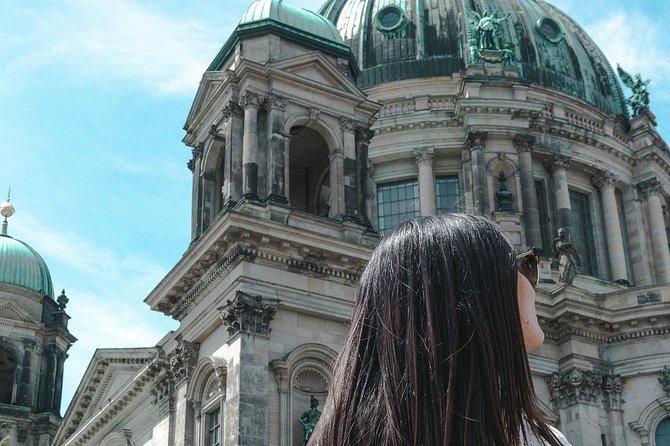
The Tiergarten receives about 10 minutes. This is Berlin’s best-known inner-city park, with gardens and grand statues spread through the city center.
The brief stop gives the route some breathing room. It also shows that Berlin’s central identity is not only government buildings and memorials. The park forms part of the city’s public life and provides a contrast to the formal avenues nearby.
Ten minutes is enough for orientation, not for a full walk through the park. If you want gardens, statues, and long paths, return on your own with more time.
The Holocaust Memorial requires a slower kind of attention
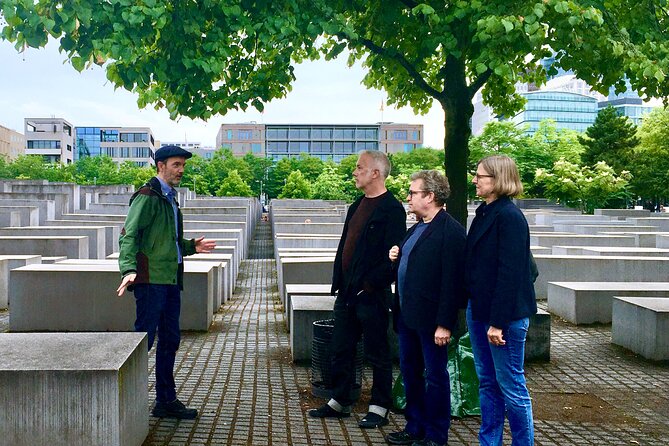
The Memorial to the Murdered Jews of Europe gets about 10 minutes. Designed by architect Peter Eisenman and opened in 2005, it consists of 2,711 concrete slabs of different heights arranged in a large open field.
You can enter the rows and experience the changing sense of space as the slabs rise around you. The design is deliberately spare and unsettling. It offers no easy decorative comfort, which is part of its force.
This is not a place for a breezy lecture or a quick group photograph. I value having a guide provide context, but you also need a little quiet time to take in the memorial for yourself.
The ten-minute allocation is tight. You can see the layout and hear its basic meaning, but you will not explore every part of the site or visit the underground information center during this tour. Treat this as an introduction, then return later if you want more time.
Hackescher Markt and the surviving courtyards
The final named stop is Hackescher Markt, where you spend about 15 minutes. This lively square offers access to preserved Art Nouveau courtyards connected with pre-war Berlin.
The courtyards provide a different view of the city from the monumental center. Instead of royal avenues and national symbols, you get a sense of older urban life, mixed-use buildings, shops, and interior spaces tucked behind street facades.
This is a smart ending because it brings the tour down to a more human scale. After the Reichstag, Brandenburg Gate, and memorials, Hackescher Markt shows how Berlin’s character also lives in courtyards and neighborhood spaces.
The tour ends somewhere in Berlin rather than at a sharply defined attraction. That gives your guide some flexibility, but you should not count on a hotel drop-off or a final ride back to your accommodation.
How the public transit affects the experience
The route covers too much ground for a three-hour walking tour alone. You will use public transportation a few times, especially between sites that are separated by large parts of central Berlin.
A Berlin Transit One Way Tarif AB ticket is listed at €2.80, with a senior fare of €1.70. A one-person Berlin Transit Day Ticket is listed at €7, with a senior fare of €4.70.
If you already have a multi-day Berlin transit pass, you can use that. If not, a day pass is the practical choice for this experience. The guide can help you buy one at the first metro station if you were unable to purchase it in advance.
This transit element is worth planning for. Keep your ticket ready, allow a moment for station movement, and wear comfortable shoes. The tour is described as a walking tour, but it is really a walking and public-transit introduction to central Berlin.
Is $156.53 a fair price?
At $156.53 per person, this is expensive compared with a basic city walk. You also pay separately for public transportation, and food, drinks, hotel pickup, and hotel drop-off are not included.
The price makes more sense if you value a specialist guide and a group capped at eight. You are paying for a connected explanation of Berlin, not just access to landmarks. A historian, professor, journalist, or architect can help you understand why these places matter and how they relate to one another.
The pace also appears efficient. The route covers a wide area and includes several major districts in about three hours. One architectural guide, Dan, is noted for leading a group at a good pace and covering a great deal of ground. If you like buildings, city planning, and clear explanations, that kind of guide can make the fee easier to justify.
I would compare this price with your own plans. If you already know Berlin well, plan to visit museums independently, or mainly want photographs, the cost may be hard to defend. If this is your first visit and you want a serious orientation before exploring alone, the small-group format gives it stronger value.
Who will get the most from this experience?
I would choose this tour if you want Berlin’s major sights explained in relation to one another. It suits first-time visitors who want a firm foundation, as well as repeat visitors who want more political and architectural context.
It should work especially well for:
- People interested in Prussian rule and militarism
- Architecture fans who want buildings explained rather than simply photographed
- Visitors who prefer small groups and direct access to a guide
- Anyone with only a short time in central Berlin
- People comfortable using the metro or local public transportation
- Visitors who want to approach the Holocaust Memorial with some historical context
You may want a different option if you need long museum visits, hotel pickup, a fully private tour, or a route with no public transit. The tour is in English only, and its schedule leaves limited time at each site.
Most people can take part, and the experience is near public transportation. Confirmation arrives when you book. Free cancellation is available if you cancel at least 24 hours before the start time. Changes or cancellations inside that window are not accepted for a refund.
Should you book this Berlin introduction?
Book it if you want a serious, compact introduction led by a specialist, and if the $156.53 price fits your budget. The combination of eight-person groups, major landmarks, Prussian context, Cold War connections, and modern Berlin gives you more than a standard orientation walk.
I would be most inclined to book it early in a Berlin visit, then use the rest of your stay to return to Museum Island, the Holocaust Memorial, and any site that deserves more time. Bring a day transit pass or plan to buy one, expect a brisk pace, and do not mistake the short stops for complete visits.
Skip it if you mainly want interiors, free time, or the lowest-cost way to see the city. For an architecture-minded visitor or anyone trying to make sense of Berlin’s political past, however, the small group and specialist guide are the strongest reasons to choose it.
FAQ
Where does the tour start?
The tour starts at Unter den Linden 42, 10117 Berlin, Germany.
Where does the tour end?
The end point is listed as Berlin, Germany, without a more specific final address.
How long does the tour last?
The tour lasts approximately three hours.
What language is the tour offered in?
The tour is offered in English.
How many people can join the tour?
The group has a maximum of eight travelers.
Is public transportation included?
No. Transportation to and from the attractions is not included. You will need to use public transportation several times because some sites are too far apart to walk.
How much does Berlin public transportation cost?
The listed one-way AB ticket price is €2.80, or €1.70 for seniors. A one-person day ticket is listed at €7, or €4.70 for seniors.
Are meals included?
No. Food and drinks are not included.
Is hotel pickup and drop-off provided?
No. Hotel pickup and drop-off are not included.
Can I cancel for a full refund?
Yes, if you cancel at least 24 hours before the experience start time. Cancellations or changes made less than 24 hours before the start time are not accepted for a refund.
Just added around Berlin
- Berlin Highlights in One Day★ 5.0 · 3 reviews
- Private Berlin One Day Tour with a Local: See the City Unscripted★ 3.5 · 3 reviews
- Individual city tour Berlin for max. 8 persons★ 5.0 · 3 reviews
- Transfer from Berlin Schönefeld Airport (SXF) to Berlin city Hotels – ROUND TRIP★ 4.0 · 3 reviews
- Berlin: Museum Island Tour★ 5.0 · 3 reviews
- Private Analogue Photography Experience in Berlin★ 5.0 · 3 reviews
- Berlin: Local Food Tour in Secrets Hidden Gems★ 4.0 · 3 reviews
- Berlin & The Third Reich Private Guided Tour★ 5.0 · 3 reviews
Walking Tours, compared.



Berlin’s Best: 2 Hour Walking Tour Third Reich and the Cold War
Read our review →

Third Reich Berlin: Hitler and WWII Walking Tour
Read our review →

Browse the lists this tour appears in