
Review · WALKING TOURS
Berlin Highlights in 2 Hours: Express Walking Tour
Berlin’s most powerful stories are packed into this two-hour walk. You move from Brandenburg Gate and the Reichstag to the Holocaust Memorial, Hitler’s former bunker site, the Berlin Wall, and Checkpoint Charlie. It is a brisk lesson in how Germany remembers its darkest years and the long division of the city.
I like the compact route and the strong mix of Nazi and Cold War history. I also like the value: at $21.77, you get a guide, a clear route, and useful context without paying museum admission fees. The trade-off is simple: nine stops in roughly two hours means little time to linger, explore exhibits, or take more than a quick look at each place.
In This Review
- Key points to know before you book
- What this two-hour Berlin walk really offers
- Brandenburg Gate and Pariser Platz
- The Reichstag and Germany’s modern government
- Remembering Sinti and Roma victims
- The Holocaust Memorial and its uneasy geometry
- The Führerbunker site and the end of the war
- The former Aviation Ministry
- Niederkirchnerstraße and a surviving piece of the Wall
- Topography of Terror and the machinery of Nazi rule
- Checkpoint Charlie and the Cold War finale
- The guide makes the pace work
- Is $21.77 good value?
- Who should take this express tour?
- Practical advice for getting the most from the walk
- Should you book Berlin Highlights in 2 Hours?
- FAQ
- How long does Berlin Highlights in 2 Hours take?
- Where does the walking tour start?
- Where does the tour end?
- Is the tour offered in English?
- How large can the group be?
- Can I cancel for a full refund?
Key points to know before you book
- Nine major sites in two hours: The route covers central Berlin’s best-known political and historical landmarks.
- A serious history focus: Expect clear discussion of the Holocaust, Nazi rule, the Berlin Wall, and the Cold War.
- A brisk group walk: The maximum group size is 25, so the pace and listening position may matter.
- Free outdoor stops: No admission ticket is required for the listed stops, though the tour does not include entry to paid attractions.
- Strong guide-led storytelling: Ryan, Gregor, Dylan, and Giles are among the guides named in the feedback, with praise for clear explanations and good pacing.
- An easy finish at Checkpoint Charlie: You end near public transportation, with central Berlin still close at hand.
What this two-hour Berlin walk really offers
This is not a museum tour with long interior visits. It is a fast-moving outdoor history lesson across the government district and former Berlin Wall zone.
You begin at Pariser Platz, walk past several sites tied to Germany’s 20th-century upheavals, and finish at Checkpoint Charlie. Each stop is scheduled for about 10 minutes. That timing gives you enough room for an explanation and a few questions, but not enough for a slow architectural study or a lengthy visit inside an exhibition.
That makes the tour useful on a first day in Berlin. You get a map of the city’s central landmarks and a basic timeline to help make sense of later museum visits. If your Berlin schedule is short, the two-hour format also protects most of your afternoon.
The tour is offered in English and accepts mobile tickets. It is capped at 25 people, although the actual size can be smaller. A small group can make questions easier, while a full group requires you to stay close to the guide.
More walking tours in Berlin:
- Discover Berlin Half-Day Walking Tour
★ 5.0 · 9,624 reviews - Berlin: Third Reich and Cold War 2 Hour Walking Tour
★ 4.9 · 6,830 reviews - Berlin: Discover Berlin Walking Tour
★ 4.9 · 5,998 reviews
Brandenburg Gate and Pariser Platz
The walk begins at Brandenburg Gate, one of Berlin’s clearest symbols of unity and peace. Its neoclassical columns frame Pariser Platz, a grand square surrounded by carefully restored buildings and heavy historical meaning.
This is an excellent starting point because the gate has witnessed several very different versions of Berlin. Your guide uses the setting to place the city’s political story in context before the route moves toward the Reichstag.
You will have about 10 minutes here. That is enough to orient yourself and hear the main points, but not enough to study every building around the square. If you want formal photographs with the gate, arrive a little early, since the scheduled stop itself is short.
The Reichstag and Germany’s modern government

The next stop is the Reichstag Building, home of Germany’s parliament. The building connects the imperial period, the Weimar Republic, Nazi rule, the divided city, and present-day German democracy.
From outside, you can appreciate its imposing architecture while your guide explains why this building matters. The focus is less on a full architectural tour and more on the political events tied to it.
The Reichstag is free to view from outside, but this walking tour does not include an interior visit. If you want to see the glass dome or enter the building, you would need to arrange that separately. That is one of the tour’s practical limits, but it also keeps the route moving.
Remembering Sinti and Roma victims
The memorial to the Sinti and Roma victims of National Socialism is a quieter stop than Brandenburg Gate or the Reichstag. It honors the Sinti and Roma people persecuted and murdered during the Holocaust.
This inclusion gives the walk a wider view of Nazi persecution. The tour does not treat the Holocaust as a single story involving only one group. You hear about the suffering of Sinti and Roma people and the importance of keeping their experience visible.
The stop lasts about 10 minutes. It rewards attention and a respectful pace rather than quick sightseeing. Since the memorial is part of an outdoor route, your guide’s explanation is especially important.
A few more Berlin tours worth weighing up
- Berlin’s Best: 2 Hour Walking Tour Third Reich and the Cold War
★ 5.0 · 5,486 reviews - Berlin: 2-Hour Lake Oberhavel Cruise from Tegel
★ 4.4 · 577 reviews - Berlin 2-Hour Segway Tour
★ 4.6 · 238 reviews - East Berlin and the Berlin Wall 2-Hour Walking Tour
★ 5.0 · 228 reviews
The Holocaust Memorial and its uneasy geometry
The Memorial to the Murdered Jews of Europe is one of Berlin’s most affecting sites. Its field of concrete slabs creates narrow paths and shifting sightlines, making the space feel different as you move through it.
Your guide gives you time to consider the memorial while explaining its purpose and the scale of the Holocaust. The design does not offer a simple statue or a single message. Instead, the changing height and arrangement of the blocks create an unsettling physical experience.
You should expect a brief visit, not a full museum session. The memorial’s underground information center is a separate attraction, and no interior admission is included here. Still, the outdoor site works well within this walk because it gives the historical discussion a strong visual center.
The Führerbunker site and the end of the war
The route then reaches the former Führerbunker site. There is no dramatic bunker interior to enter. You stand above the location while the guide explains the final days of World War II, Hitler’s suicide on April 30, 1945, and the way Germany deals with this difficult site today.
This stop is valuable partly because it avoids turning the location into a shrine. The bunker has been destroyed and covered, and the point is to understand the events and the city’s approach to remembrance.
The subject is grim, so this is not a light sightseeing stop. It is one of the moments when a good guide matters most. Gregor, one of the named guides, was praised for giving meaning to the places along the route, and that kind of presentation is particularly useful here.
The former Aviation Ministry
The former Reich Air Ministry is a striking example of Nazi-era architecture. It later served the government of East Germany and now houses Germany’s Federal Ministry of Finance.
That changing use gives the building unusual value. In one place, you can trace Nazi power, East German rule, and the current federal government. The architecture is part of the story, but so is the building’s later life.
You will view it from the outside during a short stop. The tour does not pretend that 10 minutes can explain every phase of the building. Instead, it gives you a clear reason to notice it as you walk through central Berlin.
Niederkirchnerstraße and a surviving piece of the Wall
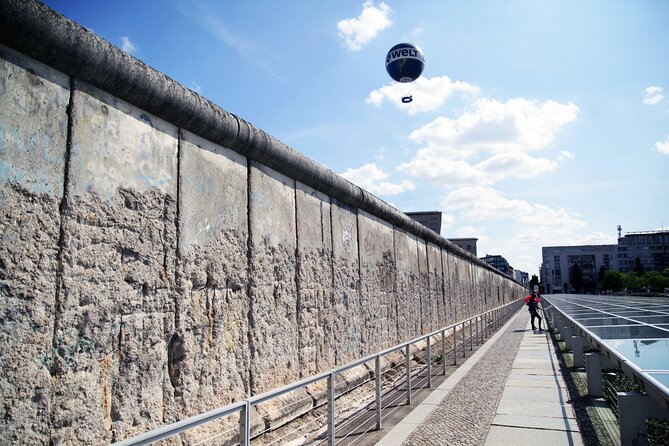
At Niederkirchnerstraße, you see a preserved section of the Berlin Wall. This is where the tour shifts from Nazi Germany and wartime memory to the division of Berlin after World War II.
The guide explains escape attempts, including successful efforts and tragic failures. You also hear about daily life on both the East and West sides of the city. That human scale helps keep the Wall from becoming just another photo stop.
The surviving section is especially useful for visualizing the physical barrier. The tour does not include a long museum visit here, so you will rely on the guide to connect the concrete structure with the wider story of divided Berlin.
Topography of Terror and the machinery of Nazi rule
The Topography of Terror occupies the former headquarters area of the SS, Gestapo, and SD. Today, an exhibition at the site documents the crimes carried out by these institutions during Nazi Germany.
This is among the most important stops on the walk because it shifts attention from famous leaders and symbols to the organizations that carried out persecution and terror. The setting itself adds weight: the place once held offices connected to the Nazi security system.
The walk introduces the site, but it is not a substitute for visiting the full exhibition. If this subject matters greatly to you, return later with more time. The express tour helps you decide what deserves a longer visit.
Checkpoint Charlie and the Cold War finale
The tour ends at Checkpoint Charlie on Friedrichstraße. This former border crossing became one of the best-known symbols of the Cold War, linked to espionage, escape attempts, and the tense division between East and West Berlin.
Ending here gives the route a clear arc. You begin with the city’s older political center and finish with the division that shaped Berlin until reunification. The final stop also leaves you in a central area with public transportation nearby.
Checkpoint Charlie can feel theatrical and commercial around the modern roadside displays. That is worth keeping in mind. The historical importance is real, but the present-day setting does not always feel as solemn as the Holocaust Memorial or the Wall remains. Your guide’s context helps separate the Cold War story from the current tourist setting.
The guide makes the pace work
A two-hour route covering nine stops can easily become a string of dates and names. The strongest part of this experience is the guide’s ability to make each place connect to the next.
Ryan was praised for keeping the discussion interesting and explaining the city clearly. Gregor was singled out for bringing meaning to the sites, even within the short format. Dylan was described as informative, engaging, and willing to answer questions. Giles was noted for clear communication and a walking pace that worked for a group ranging from people in their 20s to people in their 70s.
Those details matter because the route serves different ages and interests. You should expect to walk between stops and keep track of the group. If you prefer long pauses, private discussion, or extensive museum time, this format may feel rushed. If you want a clear introduction with room to ask questions, it is a sensible choice.
Is $21.77 good value?
At $21.77 per person, I consider this a fair price for a guided introduction to central Berlin. You are paying for the route design and the explanations, not for entry to attractions. All listed stops have free admission, so the main value is having someone connect the sites into a coherent story.
The price is especially reasonable if you are visiting Berlin for the first time or have only a day or two. A self-guided walk costs less, but you would need to research the sites, plan the order, and manage the historical connections yourself.
The tour is also a money-saving alternative to a private guide. The maximum group size is 25, so it is not as personal as a private walk. On the other hand, the price lets you cover a lot of ground without committing to a longer or more expensive tour.
The advertised average booking point is 12 days ahead. That suggests you should not leave planning until the last minute if your schedule is fixed, particularly if you want a certain day.
Who should take this express tour?
I would choose this walk for a first visit, a short Berlin stay, or a day when you want a strong overview before choosing which museums to visit. It is also a good fit for history-minded visitors who want both Nazi-era and Cold War sites in one route.
Families with older children may find the landmark-to-landmark format easier than a long indoor lecture, though the subject matter is serious. Most people can participate, and service animals are allowed. Since the tour runs in English, you should be comfortable following spoken explanations while walking.
I would skip it if you already know central Berlin well and want detailed time at each memorial. I would also think twice if you dislike brisk group walks or find discussions of genocide and political violence too heavy for a holiday morning.
Practical advice for getting the most from the walk
Meet at Pariser Platz 1, at the Brandenburg Gate, and allow enough time to find the starting point. The tour ends at Checkpoint Charlie, Friedrichstraße 43 to 45, so you finish at a different location from where you began.
Wear comfortable shoes and keep your phone available for the mobile ticket. The route is near public transportation, which makes it simple to continue sightseeing after the final stop.
I would also treat the two hours as an introduction, not the whole Berlin history program. Mark the places that catch your attention, then return to one or two of them later. The Holocaust Memorial, Topography of Terror, and Reichstag each reward more time than this express route can provide.
Should you book Berlin Highlights in 2 Hours?
Book it if you want a focused, affordable orientation to Berlin’s central historical sites. The 4.9 rating from 120 reviews and 98 percent recommendation rate fit the tour’s clear strengths: strong guides, sensible pacing, and a lot of history in a short window.
The best reason to choose it is the route itself. Few short walks connect Brandenburg Gate, the Reichstag, Holocaust memorial sites, the former Führerbunker location, the Berlin Wall, and Checkpoint Charlie so efficiently.
Do not book it expecting a slow memorial visit or extended access to buildings. Book it because you want a well-planned introduction, useful context, and plenty of free time afterward. Free cancellation is available when you cancel at least 24 hours before the start time. Inside that window, the amount paid is not refunded and changes are not accepted.
FAQ
How long does Berlin Highlights in 2 Hours take?
The tour lasts approximately two hours. It visits nine stops, with about 10 minutes planned at each location.
Where does the walking tour start?
It starts at Pariser Platz 1, 10117 Berlin, Germany, beside Brandenburg Gate.
Where does the tour end?
The tour ends at Checkpoint Charlie, Friedrichstraße 43 to 45, 10117 Berlin, Germany.
Is the tour offered in English?
Yes. The experience is offered in English.
How large can the group be?
The tour has a maximum group size of 25 people.
Can I cancel for a full refund?
Yes, if you cancel at least 24 hours before the experience start time. Cancellations made less than 24 hours before the start time are not refunded.
Just added around Berlin
- Berlin Highlights in One Day★ 5.0 · 3 reviews
- Private Berlin One Day Tour with a Local: See the City Unscripted★ 3.5 · 3 reviews
- Individual city tour Berlin for max. 8 persons★ 5.0 · 3 reviews
- Transfer from Berlin Schönefeld Airport (SXF) to Berlin city Hotels – ROUND TRIP★ 4.0 · 3 reviews
- Berlin: Museum Island Tour★ 5.0 · 3 reviews
- Private Analogue Photography Experience in Berlin★ 5.0 · 3 reviews
- Berlin: Local Food Tour in Secrets Hidden Gems★ 4.0 · 3 reviews
- Potsdam Highlights – Private sightseeing tour by minibus★ 5.0 · 3 reviews
Walking Tours, compared.



Berlin’s Best: 2 Hour Walking Tour Third Reich and the Cold War
Read our review →

Third Reich Berlin: Hitler and WWII Walking Tour
Read our review →

Browse the lists this tour appears in