
Review · WALKING TOURS
Berlin: Sightseeing Walking Tour of the Top 20 Attractions
Berlin’s past is packed into this three-hour walk, from the government quarter and Brandenburg Gate to Checkpoint Charlie, the Berlin Wall, and Museum Island. You get a fast but thoughtful introduction to the city’s Nazi, Cold War, Prussian, and modern chapters.
I like the personal format, since a private or small group lets you ask questions and adjust the discussion to your interests. I also like the guides’ use of dry Berlin humor and personal stories, especially when a guide has lived through the Wall’s fall and reunification.
The main drawback is the pace. About 6 kilometers of walking and roughly 20 sights in 180 minutes means you will see many places from the outside, with limited time at each one. At $94 per person, this is best for a first Berlin day when orientation matters more than a slow, detailed museum visit.
In This Review
- Key points to know before you book
- Why this route works for a first Berlin visit
- Starting beside the Paul-Löbe-Haus and the Chancellery
- Brandenburg Gate and the weight of the Holocaust Memorial
- Potsdamer Platz and a city rebuilt in layers
- Checkpoint Charlie and the Cold War street story
- Gendarmenmarkt and Bebelplatz
- Unter den Linden, Lustgarten, and Museum Island
- The New City Palace and the route’s modern finish
- What the guide adds to the streets
- Is $94 a fair price?
- Walking, weather, and comfort
- Who should book this Berlin walk?
- Should you book it?
- FAQ
- How long is the Berlin walking tour?
- How far will I walk?
- Where does the tour start?
- Where does the tour finish?
- What time does the tour start?
- Which languages are available?
- Is this a private tour?
- Is the walking tour wheelchair accessible?
- Can I cancel for a refund?
Key points to know before you book
- A fast route through central Berlin: Cover major landmarks in about 6 kilometers of walking.
- History beyond the postcard sights: The route includes Checkpoint Charlie, longer Wall sections, and the Topography of Terror.
- Strong guide-led storytelling: Carlos, Carlo, Antonella, and Max are among the guides praised for warmth, humor, and personal insight.
- A useful first-day overview: Finish near Museum Island with a clear sense of where to return later.
- Flexible group format: Choose a private tour or a small group, with English, Spanish, or German guiding.
- Practical outdoor planning: Wear good shoes, bring water, and be ready to walk in any weather.
Why this route works for a first Berlin visit
Berlin is not a city that reveals itself in one tidy old center. Its major sights are spread across former political zones, rebuilt squares, memorials, grand boulevards, and sites tied to two very different dictatorships. A guide can help you connect those pieces before you start exploring alone.
This tour begins near the government quarter, then moves south and east through central Berlin. The route covers the Reichstag, the Brandenburg Gate area, the Holocaust Memorial, Potsdamer Platz, Checkpoint Charlie, the Topography of Terror, Gendarmenmarkt, Bebelplatz, and Museum Island before finishing at Friedrichsbrücke.
That is a lot for three hours. You should think of it as a city orientation walk, not a series of extended site visits. The value lies in the sequence. You see how the modern German government sits beside reminders of dictatorship, how the Wall cut through ordinary streets, and how Prussian Berlin was rebuilt after wartime destruction.
The guides are expected to bring the facts to street level. Instead of only listing dates, they can explain how Berlin was divided, how daily life changed, and how the city handles its difficult past today. The tour also includes local suggestions for food, nightlife, and neighborhoods to explore afterward.
More walking tours in Berlin:
- Discover Berlin Half-Day Walking Tour
★ 5.0 · 9,624 reviews - Berlin: Third Reich and Cold War 2 Hour Walking Tour
★ 4.9 · 6,830 reviews - Berlin: Discover Berlin Walking Tour
★ 4.9 · 5,998 reviews
Starting beside the Paul-Löbe-Haus and the Chancellery
The meeting point is in front of the main entrance to the Paul-Löbe-Haus at Konrad-Adenauer-Straße 1, opposite the Federal Chancellery. Look for the TourguideMe guide near the entrance.
This is a useful starting point because you begin in the heart of present-day German government. The Paul-Löbe-Haus is part of the parliamentary complex, while the nearby Chancellery represents the federal government. The guide-led walk lets you read modern Berlin through its architecture and political setting before turning toward older and darker chapters.
You will also pass the Reichstag. The building’s history and its modern glass dome make it one of Berlin’s essential sights, but this walking tour does not function as an interior Reichstag visit. Expect guided sightseeing from the outside rather than a dedicated building tour or dome reservation.
The 10:00 AM and 2:00 PM departures give you two useful choices. The morning start leaves the afternoon open for museums, while the later tour works well if you want a relaxed morning before heading into central Berlin.
Brandenburg Gate and the weight of the Holocaust Memorial
Brandenburg Gate is one of the clearest symbols of Berlin. It began as a royal city gate and later became a powerful image of division and reunification. Your guide can give the monument meaning beyond its familiar columns and quadriga, explaining how it changed from a Prussian entrance to a Cold War symbol and then a national emblem.
The nearby Holocaust Memorial changes the tone. Its field of concrete blocks is deliberately open to interpretation, and walking among them can feel very different from viewing the site from the street. The tour includes guided time and some free time here, which is important because this is a place you should not rush through while listening to a long speech.
The memorial is also a good example of why a guide helps in Berlin. You can ask about the site’s purpose, location, and place in the city without treating it as just another photo stop. Still, keep your expectations clear: this is an outdoor visit, not a full museum session.
Potsdamer Platz and a city rebuilt in layers
Potsdamer Platz shows Berlin’s post-reunification face. The square was heavily damaged during the war, divided by the Wall, and later rebuilt as a modern commercial center. It offers a sharp contrast with the government buildings, memorials, and nineteenth-century architecture seen earlier.
The guide’s role here is to explain the gaps and changes. Berlin often makes more sense when you notice what is missing. Empty land, abrupt modern buildings, and traces of former borders are part of the city’s story.
You will have time for sightseeing and walking, but not an extended architectural study. If modern urban design is a major interest, note the location so you can return later at your own pace.
A different side of Berlin on the same trip:
- Berlin: Reichstag, Dome and Government District Guided Tour
★ 4.7 · 18,288 reviews - Berlin: 1-Hour City Tour by Boat with Guaranteed Seating
★ 4.3 · 16,993 reviews - Berlin: Boat Tour Along the River Spree
★ 4.4 · 11,252 reviews - Berlin: Hop-on Hop-off Bus Tour with Live Commentary
★ 4.3 · 8,579 reviews
Checkpoint Charlie and the Cold War street story
Checkpoint Charlie is one of Berlin’s best-known Cold War stops, but it can also feel heavily shaped for tourism. The famous guardhouse and sign make a strong visual reminder of the former border, yet the present-day setting is busy and commercial.
That contrast is exactly why a guide is useful. You can learn what the checkpoint represented, how the border worked, and why the surrounding streets mattered. The tour also includes longer sections of the Berlin Wall than a basic top sights walk, giving the Cold War story more room than a single photo stop.
The walk then reaches the Martin-Gropius-Bau area and the Topography of Terror memorial. The latter occupies the former site of the Gestapo and SS headquarters. Its outdoor displays and memorial setting focus on Nazi terror and state persecution.
This part of the route asks for attention. The subject is difficult, and the tour’s value depends on a guide who treats it with care rather than turning it into a string of dramatic anecdotes. The advertised mix of facts, stories, and humor should not mean making light of the crimes themselves. In the best moments, light Berlin wit can make a long walk feel human while the serious sites retain their proper weight.
Gendarmenmarkt and Bebelplatz
Gendarmenmarkt is one of central Berlin’s grandest squares. Its formal layout and major buildings show the confidence of Prussian and later imperial Berlin. It is a good place to pause for photographs and to hear how Berlin’s rulers used architecture to project power and order.
The exact experience can change with construction or public events, so your guide will determine the best viewing points on the day. The important benefit is context. Instead of seeing a handsome square in isolation, you connect it to the city’s changing political identity.
Bebelplatz carries a much darker memory. It is associated with the Nazi book burning of 1933, and a memorial set into the pavement recalls the event. The empty underground library is easy to miss if you do not know where to look.
This stop is one of the tour’s strongest examples of Berlin’s habit of placing painful history in ordinary public spaces. You may be standing beside a broad square used by modern city life while looking down at a memorial to censorship and persecution.
Unter den Linden, Lustgarten, and Museum Island
The walk continues along Unter den Linden, Berlin’s famous boulevard. Its linden trees, formal buildings, and links between the Brandenburg Gate and Museum Island make it one of the most useful streets for understanding the old center.
The boulevard also helps you see how Berlin’s focus shifted over time. Royal power, military display, university life, museums, and modern public life all meet along this corridor. Your guide can point out details that are easy to pass without context.
At Lustgarten, the route moves toward the cultural center around the Berlin Cathedral and Museum Island. Lustgarten has served different public and ceremonial roles, and its open space gives you a good view of the surrounding architecture.
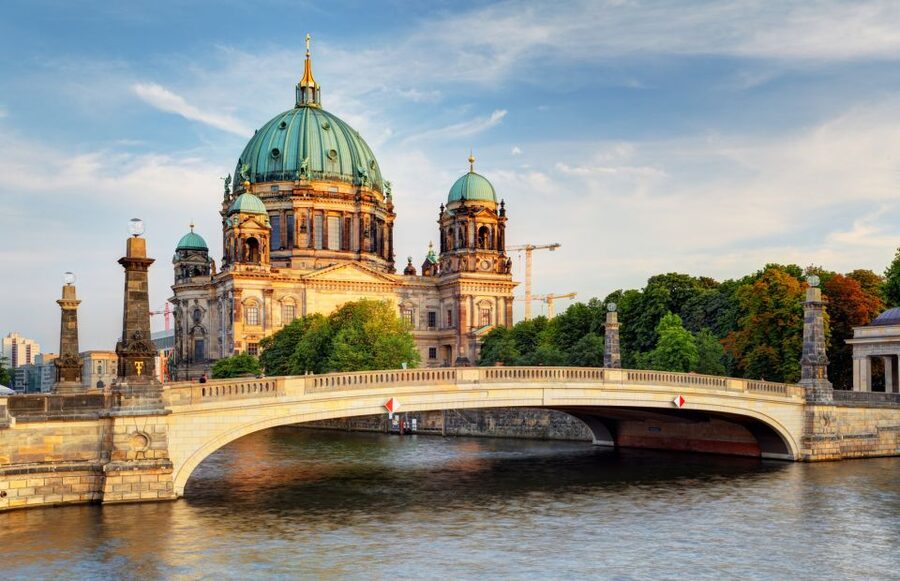
Berlin Cathedral is one of the city’s most recognizable buildings. Its large dome and ornate exterior dominate the riverfront, but this tour is designed for exterior sightseeing. If you want to visit the cathedral interior or climb to its dome, plan a separate visit.
Museum Island brings the walk to one of Berlin’s most important cultural districts. The area includes several major museums, and the Alte Nationalgalerie is among the buildings you will see. The guide can explain the island’s place in Berlin’s artistic and political development, but museum entry is not part of this experience.
That limitation is worth noting. You will get a useful introduction to the setting and can then choose which museum deserves your own time. Museum Island is far better explored slowly than squeezed into a three-hour walking route.
The New City Palace and the route’s modern finish
The tour also includes the New City Palace, known today as the Humboldt Forum. Its reconstructed exterior recalls Berlin’s former royal palace, while the present institution has a modern cultural role.
This is another stop where the guide can clarify the difference between original fabric, reconstruction, and present-day use. Berlin contains many rebuilt landmarks, and the city’s restoration choices often raise questions about memory, identity, and historical appearance.
The listed route ends at Friedrichsbrücke, near Museum Island. That is a practical finish. You can continue into a museum, walk along the river, stop for food, or use public transport to reach another part of the city. You do not end in a distant suburb with a long journey back.
One detail needs attention: the experience is marketed as a Top 20 tour, while the detailed route names fewer individual stops and leaves one itinerary line blank. Landmarks can also be viewed from several points along the walk. Ask your guide at the start how the day’s route will be arranged, especially if a specific sight matters most to you.
What the guide adds to the streets
A guide can make or break a fast city walk. The strongest descriptions of this experience point to warm, personal guiding and an ability to answer questions without making the tour feel like a classroom.
Carlos and Carlo are names associated with especially personal tours, including one guide who had lived through the fall of the Wall. Antonella and Max were also praised for friendly, engaging leadership. Guides can change, so book for the format and subject matter rather than expecting a particular person unless the operator confirms it.
The best feature here is adaptability. You can ask about Berlin politics, the Wall, local neighborhoods, food, nightlife, or daily life. A private group should have more room to shape the conversation, while a small group keeps the experience more personal than a large crowd.
One past tour continued about 30 minutes beyond the planned three hours, but you should not count on extra time. Build your day around the stated duration, particularly if you have a museum booking or restaurant reservation afterward.
Is $94 a fair price?
At $94 per person, this is not Berlin’s cheapest walking tour. It becomes better value when you use it as a compact private or small-group introduction, especially on your first day.
You are paying for a certified local guide, a focused route, three hours of interpretation, and the chance to ask questions. There are no stated extra tour costs, and the experience does not depend on museum admission fees. If the tour helps you choose the right museums and neighborhoods for the rest of your stay, it can save time and prevent a scattered first day.
The price is harder to justify if you mainly want photographs or prefer to move at your own pace. Berlin’s central sights can be visited independently, and the quick schedule means you will not linger at every location.
I would compare the price with the size of your group. For a private group sharing the cost, the personal format may make sense. For one person who prefers independent sightseeing, a lower-cost group walk could offer similar orientation.
Walking, weather, and comfort
The route covers approximately 6 kilometers. That is manageable for many people, but three hours on city streets can feel tiring, particularly because the tour keeps moving between major stops.
Wear comfortable walking shoes and bring water. The tour runs in all weather, so a rain jacket, warm layer, or sun protection may matter depending on the forecast. One guide has previously paused for a hot drink during cold, wet conditions, but do not treat that as a fixed part of the schedule.
The experience is listed as wheelchair accessible and suitable for families, seniors, and all ages and fitness levels. Still, the distance and outdoor pace are worth discussing with the operator if you have limited mobility. Ask about the day’s route and rest opportunities before booking.
The tour is mainly on foot, which keeps you close to the streets and avoids spending much of your limited time in transit. It also means you should plan for public transport separately if you need to return to your hotel after finishing near Friedrichsbrücke.
Who should book this Berlin walk?
I would choose this tour if you are visiting Berlin for the first time and want the city’s main themes explained in one concentrated morning or afternoon. It is also a good fit for couples, families, friends, and small work groups who want to ask questions instead of following a fixed script.
History-minded visitors will appreciate the balance between Nazi and Cold War sites, while architecture fans get a broad look at government buildings, Prussian squares, modern Potsdamer Platz, and Museum Island. The local tips at the end can help you decide where to eat or spend the evening.
I would hesitate if you dislike brisk walking, want interior visits, or prefer one subject explored at length. The Holocaust Memorial, Topography of Terror, Berlin Cathedral, and Museum Island each deserve more time than this route allows.
Free cancellation up to 24 hours before the start and reserve-now, pay-later terms make planning easier. The tour is offered in English, Spanish, and German, with private and small-group options.
Should you book it?
Book this tour if your priority is fast orientation with a human guide. The strongest reason to choose it is not the number 20. It is the way the route links government, royal Berlin, Nazi terror, the Wall, reunification, and modern city life in one walk.
Skip it if you want a slow museum day or a low-cost independent stroll. At $94, it needs a good guide to earn its price, but the personal stories, flexible conversation, and strong guide record make it a sensible first-day choice for many visitors.
FAQ
How long is the Berlin walking tour?
The tour lasts three hours, or 180 minutes.
How far will I walk?
The walk covers approximately 6 kilometers.
Where does the tour start?
It starts in front of the main entrance to the Paul-Löbe-Haus, opposite the Federal Chancellery, at Konrad-Adenauer-Straße 1, 10557 Berlin.
Where does the tour finish?
The route finishes at Friedrichsbrücke near Museum Island.
What time does the tour start?
Daily start times are listed as 10:00 AM and 2:00 PM.
Which languages are available?
The live tour guide service is available in English, Spanish, and German.
Is this a private tour?
Private and small-group options are available.
Is the walking tour wheelchair accessible?
The activity is listed as wheelchair accessible.
Can I cancel for a refund?
You can cancel up to 24 hours in advance for a full refund.
Just added around Berlin
- Berlin Highlights in One Day★ 5.0 · 3 reviews
- Private Berlin One Day Tour with a Local: See the City Unscripted★ 3.5 · 3 reviews
- Individual city tour Berlin for max. 8 persons★ 5.0 · 3 reviews
- Transfer from Berlin Schönefeld Airport (SXF) to Berlin city Hotels – ROUND TRIP★ 4.0 · 3 reviews
- Berlin: Museum Island Tour★ 5.0 · 3 reviews
- Private Analogue Photography Experience in Berlin★ 5.0 · 3 reviews
- Berlin: Local Food Tour in Secrets Hidden Gems★ 4.0 · 3 reviews
- Berlin & The Third Reich Private Guided Tour★ 5.0 · 3 reviews
Walking Tours, compared.



Berlin’s Best: 2 Hour Walking Tour Third Reich and the Cold War
Read our review →

Third Reich Berlin: Hitler and WWII Walking Tour
Read our review →

Browse the lists this tour appears in