
Review · THIRD REICH & WWII SITES
Hitler to Stalin – WWII & Cold War Tour (Small Group)
Berlin’s most important wartime sites are often separated by busy roads and modern buildings, but this small-group walking tour ties them into one clear story. In about two and a half hours, you move from the Brandenburg Gate and Reichstag to the Holocaust Memorial, Führerbunker site, Berlin Wall, and Checkpoint Charlie.
I like the low $23 price, which gives you a guided route through nine significant places without extra admission fees. I also like the use of historic photographs, especially when guide Mark shows how key locations looked during the war. The main drawback is the brisk pace: with nine stops packed into 150 minutes, some sites receive only 10 or 15 minutes.
In This Review
- Key points to know before booking
- Berlin’s story begins at Brandenburg Gate
- The Reichstag links empire, dictatorship, and democracy
- Soviet memorials make the Battle of Berlin personal
- The Holocaust Memorial asks you to slow down
- The Führerbunker site strips away the myth
- The Korean embassy stop adds a Cold War detail
- The June 17 uprising shows resistance under Soviet rule
- The Berlin Wall Memorial makes division visible
- Checkpoint Charlie is the busy final stop
- Why the $23 fee offers good value
- Who will get the most from this walk
- Practical details that affect the day
- Should you book Hitler to Stalin?
- FAQ
- Where does the tour start?
- Where does the tour end?
- How long does the tour last?
- How much does the tour cost?
- How many people can join the tour?
- Are admission tickets included?
- Is the tour wheelchair accessible?
- What happens if I need to cancel?
Key points to know before booking
- The route connects two eras: You follow Berlin from Hitler’s dictatorship and the Battle of Berlin to Soviet control, the Wall, and the Cold War.
- The tour ends at Checkpoint Charlie: It begins at Brandenburg Gate, making this a useful first-day orientation walk.
- Guide Mark receives especially warm praise: His historical explanations, enthusiasm, and wartime photographs add real value.
- The group is capped at 15 people: That is small enough for questions and easier listening in central Berlin.
- All stops are free to enter: The fee pays for the guide and structure, not admission tickets.
- Plan for steady walking outdoors: The tour requires good weather and includes several open-air memorials.
Berlin’s story begins at Brandenburg Gate
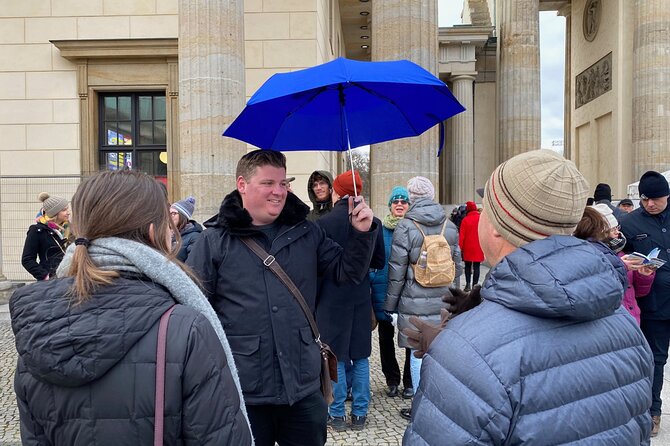
Meet at Pariser Platz, beside the Brandenburg Gate. This is an excellent starting point because the gate is not only one of Berlin’s best-known landmarks, but also a useful marker of the city’s political past.
Frederick William II built the gate in the 18th century on the site of an older city entrance. Its location between Pariser Platz and the Reichstag later placed it close to the center of German power. During the 20th century, it became a backdrop for major political events and a symbol of a divided city.
Your guide uses the gate to set up the larger story. Berlin’s past is not a neat line from one event to the next. Nazi rule, wartime destruction, Soviet occupation, German division, and reunification all left marks in this small central area.
You spend about 10 minutes here. That is enough for an introduction and orientation, but not for a full architectural lecture. I see this short stop as a strength. The tour gets moving quickly instead of spending too long on a building you can revisit later.
More Cold War Berlin:
- Berlin: Third Reich and Cold War 2 Hour Walking Tour
★ 4.9 · 6,830 reviews - Berlin’s Best: 2 Hour Walking Tour Third Reich and the Cold War
★ 5.0 · 5,486 reviews - Cold War, Berlin Wall, Spies and the East Side Gallery
★ 5.0 · 1,024 reviews
The Reichstag links empire, dictatorship, and democracy
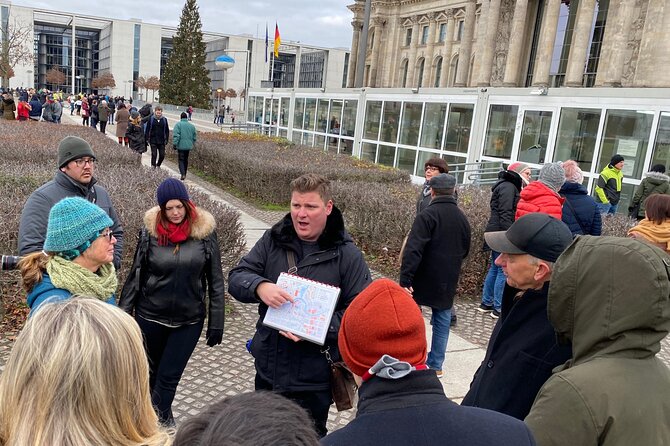
The next stop is the Reichstag, home of Germany’s lower house of parliament, the Bundestag. The building was opened in 1894 for the Imperial Diet of the German Empire.
Its wartime story is especially important. A fire in 1933 damaged the building and became part of the political crisis that helped Adolf Hitler consolidate power. The Reichstag was later badly damaged during World War II and restored in 1999.
The stop lasts about 15 minutes. You should expect historical context and an exterior look rather than a parliamentary visit. The supplied tour details do not include entry to the building or access to its glass dome, so do not book this walk expecting an indoor Reichstag tour.
I like this stop because it gives the Nazi period a political setting. The Brandenburg Gate shows public ceremony and national symbolism. The Reichstag helps explain how democratic institutions were weakened and then restored.
Soviet memorials make the Battle of Berlin personal
In the Großer Tiergarten, the group visits the Soviet War Memorial. The Soviet Union erected it in 1945 to honor soldiers of the Soviet Armed Forces who died in the Battle of Berlin.
This is a useful counterweight to a tour focused only on Hitler and Nazi Germany. The final battle for Berlin involved enormous loss of life, and the memorial reflects the Soviet role in defeating Nazi Germany. Your guide can place the monument within the last stage of the war and the political order that followed.
You have roughly 15 minutes here. Because the memorial is outdoors, the stop can feel more immediate than a museum display. You are looking at a physical reminder of the army that captured Berlin, not simply hearing dates in a classroom.
The location on the northwest side of the broad Straße des 17. Juni also helps you understand Berlin’s scale. This is not a tiny old town where every site sits around one square. The route crosses central streets and open spaces, so comfortable shoes matter.
The Holocaust Memorial asks you to slow down
The Memorial to the Murdered Jews of Europe is one of the tour’s most powerful stops. Architect Peter Eisenman designed the site, which contains 2,711 concrete slabs spread across about 19,000 square meters.
The slabs vary in height, and the ground between them is uneven. As you walk through, the open sky and changing sense of balance create an unsettled feeling. There is no single inscription telling you exactly what to think. The design leaves room for a personal response while marking the murder of Europe’s Jews under Nazi rule.
The group has about 15 minutes here. That is enough to walk among part of the memorial and hear its purpose, though you may want to return on your own for more time. A guided visit gives you the facts and setting. A second visit lets you experience the space quietly, without needing to keep pace with a group.
This stop requires care and attention. It is not a photo prop or a casual shortcut through the city. I value its place on the route because it shifts the focus from military buildings and political leaders to the people targeted and murdered by the Nazi regime.
More Third Reich sites in Berlin:
- Berlin: Berlin Story Bunker Entry Ticket
★ 4.6 · 6,759 reviews - Third Reich Berlin: Hitler and WWII Walking Tour
★ 5.0 · 3,301 reviews - Berlin: Third Reich, Hitler, and WWII Walking Tour
★ 4.9 · 1,133 reviews - Berlin Third Reich Sites: Half-Day Walking Tour
★ 5.0 · 835 reviews
The Führerbunker site strips away the myth
The former Führerbunker was an air-raid shelter and Hitler’s final headquarters. Hitler moved into the bunker on January 16, 1945, married Eva Braun there on April 29, and the two died by suicide less than 40 hours later.
The original complex is no longer presented as a dramatic underground attraction. The old Chancellery buildings were leveled by the Soviets, while later construction altered the area. The underground site remained mostly undisturbed until 1988.
That makes this a valuable historical stop, but not a conventional monument. You should expect a location and explanation rather than rooms preserved for public viewing. Its plain setting is part of the point. The absence of grand ruins makes it harder to turn Hitler’s final days into a theatrical story.
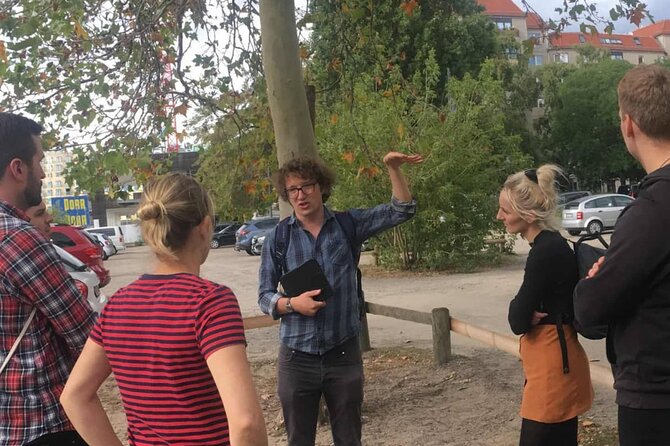
The stop takes about 15 minutes. A skilled guide can use this time to explain the final weeks of the war, the collapse of the Nazi government, and the way Berlin dealt with the physical remains afterward. Mark is praised for bringing this period to life with photographs showing wartime scenes alongside the modern city.
The Korean embassy stop adds a Cold War detail
The route then includes the Embassy of the Democratic People’s Republic of Korea at Glinkastraße 5 in Mitte. The stop is listed as 10 minutes.
This may seem like an unusual addition to a World War II walk, but it points toward Berlin’s wider Cold War role. The divided city was not only a German problem. It was part of the global rivalry between communist and Western powers.
The tour information does not describe an interior visit, so you should regard this as an exterior location and a point for historical explanation. Its value depends heavily on the guide’s ability to connect the address to the larger Cold War story.
The June 17 uprising shows resistance under Soviet rule
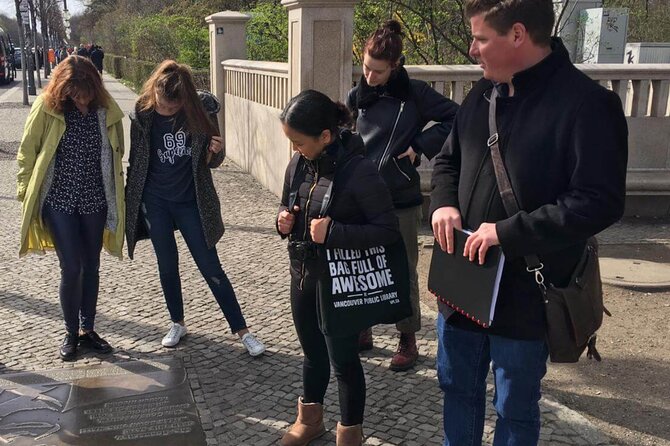
At the memorial for the June 17, 1953 uprising, the group examines the first major challenge to the communist regime in postwar East Germany. Soviet tanks suppressed the uprising, and about 15,000 people were arrested afterward.
This is one of the more important stops for understanding life between the end of World War II and the construction of the Berlin Wall. The Cold War was not only a contest between governments. It also shaped the daily choices, protests, fears, and punishments faced by people living under communist rule.
You spend around 15 minutes here. The stop gives the tour a needed human scale. Hitler and Stalin are major figures in the title and historical frame, but this memorial points to ordinary Berliners who resisted a government backed by Soviet military power.
I appreciate that the route includes this event rather than jumping straight from 1945 to the Wall. The uprising helps explain why the division of Germany remained tense and why Berlin became such a sensitive pressure point.
The Berlin Wall Memorial makes division visible
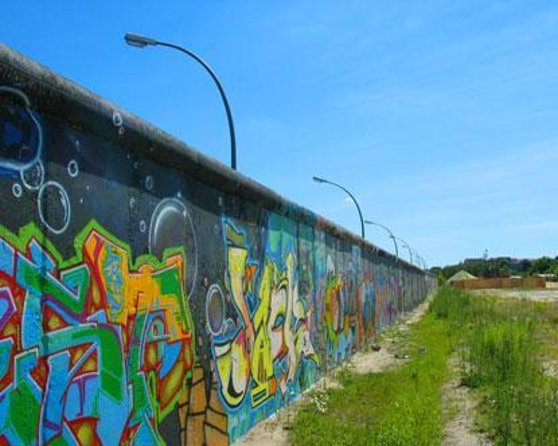
The Berlin Wall Memorial commemorates the division of Berlin and the deaths connected to the Wall. You have about 15 minutes here.
This stop is different from seeing a single painted section of concrete. The memorial’s purpose is to remember the people affected by the border and those who died trying to cross it. It gives the Wall a human meaning beyond Cold War photographs and political speeches.
Your guide can connect the Wall to the earlier events on the walk: Nazi defeat, Soviet control, the formation of rival political systems, and the long struggle between East and West. The Wall did not appear out of nowhere. It was the physical result of a divided postwar order.
The time is short, so you may want to return later if Berlin’s division is a main interest. Still, this guided stop helps you recognize the significance of places that can otherwise look like ordinary city streets.
Checkpoint Charlie is the busy final stop
The tour ends at Checkpoint Charlie on Friedrichstraße, where the Wall separated East and West Berlin. Western Allies called the crossing Checkpoint C, with Charlie taken from the NATO phonetic alphabet.
You spend about 20 minutes here, the longest stop on the route. That makes sense. Checkpoint Charlie is the best-known Cold War crossing in Berlin and an easy place to explain how the divided city worked.
It is also the most tourist-oriented location on the walk. The area is busy with shops, displays, and photo opportunities, so it can feel less solemn than the Holocaust Memorial or the Soviet memorial. The guide’s context matters here. Without explanation, you see a famous sign and guardhouse. With explanation, you can understand the crossing as a point of tension between rival powers.
Ending here is practical. You finish near public transportation in central Berlin, with easy access to other sights. If you plan to visit the nearby Wall Museum or other Cold War sites, you can continue on your own, though no extra admission is included in the $23 price.
Why the $23 fee offers good value
At $23, this tour is priced well for a 2.5-hour guided walk in central Berlin. You are not paying for museum admission, transport, or a special venue. You are paying for a route, historical structure, and a guide who can make the sites fit together.
That matters in Berlin. You can walk past the Reichstag, Holocaust Memorial, bunker site, and Checkpoint Charlie alone, but the connections are easy to miss. A guide helps you understand why these places belong in one story.
The group size is limited to 15 people. That is a useful middle ground. It is larger than a private walk but much more manageable than a big city tour. You should have a better chance of hearing the explanation and asking questions, especially if Mark is leading the group.
The strongest added value is the visual material. Mark uses photographs to compare wartime Berlin with the present city. This is especially helpful at sites where little of the original structure remains.
Who will get the most from this walk
I would recommend this tour if you want a clear introduction to Berlin’s 20th-century history before visiting museums. It suits first-time visitors, history-minded adults, and anyone who wants to connect the Nazi era with the Cold War rather than study each period separately.
It is also a good choice if you have only a short stay. The route covers a large number of major locations in one session, and the central starting and ending points fit easily around other plans.
You may want something else if you prefer long, quiet visits at each memorial. Nine stops in 150 minutes means the walk is an overview. You will hear a lot, but you will not get a full museum treatment at every location.
The subject matter is serious. The tour deals with dictatorship, mass murder, war, political repression, and deaths at the Wall. That is the right tone for these sites, and you should allow time afterward to process what you have seen.
Practical details that affect the day
The meeting point is at the Brandenburg Gate on Pariser Platz, 10117 Berlin. The tour ends at Checkpoint Charlie, Friedrichstraße 43 to 45, also in 10117 Berlin.
The route is near public transportation, and most people can participate. Service animals are allowed. The experience is outdoors and requires good weather, so check the forecast and dress for a walking tour rather than a museum visit.
The tour lasts approximately two hours and 30 minutes. The listed stop times total about 130 minutes, leaving roughly 20 minutes for walking between locations, group movement, and transitions. That schedule explains the brisk pace.
You receive confirmation when booking. Free cancellation is available up to 24 hours before the start time for a full refund. Cancellations or changes made less than 24 hours ahead are not refunded or accepted. If bad weather or low enrollment cancels the tour, you are offered another date or experience, or a full refund.
Should you book Hitler to Stalin?
Book it if you want a compact, well-priced framework for Berlin’s Nazi and Cold War history, especially if guide Mark is leading your departure. His use of photographs and clear explanations appears to be the experience’s strongest feature.
Do not book it expecting long visits, indoor access to the Reichstag or Führerbunker, or a relaxed stroll with no fixed pace. The route covers a lot of ground and asks you to move on quickly.
For $23, I think the tour is a sensible choice for a first orientation. It shows you where Berlin’s major stories happened, gives you the historical links, and leaves you with a useful map for later visits. If you have only one afternoon for modern Berlin, this walk makes the most of it.
FAQ
Where does the tour start?
The tour starts at the Brandenburg Gate on Pariser Platz, 10117 Berlin, Germany.
Where does the tour end?
The tour ends at Checkpoint Charlie at Friedrichstraße 43 to 45, 10117 Berlin, Germany.
How long does the tour last?
The tour lasts approximately two hours and 30 minutes.
How much does the tour cost?
The listed price is $23.
How many people can join the tour?
The group has a maximum of 15 people.
Are admission tickets included?
All listed stops have free admission. The tour information does not include paid entry to the Reichstag, museums, or other indoor attractions.
Is the tour wheelchair accessible?
The supplied information says most people can participate, but it does not provide specific wheelchair-access details. The tour is an outdoor walking experience, so ask the provider before booking if you need detailed accessibility guidance.
What happens if I need to cancel?
You can receive a full refund if you cancel at least 24 hours before the experience start time. Cancellations and changes made less than 24 hours before the start are not refunded or accepted. If weather or minimum enrollment cancels the experience, you are offered another date or experience, or a full refund.
Just added around Berlin
- Berlin Highlights in One Day★ 5.0 · 3 reviews
- Private Berlin One Day Tour with a Local: See the City Unscripted★ 3.5 · 3 reviews
- Individual city tour Berlin for max. 8 persons★ 5.0 · 3 reviews
- Transfer from Berlin Schönefeld Airport (SXF) to Berlin city Hotels – ROUND TRIP★ 4.0 · 3 reviews
- Berlin: Museum Island Tour★ 5.0 · 3 reviews
- Private Analogue Photography Experience in Berlin★ 5.0 · 3 reviews
- Berlin: Local Food Tour in Secrets Hidden Gems★ 4.0 · 3 reviews
- Berlin & The Third Reich Private Guided Tour★ 5.0 · 3 reviews
Third Reich & WWII Sites, compared.



Berlin’s Best: 2 Hour Walking Tour Third Reich and the Cold War
Read our review →
Third Reich Berlin: Hitler and WWII Walking Tour
Read our review →

Berlin Third Reich Sites: Half-Day Walking Tour
Read our review →
Guided Bike Tour of the Berlin Wall and Third Reich
Read our review →
Hitler’s Germany: Berlin During the Third Reich & WWII
Read our review →Browse the lists this tour appears in