
Review · DDR & EAST BERLIN TOURS
Private Taxi Tour of Berlin East and West and Neighbourhood approx. 4-6h
Berlin makes far more sense when you see its former halves together. This private taxi tour links the Brandenburg Gate, Berlin Wall sites, Potsdamer Platz, East Side Gallery, Kreuzberg, Unter den Linden, and the western shopping boulevards in one long sweep. Guide Gunter Bauer supplies the connecting story, explaining not only what a building is, but why it was built, destroyed, moved, or given a new job.
I like the hotel pickup and private car, especially if you have limited time or cannot walk for hours. I also like Gunter’s habit of mixing famous sights with useful city details, from Berlin’s 200 kilometers of waterways to the odd fate of the Bahnhof Zoo after Berlin Hauptbahnhof opened. The tradeoff is clear: this is mainly a panoramic driving tour with short walks, not a series of museum visits. One past participant also found the vehicle too small for four people, so ask about seating before booking.
In This Review
- Key points at a glance
- Why a private taxi works well in Berlin
- The central Berlin opening: Reichstag to Potsdamer Platz
- Parliament, the Chancellery, and Berlin Hauptbahnhof
- Friedrichstrasse, the Palace of Tears, and Unter den Linden
- Gendarmenmarkt, Bebelplatz, and Jewish Berlin
- Hackesche Höfe and the Humboldt Forum
- Tiergarten, the Victory Column, and West Berlin
- Ku’damm, KaDeWe, and Berlin’s western side
- The Wall, Nazi Berlin, and the route back east
- Price, timing, and who gets the best value
- Should you book this Berlin taxi tour?
- FAQ
- Is pickup included with the private Berlin taxi tour?
- Can I be picked up at BER Airport?
- How long does the tour last?
- Is this a private tour?
- Is the tour suitable for children?
- Can I cancel for a full refund?
Key points at a glance
- Berlin in two halves: See former East and West Berlin in one route, with the Wall, Cold War checkpoints, government quarter, grand boulevards, and post-reunification architecture.
- Gunter Bauer leads the tour: Expect a personal guide who contacts you before pickup, asks what interests you, and explains Berlin through architecture, politics, and local stories.
- Short stops, broad coverage: You can get out at places such as the Brandenburg Gate, Hackesche Höfe, Humboldt Forum, Topography of Terror, Checkpoint Charlie, and East Side Gallery.
- Pickup within the S-Bahn ring: Hotel or apartment collection in central Berlin is included. BER airport and locations outside the ring cost extra.
- Good for mobility limits: The taxi reduces long walks and gets close to many sights, though some walking is still part of the experience.
- Allow for traffic: The route covers a lot, but the advertised four to six hours can stretch in feel when Berlin streets are crowded or stops take longer.
Why a private taxi works well in Berlin
Berlin is spread out. The Brandenburg Gate and Museum Island may look close on a map, but the Wall, East Side Gallery, Charlottenburg area, and Kreuzberg are separated by broad avenues, rail lines, canals, and large parks. A taxi lets you connect these places without spending half the day changing trains.
The private format matters more than it might in a compact old town. You can ask questions as you pass a building, request a photo stop, or tell Gunter that a particular period interests you most. He contacts you before the tour, and several bookings included a discussion of personal priorities before pickup.
This also suits you if walking is difficult. A car can pull close to many major sights, and the tour includes parking fees, private transport, WiFi, and air conditioning. You still need to step out for some stops, but you are not committed to a long walking route in cold weather, rain, or summer heat.
The vehicle is the main practical question. One booking party of four felt it was too small, while another praised the comfortable ride and smooth driving. I would ask for the vehicle size and seating arrangement before paying, particularly if four adults will ride with coats, bags, or mobility equipment.
More East Berlin and DDR history:
- Berlin: DDR Museum Tickets
★ 4.3 · 3,443 reviews - Berlin: 75-minute Trabi Safari
★ 4.8 · 2,854 reviews - Berlin: East and West Hop-On Hop-Off Bus Tour
★ 4.2 · 2,195 reviews
The central Berlin opening: Reichstag to Potsdamer Platz
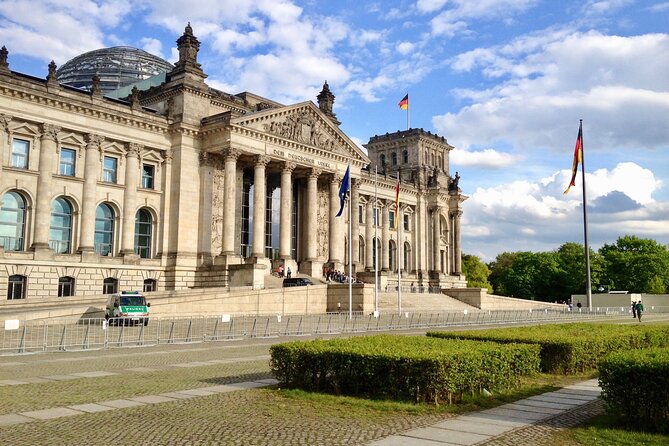
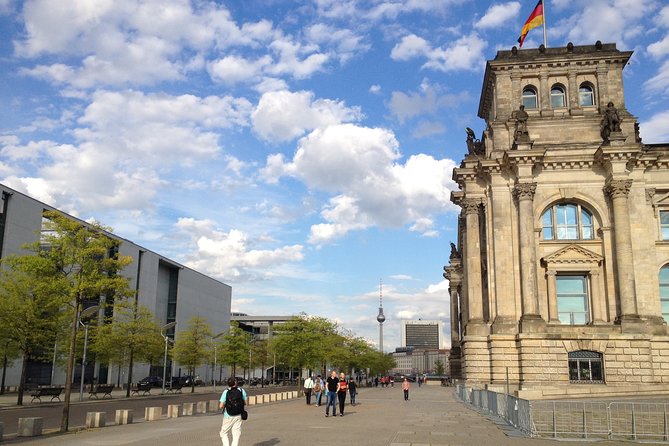
The tour usually begins in the government quarter, where Berlin’s recent story is written across a few city blocks. The Reichstag is the obvious landmark, but Gunter’s explanation goes beyond the familiar glass dome. He covers the building’s Wilhelminian design, the famous Soviet flag image, its awkward position only a few meters from the Wall, and its long period of neglect in West Berlin.
The building was gutted in the 1990s for the reunited German parliament. Christo’s temporary wrapping is part of its modern story, as is the glass dome that replaced architect Norman Foster’s more modest roof plan. If you want to visit the dome itself, confirm that separately. The driving tour gives you the setting and explanation, but it is not presented as a guaranteed interior admission.
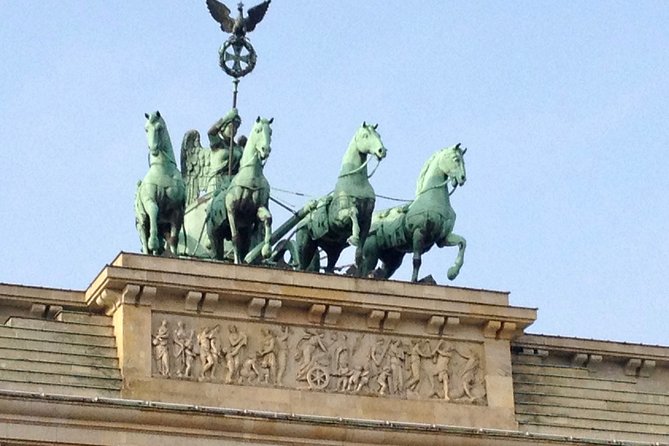
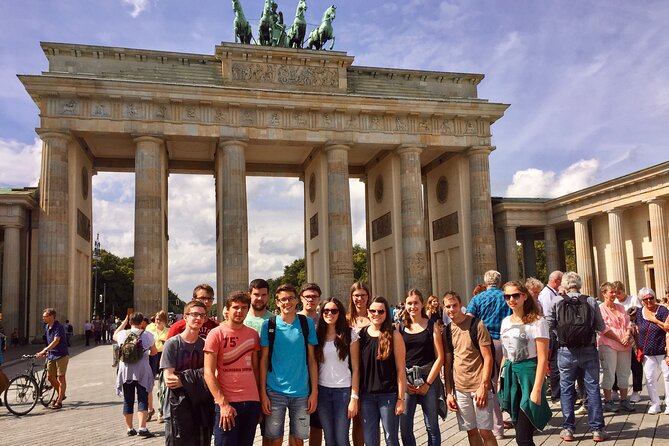
Nearby, the Brandenburg Gate occupies Pariser Platz, Berlin’s ceremonial front room. Its surroundings were destroyed in the war and later cut off by the Wall, leaving the gate isolated much like Paris’s Arc de Triomphe. After reunification, the square was rebuilt with modern structures following the old building shapes.
You can see the Liebermann House, the Academy of Arts, and the French and American embassies. The stop is listed at about five minutes, so expect a quick look and photographs rather than time to explore every building.
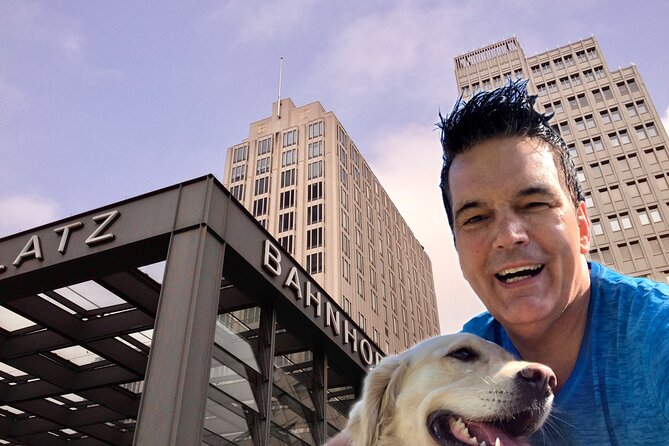
Potsdamer Platz provides a useful contrast. In the 1920s, as many as 100,000 vehicles passed through daily, and the area was known for restaurants, entertainment, and city life. War and the Wall erased that role. The rebuilt square now features the Sony Center, Mercedes-Benz buildings, the Bahn Tower, major hotels, and new entertainment venues.
The architecture is bold, but the place can feel planned rather than naturally lived in. That frank assessment is useful. You will see an important example of reunified Berlin’s ambition, but do not expect the same atmosphere as Kreuzberg or Hackesche Höfe.
Parliament, the Chancellery, and Berlin Hauptbahnhof
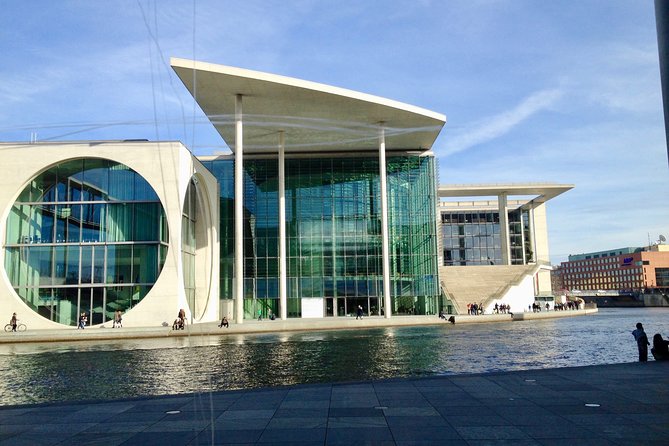
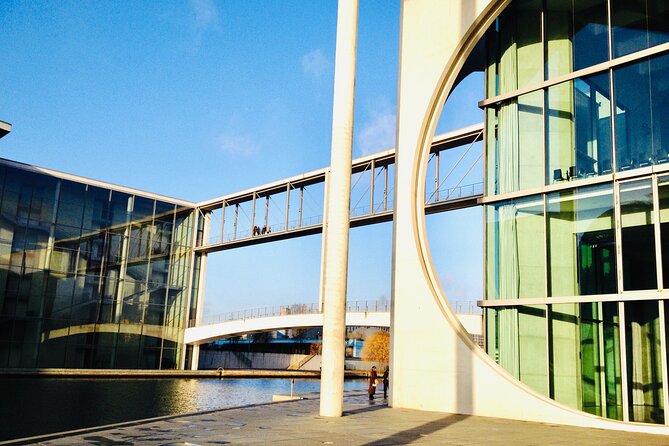
The taxi then passes the Paul-Löbe-Haus, the working engine of parliament. The Bundestag chamber is where major speeches and votes take place, but committees do much of the daily political work. The long, glass-fronted building has office spaces arranged along its riverfront form, making the idea of a visible parliament literal.
Across the Spree, the Federal Chancellery is hard to miss. Its huge scale includes ten floors, roughly 500 offices, and room for more than 300 employees. The official apartment in the upper rotunda is not used by the chancellor, and the tour adds the kind of practical detail that brings an otherwise formal building down to earth.
The Press and Information Office follows, identifiable by its giant central window. Accredited journalists gather there for government briefings, seated before a blue backdrop that reflects in the facade. These are quick views from the car, but they help you read Berlin as a capital that was rebuilt after division rather than simply restored.
At the former East-West border near the port, Gunter explains the first deaths after the Wall went up. Günter Litfin was shot while trying to swim through the harbor, a reminder that the Wall was not only a concrete structure but a system that turned ordinary water into a deadly boundary.
Berlin Hauptbahnhof gives you a change of scale. The station has underground and elevated tracks, five levels, large shopping halls, and a constant flow of connecting passengers. It replaced Berlin’s old pattern of terminal stations with a central rail hub. The decision also downgraded Bahnhof Zoo from a major West Berlin station to a regional stop, a change that caused plenty of resentment in Charlottenburg.
Friedrichstrasse, the Palace of Tears, and Unter den Linden
Friedrichstrasse runs straight through the city from the northern center toward Kreuzberg. The northern end is still being refurbished, while nearby development fills former open spaces with a new district. The tour uses the street to show how Berlin keeps layering new construction over old street plans.
Depending on traffic and the time spent earlier, you may stop at Friedrichstrasse station and the Palace of Tears. During the Wall years, it was the only station where some East to West rail journeys continued, including international trains such as the Paris to Moscow Express. East Berliners who left through here often had no return ticket.
The recreated border facilities next door show the barriers and customs checks that once divided the station. The name Palace of Tears comes from the farewells made there, often without knowing when, or if, families would meet again. This stop can be omitted if the schedule is tight, and extra time may be available at an additional cost.
Unter den Linden is Berlin’s grandest historic boulevard. It began as a royal riding path from the palace through the Brandenburg Gate toward the hunting grounds. Linden trees eventually won the planting argument over nut trees, saving the city from a very different street name.
The route passes the State Library, Humboldt University, State Opera, and former aristocratic palaces. I especially like this stretch for its ability to connect royal Berlin, Nazi-era destruction, East German rebuilding, and the present capital in one view. The median cafes are a pleasant place to return later, but the tour’s short stop does not allow for lingering.
A few more Berlin tours worth weighing up
- Berlin: Private Reichstag and Glass Dome Tour
★ 4.8 · 2,226 reviews - Berlin Private Complete History All Day Walking Tour
★ 5.0 · 474 reviews - Private Walking Tour Berlin Third Reich Hitler and World War II
★ 5.0 · 360 reviews - Private Berlin: Iconic Sights and Hidden Gems Walking Tour
★ 5.0 · 292 reviews
Gendarmenmarkt, Bebelplatz, and Jewish Berlin
Gendarmenmarkt is one of Berlin’s finest squares, framed by the German Cathedral, French Cathedral, and concert hall. Neither cathedral is a bishop’s seat. The towers were added to give the meetinghouses a grander appearance under Frederick II.
The German Cathedral now contains an exhibition on German parliamentary history. The French Cathedral remains connected to a French-speaking Reformed congregation and has a small Huguenot museum behind it. Both buildings were rebuilt during the East German period, another example of Berlin reconstructing selected pieces of its past.
Bebelplatz, once called Opernplatz, gathers the Royal Court Library, St. Hedwig Cathedral, State Opera, and Humboldt University. A glass panel in the pavement points to an empty underground library, recalling the Nazi book burning of May 10, 1933.
The square is also a good place to understand Humboldt University. It began in a palace built for Heinrich, the younger brother of Frederick II, and later became the Friedrich Wilhelm University. The tour explains these changes while you view the buildings from outside.
The New Guardhouse nearby once held the castle guard. Its current memorial, based on Käthe Kollwitz’s grieving mother sculpture, honors victims of war and tyranny. Wreaths are often placed here around Germany’s national day of mourning in November.
The New Synagogue is easy to identify by its Moorish details and gold dome. The main sanctuary was destroyed in the war, but the front section houses an exhibition on Jewish life in Berlin. Expect airport-style security before entry. The synagogue was built in 1866, when Prussia had granted Jews equal civil rights and the community wished to present its culture openly.
Hackesche Höfe and the Humboldt Forum
Hackesche Höfe offers a change from formal monuments. Built in 1908, the connected courtyards were designed to combine homes, workshops, small factories, printing businesses, and greenery. Much of the complex was run down during the East German period and used for storage before restoration began after reunification.
Today, shops and galleries occupy spaces once used by workshops. You may see Königliche Porzellan-Manufaktur displays and East Berlin’s Ampelmännchen designs. The stop is about ten minutes, enough to walk through the courtyards and take in the Art Nouveau decoration.
The Humboldt Forum occupies the site of Berlin Palace, the former residence of electors, kings, and emperors. After wartime damage, East German authorities demolished the palace despite criticism. The replacement was first a large open area and parking lot.
The modern building now carries reconstructed Baroque facades and the restored Schlüter courtyard. Inside are non-European collections and holdings connected with Humboldt University. The roof terrace offers a broad view across the center, and one booking included prearranged tickets for that viewpoint. Ask in advance if this is important to you, since the standard tour description lists the site but does not promise an interior visit.
The Red City Hall completes this central section. Its name refers to the red brick, not the political party of the mayor. The building served East Berlin’s magistrate during division, while West Berlin’s administration worked from Schöneberg Town Hall. Some rooms can be visited free of charge, including one with plaster casts of famous statues.
Nikolaiviertel is a deliberate reconstruction of old Berlin. The Nikolaikirche, the city’s oldest church, anchors a small district of narrow streets, restaurants, and period-style buildings. The GDR rebuilt the area in the 1980s, fitting around 2,000 apartments into a tight space where very little historic fabric survived.
The Knoblauchhaus is an exception. This original house, furnished in Biedermeier style, presents the life of a cloth-making family. It is a fine place to return on your own if you want a quieter look at domestic Berlin.
Tiergarten, the Victory Column, and West Berlin
The taxi crosses the Tiergarten, once a royal hunting ground enclosed to keep animals in and farmers out. Frederick II opened it to Berliners, and later Peter Lenné reshaped it into an English-style park with lakes, paths, and views. War nearly destroyed the trees, but Allied assistance helped restore the park.
The Victory Column originally stood in front of the Reichstag with three drums commemorating Prussian victories over Denmark, Austria, and France. Hitler moved it to its present position to clear space for his planned monumental capital and added another drum. The tale explains both its national symbolism and why the column remains politically loaded.
The Nordic embassies follow, grouped in modern wood-clad buildings behind a broad green copper band. Denmark, Finland, Iceland, Norway, and Sweden share facilities and a canteen. Iceland is the one most easily forgotten, so Gunter makes sure it gets its due.
Bellevue Palace, now the Berlin residence of the Federal President, was built for August Ferdinand, a younger brother of Frederick II. It was restored and later rebuilt after war damage, and Roman Herzog became the first Federal President after reunification to live there. The palace is not generally a stop for an interior visit on this tour.
Berlin Zoo is one of Germany’s oldest zoos and contains about 16,000 animals representing around 1,600 species. Its elephant and lion gates are especially visible from outside. Berlin’s second zoo is at Friedrichsfelde, and both institutions now belong together.
Ku’damm, KaDeWe, and Berlin’s western side
At Breitscheidplatz, the Kaiser Wilhelm Memorial Church presents one of Berlin’s most familiar wartime images. The damaged tower and west portal were preserved instead of being cleared away, while Egon Eiermann’s modern church buildings were added around them.
The new church interior uses thousands of blue glass blocks made in France. A double-wall design keeps it surprisingly quiet despite the traffic outside. The structure is fragile and often requires scaffolding, so do not be surprised if restoration work affects your view.
Kurfürstendamm, known locally as Ku’damm, runs almost five kilometers toward Halensee. It was modeled partly on the Champs-Élysées and once carried grand villas, cinemas, cafes, and nightlife. Today its central section is mostly a shopping street, with luxury labels, Apple, Tesla, and other flagship stores.
Tauentzienstrasse continues the shopping route toward KaDeWe, the 60,000-square-meter department store. Its food floor is the practical highlight, with champagne, oysters, chocolates, bread, and cheese. If you have time after the tour, this is a good place to return for a snack or a look around.
The route may also pass Nollendorfplatz, where the elevated and underground rail lines meet. The station reflects Berlin’s early subway history and the old border between Berlin and the once-independent city of Charlottenburg. Nearby Motzstrasse and Fuggerstrasse form one of Europe’s largest gay districts, with a long connection to Berlin’s open club culture.
The Kulturforum provides another architectural contrast to Museum Island. It includes the Philharmonie, New State Library, New National Gallery, Picture Gallery, and museums of decorative arts and musical instruments. The Picture Gallery holds old masters from Titian, Caravaggio, and Rembrandt.
Mies van der Rohe’s New National Gallery is the architectural prize. Its glass hall has a self-supporting metal roof with the columns outside, leaving the upper room open and flexible. The main changing exhibitions are above, while much of the collection is shown below because the open hall has almost no permanent interior walls.
The Wall, Nazi Berlin, and the route back east
At the Berlin House of Representatives, you see buildings from several eras close together: Wilhelminian structures, Nazi remnants, the Wall, and the Topography of Terror. The parliament once served as the Prussian Landtag, later became connected to Nazi administration, and was used as a socialist planning office during the GDR period.
The nearby Gropius Bau was designed by Martin Gropius, a great-uncle of Bauhaus founder Walter Gropius. Damaged and abandoned beside the Wall, it was restored as a major exhibition hall. Its entrance and sculptures still hint at the building’s years of decay.
Topography of Terror occupies the former site of Nazi security offices. Excavated cellars mark where the Gestapo, SS, and police interrogated and abused political opponents and other persecuted groups. The open-air display and information hall make this one of the most important short stops on the route.
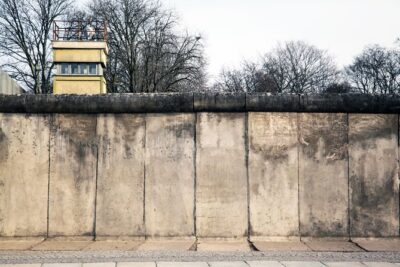
A surviving Wall section on Niederkirchnerstrasse provides a close look at the concrete barrier. Here the death strip was absent because East German authorities felt protected by nearby state buildings. A remarkable escape attempt once used a cable car from the former Luftwaffe building, with the Stasi reportedly mistaking the event for a Soviet exercise.
Checkpoint Charlie is now mostly a symbolic place. The original Allied checkpoint equipment is elsewhere, and the sentry booth here is a replica. Still, the site matters because American and Soviet tanks faced each other in October 1961, bringing the divided city close to a wider war.
The route may continue to Alexanderplatz, the socialist rebuilding project of East Berlin. The television tower remains Germany’s tallest structure, surrounded by broad spaces and GDR-era buildings designed to convey modernity and political power.
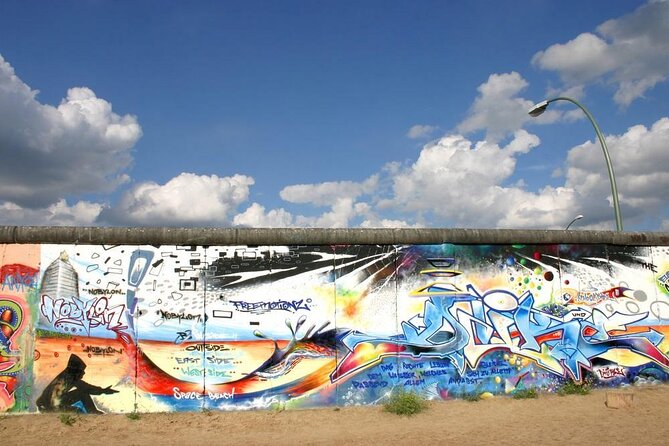
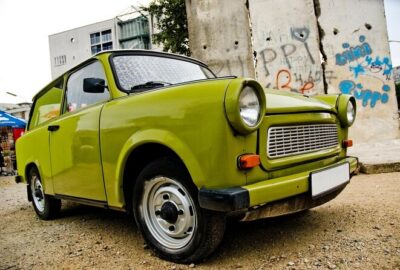
East Side Gallery is the longest surviving Wall section, about 1,600 meters. Its painted panels include the Trabant breaking through the Wall and the famous Brezhnev-Honecker kiss. The work has been restored several times, and weather continues to wear it down.
Oberbaum Bridge links Friedrichshain and Kreuzberg across the Spree. Its medieval-style towers recall the old customs boundary, while the subway runs behind the battlements above road traffic and shipping. The nearby party district around Warschauer Strasse and the RAW site shows today’s Berlin at its most energetic.
The final possible stretch through Kreuzberg and along former Stalin Allee adds social history. Kreuzberg escaped a proposed 1960s motorway route, preserving older buildings, small restaurants, and alternative culture, though rents have risen sharply. The former Stalin Allee, now Karl-Marx-Allee, is lined with grand worker housing built after the war. Its history includes the June 17, 1953 uprising, crushed by GDR authorities with Soviet tanks.
Price, timing, and who gets the best value
At $179.82 per person, the price is easiest to justify for a small private group that wants a broad first look at Berlin. It includes the taxi ride, city guiding, parking, air conditioning, private transport, WiFi, and pickup within the S-Bahn ring. For two people, it is a significant spend. For four people sharing the experience, it can compare more favorably with several separate taxis and a private guide.
The tour is listed at four to six hours, but traffic and longer stops affect how much you see. The route contains roughly 60 possible points of interest, so you cannot examine every site closely in one outing. Tell Gunter before departure which places matter most, and remind him during the tour if a specific request is being missed.
I would book this early if your dates are fixed, since it averages about 40 days of advance booking. Free cancellation is available until 24 hours before the start time. Pickup from BER airport or beyond the S-Bahn ring costs extra, based on the Berlin taxi tariff.
The tour is offered in English. Gunter’s English is generally described as very good, though a few bookings found his accent occasionally hard to follow. He repeats explanations when asked, and his fast, information-packed style means you should be ready to listen. He has also taken photos at stops and sent them afterward in some cases, but treat that as a personal extra rather than a guaranteed feature.
Should you book this Berlin taxi tour?
Book it if you have only a day, prefer history and architecture to shopping alone, or need to limit walking. It is particularly useful at the start of a Berlin visit because it shows you where to return for museums, memorials, meals, and longer walks.
Skip it if your main goal is to spend hours inside the Reichstag, museums, the Palace of Tears, or the Jewish Museum. This tour gives you context and access to many sites from the outside, but it cannot replace focused visits.
For most first-time visitors, I would book it early in the stay, send Gunter a short priority list, and request the largest suitable vehicle if your party has four people. That approach gives you the wide city view this experience handles best, while leaving later days for the places you want to explore on foot.
FAQ
Is pickup included with the private Berlin taxi tour?
Pickup from a hotel, apartment, or other requested location within Berlin’s S-Bahn ring is included. The central pickup area is about five kilometers around the Brandenburg Gate.
Can I be picked up at BER Airport?
Airport pickup is not included in the standard price. Pickup from BER, or from outside the S-Bahn ring, is available for an additional charge based on the Berlin taxi tariff.
How long does the tour last?
The tour lasts approximately four to six hours. Traffic, weather, and the amount of time spent at stops can affect the route and timing.
Is this a private tour?
Yes. Only your own group participates, and the tour uses private transportation.
Is the tour suitable for children?
Child seats are available for toddlers from six months to three years, along with booster seats for older children. A Maxi-Cosi baby seat can be brought on request.
Can I cancel for a full refund?
You can cancel at least 24 hours before the local start time for a full refund. Cancellations or changes made less than 24 hours before the start time are not accepted for a refund.
Just added around Berlin
- Berlin Highlights in One Day★ 5.0 · 3 reviews
- Private Berlin One Day Tour with a Local: See the City Unscripted★ 3.5 · 3 reviews
- Individual city tour Berlin for max. 8 persons★ 5.0 · 3 reviews
- Transfer from Berlin Schönefeld Airport (SXF) to Berlin city Hotels – ROUND TRIP★ 4.0 · 3 reviews
- Berlin: Museum Island Tour★ 5.0 · 3 reviews
- Private Analogue Photography Experience in Berlin★ 5.0 · 3 reviews
- Berlin: Local Food Tour in Secrets Hidden Gems★ 4.0 · 3 reviews
- Berlin & The Third Reich Private Guided Tour★ 5.0 · 3 reviews
DDR & East Berlin Tours, compared.


East Berlin and the Berlin Wall 2-Hour Walking Tour
Read our review →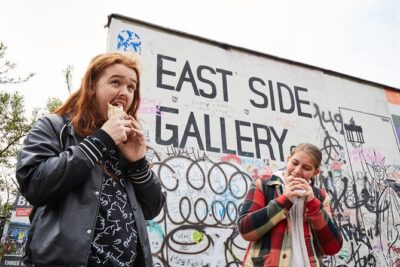
East Berlin Food & History Tour with Eating Europe
Read our review →Browse the lists this tour appears in