
Review · THIRD REICH & WWII SITES
Berlin: Private Bike Tour of the Berlin Wall and Third Reich
Berlin’s past is easier to grasp from a bike seat. In three hours, you can move from the rebuilt streets of Nikolaiviertel to former Wall sites, Nazi military remains, the Reichstag, and the parking lot that now covers Hitler’s bunker. The distance covered is the point: on foot, this same route would take far longer.
I especially like the private format, which lets your guide adjust the pace and explain the subjects your group cares about most. I also like the access to less obvious Wall sites, including Günter Litfin’s preserved watchtower and Invalidenfriedhof. The main trade-off is time. Ten minutes at many stops gives you a strong overview, but not much room for long museum visits or quiet reflection.
In This Review
- Key points to know before you book
- Why a bike is the right way to cover Berlin’s divided past
- Nikolaiviertel and the city Berlin rebuilt
- Wall memory at Mauerpark and Bernauer Strasse
- Nazi engineering at Humboldthain Flak Tower
- Günter Litfin and a Wall that killed
- Invalidenfriedhof and the divided cemetery
- Spreebogenpark, Hitler’s Great Hall, and the Reichstag
- Memorials to victims and the Holocaust Memorial
- The Führerbunker and why there is only a parking lot
- Checkpoint Charlie and the Cold War flashpoint
- Price, group size, and what you receive
- Who should book this private ride?
- Should you book it?
- FAQ
- How long is the bike tour?
- Where does the tour start?
- Where does the tour end?
- Is the tour private?
- How many people are required to operate the tour?
- Is bicycle use included?
- Is the tour available in English?
- Is Checkpoint Charlie included on every version?
- Can children join the tour?
Key points to know before you book
- The route covers both the Berlin Wall and the Third Reich: You get Cold War border history alongside Nazi-era architecture, persecution, war, and Germany’s democratic rebirth.
- A private guide shapes the ride: The Free-Berlin concept means each guide creates a distinct route, with room to tailor the experience to your group.
- The bike saves serious time: You can reach far more sites in three hours than you could on foot.
- Some of the best stops are easy to miss: The Günter Litfin Memorial, Invalidenfriedhof, and Humboldthain Flak Tower add depth beyond the usual central sights.
- Checkpoint Charlie is included in the English tour: This stop is not part of the German version according to the tour details.
- You need at least four people: The tour is private, and children can join when accompanied by an adult. Infant seats are available on request.
Why a bike is the right way to cover Berlin’s divided past
Berlin’s historic sites are spread across a wide area. The Wall did not run around one tidy monument. It cut through neighborhoods, cemeteries, parks, rail lines, and government districts. A bicycle lets you connect those fragments.
The tour lasts about three hours and begins and ends at Free Berlin Bike Tours & Rental, Poststraße 11, in central Berlin. You receive a bicycle and helmet, and the guide leads the way. The route is offered in English and German, with Dutch, French, and Spanish possible on request.
The private setup matters here. A large group often has to follow a fixed script, but this tour can put more weight on the Wall, the Third Reich, architecture, or Berlin’s democratic story, depending on your interests. The route is not identical every time because each guide designs it personally.
That flexibility also means you should not expect a museum-style tour with long indoor visits. The stops are mostly outside, usually for about five to ten minutes, with one longer fifteen-minute stop at Spreebogenpark. Dress for the weather. The tour operates in all conditions, and Berlin’s wind can make a bike ride feel much colder than a walking tour.
More of the Berlin Wall, end to end:
- Skip-the-Line: Berlin Wall Museum at Checkpoint Charlie
★ 4.1 · 2,041 reviews - Berlin: East Side Gallery Spree Cruise in a Solar Catamaran
★ 4.0 · 1,039 reviews - Cold War, Berlin Wall, Spies and the East Side Gallery
★ 5.0 · 1,024 reviews
Nikolaiviertel and the city Berlin rebuilt
The ride starts in Nikolaiviertel, described as Berlin’s only real old town. This is a useful opening because the neighborhood raises an immediate question: how much of old Berlin is truly old after wartime bombing and later rebuilding?
Your guide uses the first ten minutes to set the scene. Do not expect a preserved medieval quarter on the scale of some German cities. The value lies in the conversation about what survived, what was reconstructed, and how Berlin presents its past.
From there, the route reaches the Neue Synagoge and its Centrum Judaicum. The stop is brief, about five minutes, but the story is powerful. You hear about the night of broken glass and the police officer whose civil courage helped save the building.
This is one of the tour’s better early moments because it gives a human face to a frightening period. It also reminds you that the tour is not only about buildings and borders. Choices made by individuals matter too.
Wall memory at Mauerpark and Bernauer Strasse
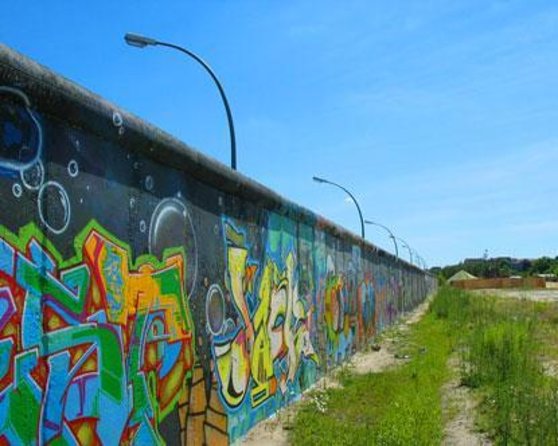
The Berlin Wall Memorial is the clearest place on the route for understanding what the Wall did to everyday life. The tour describes three places where the Wall is still alive, and this is identified as the only one where you can really experience its former force.
At the Wall Memorial, you get about ten minutes. That is enough for a sharp explanation of the border system and the way it divided Berlin, but not enough for a full visit to every part of the memorial grounds. If this subject is your main reason for booking, consider returning later on your own.
Mauerpark follows. Today it is best known for its Sunday flea market, but its earlier role was far more severe. The site helps explain the repeated efforts by East Germany’s rulers to create what they saw as the perfect border.
I like this pairing. The Wall Memorial gives you the formal historical account, while Mauerpark connects that past to a place Berliners now use for leisure. You see how a controlled border zone can become ordinary public space, even though the old meaning has not vanished.
Nazi engineering at Humboldthain Flak Tower
At Humboldthain, the subject shifts from Cold War division to Nazi military construction. The Flak Tower was both a huge fortress and an air-raid shelter. It also provides a broad view over Berlin.
The ten-minute stop is short, yet the site carries a lot of weight. You can look at the physical remains while hearing about Nazi architecture and the practical role of these massive structures during the war. The view helps you read Berlin from above, but the real point is the contrast between the city today and the military purpose of the tower.
This is not a polished monument. That is part of its value. The remains make the past feel physical without turning the site into a spectacle.
More Third Reich sites in Berlin:
- Berlin: Third Reich and Cold War 2 Hour Walking Tour
★ 4.9 · 6,830 reviews - Berlin: Berlin Story Bunker Entry Ticket
★ 4.6 · 6,759 reviews - Berlin’s Best: 2 Hour Walking Tour Third Reich and the Cold War
★ 5.0 · 5,486 reviews - Third Reich Berlin: Hitler and WWII Walking Tour
★ 5.0 · 3,301 reviews
Günter Litfin and a Wall that killed
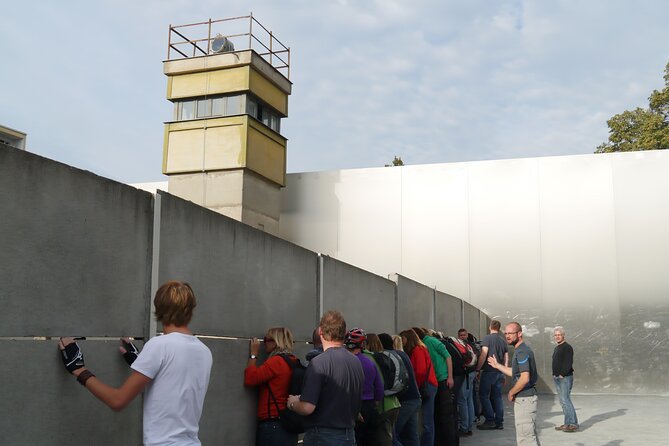
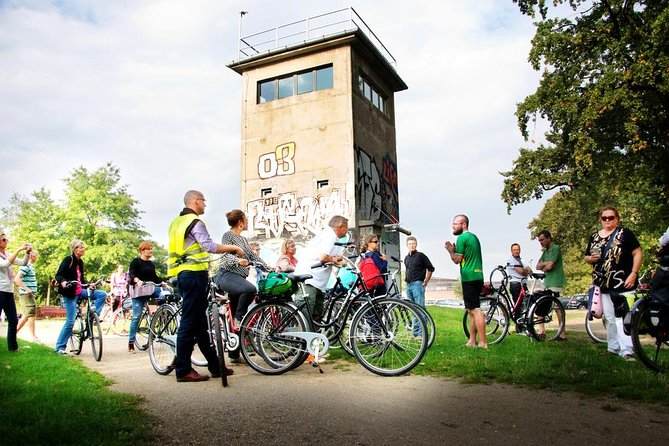
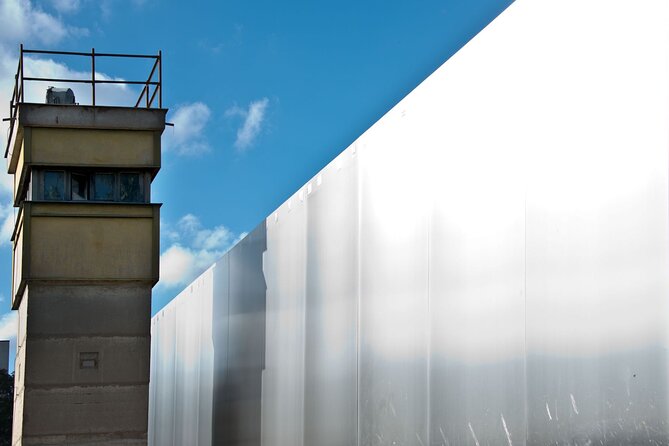
The Günter Litfin Memorial preserves an original watchtower. It remembers Günter Litfin, identified here as the first person shot at the Wall.
You stop for roughly ten minutes. This is one of the route’s most specific Wall sites, and it gives you a direct connection between the barrier and the people who died trying to cross it. The surviving tower also helps you picture how guards watched the border.
The stop is especially useful if you have already seen the larger East Side Gallery or Checkpoint Charlie. Those better-known places can make the Wall feel like a symbol. This memorial brings the cost back to one person and one preserved structure.
Invalidenfriedhof and the divided cemetery
Invalidenfriedhof was created for figures from German military history. The Wall later cut through the cemetery, dividing the burial ground itself.
The guide uses about ten minutes to discuss who was honored there and who, despite military importance, should be remembered with caution rather than praise. That distinction is important. A cemetery can preserve history without asking you to admire everyone buried there.
The site also shows how arbitrary the Wall could feel. It did not merely split streets and families. It passed through a place of burial, altering access and the meaning of the ground.
Spreebogenpark, Hitler’s Great Hall, and the Reichstag
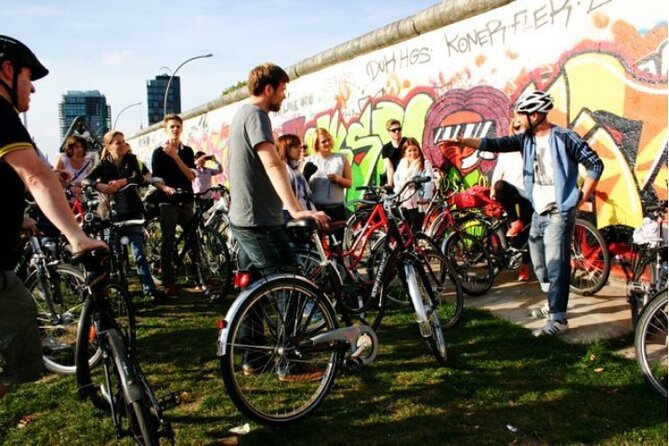
Spreebogenpark provides one of the longer pauses, about fifteen minutes. From here, you can see the German government district and hear about Albert Speer’s plans for Hitler’s capital.
The proposed Great Hall would have held 180,000 people. The number is so large that it can sound abstract, but the open view gives the idea some scale. Your guide links the planned architecture to Hitler’s political ambitions and the desire to reshape Berlin into a monumental capital.
The Reichstag comes next, with about five minutes outside. The discussion covers Hitler’s grab for power and Germany’s democratic history. You do not go inside, so this is a stop for context and exterior viewing rather than a Reichstag visit.
That limitation is worth noting. If you want the dome or interior exhibits, you need a separate visit. Still, the outside stop makes sense in a tour that connects dictatorship, war, division, and the modern German government.
Memorials to victims and the Holocaust Memorial
The route includes several memorial sites connected with the Holocaust and deportation. One memorial for victims of deportation and the Holocaust was designed during the GDR period, creating a sharp contrast with the more familiar memorial near Brandenburg Gate.
The tour also passes memorials for major victim groups of the Holocaust before reaching the Memorial to the Murdered Jews of Europe. The Holocaust Memorial receives about ten minutes.
The memorial is vast and serious, and the guide explains its scale and historical importance. You can walk among the concrete blocks, but the short stop means you should not expect a long, solitary visit. The site deserves extra time if you want to enter the information center or reflect without a schedule.
I value the way this route places several memorials in conversation with one another. You see that Berlin’s remembrance culture is not one single monument. Different sites carry different purposes, dates, and political settings.
The Führerbunker and why there is only a parking lot
At the Führerbunker site, the visible feature is a parking lot. That may seem anticlimactic, but the absence is the point.
The guide explains where Hitler spent the final weeks of the war and where he eventually committed suicide. You also learn why the bunker is not presented as a dramatic preserved attraction.
This is a good example of how the tour handles difficult history. Instead of turning the site into a shrine, it explains what happened and why the location looks ordinary today. The ten-minute stop is enough to orient you, though anyone wanting a long discussion of the final days of the Nazi regime may want additional reading or a separate history tour.
Checkpoint Charlie and the Cold War flashpoint
Checkpoint Charlie is included only on the English version of the tour. It was the best-known Cold War border station and the shared crossing associated with the United States and Soviet Union.
The stop lasts about ten minutes. Your guide explains how a confrontation here came close to triggering a third world war in the middle of Berlin.
Checkpoint Charlie is famous, but it can also feel highly commercial and crowded around the replica guardhouse. The strength of visiting it with a guide is the political context. You are less likely to treat it as a quick photo stop and more likely to understand why this crossing mattered.
If you book in German, confirm the route you will receive, since the supplied tour information specifically limits Checkpoint Charlie to the English version.
Price, group size, and what you receive
The listed price is $107.42 per person. That is not a bargain for a three-hour bike ride, but it includes a private guide, bicycle, helmet, and a route covering a wide spread of central Berlin history.
The value improves if your group has four or more people and wants a private experience. At the minimum group size, the listed per-person price would come to about $429.68 before any group discount, though the final cost can vary. Group discounts are offered, so larger parties should check the actual booking total.
You are paying for time and interpretation as much as for the bicycle. The bike gets you across Berlin quickly, while the guide connects sites that otherwise might seem unrelated. A cheaper self-guided day is possible, but you would need to plan the route, research each stop, and manage the distances yourself.
The tour is booked, on average, 43 days ahead. That suggests you should not wait until the last minute if your dates are fixed, especially since departures are offered at several times during the day.
Who should book this private ride?
I would choose this tour if you want a broad historical framework in a short period, especially if you are visiting Berlin for the first time. It suits history-focused families, couples, and small groups who prefer questions and personal pacing over a fixed group script.
Children are welcome, and infant seats can be provided on request. Children must be accompanied by an adult. Most people can take part, but you should be comfortable cycling for three hours in outdoor conditions.
I would not choose it as your only activity if you want lengthy museum visits, extensive time at memorials, or a relaxed photography tour. The itinerary moves at a steady clip. The private format gives you flexibility, but the three-hour limit still sets the basic rhythm.
Free cancellation is available up to 24 hours before the start time for a full refund. Changes or cancellations made inside that period are not accepted or refunded.
Should you book it?
Book this tour if you want to connect Berlin’s major historic chapters in one efficient ride. The strongest parts are the less obvious Wall sites, the Flak Tower, the divided cemetery, and the clear explanation of how Nazi plans and Cold War borders shaped the city.
Skip it if your priority is going inside the Reichstag, spending a long time at the Holocaust Memorial, or exploring museums in detail. For most people with three hours to spare and a group of at least four, the private bike format offers a practical way to see far more than you could on foot, with enough personal guidance to make the sites meaningful.
FAQ
How long is the bike tour?
The tour lasts approximately three hours.
Where does the tour start?
It starts at Free Berlin Bike Tours & Rental, Poststraße 11, 10178 Berlin, Germany.
Where does the tour end?
The activity ends back at the meeting point.
Is the tour private?
Yes. Only your own group participates in the tour.
How many people are required to operate the tour?
The tour operates for a minimum of four people.
Is bicycle use included?
Yes. Bicycle and helmet use are included in the price.
Is the tour available in English?
Yes. English departures are offered. German is also available, and Dutch, French, and Spanish may be possible on request.
Is Checkpoint Charlie included on every version?
No. Checkpoint Charlie is included only in the English version of the tour.
Can children join the tour?
Yes. Children are welcome, but they must be accompanied by an adult. Infant seats can be provided on request.
More Bike Days Around Berlin
- Berlin: Sights and Highlights Bike Tour with a Local Guide
★ 4.8 · 2,698 reviews - Berlin Highlights 3-Hour Bike Tour
★ 5.0 · 948 reviews - Berlin City Bike Tour with Beer Garden Stop
★ 5.0 · 917 reviews - Berlin Highlights: 3-Hour Bike Tour
★ 4.9 · 809 reviews
Just added around Berlin
- Berlin Highlights in One Day★ 5.0 · 3 reviews
- Private Berlin One Day Tour with a Local: See the City Unscripted★ 3.5 · 3 reviews
- Individual city tour Berlin for max. 8 persons★ 5.0 · 3 reviews
- Transfer from Berlin Schönefeld Airport (SXF) to Berlin city Hotels – ROUND TRIP★ 4.0 · 3 reviews
- Berlin: Museum Island Tour★ 5.0 · 3 reviews
- Private Analogue Photography Experience in Berlin★ 5.0 · 3 reviews
- Berlin: Local Food Tour in Secrets Hidden Gems★ 4.0 · 3 reviews
- Berlin & The Third Reich Private Guided Tour★ 5.0 · 3 reviews
Third Reich & WWII Sites, compared.



Berlin’s Best: 2 Hour Walking Tour Third Reich and the Cold War
Read our review →
Third Reich Berlin: Hitler and WWII Walking Tour
Read our review →

Berlin Third Reich Sites: Half-Day Walking Tour
Read our review →
Guided Bike Tour of the Berlin Wall and Third Reich
Read our review →
Hitler’s Germany: Berlin During the Third Reich & WWII
Read our review →Browse the lists this tour appears in