
Review · JEWISH BERLIN & HOLOCAUST MEMORIALS
Jewish Berlin: Walking tour The Old Jewish Quarter (private 3 Hours tour)
Berlin’s Jewish past is not contained inside one preserved quarter. It appears in scattered sites, courtyards, memorials, former synagogues, and empty spaces. This private walk connects those pieces, moving from medieval Jewish settlement to the 20th century and the Holocaust.
I like the hotel pickup and the private format, which save you from finding the first stop and let your guide adjust the pace. I also like the human scale: the Rosenstrasse protest, Otto Weidt’s rescue work, and the story of Moses Mendelssohn give the tour faces and choices, not just dates.
The main consideration is that three hours covers a lot of ground, while some stops are brief. You will get the most from it if you want thoughtful explanation at selected sites, not a long museum visit or a complete survey of every Jewish location in Berlin.
In This Review
- Key points to know before you book
- Why Berlin’s Jewish Quarter is not one tidy quarter
- Starting at the old synagogue site
- Rosenstrasse and the power of a public protest
- Hackesche Höfe and Jewish life in modern Berlin
- Otto Weidt’s workshop and a story of rescue
- The old Jewish cemetery and a quieter kind of memory
- The Missing House and the meaning of an empty space
- The New Synagogue and Berlin’s visible Jewish landmark
- What the private format is worth at $356.62
- Who will enjoy this walk most
- Booking advice and cancellation terms
- FAQ
- How long does the Jewish Berlin walking tour last?
- How many people can join the private tour?
- Is hotel pickup included?
- Is transportation between the attractions included?
- What language is the tour offered in?
- Do I need to pay admission fees at the stops?
- Is the tour suitable for children?
- How much physical fitness do I need?
- Can I cancel for a full refund?
- Should you book Jewish Berlin: The Old Jewish Quarter?
Key points to know before you book
- The old quarter is a story told through scattered places: Berlin has no single, intact Jewish district to walk through.
- The private group can include up to eight people: At the full group size, the price works out to about $44.58 per person.
- Hotel pickup is included: You meet your guide in your hotel lobby, but transportation to and from the attractions is not included.
- Several stops focus on individual courage: Rosenstrasse and Otto Weidt’s workshop bring wartime events down to a personal level.
- Guides may bring personal perspective: Past guides have included Orr, Adi, Zvi, Sharona, and Nadav, including an Israeli-German guide with a notebook of historical material.
- Plan for a moderate walk: The tour lasts about three hours, with time outdoors and an optional cemetery entrance.
Why Berlin’s Jewish Quarter is not one tidy quarter
The title can create the wrong picture. You will not enter a walled neighborhood with a gate, a row of preserved Jewish homes, and a neat beginning and end. Berlin’s Jewish story is spread across Berlin-Mitte, and much of the old built environment has changed or disappeared.
That scattered quality is part of the lesson. The walk helps you read modern Berlin through traces of an older community. A former synagogue site may be marked only by a memorial. A courtyard may look like an ordinary residential complex until your guide explains who lived there. An empty space may carry more weight than a grand building.
The chronological approach is useful. The tour begins with early Jewish settlement, moves through immigration and urban life around the turn of the 20th century, then reaches Nazi persecution, acts of resistance, rescue, and memory. Nadav, one of the guides associated with this experience, has been praised for using a notebook of historical material alongside the physical sites. That can make a short walk feel more grounded.
Because the tour is private, you can ask about the parts that matter most to you. If your family has a Berlin connection, if you are studying Jewish history, or if you simply want to understand the city beyond its major monuments, that flexibility has real value.
More Jewish Berlin and memorial walks:
- Berlin: Jewish Museum Berlin Entrance Ticket
★ 4.5 · 8,393 reviews - Nazi Berlin and the Jewish Community Tour
★ 4.8 · 55 reviews - Path of Resistance: Berlin’s Hidden Holocaust Stories
★ 5.0 · 33 reviews
Starting at the old synagogue site
The first stop is the Denkmal alte Synagoge Berlin-Mitte, a memorial marking the site of Berlin’s oldest synagogue. You spend about 15 minutes here discussing the early beginnings of Jewish settlement in Berlin.
This is a quiet opening, and that is appropriate. The site does not offer a grand interior or a large collection of objects. Instead, it gives your guide a place to set the timeline. You begin before the 20th century, before the war, and before Berlin became associated with the catastrophe that dominates many visitors’ understanding of Jewish Germany.
I would pay attention to how your guide frames the city’s early Jewish community. The value here is context. Without it, later stops can feel like disconnected Holocaust memorials. With it, you see a community that had already developed religious, cultural, commercial, and family life over many generations.
The short stop also signals the pace. This is a walking conversation with selected pauses. It is not a formal synagogue tour, and the itinerary does not promise interior access at every site.
Rosenstrasse and the power of a public protest
At Denkmal Rosenstrasse, your guide explains the women’s protest that called for the release of Jewish husbands held by the Nazi regime. The stop lasts about 15 minutes.
This is one of the most affecting parts of the route because it centers on people who took a public risk. The story is not presented only through official policy or military events. It asks you to consider what ordinary families did when the machinery of persecution reached their homes.
The memorial is especially useful in a private tour because you can pause over the difficult questions. What did protest look like under dictatorship? What risks did the women face? How should you understand an act of resistance that involved personal relationships and family ties?
The information provided for this experience identifies the protesters as gentile women protesting for their Jewish husbands. Your guide can help place that event within the wider wartime story. I would not rush this stop. Fifteen minutes may sound short, but a focused explanation here can stay with you for the rest of the walk.
Hackesche Höfe and Jewish life in modern Berlin
The Hackesche Höfe courtyards show a different side of the story. Around the turn of the 20th century, eastern European Jews who moved to Berlin lived in this area. You spend roughly 15 minutes exploring the courtyards and discussing that migration.
This stop helps correct a common mistake. Jewish Berlin was not only a story of persecution. It was also shaped by migration, work, housing, family life, and the movement of people from eastern Europe into a growing city. Hackesche Höfe lets you connect those broad changes to a real urban setting.
The courtyards themselves are a practical reminder that history often hides in plain sight. You may see attractive buildings and busy city life, while your guide draws attention to earlier residents and social conditions. The setting gives you a sense of place that a lecture room cannot provide.
The limitation is that the stop is fairly short. If you want extensive architectural detail or a long discussion of daily life, you may need to ask for more time. The private format makes that request possible, though the three-hour schedule still has limits.
More walking tours in Berlin:
- Discover Berlin Half-Day Walking Tour
★ 5.0 · 9,624 reviews - Berlin: Third Reich and Cold War 2 Hour Walking Tour
★ 4.9 · 6,830 reviews - Berlin: Discover Berlin Walking Tour
★ 4.9 · 5,998 reviews - Berlin’s Best: 2 Hour Walking Tour Third Reich and the Cold War
★ 5.0 · 5,486 reviews
Otto Weidt’s workshop and a story of rescue
The Museum Blindenwerkstatt Otto Weidt is one of the strongest stops on the route. You spend about 20 minutes at the museum hearing about Otto Weidt, a German man who risked his life to protect his Jewish employees.
This story shifts the focus from the victims of persecution to the difficult choices made by a non-Jewish employer. The museum gives the tour a personal center. Instead of hearing only about laws, deportations, and mass violence, you consider one workplace and the person who tried to shield the people who depended on him.
The stop is also a good match for the tour’s wider approach. Jewish Berlin is presented through relationships: wives and husbands at Rosenstrasse, employers and employees at Otto Weidt’s workshop, families and communities at the older sites.
You should expect a visit rather than a long museum session. Twenty minutes is enough for an introduction and guided explanation, but not enough to study every display at length. If this is the subject that interests you most, tell the guide early. A private tour can put more attention where you want it, within the limits of the schedule.
The old Jewish cemetery and a quieter kind of memory

The Memorial Jewish Cemetery brings the tour back to an earlier period. This old cemetery includes the burial place of Moses Mendelssohn, among others, and the stop lasts about 15 minutes.
Cemeteries require a different pace. You are not simply checking off another landmark. The setting can help you think about continuity, community leadership, and the Jewish presence in Berlin before the 20th-century destruction.
Entrance is optional. Men should bring or wear a head covering if they choose to enter the cemetery. That small practical point matters, especially if you are booking the walk on a tight schedule and do not want to be caught unprepared.
The cemetery stop may not suit you if you prefer a fast-moving sightseeing tour. It is quieter and more reflective than Hackesche Höfe or Rosenstrasse. For many people, that change of pace is precisely why it belongs on the route.
The Missing House and the meaning of an empty space
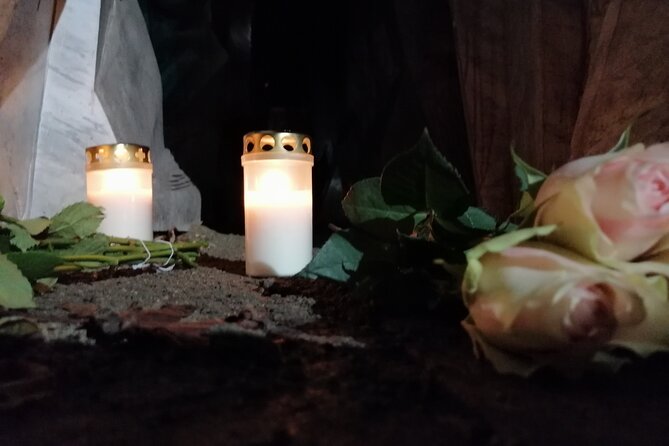
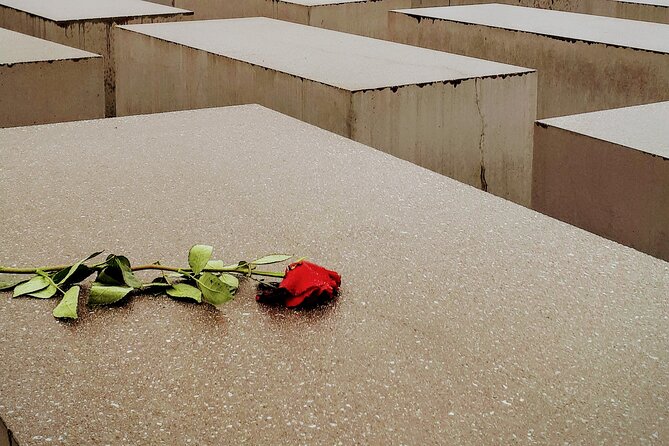
The Missing House memorial by artist Christian Boltanski is the shortest stop, at about five minutes. It marks a building and the absence left by the people who once lived there.
Do not expect a long presentation here. The power of the stop lies in its brevity. After hearing about settlement, migration, family life, and persecution, you encounter a memorial built around disappearance.
A good guide can connect the missing building to the tour’s larger idea: Jewish life in Berlin cannot be understood only through surviving landmarks. The gaps matter too. A five-minute pause is enough to introduce the artwork and explain why this particular absence has been marked.
The New Synagogue and Berlin’s visible Jewish landmark
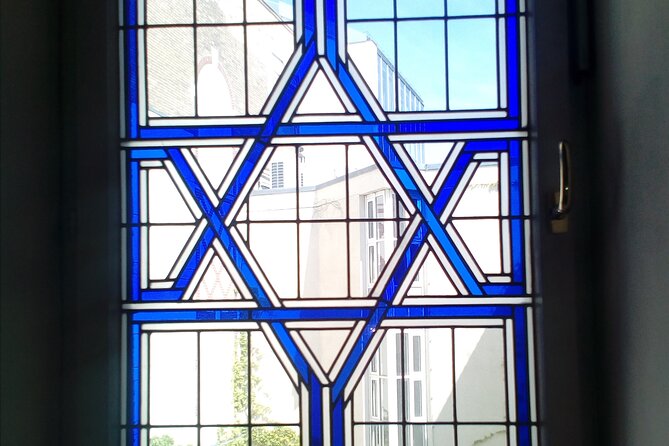
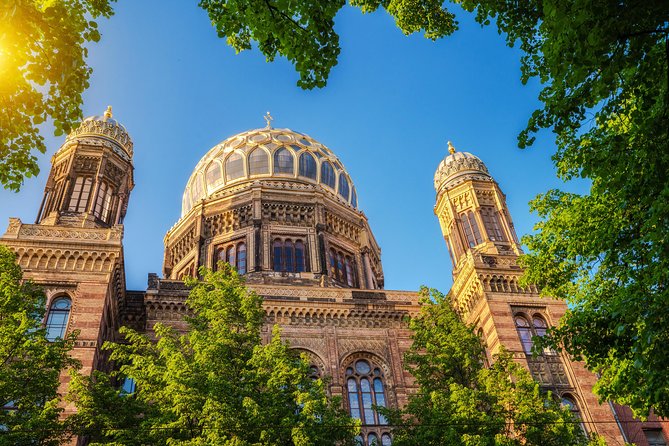
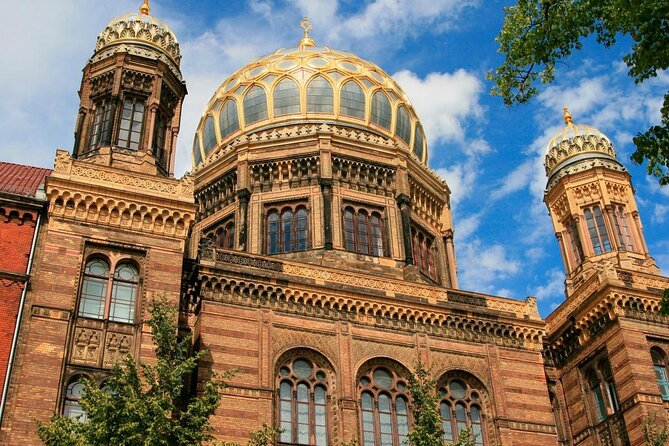
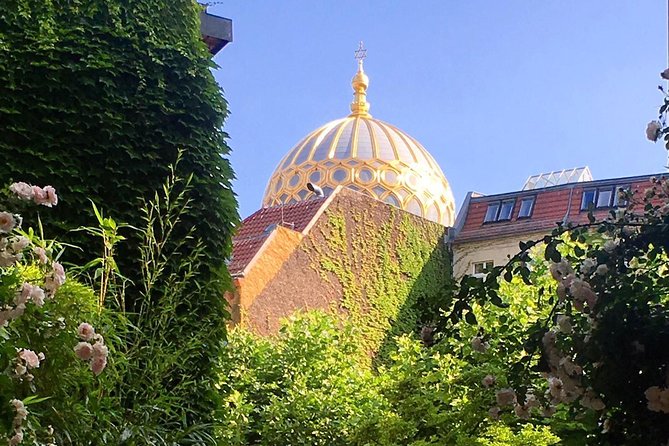
The final listed stop is the Stiftung Neue Synagoge Berlin, also known as the Centrum Judaicum. You see the synagogue and hear about its history, with approximately 15 minutes set aside.
This gives the walk a strong visual finish. After several modest memorials and less obvious traces, the synagogue offers a recognizable symbol of Jewish Berlin. The tour does not promise a full interior visit, so think of this as an exterior and historical stop unless your guide arranges something different.
The New Synagogue also lets your guide bring the chronology together. You have moved from early settlement to urban migration, wartime protest, rescue, cemetery memory, and artistic commemoration. The synagogue helps you consider Jewish life as an ongoing presence in Berlin, not only a subject from the past.
What the private format is worth at $356.62
The listed price is $356.62 for a group of up to eight people. If eight people join, that is about $44.58 per person for three hours and a private professional guide. For two people, the per-person price is much higher, but the value is easier to see if you want a serious, personal conversation rather than a standard group walk.
Hotel pickup adds convenience. You meet in your hotel lobby, which is helpful if you are unfamiliar with Berlin or want to avoid finding a meeting point. Do note the wording carefully: transportation to and from the attractions is not included. This is a walking tour with pickup at the start, not a chauffeured sightseeing circuit.
The tour is offered in English, and multilingual guides may also conduct it in German, Hebrew, English, or other languages. Specific guides associated with the experience include Orr, Sharona, Adi, Zvi, and Nadav. Their backgrounds vary, but the strongest guide experiences have combined careful historical explanation with personal connection. Adi, for example, has been described as bringing her perspective as a Jewish person and an Israeli in Berlin. Nadav has an Israeli-German background and has used a notebook of source material during the walk.
I would book this for a family, couple, or small group that wants privacy and depth. If you are alone and prefer the lowest possible cost, a shared group tour may offer better value, but that is not what this experience is designed to provide.
Who will enjoy this walk most
You are a good match if you want Jewish Berlin explained in a clear sequence and tied to actual streets and buildings. The tour suits people interested in European history, Jewish heritage, memorial culture, migration, and the choices individuals made during the Nazi period.
It can also work well for families with older children, but children must be accompanied by an adult unless another arrangement has been made. The subject matter is serious, so parents should decide how much historical detail is suitable for their children.
You should have a moderate level of physical fitness. The experience lasts about three hours and includes walking between several stops. Food and drinks are not included, so plan accordingly before or after the tour.
This is less suitable if you want a museum-heavy outing, extensive synagogue interiors, or a broad architectural tour of Berlin. It is also not ideal if you want every stop to be spectacular at first glance. Several locations are valuable because of the story attached to them, and you need to listen closely.
Booking advice and cancellation terms
The experience is often booked about 33 days ahead, so I would not leave it until the last minute if your Berlin dates are fixed. Confirmation is sent within 48 hours of booking, subject to availability.
Free cancellation is available up to 24 hours before the start time for a full refund. Cancellations or changes made less than 24 hours before the start are not accepted for a refund, and the cut-off follows local Berlin time.
FAQ
How long does the Jewish Berlin walking tour last?
The tour lasts approximately three hours.
How many people can join the private tour?
The private tour is for your group only and can include up to eight people.
Is hotel pickup included?
Yes. The guide will pick you up from the lobby of your hotel.
Is transportation between the attractions included?
No. Transportation to and from the attractions is not included. The experience is a walking tour.
What language is the tour offered in?
The tour is offered in English. It may also be conducted in German, Hebrew, English, and other languages by a multilingual guide.
Do I need to pay admission fees at the stops?
The listed stops have free admission. The cemetery entrance is optional, and men should wear a head covering for that entrance.
Is the tour suitable for children?
Children must be accompanied by an adult unless another arrangement has been made with the provider.
How much physical fitness do I need?
You should have a moderate level of physical fitness because the experience involves walking for about three hours.
Can I cancel for a full refund?
Yes, if you cancel at least 24 hours before the experience begins. Cancellations or changes made less than 24 hours before the start time are not accepted for a refund.
Should you book Jewish Berlin: The Old Jewish Quarter?
Book it if you want Berlin’s Jewish story presented through real places and individual lives, with enough privacy to ask questions. The strongest parts are the chronological structure, the Rosenstrasse protest, Otto Weidt’s rescue story, and the personal perspective some guides bring to the subject.
The tour is not a bargain for a small party, and it does not offer a complete museum tour or a single preserved Jewish neighborhood. But for a group of several people, the price becomes fair, and the hotel pickup removes a bit of friction. I would choose it for a thoughtful first introduction to Jewish Berlin, especially if you value a guide who can turn scattered sites into a clear and human story.
More 3-Hour Experiences in Berlin
- Berlin Highlights 3-Hour Bike Tour
★ 5.0 · 948 reviews - Berlin Highlights: 3-Hour Bike Tour
★ 4.9 · 809 reviews - Berlin: 3-Hour Street Art Tour
★ 4.7 · 778 reviews - Berlin: 3-Hour Secret Food Tour
★ 4.8 · 269 reviews
Just added around Berlin
- Berlin Highlights in One Day★ 5.0 · 3 reviews
- Private Berlin One Day Tour with a Local: See the City Unscripted★ 3.5 · 3 reviews
- Individual city tour Berlin for max. 8 persons★ 5.0 · 3 reviews
- Transfer from Berlin Schönefeld Airport (SXF) to Berlin city Hotels – ROUND TRIP★ 4.0 · 3 reviews
- Berlin: Museum Island Tour★ 5.0 · 3 reviews
- Private Analogue Photography Experience in Berlin★ 5.0 · 3 reviews
- Berlin: Local Food Tour in Secrets Hidden Gems★ 4.0 · 3 reviews
- Berlin & The Third Reich Private Guided Tour★ 5.0 · 3 reviews
Jewish Berlin & Holocaust Memorials, compared.

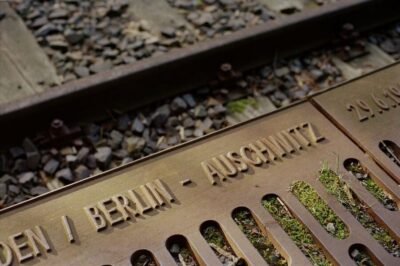
Path of Resistance: Berlin’s Hidden Holocaust Stories
Read our review →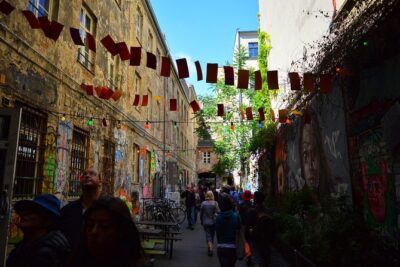
Private Tour: Jewish Heritage Walking Tour of Berlin
Read our review →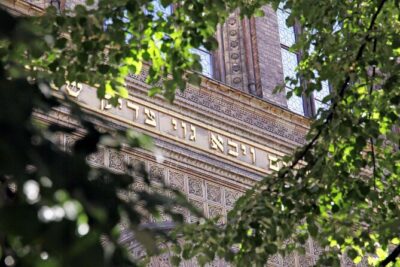
Path of Resistance: Berlin’s Hidden Holocaust Stories
Read our review →

Browse the lists this tour appears in