
Review · WALKING TOURS
Love and War in Berlin: Self-Guided Story Puzzle Walk
Berlin’s center becomes a storybook in this self-guided walk. You begin at the World Clock in Alexanderplatz and solve clues through a chain of major sights, ending near the Memorial to the Murdered Jews of Europe and the site of Hitler’s former bunker. It is a clever way to connect Nazi-era history with Berlin’s wider political past.
I like the freedom: you choose the starting time, stop for coffee, and continue later. I also like the price, just $6 per person, which makes this an easy add-on for a day in Berlin. The main drawback is that there is no human guide, and some answers must be entered very precisely. A crowded market or a missed detail can slow you down.
In This Review
- Key points at a glance
- How the Berlin puzzle walk works
- Alexanderplatz and the World Clock
- Rathaus and Neptune Fountain
- Marx, Engels, and the former East Berlin story
- Lustgarten and Neue Wache
- Bebelplatz and the Nazi book burnings
- Gendarmenmarkt and the route’s grand civic spaces
- The Hamburg state representation
- The Memorial to the Murdered Jews of Europe
- Puzzle difficulty and pacing
- What the $6 price delivers
- Who should book it
- Should you book Love and War in Berlin?
- FAQ
- How long does Love and War in Berlin take?
- Where does the puzzle walk start?
- Where does the experience end?
- Is the activity guided?
- Is the puzzle walk available in English?
- Do I need an internet connection to play?
- Is this a private activity?
- How much does the experience cost?
- Can I cancel for a refund?
Key points at a glance
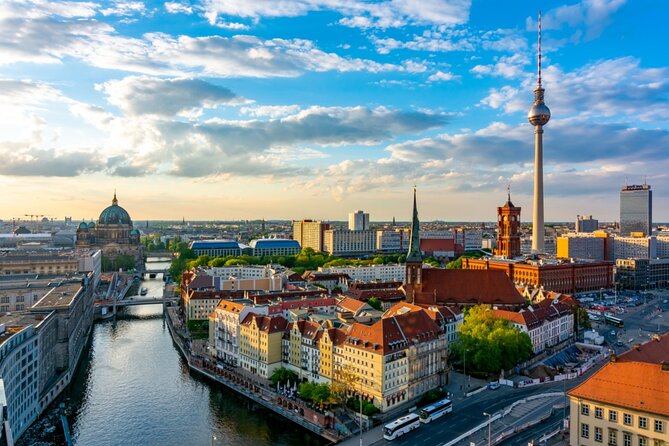
- Alexanderplatz to the Holocaust Memorial: The route crosses central Berlin and finishes at one of the city’s most serious memorial sites.
- A puzzle at every stop: You inspect monuments and public spaces to find answers that move the story forward.
- About one hour of walking: The route is short enough for a spare morning or afternoon, with time to pause.
- No internet needed during play: Download and use the city game offline on your mobile device.
- Private and self-guided: Only your group takes part, with no scheduled guide or contact with other groups.
- Very low cost: At $6 per person, it offers a budget-friendly introduction to central Berlin’s past.
How the Berlin puzzle walk works
This is not a traditional walking tour with a guide holding a flag. It is a mobile city game from Questo. You meet at Alexanderplatz, open the experience on your phone, and follow the clues from one location to the next.
At each stop, you look around for a detail that answers the current challenge. The correct answer sends you onward and adds another piece to the story. The format gives you a reason to study buildings, statues, plaques, and public spaces instead of simply walking past them.
The listed duration is about one hour. That is a reasonable target if you keep moving, but you can take breaks and resume later. The activity is available daily, with listed operating hours from 5:00 AM to 9:00 PM, and it can be started at any hour within that period.
You do not need a physical guide. You also do not need an internet connection while playing, which is useful if you want to avoid mobile data costs or do not have a German SIM card. You do need a charged phone and enough attention to read the clues carefully.
The game is private, so only your own group participates. That works well for couples, families, and friends who prefer to set their own pace. It also avoids the fixed schedule and group dynamics of a standard walking tour.
More walking tours in Berlin:
- Discover Berlin Half-Day Walking Tour
★ 5.0 · 9,624 reviews - Berlin: Third Reich and Cold War 2 Hour Walking Tour
★ 4.9 · 6,830 reviews - Berlin: Discover Berlin Walking Tour
★ 4.9 · 5,998 reviews
Alexanderplatz and the World Clock
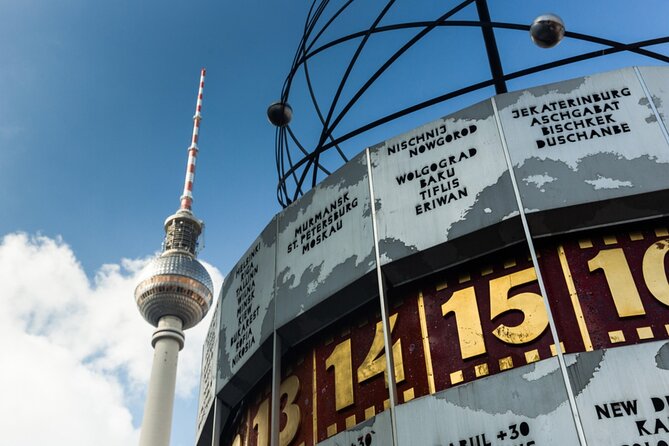
The starting point is the World Clock, also called the Urania World Clock, at Alexanderplatz. Its metal rotunda shows the current time in 148 major cities around the world.
This is a useful opening stop because the square is easy to find and the clock gives you something specific to inspect. You are not simply told a fact and sent on your way. You must look closely for the answer to the first challenge.
Alexanderplatz is one of Berlin’s best-known public spaces, but it can feel broad and busy. Give yourself a few minutes to locate the exact meeting point at Alexanderpl. 1 before starting. The game’s opening clue should help you get oriented, but a little patience here will save time later.
Rathaus and Neptune Fountain
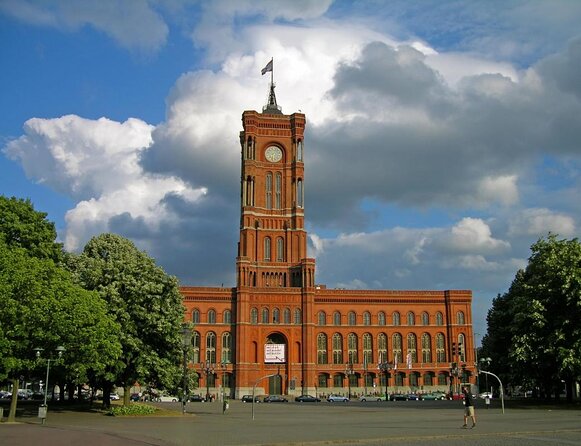
The next part brings you to Berlin’s Rathaus, or Red City Hall. Built between 1861 and 1869, it follows the Northern Italian High Renaissance style. Its tower was inspired by the cathedral tower at Notre-Dame de Laon in France, while the building itself was modeled on the Old Town Hall of Thorn, now Toruń in Poland.
This stop adds architectural context to the route. The story is not limited to the Second World War. Berlin’s political identity was shaped by the city’s earlier imperial and civic buildings, and the Rathaus helps explain that older layer.
The route then reaches the Neptune Fountain, built in 1891 and designed by Reinhold Begas. Neptune sits at the center of the fountain, surrounded by figures drawn from Roman mythology.
The fountain is scheduled as a ten-minute stop, though you can spend less or more time there. Since the challenge depends on looking closely at the site, do not rush straight through. The game works best when you treat each location as a small visual search rather than a box to tick.
Marx, Engels, and the former East Berlin story
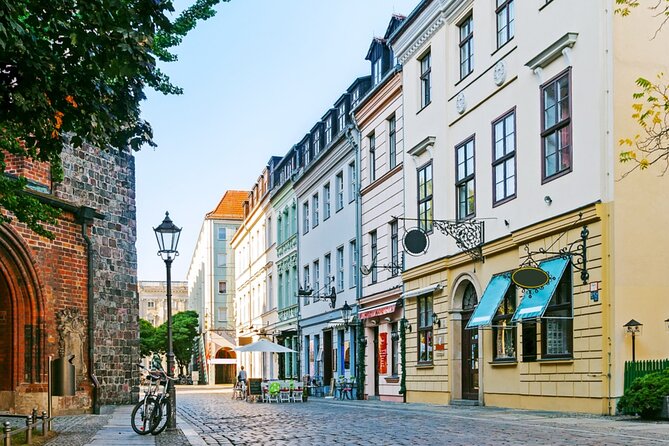
At Marx-Engels-Forum, the route shifts toward the history of the German Democratic Republic. The public park was created by GDR authorities in 1986 and is named for Karl Marx and Friedrich Engels, the authors of The Communist Manifesto.
This is one of the route’s more useful contrasts. Berlin’s central district contains reminders of the Prussian monarchy, Nazi rule, Communist East Germany, and the reunified republic, often within a short walk of one another. A puzzle route makes those changes easier to follow because each stop has a clear role in the developing story.
You may find this section less visually dramatic than the grand squares later in the walk. Its value is political rather than ornamental. Take time to consider why the GDR placed this park here and how public spaces can express a government’s preferred version of the past.
A few more Berlin tours worth weighing up
- Berlin: Solar Powered Sunset Catamaran Cruise & Audio Guide
★ 4.6 · 1,043 reviews - Berlin: Panoramic Boat Tour with Bilingual Audio Guide
★ 4.1 · 136 reviews - Berlin: Self-Guided Family and School Class Scavenger Hunt
★ 4.6 · 128 reviews - Berlin: Scavenger Hunt Self-Guided Tour
★ 4.6 · 79 reviews
Lustgarten and Neue Wache
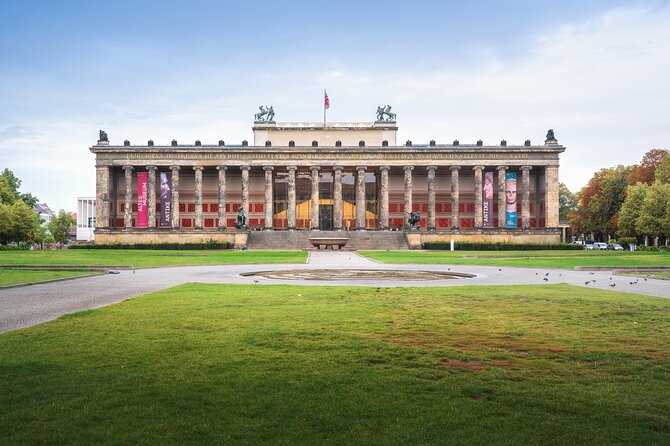
Lustgarten, on Museum Island, began as part of the grounds of the former Berlin City Palace. Over time, it served as a pleasure garden, parade ground, rally site, and public park.
That changing use is important. The same open space can carry very different meanings under different governments. A place designed for leisure can later become a setting for military display or mass politics. The puzzle format gives you a reason to notice those shifts.
The next stop is Neue Wache on Unter den Linden. Karl Friedrich Schinkel designed this neoclassical building between 1816 and 1818 as a guardhouse for the Royal Palace and a memorial to the Liberation Wars.
Neue Wache is a compact stop, but its purpose changed over the years. It is a good place to think about the way Berlin repeatedly reworks monuments to fit new political eras. You should expect the clues to focus on what you can see at the site, so read the prompt exactly and inspect the building before guessing.
Bebelplatz and the Nazi book burnings
Bebelplatz is one of the most important stops for understanding Nazi repression. On the night of May 10, 1933, Nazi-aligned student groups organized book burnings in Berlin and other German university cities.
The event targeted books considered politically or culturally unacceptable. It showed how censorship and propaganda could move from political pressure into a public ritual.
The square itself is large and visually open, so the challenge may require you to look for a specific detail rather than rely on the most obvious monument. Plan for about ten minutes here. This is not a place to skim past, particularly if the Second World War theme is the main reason you booked the walk.
Bebelplatz also helps explain why this tour is broader than a battlefield or bunker tour. It deals with the ideas and public actions that helped prepare the ground for dictatorship, not only with the war’s military events.
Gendarmenmarkt and the route’s grand civic spaces
Gendarmenmarkt brings you into one of Berlin’s most impressive squares. Its name comes from the Gens d’Armes cuirassier regiment, whose stables once occupied the site. Friedrich II later had the stables demolished, and the square developed around two churches and the theater now known as the Konzerthaus Berlin.
The setting is more polished and monumental than some earlier stops. That makes it a pleasant place to pause, but it can also tempt you to focus on photographs rather than the clue. Look at the surrounding buildings and follow the game’s instructions closely.
This section shows how the route balances history with a manageable city walk. You get major architecture, political symbolism, and public squares without being sent far across Berlin. One practical advantage is that the route stays in the central area, so the stops feel connected rather than scattered.
The Hamburg state representation
The route also passes the Berlin state representation of Hamburg on Jägerstraße. This classicist townhouse is used for political meetings and events, linking Hamburg’s local government with federal politics in Berlin.
It is a less familiar stop than the Holocaust Memorial or Gendarmenmarkt. That is part of its appeal. You are given a look at how modern German federalism operates, rather than only a parade of famous monuments.
More than 500 events and encounters take place there each year, including meetings involving Hamburg’s minister-president, visitors, and discussions about current political affairs. The building helps bring the walk into the present. Berlin’s history is not locked in museums; government still happens in these streets.
Because this is an active political building, the experience here is about observing the exterior and solving the clue. Do not expect an interior visit or a formal explanation from staff.
The Memorial to the Murdered Jews of Europe
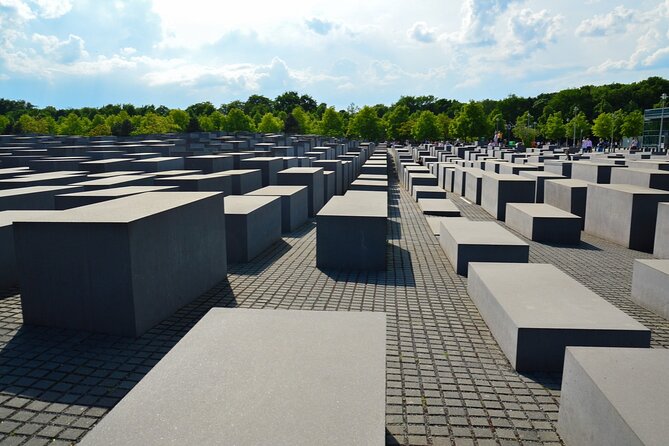
The endpoint is the Memorial to the Murdered Jews of Europe on Cora-Berliner-Straße. Germany’s parliament decided in 1999 to create a central memorial, and the competition was won by New York architect Peter Eisenman. The memorial opened in 2005.
This is a powerful place to finish. The walk has led you through political movements, public propaganda, government buildings, and wartime Berlin. You arrive at a memorial devoted to the Jewish victims of the Holocaust, where the tone becomes quieter and more reflective.
The end point is near the site of Hitler’s former war bunker. The bunker itself is not presented as an attraction to enter, and you should not expect an underground tour. The value is in understanding the location within the wider setting of the memorial district.
I recommend allowing extra time after the final puzzle. The listed activity lasts about an hour, but the memorial deserves more than a quick answer-and-leave finish. If you are using the game as an introduction to Berlin’s Nazi-era sites, this is the point where you may want to pause and continue your own reading or visit another nearby memorial.
Puzzle difficulty and pacing
The challenges vary. Some are easy to solve from the obvious details at a site. Others require closer inspection or very exact wording. That variety keeps the walk lively, but it can also frustrate you if the answer field accepts only one precise form.
The safest approach is to read each clue twice before entering an answer. Check spelling, numbers, and singular or plural wording. If an answer seems right but does not work, look again at the exact detail requested rather than assuming the app is wrong.
The route is generally manageable and not too long. Still, crowded areas can affect the experience. A Christmas market once blocked parts of the route and required a few maneuvers. Seasonal events, construction, or large crowds may create the same problem, so leave some flexibility in your timing.
You can pause whenever needed. That matters if you are traveling with children, want to eat along the way, or prefer to stop at a museum. The ability to resume later is more useful here than on a standard one-hour tour, since the sights invite extra stops.
What the $6 price delivers
At $6 per person, this is inexpensive by Berlin tour standards. You are paying for a structured route, a historical story, and interactive clues, not for a guide’s personal commentary.
The value is strongest if you already enjoy walking and want a reason to pay attention to the city around you. A group can split the cost easily, and group discounts may be available. Since there is no admission fee at the listed outdoor stops, you can complete the route without adding attraction tickets.
The tradeoff is depth. A human guide could explain the political background, answer follow-up questions, and adjust the pace to your interests. This game gives you a lighter layer of information. It works best as an engaging introduction, not as your only study of WWII Berlin.
The private format is another plus. You do not have to keep up with strangers, and you can stop without holding up a scheduled group. The lack of personal contact also suits people who prefer independent sightseeing.
Who should book it
I would choose this for couples, families with older children, and friends who like small challenges during a city walk. It is also a good fit for a solo visitor who wants structure without joining a group.
Berlin residents may find it worthwhile too. Several of the stops are familiar public places, but the clues and historical links can reveal details you have previously walked past.
This is less suitable if you want a full spoken lecture on WWII, a specialist guide, or access inside historic buildings. You should also think twice if phone-based puzzles make sightseeing feel like work.
Bring comfortable shoes and a charged phone. Start with enough daylight to inspect the outdoor clues comfortably, and keep the app instructions handy. The listed hours run from 5:00 AM to 9:00 PM, Monday through Sunday, but an earlier or later start may affect how easy it is to see details and navigate around events.
Bookings receive confirmation at the time of purchase. Service animals are allowed, public transportation is nearby, and most people can take part. Free cancellation is available up to 24 hours before the scheduled start time. Cancellations or changes inside that window are not refunded or accepted.
Should you book Love and War in Berlin?
Book it if you want a low-cost, flexible way to connect Berlin’s major central sights through puzzles. The route covers a useful sweep of history, from the World Clock and Prussian architecture to Nazi censorship, GDR politics, federal government, and the Holocaust Memorial.
Skip it if you need a live guide or want a detailed academic treatment of the war. For everyone else, $6 buys a well-paced hour of independent exploration, with the freedom to stop and continue when you like. Just read the clues carefully, allow for crowds, and give the final memorial more time than the game itself requires.
FAQ
How long does Love and War in Berlin take?
The experience lasts approximately one hour. You can also take breaks and resume later.
Where does the puzzle walk start?
It starts at the World Clock in Alexanderplatz, at Alexanderpl. 1, 10178 Berlin, Germany.
Where does the experience end?
The walk ends at Cora-Berliner-Straße 1, 10117 Berlin, Germany, near the Memorial to the Murdered Jews of Europe.
Is the activity guided?
No. It is self-guided, and no physical tour guide is included.
Is the puzzle walk available in English?
Yes. The experience is offered in English.
Do I need an internet connection to play?
No. The activity can be played offline after you have access to it on your mobile device.
Is this a private activity?
Yes. Only your own group participates.
How much does the experience cost?
The listed price is $6 per person. Group discounts are available.
Can I cancel for a refund?
Yes. You can cancel up to 24 hours before the experience start time for a full refund. Cancellations made less than 24 hours before the start time are not refunded.
Just added around Berlin
- Berlin Highlights in One Day★ 5.0 · 3 reviews
- Private Berlin One Day Tour with a Local: See the City Unscripted★ 3.5 · 3 reviews
- Individual city tour Berlin for max. 8 persons★ 5.0 · 3 reviews
- Transfer from Berlin Schönefeld Airport (SXF) to Berlin city Hotels – ROUND TRIP★ 4.0 · 3 reviews
- Berlin: Museum Island Tour★ 5.0 · 3 reviews
- Private Analogue Photography Experience in Berlin★ 5.0 · 3 reviews
- Berlin: Local Food Tour in Secrets Hidden Gems★ 4.0 · 3 reviews
- Berlin & The Third Reich Private Guided Tour★ 5.0 · 3 reviews
Walking Tours, compared.



Berlin’s Best: 2 Hour Walking Tour Third Reich and the Cold War
Read our review →

Third Reich Berlin: Hitler and WWII Walking Tour
Read our review →

Browse the lists this tour appears in