
Review · THIRD REICH & WWII SITES
Third Reich Berlin Walking Tour with a French-Speaking Guide
Berlin’s Nazi past comes into sharper focus when you move through the actual streets where deportations, resistance, and daily Jewish life unfolded. This French-language walk connects the Bendlerblock resistance memorial with Berlin’s Jewish Quarter and the small Otto Weidt Museum, giving you both political history and personal stories.
I like the clear route from Potsdamer Platz to Hackescher Markt, and I like that public transportation is used as part of the journey rather than hiding the city behind a tour bus. The French-speaking guides, including Julie, are praised for making a painful subject clear and engaging.
The main consideration is the pace. You walk for about three hours, use a train between sections, and spend much of the time outdoors. Also, the overview refers to the Topography of Terror, but the detailed stop list does not include it, so confirm the exact route before booking.
In This Review
- Key points to know before booking
- Why this route gives Berlin’s Nazi history a human scale
- The Bendlerblock and the story of German resistance
- Anhalter Bahnhof and the machinery of deportation
- The New Synagogue and Berlin’s Jewish community
- Auguststrasse and the institutions that disappeared
- Grosse Hamburger Strasse and the forced collection of Berlin Jews
- Otto Weidt’s workshop and an example of courage
- The mention of the Topography of Terror needs checking
- What the $31.99 price gets you
- Timing, fitness, and what to bring
- Who will get the most from this French-language walk
- Should you book it?
- FAQ
- What language is the tour conducted in?
- How long does the tour last?
- What time does the tour start?
- Where does the tour begin?
- Where does the tour end?
- Is public transportation included?
- What sites are included on the route?
- Is admission included?
- Does the tour operate in bad weather?
- Can I cancel for a full refund?
Key points to know before booking
- French-language history walk: The tour is designed for French-speaking visitors and explains Berlin’s Nazi era in French.
- Operation Valkyrie site: At the Bendlerblock, you learn how the failed July 20 resistance plot was directed.
- Jewish Berlin beyond monuments: The route covers the New Synagogue, Auguststrasse, Grosse Hamburger Strasse, and former detention sites.
- A small museum with a human focus: The Otto Weidt Museum tells how one brush-maker tried to protect blind and deaf Jewish workers.
- Public transport is part of the plan: You need your own Berlin AB day card because transportation is not included.
- A compact group format: The maximum group size is 24 people, with a 10 a.m. start and a finish near Hackescher Markt.
Why this route gives Berlin’s Nazi history a human scale
This is not a tour built around grand military monuments. Its strength is the way it links ordinary addresses, train stations, schools, workshops, and memorials to the Nazi period.
You begin near Potsdamer Platz, an area that today feels modern and central. From there, the walk moves toward places tied to resistance and persecution. That contrast matters. Berlin does not place its difficult history in one remote park. You encounter it among offices, shops, transport lines, and everyday city streets.
The French-speaking guide is the key to making those connections. One review praises the guide for presenting both the broad events and the individual lives in a lively, clear way. That is exactly the right approach for this subject. Dates and political names matter, but they can feel distant without the people affected by them.
The tour lasts about three hours and accepts up to 24 people. That is a manageable size for a city walk, though not an intimate private tour. You should expect a group experience, with questions and explanations shared among the whole party.
More Third Reich sites in Berlin:
- Berlin: Third Reich and Cold War 2 Hour Walking Tour
★ 4.9 · 6,830 reviews - Berlin: Berlin Story Bunker Entry Ticket
★ 4.6 · 6,759 reviews - Berlin’s Best: 2 Hour Walking Tour Third Reich and the Cold War
★ 5.0 · 5,486 reviews
The Bendlerblock and the story of German resistance
The first major stop is the German Resistance Memorial Center at the Bendlerblock. You reach it after seeing a memorial to Varian Fry, the American journalist who helped people escape Nazi persecution.
At the Bendlerblock, the guide explains the German resistance to Hitler and the role of Operation Valkyrie. This was the plan used by resistance officers in an attempt to remove Hitler and take control of Germany. The plot failed, and the building became linked with the executions of several conspirators.
The memorial now honors Germans who opposed Nazism in many different ways. That wider focus is useful. Resistance was not limited to one political group or one dramatic conspiracy. You are encouraged to think about people who fought the regime, helped others, or refused to accept its rules.
You have about 50 minutes here, the longest scheduled stop. That gives the guide time to provide real context instead of pointing to a plaque and moving on. It also means this is not a quick photo stop.
The museum admission is listed as free, but do not confuse that with the overall tour cost. You pay for the guide and organized route, not for a package of paid museum tickets. The attraction is the explanation and the way the sites are connected.
Anhalter Bahnhof and the machinery of deportation
The route then goes to Anhalter Bahnhof, once one of Berlin’s major railway stations. Only part of the original structure remains, leaving a striking fragment rather than a complete station.
The stop lasts about 10 minutes. The guide explains how the station was used as one of the departure points for deportations of Berlin’s Jewish population. That detail changes how you see a building that might otherwise look like a romantic ruin.
This is also where the practical side of the tour matters. You take a train from this area to Berlin’s Jewish Quarter, and transportation is not included. You should buy a Berlin public transport day card for zones AB before the tour begins.
The train ride is not just a transfer. It shows how the city’s transport system links districts that hold very different parts of Berlin’s past. Still, the group needs to move together, and a valid ticket is your responsibility. Give yourself enough time to buy the day card before the 10 a.m. start.
The New Synagogue and Berlin’s Jewish community
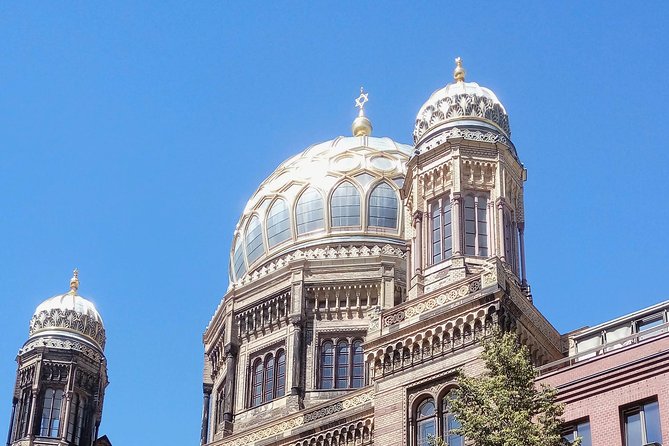
In the Jewish Quarter, the route begins at the New Synagogue, officially the Stiftung Neue Synagoge Berlin, Centrum Judaicum. The scheduled explanation lasts about 15 minutes.
The guide covers the Jewish community in the 19th and 20th centuries and explains the synagogue’s history. This helps place the Nazi period in a longer timeline. Jewish life in Berlin did not begin with persecution, and it cannot be understood only through the destruction of the 1930s and 1940s.
A short stop here also gives you a sense of the limits of a three-hour walking tour. You receive an introduction rather than a full museum visit. If you want to study the synagogue or its exhibitions in depth, plan separate time on another day.
The stop is valuable because it prevents the route from becoming only a sequence of Nazi crimes. You see the community that existed before the dictatorship, not just the damage done to it.
More walking tours in Berlin:
- Discover Berlin Half-Day Walking Tour
★ 5.0 · 9,624 reviews - Berlin: Discover Berlin Walking Tour
★ 4.9 · 5,998 reviews - Berlin: Hidden Backyards Guided Walking Tour
★ 4.8 · 5,360 reviews - Third Reich Berlin: Hitler and WWII Walking Tour
★ 5.0 · 3,301 reviews
Auguststrasse and the institutions that disappeared
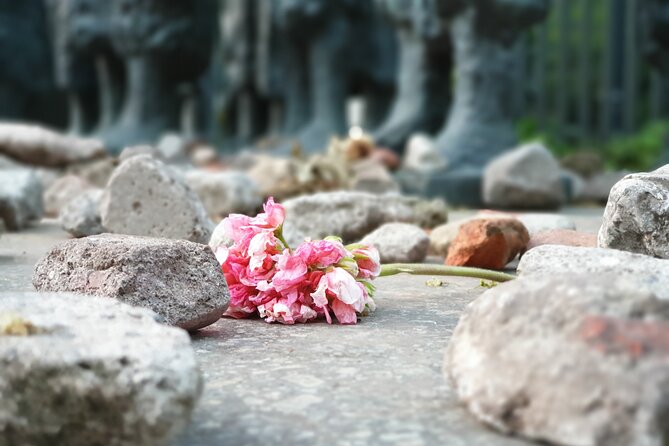
Auguststrasse adds another layer to the story. The guide discusses former Jewish institutions on the street, including a school for Jewish girls and an orphanage that existed during the Nazi period.
These places bring the subject down to a neighborhood level. A school and an orphanage are easier to picture than an abstract description of persecution. They also raise difficult questions about children, education, family separation, and the destruction of community life.
The scheduled time is about 20 minutes. You should expect to listen outdoors while moving through the street, rather than spending a long period inside one building. Dress for the weather, since the tour operates in rain and other conditions.
I like this part of the walk because it shows that Jewish Berlin was not a single landmark. It was made up of institutions that served real social needs. The guide’s job is to help you see those former functions in the present-day street.
Grosse Hamburger Strasse and the forced collection of Berlin Jews
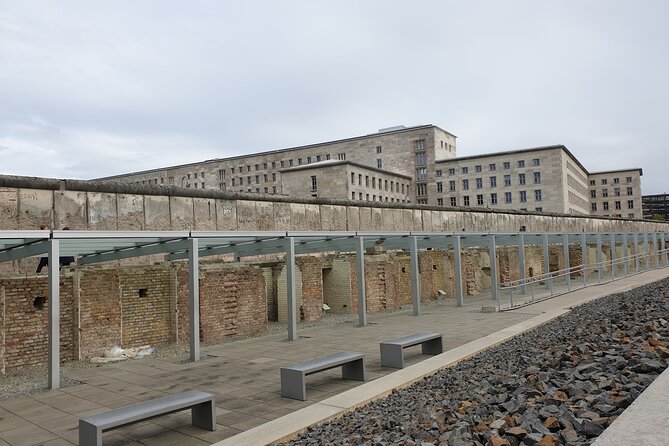
The next stop, Grosse Hamburger Strasse, is given about 30 minutes. Here you see the old Jewish cemetery and learn about a Sammellager, a collection camp where Jews were detained before deportation.
The word itself is stark, but the place becomes more meaningful when the guide explains how detention fit into the larger process. Deportation required organization, and that organization took place through buildings, streets, schedules, and transport points.
The old cemetery adds a different kind of memory. It points to the long presence of Jewish life in Berlin before the Nazi regime. Together, the cemetery and detention site show the gap between an established community and the violence imposed upon it.
This is one of the more emotionally heavy sections of the walk. The subject is not softened, but the route does not rely on sensational presentation. The French-language explanations are meant to make the facts understandable and connected to place.
Otto Weidt’s workshop and an example of courage
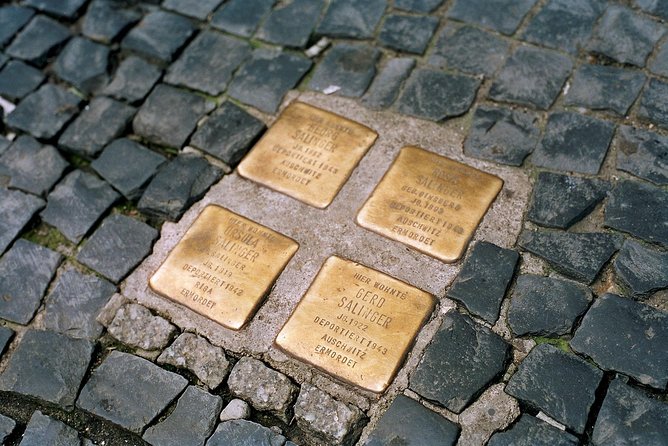
The final major stop is the Museum Blindenwerkstatt Otto Weidt. This small museum tells the story of Otto Weidt, who ran a workshop producing brooms and brushes and employed mainly blind and deaf Jewish workers during World War II.
Weidt tried to protect his employees. The museum focuses on his actions and on the people he helped, creating a more personal ending than a stop devoted only to military events or government policy.
The scheduled visit lasts about 20 minutes. That is enough time for the guide to explain the workshop and its importance, but you should not expect a long independent museum session. The story is about everyday courage, practical choices, and the risks involved in helping people under a criminal dictatorship.
I especially like this final stop because it gives the tour a human ending. The Bendlerblock presents organized resistance at the level of officers and political plans. Otto Weidt’s workshop shows another form of resistance: protecting specific people in a small workplace.
The tour ends at Hackescher Markt, close to the S-Bahn station. That is convenient for continuing your day, though the formal end point is not the same as the starting point at Potsdamer Platz.
The mention of the Topography of Terror needs checking
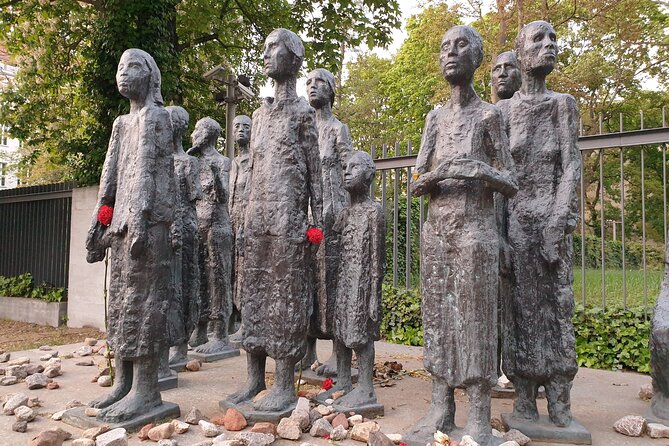
The general tour description says the experience includes the Topography of Terror. However, the detailed route provided for the tour lists the Bendlerblock, Anhalter Bahnhof, the New Synagogue, Auguststrasse, Grosse Hamburger Strasse, and the Otto Weidt Museum, but not the Topography of Terror.
That difference matters because the Topography of Terror is a substantial documentation center about Nazi institutions of terror. If it is important to you, ask Vive Berlin Tours to confirm whether it is included on the date you book, substituted for another stop, or mentioned only as part of the wider historical discussion.
Do not assume that a reference in the overview guarantees a dedicated visit. The stated duration is only about three hours, so the exact balance of stops may depend on the guide and the day’s route.
What the $31.99 price gets you
At $31.99 per person, this is a fair price if you want a guided French-language route through several parts of central Berlin. The fee covers a local professional guide and local taxes. It does not cover transport, food, drinks, or separate admission costs.
The value comes from the structure. You could walk to some of these places on your own, but you would need to research the sites, work out the order, and understand how they relate to one another. The tour does that work for you.
You also get a route that combines well-known political history with less obvious places such as Auguststrasse and the Otto Weidt workshop. For a first visit to Berlin, that mix can be more useful than spending three hours at only one large museum.
The cost is less attractive if you already know the period well, speak German comfortably, or prefer to explore at your own speed. A group of up to 24 people cannot offer the same flexibility as a private guide.
Timing, fitness, and what to bring
The tour begins at 10 a.m. at Potsdamer Platz 10 and ends near Hackescher Markt. Plan on roughly three hours, though the walking route and public transport connection require you to stay with the group.
A moderate level of physical fitness is recommended. The tour involves walking between sites, standing during outdoor explanations, and using public transport. It is not designed as a seated museum tour.
Wear comfortable shoes and dress for changing weather. The tour runs in all weather conditions. Since the route includes outdoor streets, memorial areas, and transport connections, a rain jacket or suitable layers can make the experience much easier.
Bring a Berlin AB day card, since the train ride is not included. You should also allow time before the start to find the meeting point at Potsdamer Platz. The mobile ticket is convenient, and confirmation is sent when you book.
Service animals are allowed, and the route is near public transportation. The available details do not give more specific information about step-free access or seating, so contact the provider if you have mobility needs.
Who will get the most from this French-language walk
This tour suits you best if French is your preferred language for serious historical subjects. The guide can explain terms, names, and cause and effect without forcing you to translate every detail in your head.
It is also a good match if you want to see Berlin on foot and prefer a route that combines major memorials with neighborhood sites. The walk does not treat the Third Reich as a sealed-off chapter. It shows how the history is spread through the city.
I would recommend it for first-time Berlin visitors who want an organized introduction, as well as for repeat visitors who have seen the major central sights but have not yet explored the Jewish Quarter in this focused way.
It may not suit you if you want a relaxed stroll with little emotional weight. This is difficult material. The guide must discuss deportation, detention, persecution, and resistance. The positive comments about Julie and the other guides point to a lively and clear style, but the topic itself remains painful.
Should you book it?
Book this tour if you want a French-speaking guide, a compact three-hour route, and a serious look at both resistance and Jewish life in Berlin. The Bendlerblock, Anhalter Bahnhof, Grosse Hamburger Strasse, and Otto Weidt Museum give the walk a strong range.
Before paying, confirm the Topography of Terror question and remember to buy your own Berlin AB transport pass. If those details suit your plans, $31.99 is a sensible price for the historical context and organized route.
FAQ
What language is the tour conducted in?
The tour is conducted in French with a French-speaking guide.
How long does the tour last?
The walking tour lasts approximately three hours.
What time does the tour start?
The tour starts at 10:00 a.m.
Where does the tour begin?
The meeting point is Potsdamer Platz 10, 10785 Berlin, Germany.
Where does the tour end?
The tour ends at Hackescher Markt, near the Hackescher Markt S-Bahn station.
Is public transportation included?
No. You should buy a Berlin public transportation day card for zones AB. Transportation to and from the attractions is not included.
What sites are included on the route?
The route includes the German Resistance Memorial Center at the Bendlerblock, Anhalter Bahnhof, the New Synagogue and Centrum Judaicum, Auguststrasse, Grosse Hamburger Strasse, and the Museum Blindenwerkstatt Otto Weidt.
Is admission included?
The listed stops have free admission. The tour price includes a local professional guide and local taxes, but food and drinks are not included.
Does the tour operate in bad weather?
Yes. The tour operates in all weather conditions, so you should dress appropriately.
Can I cancel for a full refund?
Yes. You can cancel at least 24 hours before the experience start time for a full refund. Cancellations or changes made less than 24 hours before the start time are not accepted for a refund.
Just added around Berlin
- Berlin Highlights in One Day★ 5.0 · 3 reviews
- Private Berlin One Day Tour with a Local: See the City Unscripted★ 3.5 · 3 reviews
- Individual city tour Berlin for max. 8 persons★ 5.0 · 3 reviews
- Transfer from Berlin Schönefeld Airport (SXF) to Berlin city Hotels – ROUND TRIP★ 4.0 · 3 reviews
- Berlin: Museum Island Tour★ 5.0 · 3 reviews
- Private Analogue Photography Experience in Berlin★ 5.0 · 3 reviews
- Berlin: Local Food Tour in Secrets Hidden Gems★ 4.0 · 3 reviews
- Berlin & The Third Reich Private Guided Tour★ 5.0 · 3 reviews
Third Reich & WWII Sites, compared.



Berlin’s Best: 2 Hour Walking Tour Third Reich and the Cold War
Read our review →
Third Reich Berlin: Hitler and WWII Walking Tour
Read our review →

Berlin Third Reich Sites: Half-Day Walking Tour
Read our review →
Guided Bike Tour of the Berlin Wall and Third Reich
Read our review →
Hitler’s Germany: Berlin During the Third Reich & WWII
Read our review →Browse the lists this tour appears in