
Review · WALKING TOURS
Berlin: Private Walking Tour with a Local Guide
Berlin’s story is written across a surprisingly compact stretch of central streets. On this private three-hour walk, you can move from royal buildings and grand squares to the former divide between East and West Berlin, with a guide explaining what you are seeing as the city unfolds around you.
I like the one-group format, which lets you ask questions and adjust the route instead of following a fixed script. I also like the chance to connect famous sights such as Brandenburg Gate, Checkpoint Charlie, and the Berlin Wall in one outing. The main consideration is simple: this is a walking tour with no included entries, food, or drinks, and it is not suitable for wheelchair users.
In This Review
Key points at a glance
- Private group of up to 15: You get your own guide rather than joining a large public group.
- Three hours on foot: The tour covers a useful central section of Berlin without taking up your entire day.
- Major historic landmarks: Expect sights such as Brandenburg Gate, Checkpoint Charlie, the Berlin Wall, and Berlin Cathedral.
- Flexible route: You can tell the guide which places matter most to you and shape the experience on the day.
- English or German guide: The live tour is offered in both languages.
- Bring comfortable shoes: The tour is entirely focused on exploring Berlin on foot.
Berlin can feel scattered at first. Its major sights belong to different eras, and the most meaningful places are not all gathered around one square. This tour gives you a useful first look by linking the city’s royal, political, religious, and divided past in a single central route.
You meet the guide in front of the Berlin State Opera at Staatsoper, Unter den Linden 7. From there, the walk takes you through a part of Berlin where grand architecture and twentieth-century upheaval sit close together. That contrast is the real appeal. One moment you are looking at a historic palace or cathedral, and the next you are considering a former border crossing or a surviving section of the Berlin Wall.
Because the group is private, you can ask for more attention to the subjects that interest you. You might want a strong focus on the Cold War, a closer look at Berlin’s monumental buildings, or a broad introduction that helps you plan the rest of your stay. The guide can tailor the route to your priorities, although the exact final sequence is decided with the guide on the day.
The meeting point puts you on Unter den Linden, one of central Berlin’s best-known avenues. The Berlin State Opera is a practical starting place because it places you near several important sights, including Humboldt University, St. Hedwig’s Cathedral, the Crown Prince’s Palace, and Schloss Bridge.
You can expect the guide to use this first stretch to set the scene. Berlin is not a city where every important building tells the same story. The State Opera points to music and court culture, while the nearby university reflects Berlin’s long academic tradition. St. Hedwig’s Cathedral adds a major religious landmark, and the Crown Prince’s Palace brings another layer of royal architecture.
The value here is not just seeing façades. A private guide can explain why these buildings matter and help you notice how closely they sit together. Without that context, you might pass from one handsome structure to the next without seeing the connections.
The opening section should also help you settle into the pace. Three hours is enough time for a substantial introduction, but not enough for long interior visits at every stop. Since entrance fees are not included, you should think of this primarily as an outdoor sightseeing experience.
The route includes the State Opera, St. Hedwig’s Cathedral, the Crown Prince’s Palace, Schloss Bridge, and Humboldt University. These sights give the tour a strong architectural and civic side before the focus turns more directly to Berlin’s twentieth-century divisions.
I like this part of the itinerary because it prevents the tour from becoming only a Berlin Wall and Checkpoint Charlie walk. Berlin’s story did not begin in the twentieth century. The avenue’s grand buildings show the city as a center of monarchy, learning, government, and culture long before the Cold War reshaped its streets.
Schloss Bridge is another useful pause in the route. It connects important central areas and offers a change from the formal façades along Unter den Linden. The bridge also helps you understand how the city is arranged, something that is easy to miss when you move from sight to sight by vehicle.
Humboldt University gives the walk another point of reference. You may find that your guide spends more time on architecture, education, politics, or the personalities connected with these places, depending on your questions. That flexibility is one of the better reasons to choose a private tour rather than a fixed group route.
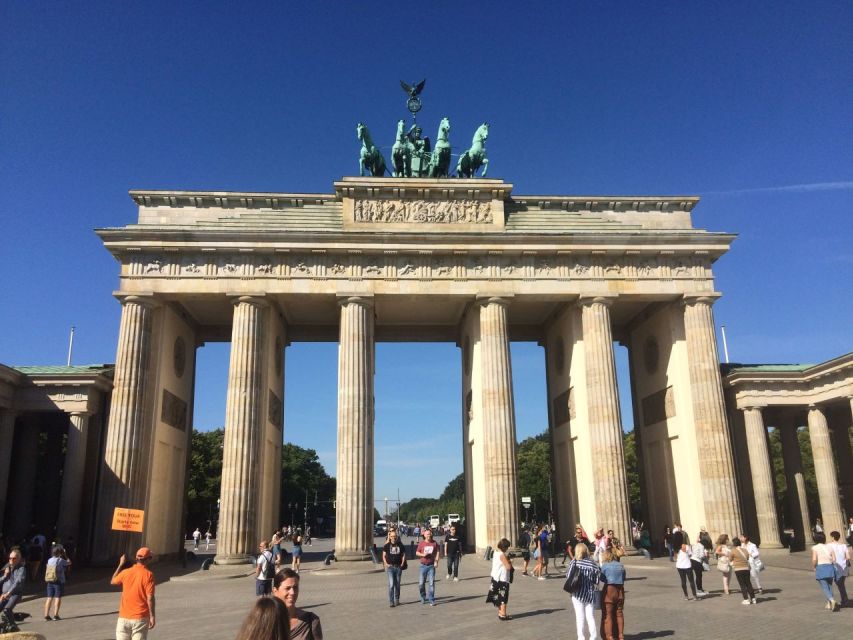
Brandenburg Gate is one of the essential stops, and it earns its place. The gate is instantly recognizable, but its importance goes beyond its appearance. It has been used as a public symbol through several chapters of Berlin’s past and now acts as one of the city’s clearest visual markers.
A guide adds value here by helping you read the gate as part of its setting rather than as an isolated photo stop. You can expect a busy public space, so having someone point out what to look for keeps the visit focused. The private format also makes it easier to ask questions without holding up a large group.
This is likely to be one of the most photographed moments of the walk. Bring your camera, but give yourself time to look beyond the obvious front view. The surrounding area connects easily with other major central sights, and the guide can help you decide how much time to spend here compared with the Cold War locations.
If Brandenburg Gate is high on your list, mention it early. The route is customizable, but that does not mean every participant automatically gets equal time at every listed sight. A short conversation at the start can make the three-hour schedule work better for your group.
Checkpoint Charlie represents the divided city in a very direct way. It was a crossing point between East and West Berlin, and its name has become shorthand for the tension of the Cold War. Seeing the location with a guide can help turn a familiar name into a place with political and human meaning.
The important distinction is that the tour takes you to the former crossing point as part of a broader historical walk. It does not include an admission to a museum or an indoor exhibit. Entrance fees are not included, so any optional visit you choose to make separately would be at your own cost.
I would treat Checkpoint Charlie as a place for explanation rather than a long stop in itself. Its significance comes from understanding what the crossing controlled, who used it, and how the border affected everyday life. The guide’s role is especially useful here because the modern surroundings can make it hard to picture the former division without help.
This is also a good point to ask questions about the Berlin Wall and the city’s division. If your group has a particular interest in Cold War Berlin, say so. The private setup gives the guide a chance to adjust the balance of the walk rather than giving every group the same amount of background.
The Berlin Wall is another central focus of the tour. Even when only parts or traces remain, the idea of the wall changes the way you see Berlin. It divided neighborhoods, families, and daily routines, not just two political systems.
A walk is well suited to this subject because you experience distance and place directly. You are not simply looking at an image in a museum. You are moving through the city and considering how a barrier once cut through streets that now appear connected.
The precise Wall location visited on your route is not specified, so you should ask the guide at the beginning which section is planned. That question matters if you have already visited one memorial or want to concentrate on a particular part of Berlin’s divided past.
The tour pairs the Wall with Checkpoint Charlie, which creates a useful comparison. One is a physical barrier and the other a controlled crossing point. Together, they help you understand how Berlin functioned as a divided city, while Brandenburg Gate and the central buildings show the city before and after that period.
Berlin Cathedral is included among the major sights you can see. Its large scale and prominent position make it an easy landmark to recognize, but its real value on this tour is the way it adds a religious and imperial note to the route.
The cathedral also helps broaden your view of Berlin. The city is not defined by one period. Along with political monuments and Cold War sites, you see evidence of royal power, religious life, scholarship, and national ambition.
As with the other listed attractions, the standard experience is a guided walk rather than an included interior visit. Admission fees are not part of the price. If entering the cathedral matters to you, ask whether the route leaves enough time for a separate visit, and plan to pay the entrance cost yourself.
That limitation is worth keeping in mind when comparing this tour with a museum-focused option. Its strength is the connected outdoor route and the conversation with your guide, not a series of included indoor admissions.
The tour costs $307 per group of up to 15 people. That price looks high for one person, but the calculation changes quickly when you share it with family or friends. At the full group size, it works out to about $20.47 per person. For four people, it is about $76.75 each, and for a couple, the full group price is a much bigger commitment.
The best value comes when you have a group that wants its own pace. You are paying for a private professional guide, not for tickets or refreshments. If your group asks many questions, has mixed interests, or wants to adjust the route, the private arrangement may justify the cost.
For a solo visitor or a couple watching every expense, a standard group walk may offer better value if one is available on your travel dates. This private option makes more sense for families, friend groups, and visitors who want direct attention rather than the lowest possible price.
The maximum group size is 15. That is still a fairly large private party, so do not assume the experience will feel like a personal walk for two if you fill all 15 places. The guide can tailor the route, but everyone still needs to agree on priorities.
Wear comfortable shoes. That is the one item specifically recommended, and it is sound advice for a tour that moves between several central landmarks. You should also arrive ready to spend the full three hours outdoors, since food, drinks, and entrance fees are not included.
The starting point is easy to identify: in front of the Berlin State Opera at Staatsoper, Unter den Linden 7, 10117 Berlin. Check the exact starting time when you book, since availability determines the departure options.
The tour is offered in English and German. If language is important to your group, choose the right option at booking and confirm it when arranging the tour. A clear language match matters on a history walk, since much of the value comes from the guide’s explanations rather than from simply seeing the buildings.
The route is not suitable for wheelchair users. If anyone in your party has limited mobility for another reason, you should ask about the planned route before booking, since the experience is built around walking between multiple sights.
The tour has free cancellation up to 24 hours in advance, and you can reserve now while paying later. Those terms give you some flexibility if your Berlin schedule is still changing, but they do not replace checking the final meeting time and group details before the day.
I would recommend this tour to first-time visitors who want an organized introduction without giving up the ability to ask questions. It also suits families and small groups that want to keep the route focused on their own interests.
History-minded visitors should find plenty to work with, especially if they ask for more time at Checkpoint Charlie and the Berlin Wall. Architecture fans may prefer to emphasize the State Opera, St. Hedwig’s Cathedral, the Crown Prince’s Palace, Humboldt University, Berlin Cathedral, and Brandenburg Gate.
The tour is less suitable if you want long indoor visits, included museum admissions, or a relaxed café break. Three hours goes quickly when you are covering many major sights, so you should see the walk as a strong orientation rather than a complete study of Berlin.
The guide’s manner matters greatly on a private experience. The available feedback describes the guide as friendly and interesting, which is exactly what this format needs. No guide name is provided, so you cannot choose a particular person in advance.
FAQ
More walking tours in Berlin:
- Discover Berlin Half-Day Walking Tour
★ 5.0 · 9,624 reviews - Berlin: Third Reich and Cold War 2 Hour Walking Tour
★ 4.9 · 6,830 reviews - Berlin: Discover Berlin Walking Tour
★ 4.9 · 5,998 reviews
How long does the Berlin private walking tour last?
The tour lasts three hours.
Where does the tour meet?
You meet the guide in front of the Berlin State Opera, Staatsoper, at Unter den Linden 7, 10117 Berlin, Germany.
Is the tour private?
Yes. It is a private group experience for up to 15 people.
A few more Berlin tours worth weighing up
- Berlin: Private Reichstag and Glass Dome Tour
★ 4.8 · 2,226 reviews - Berlin Private Complete History All Day Walking Tour
★ 5.0 · 474 reviews - Private Walking Tour Berlin Third Reich Hitler and World War II
★ 5.0 · 360 reviews - Private Berlin: Iconic Sights and Hidden Gems Walking Tour
★ 5.0 · 292 reviews
Which languages are available?
The live guide is available in English or German.
Which Berlin sights are included?
The route can include Berlin Cathedral, Brandenburg Gate, Checkpoint Charlie, the Berlin Wall, the State Opera, St. Hedwig’s Cathedral, the Crown Prince’s Palace, Schloss Bridge, Humboldt University, and other important sights.
Can the route be customized?
Yes. You can decide which sights you most want to see with the guide on the day.
Are entrance fees included?
No. Entrance fees, food, and drinks are not included.
Is the tour suitable for wheelchair users?
No. The activity is not suitable for wheelchair users.
Book it if you want a flexible introduction to central Berlin and can share the $307 group price with several people. The combination of Brandenburg Gate, the Berlin Wall, Checkpoint Charlie, Berlin Cathedral, and the Unter den Linden landmarks gives you a useful first map of the city.
I would skip it if your main goal is museum entry, a low per-person price for one or two people, or a tour designed for wheelchair access. For everyone else, especially a family or friend group that wants a guide who can adjust the emphasis, this three-hour walk offers a practical way to connect Berlin’s grand public buildings with the harder story of its divided past.
Just added around Berlin
- Berlin Highlights in One Day★ 5.0 · 3 reviews
- Private Berlin One Day Tour with a Local: See the City Unscripted★ 3.5 · 3 reviews
- Individual city tour Berlin for max. 8 persons★ 5.0 · 3 reviews
- Transfer from Berlin Schönefeld Airport (SXF) to Berlin city Hotels – ROUND TRIP★ 4.0 · 3 reviews
- Private Analogue Photography Experience in Berlin★ 5.0 · 3 reviews
- Berlin: Museum Island Tour★ 5.0 · 3 reviews
- Berlin: Local Food Tour in Secrets Hidden Gems★ 4.0 · 3 reviews
- Berlin & The Third Reich Private Guided Tour★ 5.0 · 3 reviews
Walking Tours, compared.



Berlin’s Best: 2 Hour Walking Tour Third Reich and the Cold War
Read our review →

Third Reich Berlin: Hitler and WWII Walking Tour
Read our review →

Browse the lists this tour appears in