
Review · THIRD REICH & WWII SITES
Berlin: World War Two Third Reich and Cold War Walking Tour
Berlin’s most powerful sights are often plain walls, empty lots, and scraps of concrete. This five-hour walk connects those quiet places to the events that shaped modern Europe, from the Third Reich and Hitler’s final days to East German communism and the fall of the Berlin Wall. The route links World War II and Cold War Berlin, rather than treating them as separate chapters.
I like the broad sweep of the tour and the chance to see Berlin Wall remains, escape routes, guard towers, and memorial sites on foot. I also like the low $21 price for a full half-day with an English-speaking local historian. The main concern is organization at the meeting point: several tours may gather there at once, and the group assignment can be unclear, so arrive early and confirm the exact tour before setting off.
In This Review
- Key points to know before you book
- Why this Berlin history walk is different
- Starting under the white umbrella at Alexanderplatz
- Nazi Berlin, the Reichstag, and the road to war
- From defeat to a divided city
- Reading the Berlin Wall at Eastside Gallery
- Berlin Wall Memorial and the human cost of escape
- Architecture that survived Berlin’s upheavals
- Five hours on foot: the practical reality
- Is $21 good value for this route?
- Who should book this walking tour?
- Should you book the Berlin Third Reich and Cold War walk?
- FAQ
- How long is the Berlin World War Two and Cold War walking tour?
- Where does the tour start?
- Where does the tour finish?
- What language is the tour conducted in?
- Is the walking tour wheelchair accessible?
- Are food and drinks included?
- What should I bring?
Key points to know before you book
- Five hours on foot: Plan for a serious walking outing, not a quick city stroll.
- Two defining eras: The route connects Nazi Berlin, World War II, East Germany, the Cold War, and the Berlin Wall.
- Major sites included: Expect references to the Reichstag, Hitler’s bunker, Flak Tower, Eastside Gallery, Berlin Wall Memorial, and a Russian-German war museum.
- Meeting point: Look for the white umbrella on the corner in front of Generator Berlin Alexanderplatz.
- English only: The tour is led in English by a local historian.
- Bring your own fuel: Meals and drinks are not included, so pack snacks and water.
Why this Berlin history walk is different
Many city walks focus on one period, usually the old Prussian center or the Cold War Wall. This one tries to show how Berlin’s political shocks followed one another. The Nazi dictatorship, the ruins of World War II, Soviet influence, the division of Germany, and the Wall are presented as connected parts of one city story.
That approach matters because Berlin can feel confusing if you see each monument on its own. A section of Wall is not just a piece of concrete. A bunker is not just a wartime relic. A broad avenue in the former East can reveal how government power, military control, and daily life once worked together.
You should expect interpretation rather than a long list of dates. The guide is meant to explain what happened, who lived through it, and how Berliners experienced the changes. The activity description promises a local historian, and the tour is conducted in English. No individual guide name is provided, so you cannot request a particular historian in advance.
The route also reaches beyond military and political events. Berlin’s influence on music, art, and revolutionary movements forms part of the story. That wider view gives the walk some balance. Berlin is not presented only as a place of dictators, ruins, checkpoints, and walls, but as a city where ideas and creative movements continued to develop under pressure.
More Cold War Berlin:
- Berlin: Third Reich and Cold War 2 Hour Walking Tour
★ 4.9 · 6,830 reviews - Berlin’s Best: 2 Hour Walking Tour Third Reich and the Cold War
★ 5.0 · 5,486 reviews - Cold War, Berlin Wall, Spies and the East Side Gallery
★ 5.0 · 1,024 reviews
Starting under the white umbrella at Alexanderplatz
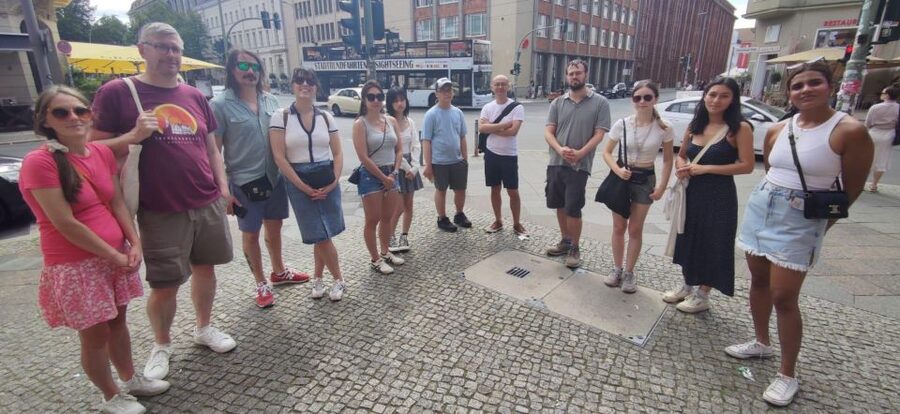
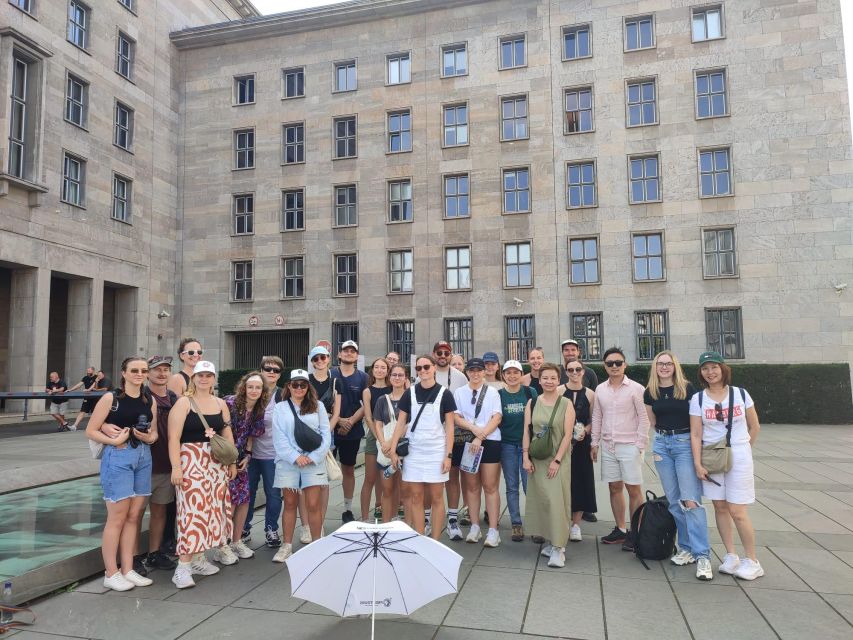
The meeting point is easy to state: look for a white umbrella on the corner in front of Generator Berlin Alexanderplatz. In practice, you should allow extra time to find the correct group.
Several tours may use the same general meeting area. That can create a noisy start, with people arriving for different routes and waiting to be sorted. One serious warning attached to this experience is that a group may not be clearly identified or may appear to merge with other tours. If the exact World War Two Third Reich and Cold War walk is not confirmed, ask before leaving the meeting point.
This is not a small detail. A five-hour historical walk depends on the right guide and route. Arriving ten minutes early gives you time to locate the white umbrella, show your booking, and make sure you are assigned to the correct English-speaking group.
Alexanderplatz is also a useful place to begin a day in Berlin. It puts you in the former East Berlin and near major public transport links, shops, and places to buy a drink or snack. The tour itself does not include hotel pickup, so you must make your own way there.
Nazi Berlin, the Reichstag, and the road to war
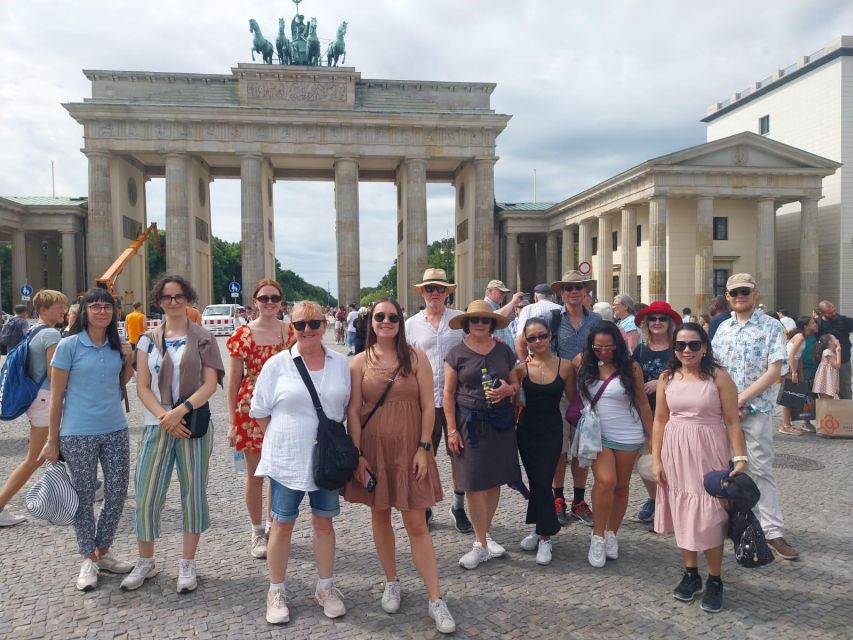
The first part of the walk focuses on the Third Reich and World War II. The Reichstag is one of the key landmarks named for the route. Its importance goes beyond architecture. It represents the German state, the political upheavals that helped bring Hitler to power, and the later rebuilding of a democratic Germany.
A good guide can use the Reichstag to explain how Berlin changed from a capital of dictatorship and war into the seat of a reunified parliament. You may hear how the building’s symbolism shifted over time, from a damaged structure in a defeated country to a working part of modern Germany.
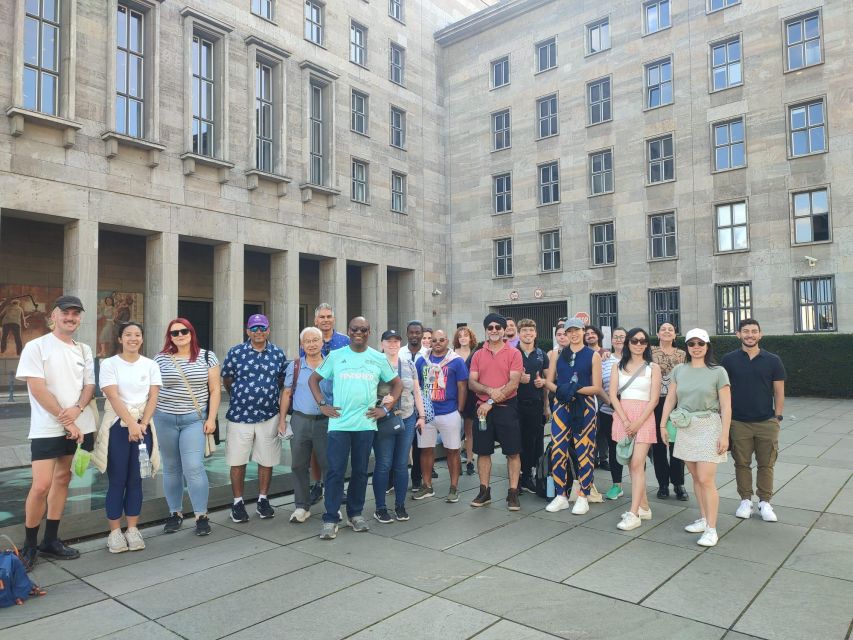
The route also includes Hitler’s bunker, or the site connected with it. This is a place where context matters more than what you see. There is no grand monument to admire, and the physical remains are limited. The significance comes from learning how the final days of the Nazi regime unfolded underground while Berlin was being destroyed above.
I appreciate that this stop can puncture the usual sightseeing habit. You are not being offered a polished attraction. You are being asked to understand a location whose importance comes from the decisions made there and the devastation those decisions helped produce.
The walk may also take in wartime defenses such as Flak Tower. These huge concrete structures were built for anti-aircraft guns and protection during air raids. They show the scale of wartime planning and the difficulty of removing the physical traces of the conflict. Their heavy construction also helps explain why some wartime structures survived when much of Berlin did not.
A Russian-German war museum is another named point on the route. It adds a military perspective to the story, especially the conflict between Germany and the Soviet Union. Expect this part of the tour to deal with battle, occupation, destruction, and the cost of war rather than only Berlin’s political leaders.
From defeat to a divided city
After World War II, Berlin became a center of the new conflict between the Soviet Union and the Western powers. The tour shifts from the Nazi period to East German communism and the Cold War, showing how one catastrophe led into another tense political order.
This transition is one of the strongest reasons to choose the walk. You can understand the Cold War better when you first know what Berlin looked like after 1945. The city was physically damaged, politically split, and occupied by rival powers. The division was not an abstract line on a map. It affected work, family life, travel, housing, and personal freedom.
The route aims to explain daily life behind the Berlin Wall. That human scale is important. A border barrier can seem like a museum object until you learn about the people who tried to cross it, the families separated by it, and the rules that shaped ordinary movement through the city.
The guide also discusses East German communism. You may hear about the political system, Soviet influence, and the lives of people living in East Berlin. The exact depth will depend on the guide and the pace of the group, but the subject gives the Wall a setting. It was not built in a vacuum. It was the visible result of a divided country and a much wider struggle between political systems.
More Third Reich sites in Berlin:
- Berlin: Berlin Story Bunker Entry Ticket
★ 4.6 · 6,759 reviews - Third Reich Berlin: Hitler and WWII Walking Tour
★ 5.0 · 3,301 reviews - Berlin: Third Reich, Hitler, and WWII Walking Tour
★ 4.9 · 1,133 reviews - Berlin Third Reich Sites: Half-Day Walking Tour
★ 5.0 · 835 reviews
Reading the Berlin Wall at Eastside Gallery
Eastside Gallery is one of the tour’s most recognizable Wall stops. It is known for its large painted sections, so it brings art into a route otherwise filled with war, repression, and political control.
The murals help explain Berlin’s cultural response to the Wall and its fall. The art is not simply decoration. It reflects protest, memory, hope, satire, and the city’s wish to reclaim a barrier that once controlled movement. The tour connects this creative side of Berlin with its political story.
You should keep your expectations sensible. Eastside Gallery is an outdoor stretch rather than a formal museum visit. You may find crowds, changing artwork, and limited time for every mural. Still, it gives the walk a welcome change of mood and shows how public art became part of Berlin’s identity.
The tour also refers to less obvious sections of the Wall, along with guard towers and escape routes. These sites are often more affecting than the famous painted panels because they reveal how the border worked. The Wall was a system of barriers, patrols, open ground, and surveillance, not just a single slab of concrete.
A guide can help you spot the difference between original remains, reconstructed sections, and memorial elements. That distinction is useful in Berlin, where the city has had to preserve enough of the past to explain it without turning every site into a frozen exhibit.
Berlin Wall Memorial and the human cost of escape
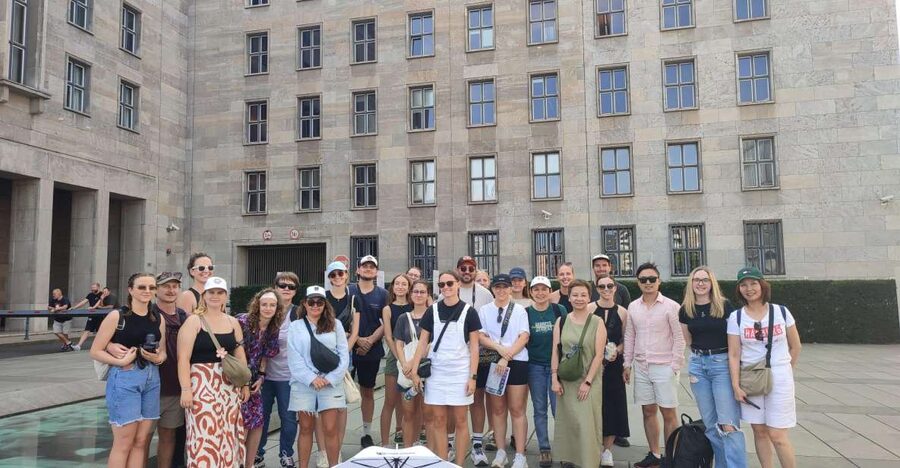
The Berlin Wall Memorial provides a more serious setting for the divided-city story. Here the focus is likely to shift from the Wall as a political symbol to the people who lived beside it and tried to get across it.
Escape routes are a key part of the experience. Learning how people attempted to leave East Berlin makes the border feel personal and dangerous. Some efforts involved tunnels or carefully planned routes, while others ended in arrest or death. The supplied tour details do not promise a particular escape story, so the exact examples will depend on the guide.
The memorial setting also helps explain how the Wall changed the shape of neighborhoods. Streets, homes, churches, and public spaces could be caught inside the border zone. A family might live only a short distance from relatives yet be unable to visit them freely.
This part of the tour may be the most emotionally demanding. It deals with surveillance, restricted movement, and the fear attached to a border that remained in place for decades. If you prefer lighter sightseeing, this is not the right type of city walk. If you want a clear account of how political decisions affected ordinary people, it is a valuable part of the route.
Architecture that survived Berlin’s upheavals
The tour pays attention to buildings as evidence. Berlin’s architecture records war damage, occupation, rebuilding, and political division. Some structures survived because they were built to withstand attack. Others were repaired, altered, or given new uses after the war.
The Reichstag and Flak Tower show two very different sides of that story. One is tied to national government and public life. The other reflects the practical demands of wartime defense. Together with Wall remains and Cold War sites, they create a city lesson you can read at street level.
I like this use of architecture because it keeps the history visible. You do not have to rely only on a museum display. A scarred building, an empty space, or a preserved section of border can help you picture the city at different points in time.
At the same time, do not expect entry into every landmark named in the description. The experience is a guided walking tour, and the supplied details do not specify opening hours, interior access, or how long you spend inside each site. The phrase exclusive entry to pivotal landmarks suggests access is included at selected places, but you should confirm the exact interiors when booking.
Five hours on foot: the practical reality
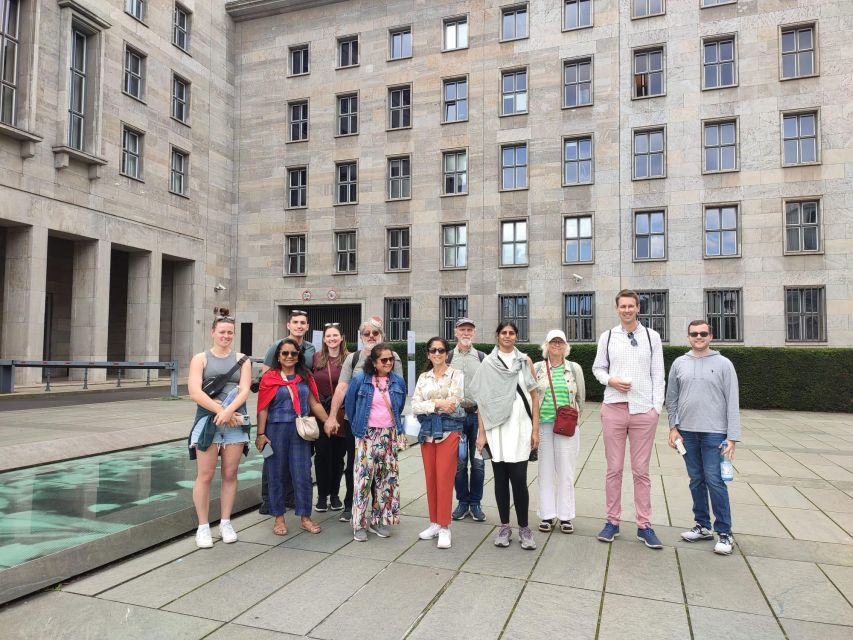
Five hours is long enough to connect several parts of Berlin, but it requires preparation. Wear comfortable shoes and clothing suited to the weather. Bring snacks and drinks because meals and refreshments are not included.
Cash is also listed among the recommended items. You may want it for personal purchases or small needs along the way, but no specific paid stop or required expense is given. Souvenirs are not included, so budget separately if you want a Wall-related keepsake.
The tour is listed as wheelchair accessible. That is useful information, though a long route across city streets and historic areas can still feel tiring. If you use a wheelchair, confirm the exact route and any interior access details before booking, since the supplied information does not describe the surface conditions or facilities at each stop.
There is no hotel pickup or drop-off. You meet at Alexanderplatz and return to the meeting point at the end. Returning to the same central location is convenient if you want to continue sightseeing, eat nearby, or use public transport to reach your hotel.
Starting times vary, so check availability for the date you want. The tour is offered in English, and no other language is listed.
Is $21 good value for this route?
At $21 per person, the tour is priced well for a five-hour guided walk. You are paying less than many museum-led experiences while covering several major periods and sites. The value comes mainly from the guide’s explanations and the way the locations are connected.
This is not the right choice if you want a private tour, a relaxed pace, or guaranteed long visits inside museums. It is a group walk, and the number of stops means some places may receive only a short explanation. The price also does not cover food, drinks, souvenirs, or hotel transport.
The low cost makes the tour a sensible first introduction to Berlin’s 20th-century story. You can use it to decide which subjects deserve more time later. Afterward, you may want to return to a memorial or museum that caught your attention.
The one value risk is poor coordination at the start. A cheap tour is not a bargain if you are placed into the wrong group or cannot confirm that the advertised route is running. Arrive early, show your booking clearly, and ask the staff to identify the correct World War Two and Cold War group before you leave.
Who should book this walking tour?
I would choose this experience if you want one broad, serious introduction to Berlin’s Nazi and Cold War past. It suits first-time visitors who want a guide to connect sites that can otherwise feel scattered across the city.
It is also a good fit for students, history-minded adults, and anyone interested in how war, dictatorship, communism, and popular protest shaped modern Europe. The cultural material on music, art, and revolution gives the route more range than a purely military tour.
You should think twice if five hours of walking sounds tiring, if you need extensive museum time, or if you want a quiet private experience. Families with older children may find the subject useful, but the themes are grave and may not suit young children.
Should you book the Berlin Third Reich and Cold War walk?
Book it if you want a low-cost, full-length history walk that joins Nazi Berlin, wartime destruction, East Germany, the Berlin Wall, and modern cultural memory. The combination of major landmarks, Wall remains, escape stories, and local historical guidance gives you a strong framework for exploring Berlin afterward.
I would not book without checking the meeting arrangements carefully. The white umbrella in front of Generator Berlin Alexanderplatz is the stated start, but the gathering area can be confusing when several tours collect there. Once that detail is handled, this can be a useful and affordable way to understand why Berlin looks and feels the way it does today.
FAQ
How long is the Berlin World War Two and Cold War walking tour?
The tour lasts five hours.
Where does the tour start?
Meet at the white umbrella on the corner in front of Generator Berlin Alexanderplatz.
Where does the tour finish?
The activity ends back at the meeting point.
What language is the tour conducted in?
The tour is conducted in English with a live guide.
Is the walking tour wheelchair accessible?
Yes, the activity is listed as wheelchair accessible.
Are food and drinks included?
No. Meals and refreshments are not included, so bring snacks and drinks.
What should I bring?
Bring comfortable shoes, weather-appropriate clothing, snacks, drinks, and cash.
More Walking Tours in Berlin
- Discover Berlin Half-Day Walking Tour
★ 5.0 · 9,624 reviews - Berlin: Discover Berlin Walking Tour
★ 4.9 · 5,998 reviews - Berlin: Hidden Backyards Guided Walking Tour
★ 4.8 · 5,360 reviews - Berlin: Alternative Berlin Walking Tour
★ 4.6 · 1,204 reviews
Just added around Berlin
- Berlin Highlights in One Day★ 5.0 · 3 reviews
- Private Berlin One Day Tour with a Local: See the City Unscripted★ 3.5 · 3 reviews
- Individual city tour Berlin for max. 8 persons★ 5.0 · 3 reviews
- Transfer from Berlin Schönefeld Airport (SXF) to Berlin city Hotels – ROUND TRIP★ 4.0 · 3 reviews
- Berlin: Museum Island Tour★ 5.0 · 3 reviews
- Private Analogue Photography Experience in Berlin★ 5.0 · 3 reviews
- Berlin: Local Food Tour in Secrets Hidden Gems★ 4.0 · 3 reviews
- Potsdam Highlights – Private sightseeing tour by minibus★ 5.0 · 3 reviews
Third Reich & WWII Sites, compared.



Berlin’s Best: 2 Hour Walking Tour Third Reich and the Cold War
Read our review →
Third Reich Berlin: Hitler and WWII Walking Tour
Read our review →

Berlin Third Reich Sites: Half-Day Walking Tour
Read our review →
Guided Bike Tour of the Berlin Wall and Third Reich
Read our review →
Hitler’s Germany: Berlin During the Third Reich & WWII
Read our review →Browse the lists this tour appears in