
Review · THIRD REICH & WWII SITES
Private Walking Tour: World War 2 and Cold War Sites in Berlin
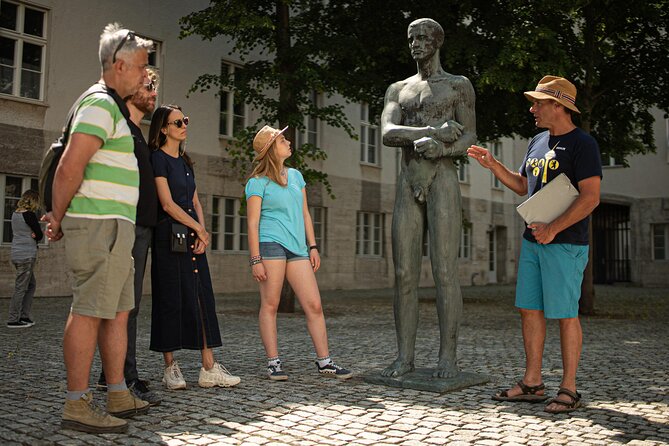
Berlin’s most important 20th-century sights are scattered across a large city, and a good guide can turn disconnected monuments into one clear story. This private walking tour links the Nazi capital, the divided city, and reunified Berlin, with time for the Brandenburg Gate, Hitler’s bunker site, Checkpoint Charlie, and the Berlin Wall.
I especially like the freedom to choose WWII, the Cold War, or both. I also like the personal pace: guides such as Hannah, Glen, Daniel, Maria, and Ariel have adjusted routes, answered many questions, and helped people plan the rest of their stay. The catch is that the full list of possible stops cannot fit comfortably into four hours on foot, so you need to state your priorities clearly when booking.
In This Review
- Key points to know before you book
- Why this private Berlin history walk works
- Reichstag and Brandenburg Gate: the best opening chapter
- Holocaust Memorial and the Führerbunker site
- Reich Air Ministry and the Topography of Terror
- Checkpoint Charlie and the Palace of Tears
- Bernauer Strasse and Berlin Wall Memorial
- Prenzlauer Berg and the Stasi prison story
- East Side Gallery and Tempelhofer Feld
- How to get the most from the three to four hours
- The guides and the personal touch
- Who should book this tour?
- Should you book it?
- FAQ
- How long does the private Berlin history tour last?
- Can I choose between WWII and Cold War history?
- Is the tour private?
- Is hotel pickup included?
- Is the tour offered in English?
- Which major Berlin sights can be included?
- Are admission tickets included?
- Will the East Side Gallery and Berlin Wall Memorial always be included?
- What is the cancellation policy?
Key points to know before you book
- Choose your historical focus: Build the walk around Nazi Germany, the Cold War, or a combination of both.
- Expect a private guide: Only your group takes part, allowing room for questions and changes along the way.
- See Berlin’s major symbols: The Brandenburg Gate, Reichstag, Holocaust Memorial, Checkpoint Charlie, and Berlin Wall sites can form the backbone of the route.
- Prepare for substantial walking: The tour is about three to four hours, with several stops requiring time on your feet.
- Ask for specific places in advance: The East Side Gallery, Berlin Wall Memorial, and other distant sites may not all be included unless you request them.
- Use the tour early in your stay: Several people found it useful for understanding Berlin’s layout and deciding what to see afterward.
Why this private Berlin history walk works
Berlin can feel like an open-air history book with several chapters printed on top of one another. A Nazi government building may later have served East Germany. A former border crossing can now be surrounded by shops and traffic. A strip of Wall can carry bold paintings about freedom. Without explanation, the pieces do not always connect.
That is the main value here. Your guide gives you the political and human context as you walk, instead of leaving you to read isolated plaques. The route can explain Hitler’s rise, the Third Reich, the Battle of Berlin, the Soviet occupation, the division of Germany, escape attempts, and the Wall’s fall.
The private format matters. Guides have adapted the pace for older walkers, spent more time at subjects that interested a group, and changed the route when a place had already been seen. One guide, Jamie, also helped a group learn to use Berlin’s U-Bahn and S-Bahn, which is a useful bonus early in a city visit.
The tour costs $192.97 per person. That is a serious price for a walking tour, especially for two people, but the calculation changes with group size. You are paying for a private guide rather than a seat on a large shared outing, hotel pickup and drop-off, and the ability to shape the discussion around your interests. If your group wants a quick orientation and serious historical explanation, the cost can make sense. If you only want photographs of the main monuments, it is harder to justify.
More Cold War Berlin:
- Berlin: Third Reich and Cold War 2 Hour Walking Tour
★ 4.9 · 6,830 reviews - Berlin’s Best: 2 Hour Walking Tour Third Reich and the Cold War
★ 5.0 · 5,486 reviews - Cold War, Berlin Wall, Spies and the East Side Gallery
★ 5.0 · 1,024 reviews
Reichstag and Brandenburg Gate: the best opening chapter
The Reichstag is a strong place to begin because it brings together imperial Germany, the Nazi period, the war, and modern reunification. From outside, your guide can explain the building’s role in Berlin and discuss the political story surrounding the fall of the Third Reich.
The tour may also cover Claus von Stauffenberg and other people who opposed the Nazi regime, along with memorials to those killed during the period. You can hear about Albert Speer’s grand plans for Germania and the Soviet monumental style that followed the war.
The Reichstag stop is brief, listed at about 10 minutes, and admission is free. Do not expect this walking tour to provide a full interior visit or a long architectural tour. Its purpose is to place the building inside the larger story.
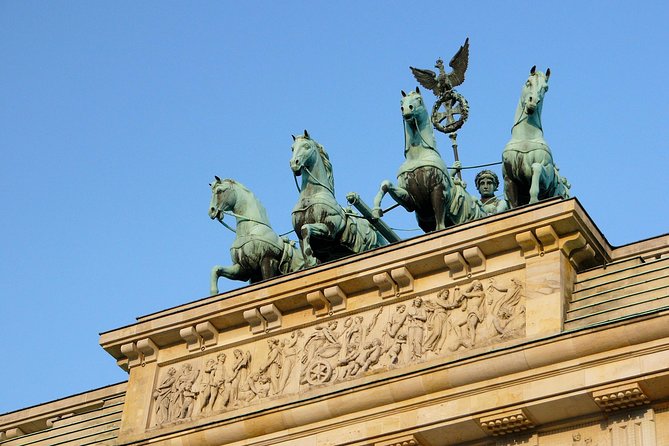
A short walk brings you to the Brandenburg Gate, one of Berlin’s essential sights. During the Cold War, it represented division because it sat near the border between East and West Berlin. Today it represents a united Germany. That change in meaning is exactly the kind of detail that makes a guided visit worthwhile.
Again, the planned stop is about 10 minutes. The gate is easy to photograph, but the real benefit comes from understanding how its symbolism changed from Prussian monument to Cold War icon to national symbol.
Holocaust Memorial and the Führerbunker site
The Memorial to the Murdered Jews of Europe is one of Berlin’s most affecting places. Its 2,711 concrete slabs form a grid near the Brandenburg Gate. The blocks vary in height, and the ground between them changes as you walk, creating an uneasy sense of disorientation.
Your guide can explain the memorial’s purpose and the Nazi murder of Europe’s Jews. An underground information center beneath the field of stelae contains historical material and personal accounts. The walking tour lists about 15 minutes here, so ask in advance if you want more time for the underground center.
The memorial asks for quiet attention. It is not a place to rush through while taking selfies, though you will see people doing exactly that. A guide can help you read the design with respect and keep the focus on the people and events being remembered.
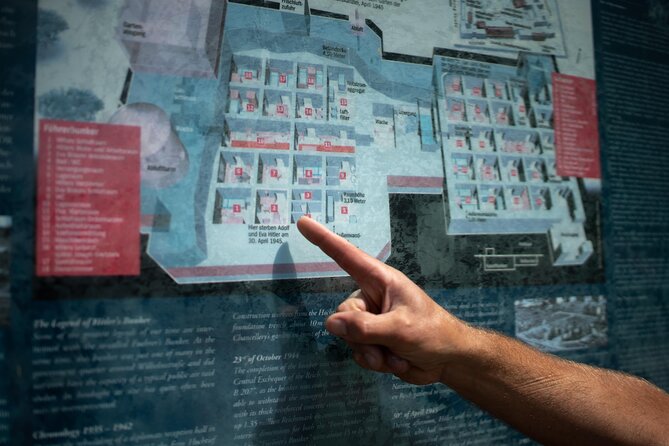
Nearby, the Führerbunker site marks the location where Adolf Hitler spent his final days. The bunker itself is not open as a preserved attraction. You will see the location and hear how it fits into the collapse of the Nazi regime and the Battle of Berlin.
This is a useful stop because the plain setting can be misleading. There is no dramatic underground chamber to explore. The guide supplies the context, explains why the site looks ordinary today, and connects it to Berlin’s effort to confront its past without turning the place into a shrine.
Reich Air Ministry and the Topography of Terror
The former Reich Air Ministry is one of the most striking surviving Nazi-era buildings in central Berlin. Completed in 1936, it housed the Luftwaffe and was closely linked with Hermann Göring. Its massive scale was meant to project state power.
The building survived the war and later served East Germany’s Ministry of Transport. That later use gives the site an extra layer: Nazi authority, wartime damage, East German government, and present-day Berlin all occupy the same address.
The stop is generally brief, about 10 minutes, and admission is free. You will not be touring Göring’s office as a museum room, but the exterior and its changing role make it a valuable piece of the city’s political story.
At the Topography of Terror, you learn about the institutions that carried out Nazi persecution. The site once housed the headquarters of the SS, Gestapo, and SD. Its exhibitions focus on the people and agencies responsible for terror, not only on the victims and battlefields.
That distinction is important. Understanding how the machinery of repression operated helps explain how ordinary administration, policing, propaganda, and violence were tied together. The suggested stop is about 15 minutes, so tell your guide if this subject is central to your interests.
More Third Reich sites in Berlin:
- Berlin: Berlin Story Bunker Entry Ticket
★ 4.6 · 6,759 reviews - Third Reich Berlin: Hitler and WWII Walking Tour
★ 5.0 · 3,301 reviews - Berlin: Third Reich, Hitler, and WWII Walking Tour
★ 4.9 · 1,133 reviews - Berlin Third Reich Sites: Half-Day Walking Tour
★ 5.0 · 835 reviews
Checkpoint Charlie and the Palace of Tears
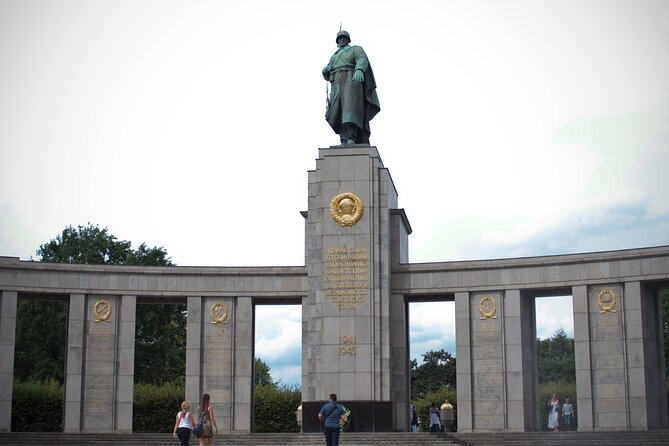
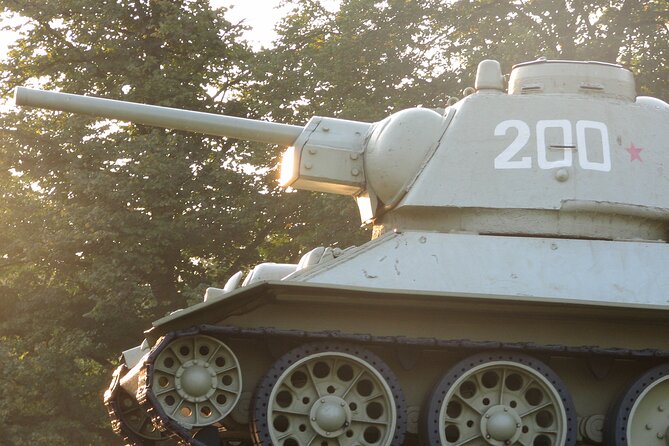
Checkpoint Charlie is Berlin’s most famous former crossing point between East and West. It became the scene of a tense American and Soviet tank confrontation in 1961, after the Berlin Wall had divided the city.
Your guide can explain the checkpoint’s role in Cold War politics, espionage, escape attempts, and the daily cost of separation. The stop is listed at 15 minutes. The modern area is busy and commercial, and the guardhouse setting is not a preserved border in the way first-time visitors sometimes expect. The story is stronger than the physical remains.
That is why a guide is useful here. You can learn how a place that now feels like a regular city intersection once carried the risk of international war and personal imprisonment.
The Palace of Tears at Friedrichstrasse Station offers a more human view of the same division. From 1961 to 1989, it served as a departure hall for East Germans crossing into West Berlin. Families and friends said goodbye there under strict travel rules, often with no clear idea when they would meet again.
The museum explains those farewells and the personal effects of the Wall. The suggested visit lasts about 20 minutes. It is a particularly good addition for anyone who wants to understand how the Cold War affected ordinary families, not only governments and soldiers.
Bernauer Strasse and Berlin Wall Memorial
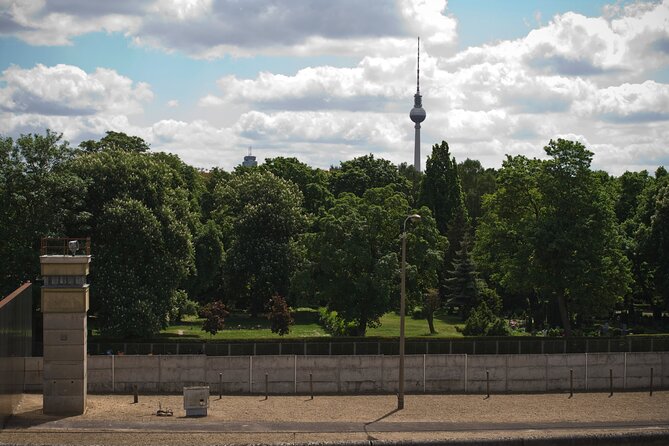
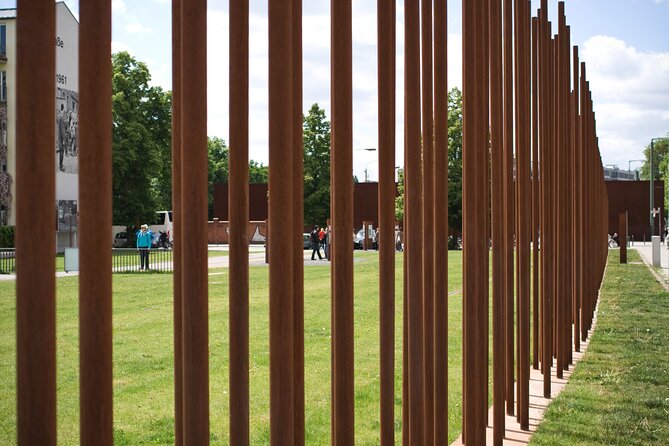
The Berlin Wall Memorial on Bernauer Strasse is one of the strongest Cold War stops on the route. When the Wall went up in 1961, it cut directly through the street and split neighbors from one another. East Berlin residents were trapped on one side while people in West Berlin watched from nearby.
The memorial preserves sections of the Wall, a watchtower, and the former border zone. You can hear about escape tunnels, including Tunnel 29, which helped 29 people flee in 1962, and Tunnel 57, used by 57 people in 1970.
The suggested stop is about 25 minutes, longer than several central monuments. That is sensible. Bernauer Strasse needs time because the physical remains, photographs, and personal stories work together.
I would prioritize this site over a quick photo stop at Checkpoint Charlie if your main interest is how the Wall shaped daily life. It gives you a better sense of the barriers, guard systems, and risks involved in escaping East Germany.
Prenzlauer Berg and the Stasi prison story
The Prenzlauer Berg portion can introduce a less polished side of Cold War Berlin. You may visit an old NKVD prison, later used by East Germany’s Stasi, and learn about interrogation methods used against prisoners.
The stop lasts about 10 minutes and focuses on how political policing worked. It also raises a question that runs through modern Berlin: how should Germany preserve places connected with dictatorship and repression?
This site may appeal most to people who want more than the famous landmarks. It is not as instantly recognizable as the Brandenburg Gate, but it helps explain the fear and surveillance that shaped life in East Germany.
East Side Gallery and Tempelhofer Feld
The East Side Gallery is the longest remaining section of the Berlin Wall and one of the world’s longest permanent open-air graffiti galleries. Murals cover the concrete with images tied to freedom, justice, and political change.
It is a lively, visual contrast to Bernauer Strasse. At Bernauer, you see the Wall as a barrier. At East Side Gallery, you see it turned into public art. The two places together show how Berlin has reused and reinterpreted the remains of division.
There is one practical warning: East Side Gallery is far from several central WWII sites. The route cannot reasonably linger at every central stop and also cover distant Wall locations in a short walk. Tell the company and guide if this is a must-see.
Tempelhofer Feld adds another wide-ranging stop. The former Nazi airport later played a role in the Allied airlift of 1948 and 1949. The airport no longer functions as an airport, and its huge grounds are now used as a public recreation area.
This is an unusual place to include in a history walk. You get the airport’s wartime and Cold War importance, along with a sense of how Berlin has reclaimed a former symbol of military power for everyday public use. Its location also makes it a route choice rather than an automatic addition.
How to get the most from the three to four hours
Start by deciding what you want the tour to accomplish. If you are new to Berlin, a blend of WWII and Cold War history gives you a useful framework. If you have already visited the central monuments, ask for Bernauer Strasse, East Side Gallery, Tempelhofer Feld, or the less familiar government and prison sites.
Send specific requests when you book. One disappointing outing resulted from an assumption that the East Side Gallery and Berlin Wall museum would automatically be included. The company explained that those places had not been requested in advance. The lesson is simple: customized does not mean every listed stop is guaranteed.
You can choose a morning or afternoon departure. A morning start on your first full day can help you get your bearings fast and decide what to revisit later. Afternoon timing may work better if you want a slower first morning, but remember that the tour is primarily outdoors.
Wear comfortable shoes and plan for several hours on foot. One group walked continuously without a drink break, while other guides adjusted the pace for older participants. Bring water and tell your guide about pacing needs at the start.
The tour includes hotel pickup and drop-off, with a central Berlin hotel lobby used for the meeting. Food and drinks are not included. The booking information says the activity is near public transportation, and one guide helped people learn the U-Bahn and S-Bahn, but this is still a walking tour rather than a sightseeing ride.
The guides and the personal touch
The strongest pattern across the guide feedback is not one fixed personality or script. It is the ability to adapt. Hannah was praised for an in-depth account of Berlin and Germany, while Glen was described as energetic, patient with questions, and good at giving both historical and cultural context.
Daniel, Ariel, Maria, Jamie, Joerg, Klaus, Emma, Peter, Rohan, Steve, Jim, Callum, Maggie, Gilly, and others have all been singled out for clear explanations, personal attention, or a well-managed pace. You should not assume you can select a particular guide unless the company confirms it, but it is reasonable to request the style you prefer.
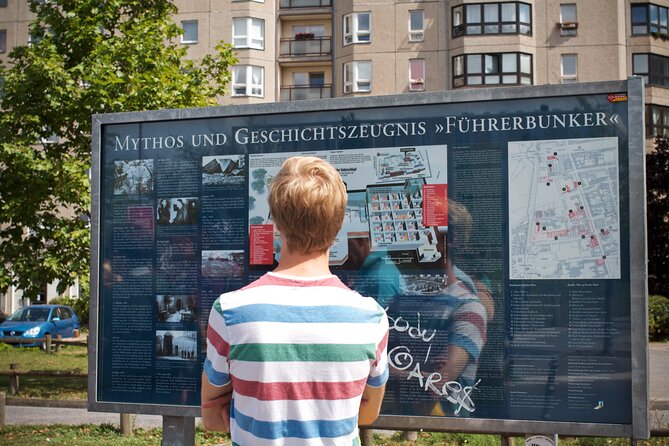
Some guides use photographs or picture books to show how places looked before and after the war. That can be especially helpful at the Wall, the Führerbunker site, and former government buildings where little remains for an untrained eye.
The quality can vary by individual guide. One critical experience raised concerns about historical explanations and about missing requested sites. That is why I would communicate your interests before the meeting and ask the guide to confirm the route at the beginning.
Who should book this tour?
This tour suits you if you want history explained in place, prefer a private guide, and have enough interest to ask questions. It is especially useful for families, couples, and small groups with different levels of background knowledge, since the guide can slow down, simplify, or go deeper as needed.
It also works well as an opening activity. Several people found that the tour helped them understand Berlin’s layout and choose later museums and neighborhoods. If you have already walked past the main sights, a guide can supply the missing story.
I would be more cautious if you dislike long walks, want extended museum visits, or expect every possible stop in a four-hour period. You may get better value from choosing a shorter central route and spending the rest of the day inside a museum.
Cancellation is free up to 24 hours before the start time. Changes or cancellations within 24 hours are not accepted for a refund. Service animals are allowed, and the activity says most people can participate, but you should still mention mobility or pacing concerns when arranging the route.
Should you book it?
Book this private Berlin WWII and Cold War walking tour if you want a serious introduction shaped around your own questions. The best version focuses on a manageable set of sites, with a guide who can connect the Reichstag and Brandenburg Gate to the Nazi period, then explain division at Checkpoint Charlie, the Palace of Tears, and the Wall Memorial.
At $192.97 per person, it is not a bargain sightseeing stroll. It becomes better value when shared by a small group and when you use the guide’s advice for the rest of your visit. Confirm your must-see places before the day, bring water, wear good shoes, and treat the itinerary as a menu rather than a promise to see everything.
FAQ
How long does the private Berlin history tour last?
The tour lasts approximately three to four hours. A shorter three-hour version may be available, depending on the arrangement and route.
Can I choose between WWII and Cold War history?
Yes. You can focus on World War II, focus on the Cold War, or request a combination of both.
Is the tour private?
Yes. Only your group participates, so the guide can tailor the route, pace, and discussion to your interests.
Is hotel pickup included?
Yes. The experience includes pickup and drop-off at your hotel. The meeting is described as a meet and greet in a central Berlin hotel lobby.
Is the tour offered in English?
Yes. The tour is offered in English.
Which major Berlin sights can be included?
Possible sights include the Reichstag, Brandenburg Gate, Holocaust Memorial, Führerbunker site, former Reich Air Ministry, Topography of Terror, Checkpoint Charlie, Palace of Tears, Berlin Wall Memorial, and East Side Gallery.
Are admission tickets included?
The listed stops have free admission. Food and drinks are not included.
Will the East Side Gallery and Berlin Wall Memorial always be included?
Not necessarily. The route is customized, and the full list of places cannot all fit into every three to four hour walk. Request these sites specifically when booking.
What is the cancellation policy?
You can cancel up to 24 hours before the local start time for a full refund. Cancellations or changes made less than 24 hours before the start time are not accepted for a refund.
More Walking Tours in Berlin
- Discover Berlin Half-Day Walking Tour
★ 5.0 · 9,624 reviews - Berlin: Discover Berlin Walking Tour
★ 4.9 · 5,998 reviews - Berlin: Hidden Backyards Guided Walking Tour
★ 4.8 · 5,360 reviews - Berlin: Alternative Berlin Walking Tour
★ 4.6 · 1,204 reviews
Just added around Berlin
- Berlin Highlights in One Day★ 5.0 · 3 reviews
- Private Berlin One Day Tour with a Local: See the City Unscripted★ 3.5 · 3 reviews
- Individual city tour Berlin for max. 8 persons★ 5.0 · 3 reviews
- Transfer from Berlin Schönefeld Airport (SXF) to Berlin city Hotels – ROUND TRIP★ 4.0 · 3 reviews
- Berlin: Museum Island Tour★ 5.0 · 3 reviews
- Private Analogue Photography Experience in Berlin★ 5.0 · 3 reviews
- Berlin: Local Food Tour in Secrets Hidden Gems★ 4.0 · 3 reviews
- Berlin & The Third Reich Private Guided Tour★ 5.0 · 3 reviews
Third Reich & WWII Sites, compared.



Berlin’s Best: 2 Hour Walking Tour Third Reich and the Cold War
Read our review →
Third Reich Berlin: Hitler and WWII Walking Tour
Read our review →

Berlin Third Reich Sites: Half-Day Walking Tour
Read our review →
Guided Bike Tour of the Berlin Wall and Third Reich
Read our review →
Hitler’s Germany: Berlin During the Third Reich & WWII
Read our review →Browse the lists this tour appears in