
Review · JEWISH BERLIN & HOLOCAUST MEMORIALS
Berlin: Jewish Walking Tour including World War II
Berlin’s Jewish story is written into ordinary Mitte streets, courtyards, memorials, schools, and cemetery stones. This private walk with Tal connects the community’s growth from the time of Moses Mendelssohn to its destruction during World War II, then brings the story forward to Jewish life in Berlin today.
I like the clear human stories, especially Otto Weidt’s efforts to protect Jewish workers and the 1943 women’s protest. I also like that Tal can shape the walk around your interests rather than march you through a fixed script. The main drawback is the price: at $318 per person, this makes the most sense for a private group that wants several hours with a specialist guide.
In This Review
- Key points to know before you book
- Why this Mitte walk matters
- Starting at Hackescher Markt
- The Block of Women and the power of public protest
- Otto Weidt’s workshop and a story of protection
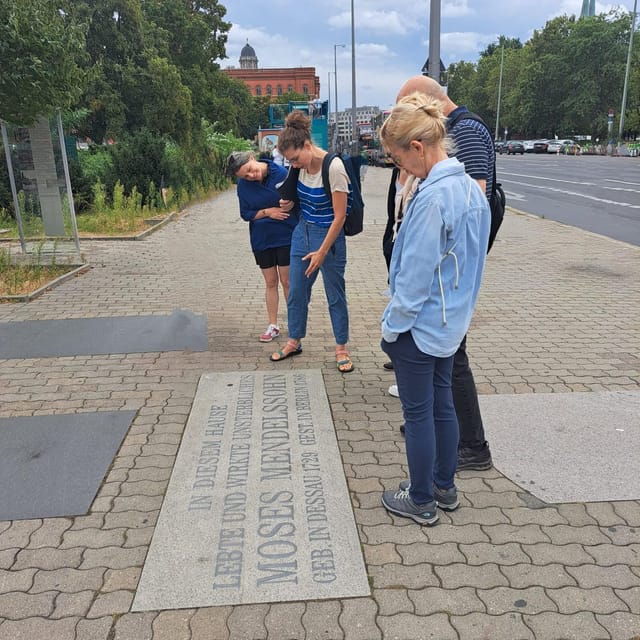
- Old cemetery and Moses Mendelssohn
- The first synagogue and the community’s changing identity
- The New Synagogue from the outside
- Schools and community institutions in Mitte
- From wartime Berlin to Jewish life today
- Optional extensions beyond the main route
- Price, group size, and practical value
- Who should take this tour
- Should you book Tal’s Berlin Jewish walking tour?
- FAQ
- How long does the Berlin Jewish walking tour last?
- Where does the tour begin?
- Where does the tour finish?
- Which languages are available?
- Is entry to the New Synagogue museum included?
- What should I bring?
Key points to know before you book
- Moses Mendelssohn’s grave: Visit Berlin’s first Jewish cemetery, where the major Enlightenment-era thinker is buried.
- A walk through Mitte: Hackescher Markt, former community institutions, synagogue sites, memorials, and the cemetery create a connected route.
- Personal stories from the war years: The Otto Weidt Museum and Block of Women add individual courage and protest to the larger historical account.
- A private experience: Tal can adjust the focus and add sites such as the Kindertransport Memorial or Grunewald Deportation Memorial.
- English or Hebrew guiding: Tal is a certified Berlin guide and also works professionally on Berlin and German Jewish history.
- Check the access details: The activity is described as wheelchair accessible in one place, but also as unsuitable for wheelchair users and people with mobility impairments. Confirm before booking.
Why this Mitte walk matters
A Jewish history tour of Berlin can easily become a list of dates and tragedies. This one has a wider frame. You begin with the community’s re-establishment in the second half of the 17th century, learn about its intellectual and social growth, see evidence of its institutions, and then follow the road toward persecution, deportation, and murder.
That wider view matters. Berlin’s Jewish community did not begin with World War II, and it did not end there. The walk gives time to the period when Jewish Berliners built schools, places of worship, businesses, and cultural institutions. It also covers the arrival of Ostjuden, Eastern European Jews who came to Berlin after pogroms, and the tension their arrival created among established German Jews.
Tal’s background gives the walk unusual depth. Alongside personal interest in Jewish life in the 19th century and today, Tal has academic and professional experience with Berlin and German Jewish history. That includes post-doctoral work on how present-day staff at Berlin’s Charité Hospital deal with the hospital’s role in the 1930s and 1940s.
You should expect serious subject matter, but not a dry lecture. The tour’s strongest moments come when large events are linked to a particular person, building, or act of resistance.
More Third Reich sites in Berlin:
- Berlin: Third Reich and Cold War 2 Hour Walking Tour
★ 4.9 · 6,830 reviews - Berlin: Berlin Story Bunker Entry Ticket
★ 4.6 · 6,759 reviews - Berlin’s Best: 2 Hour Walking Tour Third Reich and the Cold War
★ 5.0 · 5,486 reviews
Starting at Hackescher Markt
The meeting point is in front of Starbucks, near Hackescher Markt. It is a practical place to begin, though the modern café is not the point of the stop. From here, Tal sets the area within the story of Jewish Berlin and explains why Hackescher Markt became important to Eastern European Jewish newcomers.
This is a useful opening because it complicates the picture of a single Jewish community. Berlin included people with different languages, customs, social positions, and ideas about religious practice. Established German Jews sometimes felt embarrassed by the arrival of poorer Eastern European Jews, even though both groups faced hostility and exclusion.
The guided portion here lasts about 15 minutes. It is long enough to establish the setting without using up too much of the walk before the major memorials and museums.
The Block of Women and the power of public protest
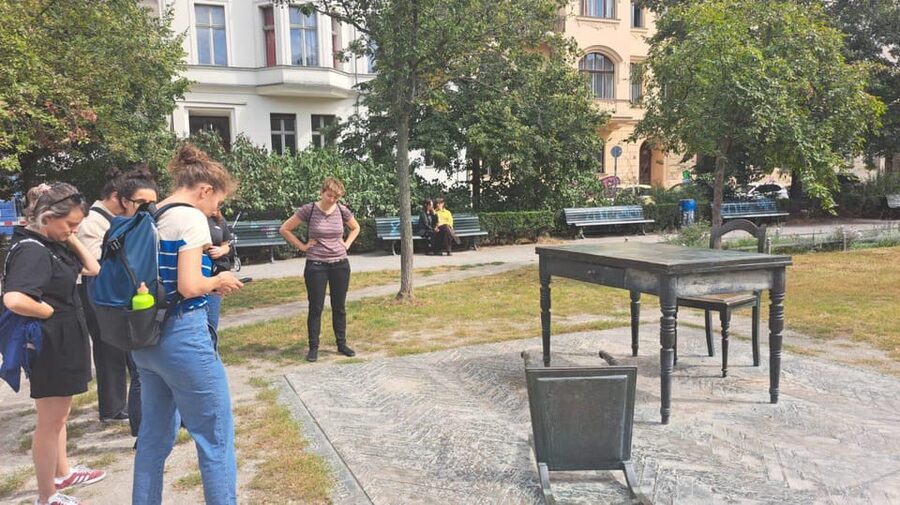
The Block of Women memorial recalls the women’s protest of 1943. This is one of the most striking stops because it focuses on an act of civilian resistance rather than a military event or government decision.
The story belongs to Berlin’s wartime history, but the memorial also raises questions about who could protest, what made protest possible, and how family ties shaped the experience of persecution. Tal gives the stop about 20 minutes, enough time for the event to be explained instead of reduced to a quick photo opportunity.
I like this part of the route because it brings a personal scale to World War II. You are not simply told that Berliners suffered or resisted. You are shown how a particular group of women used public pressure in an attempt to protect their husbands and relatives.
As with every memorial on a serious tour, allow yourself time to listen. This is not a stop to rush through while checking your phone.
Otto Weidt’s workshop and a story of protection
The Otto Weidt Museum is the emotional center of the walk. You enter the former workshop of Otto Weidt, who employed blind and deaf Jewish workers and made efforts to protect people from Nazi persecution.
The visit includes admission except on days when the museum is closed. The guided time is about 30 minutes, though the exact visit may depend on museum operations and the group’s pace.
Weidt’s story is valuable because it shows how resistance could take many forms. Not everyone who helped Jewish people was part of an organized underground movement. Some used a workplace, personal contacts, lies, bribes, or persistence to shield people from danger.
This stop also gives the tour a physical setting for its wartime history. Memorials can feel abstract. A workshop connected to a named person and his workers makes the moral choices more concrete. You can ask Tal questions about Weidt, the workers, and the wider setting of Jewish life in Berlin during the war.
The museum is small, so do not expect a large exhibition hall. That is part of its strength, but it also means the experience depends heavily on Tal’s explanation and your attention.
More Jewish Berlin and memorial walks:
- Berlin: Jewish Museum Berlin Entrance Ticket
★ 4.5 · 8,393 reviews - Nazi Berlin and the Jewish Community Tour
★ 4.8 · 55 reviews - Path of Resistance: Berlin’s Hidden Holocaust Stories
★ 5.0 · 33 reviews - Private Tour: Jewish Heritage Walking Tour of Berlin
★ 5.0 · 29 reviews
Old cemetery and Moses Mendelssohn
The old Jewish cemetery is one of the most important historical stops. It was the community’s first cemetery, and Moses Mendelssohn is buried here.
Mendelssohn’s name opens the door to Berlin’s Jewish Enlightenment and to the intellectual life of the 18th century. His story helps you understand that Jewish Berlin was connected to debates about education, philosophy, language, religious practice, and citizenship long before the modern city took shape.
The cemetery visit is included except on Jewish holidays and Saturdays. A head covering or kippah is listed among the things to bring, so plan to dress respectfully. Comfortable shoes are also important, since the tour lasts about three and a half hours and includes several walking sections.
The cemetery is not just another location on a route. It gives you a sense of continuity. A grave can preserve a name and a connection to a person whose work shaped the community, even after the institutions around him changed or disappeared.
The first synagogue and the community’s changing identity
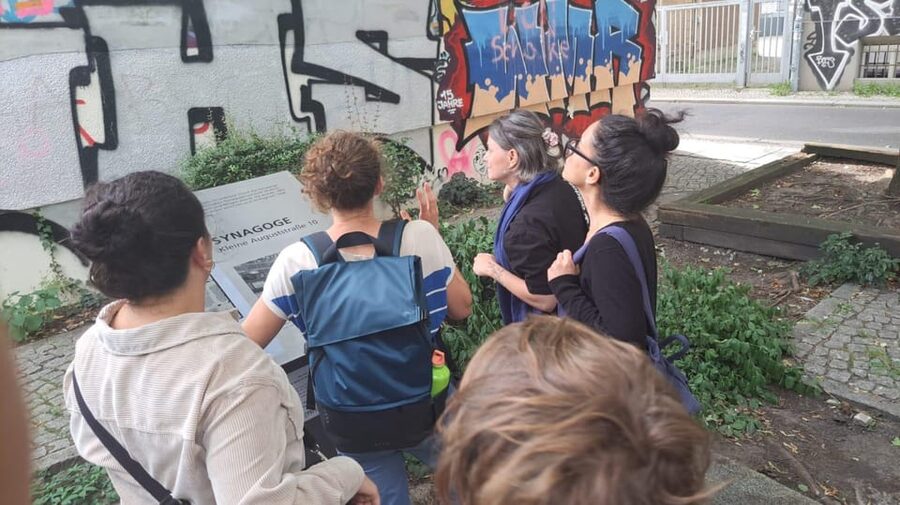
The route also includes the site of the community’s first synagogue. This stop helps explain how Jewish religious life developed in Berlin and how the community’s needs changed as it grew.
The tour covers disagreements caused by changes in worship, including the introduction of an organ. Such disputes may sound minor at first, but they reveal major questions about identity. Should a Jewish congregation adapt its services to fit wider German society, or protect older forms of practice? Who gets to decide what belongs inside a synagogue?
This is the sort of detail that makes the walk more useful than a simple list of famous buildings. You learn that the community was never one uniform group. It had internal arguments, social divisions, and competing ideas about the future.
The stop itself is guided for about 20 minutes. Some itinerary details do not name every location, so the precise order can vary. That is a good reason to tell Tal before starting if you are especially interested in religious practice, architecture, social history, or wartime events.
The New Synagogue from the outside
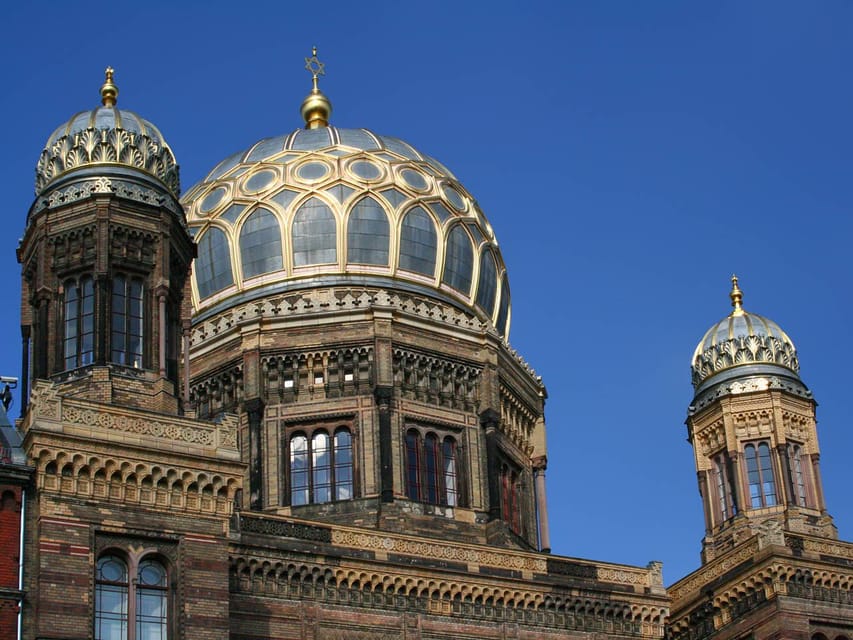
The New Synagogue is one of Berlin’s best-known Jewish landmarks. On this walk, you see the building from the outside and learn how it represented the community’s golden era, as well as the later destruction and loss.
The synagogue’s grand appearance gives a clear sense of confidence and prosperity. It also makes the story that followed harder to ignore. A building associated with Jewish public life became part of a city marked by Nazi persecution and wartime damage.
The guided stop lasts about 30 minutes. Admission to the Centrum Judaicum, the museum inside the New Synagogue, is not included. If you want to enter, you must buy a separate ticket and allow extra time.
This distinction matters when comparing tours. You are paying for a private walking experience and for entry to the Otto Weidt Museum and old cemetery when they are open. You are not getting a full indoor museum visit at the New Synagogue. If the interior exhibition is your main goal, ask Tal about adding it or plan a separate visit.
Schools and community institutions in Mitte
Along the way, Tal points out former and current community institutions, including the Mendelssohn School and the girls’ school. These locations show how Jewish life was built through education, not only through synagogues and cemeteries.
Schools can tell you a great deal about a community. They reveal how families prepared children for religious life, German civic life, and professional work. They also show the importance of girls’ education, which is easy to overlook when a tour focuses only on famous male figures.
The route includes another guided section of about 30 minutes around these kinds of sites. Since some locations are outside rather than indoor attractions, their value comes from explanation and context. You may not find a dramatic ruin or a large display, but you can better understand how an organized community functioned day by day.
From wartime Berlin to Jewish life today
The tour does not stop with destruction. Its stated aim is also to explain what is happening in Berlin’s Jewish community today.
That final perspective is important. A visit focused only on Nazi persecution can leave you with the false impression that Jewish history in Berlin ended in 1945. This walk places the Holocaust within a much longer story of rebuilding, memory, migration, religious life, and public debate.
Tal’s interest in both 19th-century questions and Jewish life today should be useful here. You can ask about changes in the community, the return of institutions, and how Berlin deals with its past. The available information does not promise a particular modern institution visit, so ask in advance if you want current community life to be a major part of the discussion.
Optional extensions beyond the main route
You can extend the walk for extra time and cost. The options are useful because each adds a different angle.
The Schönhauser Allee Cemetery contains the graves of well-known members of Berlin’s Jewish community from its golden era. This is the best add-on if you want more cemetery time and a closer look at the community’s prominent families and figures.
The Kindertransport Memorial at Friedrichstraße Station focuses on children sent away from Nazi-controlled territory. It offers a way to consider separation, rescue, and the human cost of decisions made under persecution.
The Grunewald Deportation Memorial marks the deportation of Berlin’s Jews. Choose this extension if you want the tour to give more weight to the machinery of deportation and the city’s role in it.
Because the main walk already lasts 3.5 to 4 hours, an extension can make for a long day on foot. I would choose one add-on based on your main interest rather than trying to fit in all three.
Price, group size, and practical value
The listed price is $318 per person. That is a significant cost for a walking tour, but this is a private group experience rather than a standard large-group outing. The value depends on how many people are sharing the booking and how much you want a tailored discussion.
You are paying for roughly three and a half hours with Tal, guiding in English or Hebrew, plus entry to the Otto Weidt Museum and old cemetery when open. You also have the chance to customize the route and add more sites for an additional charge.
I would consider it good value for a small private group with a strong interest in Jewish and German history. For one person or a couple watching expenses, the price is harder to justify unless the specialist focus and personal format matter more than saving money.
Meals and drinks are not included. Bring water, sunscreen, a hat, and weather-appropriate clothing. Smoking and flash photography are not allowed. Wear comfortable walking shoes, since the route covers several stops in central Berlin and includes a cemetery visit.
The activity is described as private and wheelchair accessible in one section, but the practical notes also say it is not suitable for wheelchair users or people with mobility impairments. That is a serious contradiction. Contact the provider before booking and ask about the exact route, surfaces, entrances, and seating options.
There is also a meeting-point detail worth confirming. The tour lists a finish at the Jewish cemetery, while another note says the activity ends back at the meeting point. Ask Tal where your group will actually finish, especially if you have a later reservation.
Free cancellation is available up to 24 hours in advance, and you can reserve now and pay later. Those terms help if your Berlin schedule is still changing, but they do not reduce the tour’s relatively high cost.
Who should take this tour
I would recommend this walk if you want more than a Holocaust memorial circuit. It suits you especially well if you are interested in:
- Moses Mendelssohn and Jewish Enlightenment
- Jewish religious and social divisions
- Eastern European Jewish migration to Berlin
- Personal stories of protection and resistance
- Jewish schools and community institutions
- How Berlin remembers its Jewish past and supports Jewish life today
It also works well for families with older teenagers who can handle serious material and for private groups that want to ask many questions. The private format lets you spend more time on one subject instead of following a fixed lecture.
I would hesitate if you want a light sightseeing walk, a short introduction, or extensive indoor museum time. The New Synagogue museum is not included, and some stops are sites or memorials whose meaning comes from Tal’s explanation.
Should you book Tal’s Berlin Jewish walking tour?
Book it if you want a focused, personal look at Berlin’s Jewish past and you value a guide who can connect academic history with individual stories. The combination of the Block of Women, Otto Weidt’s workshop, Moses Mendelssohn’s grave, synagogue sites, and community schools gives the walk a thoughtful range.
Before paying, confirm the actual finishing point, the route’s suitability for your mobility needs, and whether you can add the Centrum Judaicum or one of the extended memorial sites. If those details fit your plans, this is a strong choice for a serious, human-scale history tour in Mitte.
FAQ
How long does the Berlin Jewish walking tour last?
The main tour lasts about 3.5 hours, with some information describing it as 3.5 to 4 hours. It includes a short break.
Where does the tour begin?
The meeting point is in front of Starbucks near Hackescher Markt in central Berlin.
Where does the tour finish?
The itinerary identifies the Memorial Jewish Cemetery as the final stop, while another activity note says the tour ends back at the meeting point. Confirm the exact end point with Tal before booking.
Which languages are available?
The live guide is available in English and Hebrew.
Is entry to the New Synagogue museum included?
No. The tour includes an outside visit to the New Synagogue. Entry to the Centrum Judaicum, the museum inside the synagogue, requires a separate ticket.
What should I bring?
Bring comfortable walking shoes, water, sunscreen, a hat, and weather-appropriate clothing. A head covering or kippah is also listed among the suggested items.
More Walking Tours in Berlin
- Discover Berlin Half-Day Walking Tour
★ 5.0 · 9,624 reviews - Berlin: Discover Berlin Walking Tour
★ 4.9 · 5,998 reviews - Berlin: Hidden Backyards Guided Walking Tour
★ 4.8 · 5,360 reviews - Third Reich Berlin: Hitler and WWII Walking Tour
★ 5.0 · 3,301 reviews
Just added around Berlin
- Berlin Highlights in One Day★ 5.0 · 3 reviews
- Private Berlin One Day Tour with a Local: See the City Unscripted★ 3.5 · 3 reviews
- Individual city tour Berlin for max. 8 persons★ 5.0 · 3 reviews
- Transfer from Berlin Schönefeld Airport (SXF) to Berlin city Hotels – ROUND TRIP★ 4.0 · 3 reviews
- Private Analogue Photography Experience in Berlin★ 5.0 · 3 reviews
- Berlin: Museum Island Tour★ 5.0 · 3 reviews
- Berlin: Local Food Tour in Secrets Hidden Gems★ 4.0 · 3 reviews
- Berlin & The Third Reich Private Guided Tour★ 5.0 · 3 reviews
Jewish Berlin & Holocaust Memorials, compared.

Path of Resistance: Berlin’s Hidden Holocaust Stories
Read our review →
Private Tour: Jewish Heritage Walking Tour of Berlin
Read our review →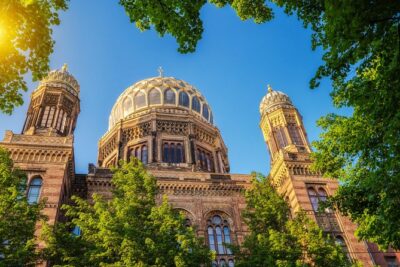
Jewish Berlin: Walking tour The Old Jewish Quarter (private 3 Hours tour)
Read our review →
Path of Resistance: Berlin’s Hidden Holocaust Stories
Read our review →
Browse the lists this tour appears in